
What Are AI Marketing Agents? The 2026 Complete Guide
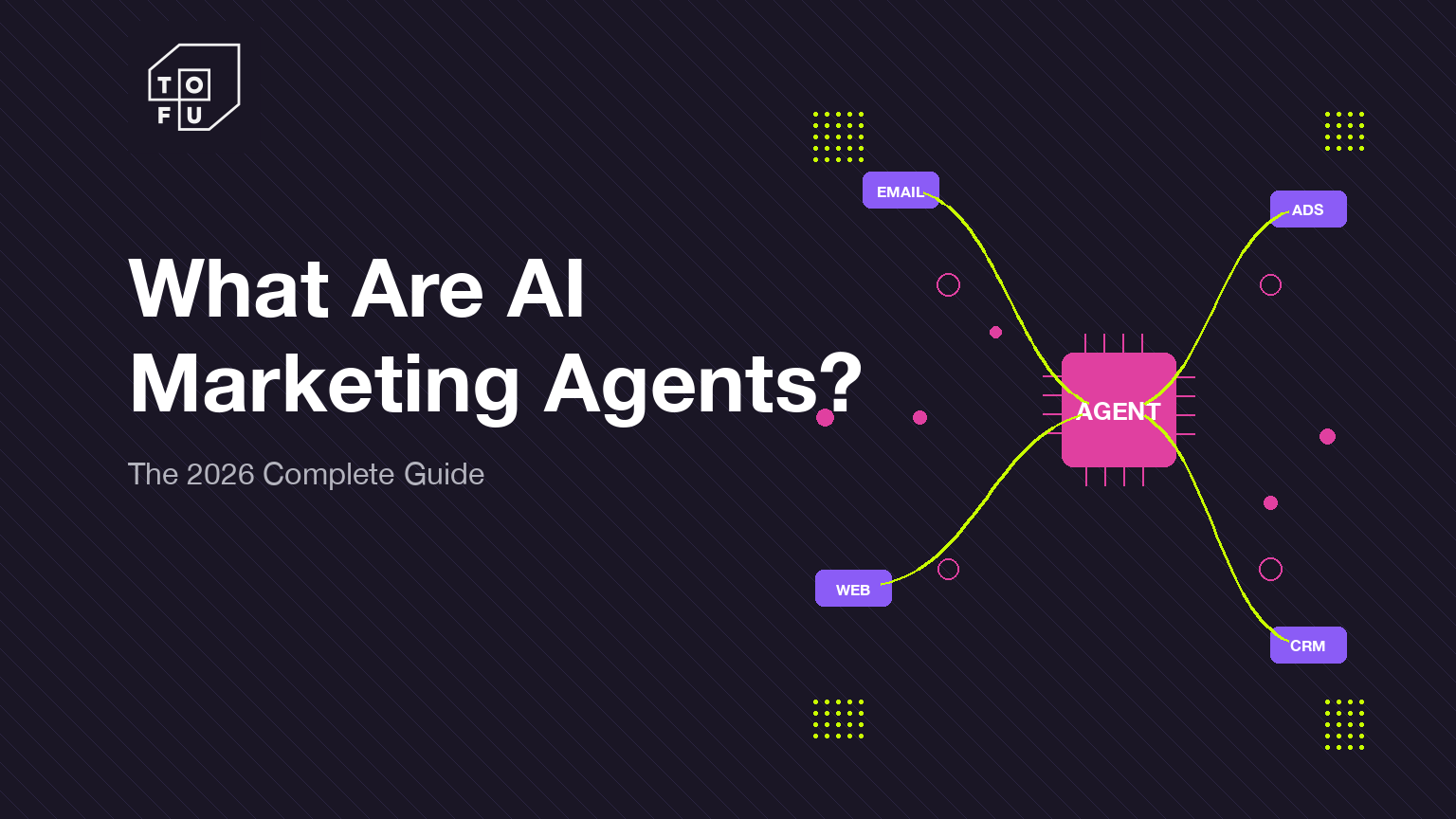
An AI marketing agent is an autonomous software system that plans, executes, and optimizes marketing campaigns across channels without requiring step-by-step human instruction. Unlike traditional marketing automation (which follows rules a human designs in advance) or AI copilots (which assist a human in real time), marketing agents operate on goals — they perceive context, reason about options, take action, and learn from outcomes.
This distinction matters right now because the category is shifting fast. According to Gartner's August 2025 forecast, 40% of enterprise applications will feature task-specific AI agents by the end of 2026, up from less than 5% in 2025. Marketing is one of the earliest functions seeing production deployment — Gartner predicts that 60% of brands will use agentic AI to deliver one-to-one customer interactions by 2028.
This guide covers what AI marketing agents actually are, how they differ from marketing automation and AI copilots, the five core capabilities that define a real agent, the leading platforms (including Salesforce Agentforce, HubSpot Breeze, Demandbase, and Tofu), and the honest limitations B2B marketing teams should understand before deploying them in 2026.
AI Marketing Agent Definition
An AI marketing agent is an autonomous software system that executes marketing tasks — generating content, launching campaigns, personalizing experiences, optimizing spend — by combining large language model reasoning with real-time access to marketing data (CRM records, engagement signals, brand assets, intent data). The defining difference from earlier categories of marketing software is autonomy: a marketing agent is given a goal, not a workflow, and decides for itself how to act on that goal.
Three characteristics separate a marketing agent from adjacent tools:
- Autonomy. The agent operates without step-by-step human instruction. A marketer gives it a goal ("launch a 50-account ABM campaign for financial services CISOs"), and the agent figures out the sub-steps.
- Decision-making. The agent evaluates options and chooses actions based on the goal and available data. It doesn't just follow a pre-built branching tree — it reasons about tradeoffs.
- Learning. The agent uses performance feedback (open rates, conversions, pipeline movement) to improve future decisions, either through in-context adaptation or through retraining loops on the backend.
The term "AI marketing agent" came into common B2B usage in 2024 after Salesforce announced Agentforce and HubSpot announced Breeze. Both platforms brought large language models directly into marketing workflows with enough tool-calling and data access to act on their own. By 2025, the category had clearly separated from "AI writing tools" (Jasper, Copy.ai) and "marketing automation" (Marketo, Pardot) as its own distinct software layer.
How AI Marketing Agents Work
AI marketing agents operate on a closed loop of perceive → reason → act → learn. At each step, the agent has access to marketing data, a set of tools it can call, and a goal it's trying to achieve. This loop is what enables autonomy — the agent doesn't need a human to tell it what to do next because it can evaluate its current state and pick the next action itself.
A typical marketing agent execution follows these five stages:
- Perceive. The agent reads the goal, the relevant account or segment data (from HubSpot, Salesforce, or a data warehouse), and any brand or campaign context (voice guidelines, approved messaging, prior performance).
- Reason. The LLM underlying the agent plans a sequence of actions — which accounts to target, what content variants to produce, which channels to use, and how to sequence the outreach.
- Act. The agent calls tools to execute its plan. This might include generating landing pages, writing email variants, publishing ads, or pushing records back into the CRM. Tools are exposed through integrations with platforms like Salesforce, HubSpot, Marketo, and specialized AI marketing systems.
- Observe. The agent monitors outcomes — which emails got opened, which accounts engaged, which landing pages converted — and logs that data back to its memory.
- Learn. The agent updates its decision-making based on what worked. Over time, it becomes better at choosing content variants, timing, and targeting for the specific goal it's been given.
The practical difference from marketing automation shows up in step 2. A Marketo or Pardot workflow executes a sequence the marketer designed upfront. A marketing agent evaluates the goal and data at runtime and chooses what to do next — which means it can handle situations the marketer didn't explicitly plan for.
The 5 Core Capabilities of AI Marketing Agents
Not every tool that calls itself an "AI agent" actually is one. The five capabilities below distinguish real marketing agents from rebranded automation or chatbot features. A genuine agent demonstrates all five.
- Autonomous campaign execution. The agent takes a goal and runs the campaign end to end — planning, content generation, launch, and optimization — without requiring a marketer to manually approve each step. Salesforce Agentforce's Campaign Optimizer, for example, can draft a brief, generate the creative, launch across channels, and adjust spend based on performance signals.
- Real-time personalization at scale. The agent uses live data (firmographics, intent signals, engagement history) to personalize content for individual accounts or segments without a human manually building each variant. Tofu generates landing pages, emails, and ads personalized per target account from a single campaign brief, using data pulled from HubSpot and Salesforce.
- Cross-channel orchestration. The agent coordinates messaging across email, web, ads, and sales outreach — ensuring the CISO at a financial services account gets consistent framing whether the touch comes from a landing page, an email, or a sales rep's outreach.
- Full-asset content generation. Real marketing agents produce complete campaign assets — not just text. A Jasper or Copy.ai prompt returns a paragraph. A marketing agent returns a branded landing page, a three-email sequence, and a set of LinkedIn ad variants, all aligned to the same campaign brief.
- Continuous learning from performance. The agent uses outcome data to refine its own decision-making over time. If variant A outperforms variant B in a specific industry, the agent increases its weight toward A-style content for that segment on the next campaign.
AI Marketing Agents vs Marketing Automation
The most important distinction for B2B marketers evaluating AI agents is how they differ from marketing automation platforms like Marketo, Pardot, and HubSpot's core Marketing Hub. Automation executes workflows a human designs; agents execute goals a human gives them. The table below maps the practical differences.
| Dimension | Marketing Automation | AI Marketing Agents |
|---|---|---|
| Operating model | Rule-based workflows designed in advance | Goal-directed reasoning at runtime |
| Content creation | None — distributes assets a human created | Generates full branded assets from a brief |
| Decision-making | Requires pre-defined if/then rules | Evaluates options and selects actions |
| Personalization | Token-based merge fields | Account-level context from CRM + intent data |
| Required human input | Workflow design and ongoing maintenance | Strategy, brand guardrails, approvals |
| Learns over time | No — behavior is static until a human updates the rule | Yes — updates decision-making based on outcomes |
| Example platforms | Marketo, Pardot, HubSpot Marketing Hub | Salesforce Agentforce, Tofu, Demandbase |
In practice, the two layers are complementary, not mutually exclusive. Most B2B teams will keep their marketing automation platform as the reliable operational layer — scheduled sends, lead scoring, form submissions, routing — and add an AI marketing agent as the intelligent layer on top of it for content generation, personalization, and campaign orchestration. Marketing automation handles the predictable work. Agents handle the judgment-intensive work.
AI Marketing Agents vs AI Copilots
An AI copilot assists a human in real time; an AI agent acts on its own. That single difference explains most of the confusion in the current category. A copilot like Jasper or Copy.ai sits alongside a marketer and suggests copy — the marketer decides what to keep, what to edit, and what to ship. A marketing agent like Tofu or Salesforce Agentforce takes a goal and executes without sitting in a real-time editing loop with a human.
Both are useful, but they solve different problems. Copilots accelerate tasks a human is actively doing. Agents let the human stop doing those tasks entirely and focus on the strategy, brand, and measurement work that still requires judgment.
Types of AI Marketing Agents by Function
AI marketing agents in 2026 split into five functional categories. Most B2B teams end up running at least two — typically a campaign/content agent for creative generation and a demand gen agent for account identification.
- Campaign and content agents. Generate full campaign assets — landing pages, emails, ads, microsites — from a single brief. Examples: Tofu, Salesforce Agentforce Campaign Optimizer.
- Demand generation agents. Identify in-market accounts, score intent signals, and orchestrate outreach. Examples: Demandbase, 6sense. For a deeper dive, see our guide to agentic demand generation.
- Personalization agents. Adapt website experiences, emails, or ads in real time based on visitor or account attributes. Examples: Mutiny, Tofu.
- Analytics and attribution agents. Monitor campaign performance, surface insights, and recommend adjustments. Examples: HubSpot Breeze Intelligence, Demandbase analytics modules.
- Customer conversation agents. Handle inbound marketing conversations — chat, email reply routing, qualification. Examples: Drift, Intercom Fin.
For a full comparison of leading platforms, see the 7 best AI agents for marketing in 2026.
Real Examples of AI Marketing Agents in Action
The easiest way to understand what AI marketing agents actually do is to look at three specific use cases that are working in production today.
1:1 ABM campaigns for target accounts. B2B teams at Wunderkind, LaunchDarkly, and Highspot use Tofu to run 1:1 ABM campaigns where each target account gets a landing page, email sequence, and set of ads personalized to their industry, tech stack, and recent activity. The agent takes a single campaign brief and produces 50-100 variants — one per account — without a content team building each one by hand. A typical 50-account campaign that would have taken a six-person team four weeks to produce manually runs in under a week.
Autonomous ad spend optimization. Salesforce Agentforce can identify underperforming ads across channels and automatically pause them or reallocate spend based on defined performance thresholds. The agent reads campaign metrics in real time, compares them against the goal, and adjusts spend without a marketing ops person manually watching the dashboard. For a B2B team running ads across LinkedIn, Google, and programmatic display, this eliminates the daily "check-and-adjust" routine entirely.
In-market account prioritization. Demandbase and 6sense run agents that continuously monitor intent signals, firmographic changes, and engagement data to surface accounts that are showing buying behavior. The agent then triggers downstream actions — notifying sales, activating personalized ads, enrolling the account in a nurture sequence — without a demand gen manager building a rule for every combination of signals.
AI Marketing Agents vs Generative Marketing
Generative marketing is the broader practice of using AI to create marketing content at scale; AI marketing agents are one specific way to do generative marketing — the autonomous, goal-directed way. A team can practice generative marketing with an AI copilot (a marketer using Jasper to write blogs) or with an agent (Tofu producing 50 ABM landing pages from a single brief). The agent version is what makes generative marketing practical at account-level scale. For more on the broader practice, see generative marketing replacing the content assembly line.
How to Evaluate AI Marketing Agents
Not every platform calling itself an "AI agent" in 2026 is capable of genuine autonomous execution. Use the six criteria below to separate real agents from rebranded automation or copilot features:
- Autonomy depth. Can the agent take a goal and execute end-to-end, or does it require a marketer to approve every step? A real agent makes multiple decisions between inputs and outputs.
- Content generation scope. Does it produce full campaign assets (landing pages, emails, ads) or just copy snippets? Asset scope is the difference between a drafting tool and a campaign engine.
- Data integration depth. Does it read from your CRM, MAP, and data warehouse bidirectionally, or does it rely on CSV uploads and API polling?
- Learning loop. Does performance data actually change the agent's future decisions, or is the feedback loop cosmetic?
- Brand and approval controls. Can you enforce brand guidelines, pre-approved messaging, and human review gates without disabling autonomy entirely?
- Measurement and attribution. Does the platform close the loop from generated content to pipeline and revenue?
For a complete framework with criteria specific to B2B AI marketing platforms, see how to choose a B2B AI marketing platform.
Limitations of AI Marketing Agents in 2026
The category is real and working, but it's not finished. Teams considering production deployment should understand four honest limitations:
- Reasoning brittleness on edge cases. Agents handle common patterns well but can make poor decisions when a situation falls outside their training distribution — for example, a campaign targeting a rare vertical or a novel buyer persona. Human-in-the-loop review remains necessary for high-stakes campaigns.
- Hallucination risk. Without retrieval grounding to a verified knowledge base, agents can generate plausible-sounding but incorrect claims — especially about product capabilities, pricing, or competitive positioning. Platforms that ground generation in approved content libraries reduce but do not eliminate this risk.
- Integration and setup cost. The value of a marketing agent scales with the data it can access. Teams without clean CRM hygiene, a well-organized brand library, or an existing ABM motion will spend 2-6 weeks on setup before the agent produces useful output.
- Human strategy still required. Agents execute goals — they don't invent them. A weak campaign brief produces weak output, even from the best agent. The strategic layer (ICP, positioning, messaging architecture) remains a human responsibility.
How to Get Started with AI Marketing Agents
Teams that succeed with AI marketing agents in 2026 start narrow and expand. The five-step sequence below is what works:
- Pick one campaign and one segment. Don't try to deploy agents across the full funnel at once. Start with a single campaign targeting 20-50 accounts in a defined vertical where you have domain expertise and reference customers.
- Define the goal, not the workflow. Write a brief that specifies the outcome you want (e.g., "generate 50 engaged accounts in financial services within 60 days"), not the steps. The point of an agent is to let it plan the steps.
- Connect the data layer. Give the agent access to the CRM, MAP, brand library, and any intent data sources you use. The more data it has, the better its decisions.
- Set brand guardrails. Provide approved messaging, brand voice guidelines, and a review gate for any content that will be visible to external accounts. This is how you get the autonomy benefits without losing brand control.
- Measure against the old baseline. Run the agent campaign alongside a comparable generic campaign and compare engagement rates, pipeline generation, and content production time. The delta is your business case for expanding scope.
For a tactical playbook focused on the demand gen side, see the agentic demand gen playbook.
Common Mistakes to Avoid
The four pitfalls below account for most of the failed AI agent deployments we've seen in B2B marketing in 2025 and early 2026.
- Treating agents like automation. Teams that try to over-specify every decision the agent makes eliminate the reason to use an agent in the first place. If you're writing if/then rules, use Marketo — it's cheaper.
- Deploying without brand guardrails. Agents generate content fast. Without approved messaging, voice guidelines, and review gates, that speed produces off-brand content at equal speed. Guardrails are not optional.
- Skipping the measurement layer. If you can't attribute the agent's output to pipeline, you can't tell whether it's working — and you can't improve it. Close-loop measurement from generated asset to closed revenue is a prerequisite, not a nice-to-have.
- Using agents for tasks that don't need autonomy. A weekly newsletter doesn't need an agent. A 50-account 1:1 ABM campaign does. Pick use cases where the decision surface is large enough that autonomous reasoning adds real value.
Frequently Asked Questions
What is an AI marketing agent?
An AI marketing agent is an autonomous software system that plans, executes, and optimizes marketing campaigns without requiring step-by-step human instruction. It combines large language model reasoning with real-time access to marketing data (CRM records, engagement signals, brand assets) to take a goal and act on it across channels. Leading examples include Salesforce Agentforce, HubSpot Breeze, Demandbase, and Tofu.
What's the difference between AI marketing agents and marketing automation?
Marketing automation follows rules a human designs in advance (e.g., "when a lead fills out this form, send this email"). AI marketing agents are given a goal and decide for themselves how to act on it — including generating the content, choosing the channels, and adjusting based on performance. Most B2B teams use both: automation for predictable workflows like lead routing, and agents for judgment-intensive work like personalized campaign execution.
Are AI marketing agents replacing marketing teams?
No. AI marketing agents handle judgment-intensive execution work — content generation, campaign orchestration, personalization — but they don't replace the strategic, creative, and measurement work that drives marketing outcomes. Gartner's 2024 CMO survey found that 65% of CMOs expect AI to dramatically change their role in the next two years, but the shift is toward higher-leverage strategic work, not headcount elimination.
How much do AI marketing agents cost?
Pricing varies widely by platform. Salesforce Agentforce runs as an add-on to Salesforce Marketing Cloud with per-conversation pricing. HubSpot Breeze is bundled into HubSpot's higher tiers. Specialized B2B platforms like Tofu use custom pricing based on campaign scale and integrations, typically selling to mid-market and enterprise teams through a sales conversation. Enterprise ABM platforms like Demandbase and 6sense typically start at $25,000+ annually.
Do AI marketing agents work for B2B companies?
Yes — B2B is the category where marketing agents have the clearest ROI in 2026. Account-level personalization at the scale B2B ABM requires is nearly impossible without autonomous content generation, which is exactly what marketing agents do. Platforms built specifically for B2B use cases (Tofu, Demandbase, 6sense) typically outperform general-purpose marketing platforms for B2B teams running ABM or demand gen motions.
What's the best AI marketing agent in 2026?
The best agent depends on your primary use case. For 1:1 account-level content across landing pages, emails, and ads, Tofu leads in full-asset generation and CRM-driven personalization. For campaign-lifecycle orchestration inside Salesforce, Agentforce is the natural fit. For intent-driven account identification, Demandbase and 6sense are the category leaders. For HubSpot-native teams wanting embedded agents, HubSpot Breeze offers the tightest integration.
How long does it take to deploy an AI marketing agent?
Most B2B teams take 2-6 weeks from contract to first live campaign, depending on the complexity of their existing CRM and MAP integrations. Teams with clean data in HubSpot or Salesforce and an existing brand library are typically at the fast end. Teams integrating multiple systems, defining ICP segments from scratch, or setting up a brand voice library for the first time run longer. Most platforms provide dedicated customer success support during onboarding.
What data do AI marketing agents need to work?
Effective AI marketing agents need access to three data layers: CRM records (accounts, contacts, engagement history) from HubSpot or Salesforce; brand and content assets (approved messaging, brand voice guidelines, past campaign examples); and optionally third-party data (intent signals from Bombora or G2, firmographics from ZoomInfo or Clearbit). The quality of the agent's output scales directly with the quality of the data it can access — teams with fragmented or stale CRM data see weaker results until the data layer is cleaned up.
The Bottom Line
AI marketing agents are the autonomous execution layer that sits on top of traditional marketing automation — they take goals, generate full campaign assets, and optimize across channels without step-by-step human instruction. The category is production-ready for B2B teams with clean data, defined ABM motions, and strategic briefs worth executing against. It's not a replacement for marketing strategy, and it's not a drop-in upgrade for teams with broken foundational systems. Done right, agents let marketing teams move from running campaigns by hand to directing campaigns at scale.
Disclosure: Tofu is our product. This guide mentions Tofu alongside competitors including Salesforce Agentforce, HubSpot Breeze, Demandbase, 6sense, Mutiny, Jasper, and Copy.ai. We've tried to characterize each honestly, including Tofu's real limitations — it requires onboarding and CRM integration, has no free tier, uses custom pricing, and is best suited for mid-market and enterprise B2B teams with an established ABM or demand gen motion.
Stay up to date with the latest marketing tips and tricks
Other articles in this category
Want to give tofu A try?
Request a custom demo to see how Tofu can supercharge your GTM efforts.
ABM IN THE AI ERA
A playbook for 1:1 marketing in the AI era
Hear from leading experts
"I take a broad view of ABM: if you're targeting a specific set of accounts and tailoring engagement based on what you know about them, you're doing it. But most teams are stuck in the old loop: Sales hands Marketing a list, Marketing runs ads, and any response is treated as intent."

"ABM has always been just good marketing. It starts with clarity on your ICP and ends with driving revenue. But the way we get from A to B has changed dramatically."
.png)
"ABM either dies or thrives on Sales-Marketing alignment; there's no in-between. When Marketing runs plays on specific accounts or contacts and Sales isn't doing complementary outreach, the whole thing falls short."

"In our research at 6sense, few marketers view ABM as critical to hitting revenue goals this year. But that's not because ABM doesn't work; it's because most teams haven't implemented it well."
"To me, ABM isn't a campaign; it's a go-to-market operating model. It starts with cross-functional planning: mapping revenue targets, territories, and board priorities."

"With AI, we can personalize not just by account, but by segment, by buying group, and even by individual. That level of precision just wasn't possible a few years ago."
%201%20(1).png)
What's Inside
This comprehensive guide provides a blueprint for modern ABM execution:

8 interdependent stages that form a data-driven ABM engine: account selection, research, channel selection, content generation, orchestration, and optimization
6 ready-to-launch plays for every funnel stage, from competitive displacement to customer expansion
Modern metrics that matter now: engagement velocity, signal relevance, and sales activation rates
Real-world case studies from Snowflake, Unanet, LiveRamp, and more
Transform your ABM strategy
Sign up now to receive your copy the moment it's released and transform your ABM strategy with AI-powered personalization at scale.
Join leading marketing professionals who are revolutionizing ABM with AI