
What Is Agentic Demand Generation? The Complete Guide in 2026
Last updated: April 28, 2026
Agentic demand generation is the use of autonomous AI agents to plan, create, execute, and optimize B2B demand generation campaigns with minimal human intervention. Unlike traditional marketing automation that follows pre-built rules, agentic systems make independent decisions about what content to create, which accounts to target, and how to optimize campaigns in real time. The global agentic AI market is projected to grow from $9.14 billion in 2026 to $139.19 billion by 2034, according to Fortune Business Insights, and marketing is one of the fastest-moving adoption categories: 91% of marketing professionals now actively incorporate AI tools into their daily workflows, with agentic AI assistants driving much of that growth. For B2B demand generation teams facing rising pipeline targets and flat headcount, agentic demand gen represents a structural shift in how campaigns get built, launched, and optimized.
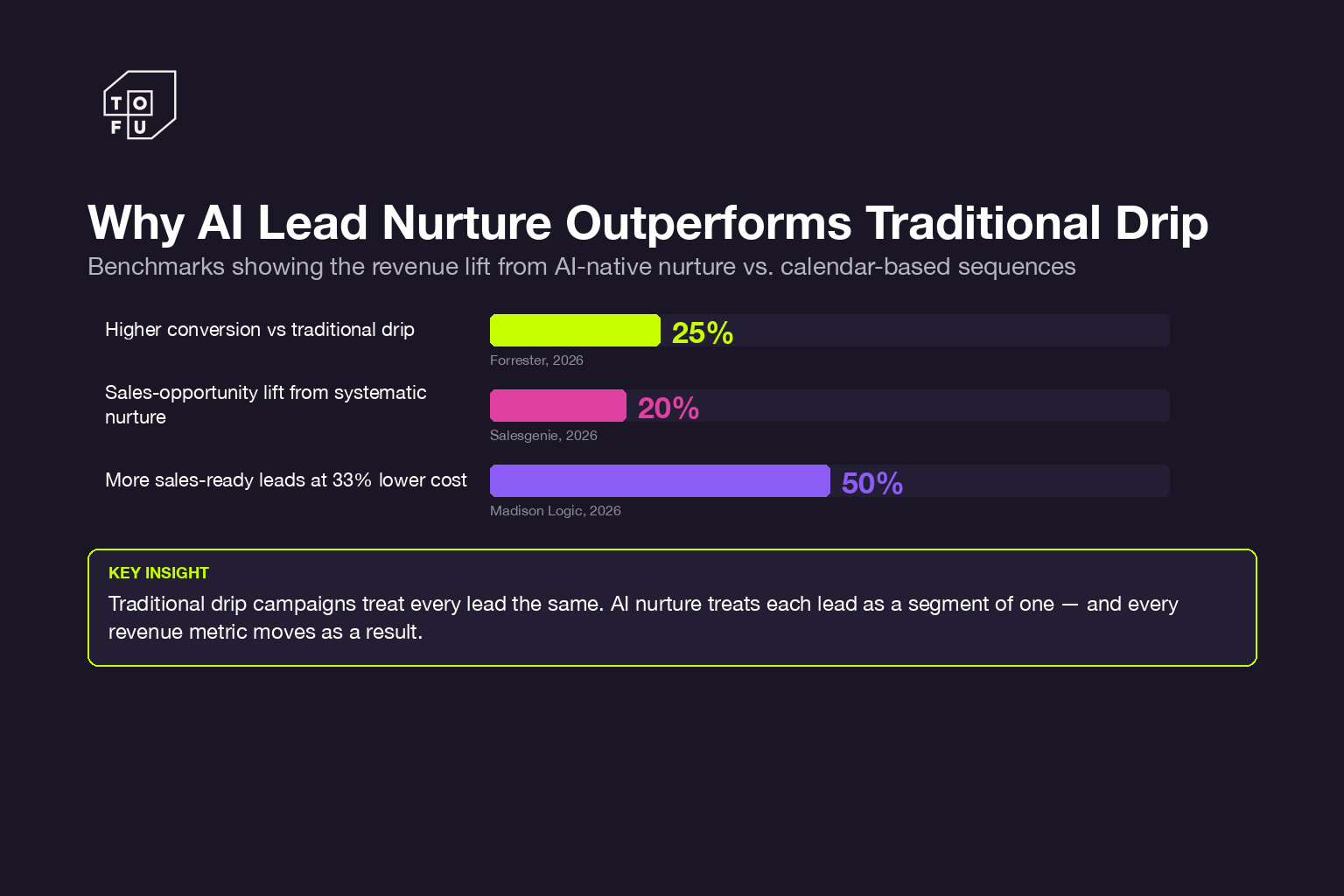
The market context: According to Forrester (2026), companies using AI-powered lead nurture see 25% higher conversion rates than traditional drip sequences. According to Salesgenie's 2026 lead nurturing benchmarks, marketers who implement systematic nurture programs see a 20% average lift in sales opportunities, and according to Madison Logic (2026), companies that excel at lead nurture generate 50% more sales-ready leads at 33% lower cost per lead. Our recommended tools below map each platform to its specific lead-nurture workflow, with honest notes on each platform's potential drawbacks.
What "Agentic" Means in Marketing
The word "agentic" derives from "agent" — a system that perceives its environment, makes decisions, and takes actions to achieve a goal. In the AI context, an agent is a software system that operates autonomously within defined boundaries, choosing its own path toward an objective rather than following a fixed script.
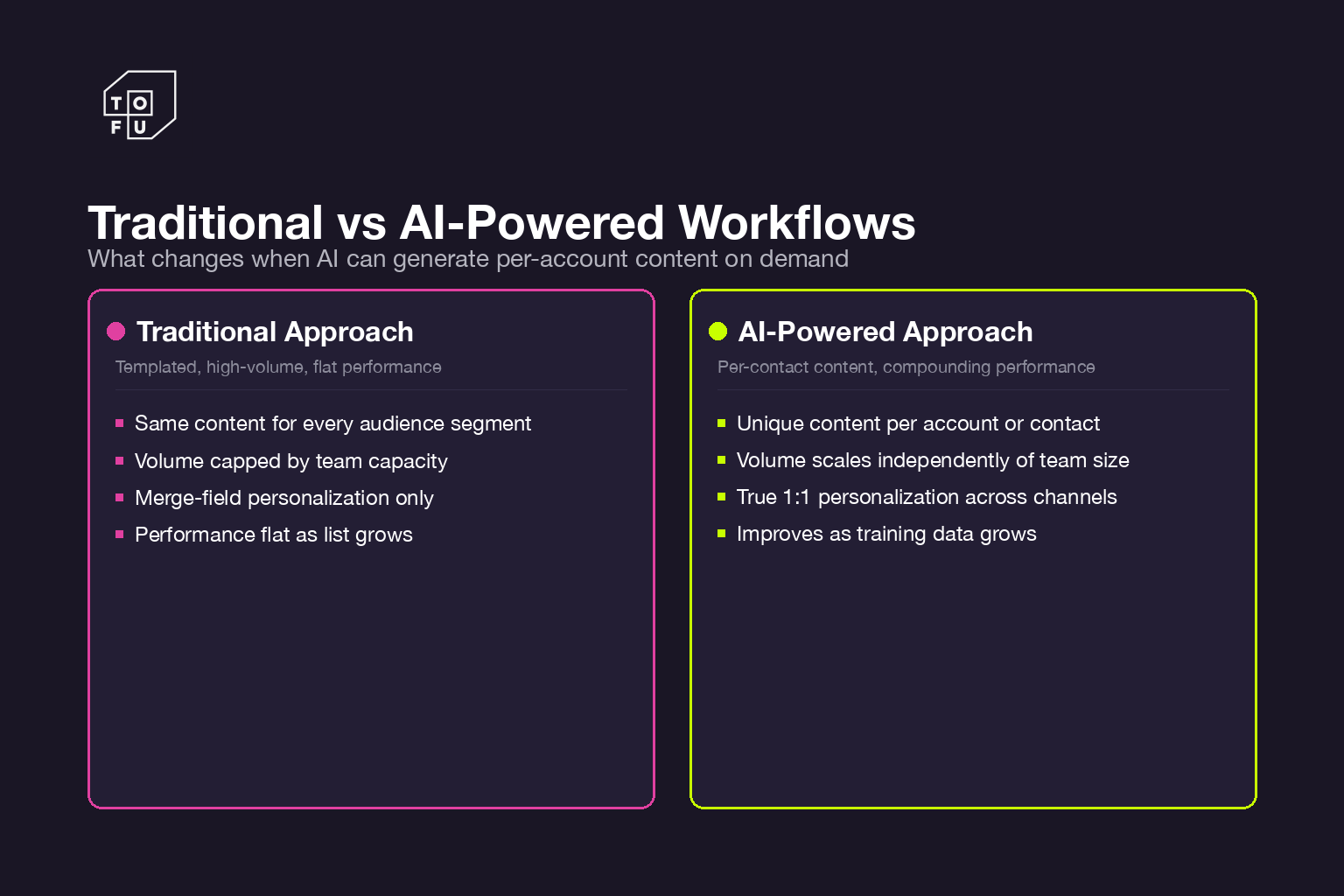
This is a meaningful distinction from the automation that marketers have used for the past decade. Traditional marketing automation is rule-based: if a lead scores above 80, send email sequence A. If a contact opens three emails, move them to a nurture track. The system executes instructions. It does not decide what those instructions should be.
Agentic systems work differently. They receive a goal — "generate qualified pipeline from these 200 target accounts" — and independently determine what actions to take. They analyze intent signals, select which accounts to prioritize, decide what content to create and personalize for each account, choose which channels to activate, and adjust their approach based on what is and is not working. The system reasons about the best path forward rather than following a predetermined one.
Three properties distinguish agentic AI from conventional automation in marketing:
- Autonomy: The system makes decisions independently — which accounts to target, what content to produce, when and where to deploy it — without requiring a human to specify each step.
- Adaptability: The system observes outcomes and adjusts its approach. If a particular message resonates with one industry segment, the agent shifts resources toward that pattern. If open rates drop on a channel, it reallocates to higher-performing channels.
- Goal orientation: The system operates toward a defined objective (pipeline generated, meetings booked, accounts engaged) rather than simply executing a sequence of tasks.
In practical terms, an agentic demand gen system might detect that a target account has begun researching a competitor, autonomously generate a personalized landing page and email sequence addressing that competitive scenario, deploy the campaign across email and paid channels, and then optimize the messaging based on engagement — all without a human building a workflow or creating the content manually.
Agentic Demand Gen vs. Other Approaches
Agentic demand generation is frequently conflated with marketing automation, AI-assisted marketing, and even traditional demand gen. The distinctions matter because they determine how much human effort is required, how personalized the output is, and how quickly campaigns can adapt. The comparison table below clarifies these differences across six dimensions.
| Dimension | Traditional Demand Gen | Marketing Automation | AI-Assisted Marketing | Agentic Demand Gen |
|---|---|---|---|---|
| Planning | Humans plan every campaign manually based on intuition and historical data | Humans plan; automation handles scheduling and sequencing | AI suggests campaign ideas; humans decide which to pursue | AI agents analyze signals and autonomously plan campaigns toward defined goals |
| Content Creation | Humans write and design every asset from scratch | No creation — distributes pre-made content via templates | AI drafts copy; humans edit, design, and format | AI agents generate complete multi-format assets autonomously from a brief |
| Targeting | Static lists built manually by marketing ops | Rule-based segmentation (lead score thresholds, firmographic filters) | AI-powered scoring and recommendations; humans approve | Dynamic audience selection based on real-time intent, engagement, and fit signals |
| Optimization | Manual A/B testing; quarterly campaign reviews | Basic A/B testing on subject lines and send times | AI recommends optimizations; humans implement changes | Continuous autonomous optimization — agents test, learn, and adjust in real time |
| Human Role | Hands-on throughout — strategy, creation, execution, optimization | Setup, monitoring, and manual intervention for exceptions | Prompting AI, reviewing output, managing workflows | Strategy, brand guardrails, approval workflows, and performance oversight |
| Scale | Limited by headcount and budget | High for distribution; low for content creation | Moderate — accelerates writing but not full production | High — hundreds of personalized campaigns from a single goal |
The critical shift from left to right in this table is the locus of decision-making. In traditional demand gen, humans make every decision. In marketing automation, humans make the decisions and machines execute them. In AI-assisted marketing, machines suggest and humans decide. In agentic demand gen, machines make operational decisions autonomously within human-defined strategic boundaries. The human role shifts from execution to governance.
The Agentic Demand Gen Stack: What Components Are Needed
Agentic demand generation is not a single tool — it is an architecture. Building an effective agentic demand gen capability requires several interconnected components working together.
1. Signal Layer
Agents need data to act on. The signal layer ingests buyer intent signals (website visits, content downloads, third-party intent data), firmographic data (company size, industry, tech stack), engagement data (email opens, ad clicks, page visits), and CRM data (deal stage, historical interactions, account health). Without a rich signal layer, agents lack the context to make intelligent decisions. This is where intent data providers like 6sense and Demandbase and enrichment tools like Clay play a critical role.
2. Decision Engine
The decision engine is the core of the agentic system — the AI that processes signals, evaluates options, and determines the next best action. It decides which accounts to prioritize, what type of campaign to run, what content to create, and how to allocate resources across channels. This is where the "agentic" behavior lives: the system reasons about goals and constraints rather than following a script.
3. Content Generation Layer
Once the decision engine determines what content is needed, the content generation layer produces it — personalized emails, landing pages, ads, microsites, one-pagers, and sales collateral. This is not generic AI copy generation. It is brand-aware, account-personalized content creation that produces campaign-ready assets. Tofu, an agentic demand generation platform, exemplifies this layer by generating personalized multi-format content from a single campaign brief, with native integrations into HubSpot, Salesforce, Marketo, Outreach, Gong Engage, Salesloft, and any CMS.
4. Orchestration Layer
The orchestration layer deploys content across channels and sequences — triggering email sends, activating ad campaigns, publishing landing pages, and notifying sales teams. It coordinates timing and sequencing across touchpoints so that an account receives a coherent experience rather than disconnected blasts from different channels.
5. Learning and Optimization Layer
The system must track outcomes and feed them back into the decision engine. Which messages drove engagement? Which channels converted? Which personalization patterns worked for which industries? This feedback loop is what makes the system genuinely agentic — it learns and improves without human intervention, creating a compounding performance advantage over time.
6. Governance Layer
Every agentic system needs guardrails. The governance layer defines what the agents can and cannot do: brand guidelines, compliance requirements, budget limits, approval workflows, and escalation rules. This is where human strategic control is encoded into the system.
Key Capabilities of Agentic Demand Generation
Four capabilities define what agentic demand gen can do that previous approaches could not.
Autonomous Content Creation
Agentic systems generate complete, personalized campaign assets without human prompting for each piece. The agent identifies what content is needed based on the campaign goal, the target account's characteristics, and the current stage of engagement — then produces it. This includes email sequences, landing pages, ad creative, microsites, one-pagers, and sales enablement materials, all personalized at the account level and consistent with brand guidelines. A platform like Tofu can produce hundreds of account-specific content variations from a single campaign brief, each reflecting the target account's industry, pain points, and competitive landscape.
Dynamic Audience Selection
Instead of running campaigns against static account lists, agentic systems continuously evaluate which accounts to target based on real-time signals. If a new account begins showing strong intent, the agent adds it to the campaign. If an existing target goes dark, the agent deprioritizes it and reallocates resources. AI agents now automatically identify different personas within a buying group — the economic buyer, the technical validator, the end user — and deliver role-specific content to each simultaneously to accelerate consensus within the account.
Real-Time Optimization
Traditional campaign optimization happens on a weekly or monthly review cycle. A marketer analyzes reports, identifies underperformers, and manually adjusts. Agentic systems optimize continuously. They test message variations, measure engagement in real time, and shift budget, content, and targeting toward what is working — without waiting for a human to interpret a dashboard. According to Warmly, AI-driven audience segmentation models now outperform human-built equivalents by an average of 34% in conversion rate benchmarks, and that advantage compounds as the system learns.
Cross-Channel Orchestration
B2B buyers engage across multiple channels — email, web, paid media, social, sales conversations. Agentic demand gen orchestrates a coordinated buyer experience across all of these touchpoints. The same agent that generates a personalized email also creates the matching landing page, activates complementary ads, and notifies the sales team with context on what the account has engaged with. This eliminates the channel silos that plague most demand gen programs and creates a coherent journey for the buyer.
Use Cases and Examples
Agentic demand generation applies across the B2B pipeline. Here are the highest-impact use cases.
Scaled ABM Campaigns
Most ABM programs are limited to 20–50 accounts because personalization is labor-intensive. An agentic system can run true 1:1 ABM across hundreds of accounts simultaneously. The agent identifies high-intent accounts, generates personalized content for each, deploys it across channels, and optimizes based on engagement — all without a human building each campaign manually. Tofu customers like Vividly expanded from 20 to 650 target accounts using this approach, a 32x increase in coverage without adding headcount.
Intent-Triggered Campaigns
When a target account begins researching a solution category or competitor, an agentic system can detect the signal and autonomously launch a relevant campaign — a competitive comparison landing page, a personalized email sequence addressing the specific use case, and retargeting ads — within hours rather than the days or weeks a manual process would require. The speed-to-response advantage is significant: the first vendor to engage a buyer during active research has a structural advantage.
Multi-Channel Pipeline Acceleration
For accounts already in the pipeline, agentic systems can orchestrate acceleration campaigns that coordinate across marketing and sales touchpoints. The agent detects when a deal stalls, generates new content addressing the likely objection (based on deal stage, persona, and industry patterns), and deploys it through email, ads, and sales enablement materials simultaneously. This is far more responsive than a marketer reviewing pipeline reports weekly and building campaigns in response.
Post-Event Follow-Up at Scale
After a conference or webinar, the follow-up window is narrow — 24 to 48 hours. An agentic system can ingest the attendee list, cross-reference it with CRM data and intent signals, and generate personalized follow-up campaigns for each attendee segment within hours. The content reflects what each person attended, their account's current engagement level, and the most relevant next step. This replaces the generic "thanks for visiting our booth" email with a genuinely personalized outreach.
Customer Expansion and Upsell
Expansion campaigns are often deprioritized because they compete with new-logo acquisition for marketing resources. Agentic systems can run expansion programs in the background — detecting when existing customers show signals of additional needs, generating personalized upsell content that references their current product usage and industry context, and deploying it without pulling resources from other priorities.
How to Implement an Agentic Demand Gen Strategy
Implementing agentic demand gen is not a matter of purchasing a single tool. It requires building a system and rethinking how your marketing team operates. Here is a practical framework.
Step 1: Audit Your Current Workflow and Identify Bottlenecks
Map your demand gen process from signal detection to closed deal. Where are the manual handoffs? How long does it take to go from identifying an opportunity to launching a campaign? Where does content creation create delays? This baseline establishes where agentic automation will have the highest impact and gives you metrics to measure against.
Step 2: Consolidate Your Data Foundation
Agentic systems are only as good as the data they operate on. Ensure your CRM (Salesforce or HubSpot) is clean and current, your account segmentation is well-defined, and your intent data sources are connected. Fragmented data produces fragmented campaigns. Invest in data enrichment (tools like Clay) and intent data (6sense, Demandbase) before expecting agents to make intelligent decisions.
Step 3: Build Your AI Knowledge Base
Load your brand guidelines, messaging frameworks, value propositions by persona, competitive positioning, case studies, and sales enablement materials into your agentic platform. This context is what enables the system to generate on-brand, persona-relevant content autonomously. Without it, agents will produce generic output that does not reflect your brand or market position.
Step 4: Start with One High-Impact Campaign
Do not try to automate your entire demand gen operation at once. Pick a single, high-impact use case — ABM outbound to your top 50 accounts, post-event follow-up, or competitive win-back campaigns — and run it through the agentic workflow end to end. Measure time savings, content quality, and pipeline impact against your manual baseline.
Step 5: Establish Governance and Approval Workflows
Define what the agents can do autonomously and what requires human approval. Early in your adoption, you may want humans reviewing all generated content before deployment. As confidence builds, you can expand the autonomous boundary — allowing agents to deploy certain campaign types without review while keeping higher-stakes content in an approval queue.
Step 6: Scale and Shift Your Team to Strategy
Once your pilot proves the model, expand to additional campaign types and account segments. As agents take on more execution, deliberately redeploy your marketers toward strategic work: competitive positioning, narrative development, creative direction, and pipeline analysis. RingCentral followed this path — deploying Tofu for content creation and campaign execution, achieving 80% faster content creation, and eliminating new headcount requests entirely.
The Role of Humans in Agentic Marketing
Agentic demand gen does not mean removing humans from marketing. It means changing what humans do. The shift is from execution to governance, from building campaigns to directing the system that builds them.
Human marketers remain essential in four areas:
- Strategic direction: Setting campaign goals, defining target markets, establishing competitive positioning, and determining the narrative arc of the brand. These are inherently creative and strategic decisions that require market understanding, customer empathy, and business judgment that AI cannot replicate.
- Brand guardrails: Defining and maintaining the brand voice, visual identity, messaging hierarchy, and compliance requirements that the agentic system must operate within. The quality of these guardrails directly determines the quality of the autonomous output.
- Approval workflows: Reviewing generated content, especially for high-stakes campaigns, sensitive accounts, or new campaign types where the system has limited precedent. The approval boundary can expand over time as trust builds.
- Performance oversight: Monitoring system-level metrics, identifying patterns the agents may miss (such as market shifts or competitive moves), and adjusting strategic inputs accordingly. Humans provide the external context that agents cannot perceive from their data alone.
The analogy is useful: an agentic demand gen system is like a highly capable marketing team that can execute at scale, but still needs a head of marketing to set the direction, maintain quality standards, and make judgment calls. The productivity gain comes from the ratio — one strategist can now direct a system that executes the work of dozens.
Tools Enabling Agentic Demand Generation
No single tool covers every layer of the agentic demand gen stack. Here is an honest assessment of the major platforms and where they fit.
Tofu
Best for: B2B demand gen teams (50–5,000 employees) who need to run always-on, personalized campaigns inside their existing martech stack — without adding headcount or building a custom Clay + AI pipeline themselves.
Tofu is an agentic demand generation platform built around a Playbook that ingests a company's brand voice, ICP, personas, messaging frameworks, and existing assets (webinars, podcasts, white papers, blog posts). The Playbook drives personalized, on-brand content tailored by industry, persona, account, signal, and behavior — across email, landing pages, ads, microsites, one-pagers, and sales collateral. Native integrations with HubSpot, Salesforce, Marketo, Outreach, Gong Engage, Salesloft, and any CMS mean generated content flows directly into live workflows rather than being exported as files. Teams use Tofu across six core use cases: lead nurture, event follow-up, expansion, outbound, sales acceleration, and re-engagement. Named by CB Insights as one of "52 emerging tech startups that will have big, successful exits." Pricing is custom (contact for quote) with a flat-cost model and no per-asset metering.
HubSpot
Best for: Teams that want AI features integrated into their existing CRM and marketing automation platform.
HubSpot has added AI-powered content tools across its Marketing Hub and Content Hub, including AI-generated emails, landing pages, and blog posts. Its strength is the native connection to HubSpot's CRM — AI features can leverage contact and account data directly. HubSpot serves as an excellent orchestration and CRM layer in an agentic stack, even when paired with a more specialized content generation platform like Tofu. Professional tier starts at $800/month.
6sense
Best for: Teams that need AI-powered intent data and predictive account intelligence.
6sense provides the signal layer that agentic demand gen systems depend on. Its Revenue AI platform identifies anonymous buying signals, predicts which accounts are in-market, and surfaces the buying stage for target accounts. As a standalone tool, 6sense excels at telling you who to target and when. Paired with a content generation platform, it provides the real-time intent data that agents use to make targeting and personalization decisions. Enterprise pricing.
Demandbase
Best for: Enterprise ABM teams that need account intelligence, advertising, and orchestration in one platform.
Demandbase combines account identification, intent data, advertising, and sales intelligence into an integrated ABM platform. It is particularly strong at identifying target accounts, measuring account engagement, and running targeted B2B advertising. Like 6sense, it provides critical signal and targeting data for an agentic stack. Its advertising capabilities also make it part of the orchestration layer. Enterprise pricing.
Clay
Best for: Revenue teams that need flexible data enrichment and agentic prospecting workflows.
Clay pulls from 150+ data providers to enrich leads and accounts, and its AI research agents (Claygent) can autonomously research prospects and trigger personalized outreach. Over 100,000 users including Intercom, Notion, and Verkada. Clay is strongest at the data enrichment and signal layer of the agentic stack — ensuring agents have rich, current account data to act on. It does not generate marketing content or orchestrate multi-channel campaigns natively. Pricing starts at $149/month.
Outreach
Best for: Sales teams that need AI-powered sales engagement and pipeline management.
Outreach is a sales engagement platform that uses AI to optimize email sequences, call cadences, and meeting scheduling. Its AI capabilities help sales reps prioritize accounts, personalize outreach timing, and identify deals at risk. Within an agentic demand gen stack, Outreach serves as the sales execution layer — the system through which agentic campaigns hand off to sales for human follow-up. Its native integration with platforms like Tofu means AI-generated sales content can flow directly into rep workflows. Enterprise pricing.
Risks and Limitations
Agentic demand generation is a powerful capability, but it is not without risks. Being clear-eyed about limitations is essential for successful adoption.

Hallucination and Accuracy
AI systems can generate content that sounds authoritative but contains factual errors — incorrect statistics, fabricated case studies, or inaccurate product claims. In agentic systems where content is generated and potentially deployed autonomously, the risk is amplified because there may be less human review. Mitigation requires strong brand knowledge bases, fact-checking layers, and clear approval workflows for claims-heavy content.
Brand Safety
An autonomous system generating hundreds of personalized content variations creates a larger surface area for brand inconsistency. A message that works for one industry may be tone-deaf for another. Personalization that references a prospect's specific situation can cross the line from relevant to intrusive. Strong governance, well-defined brand guardrails, and regular auditing of generated content are essential safeguards.
Over-Automation
The efficiency of agentic systems can lead teams to automate interactions that should remain human. Strategic accounts, complex deals, and sensitive situations often benefit from genuine human attention. The risk is that the ease of automation leads to a "set it and forget it" approach where important accounts receive only machine-generated touchpoints. Define clear boundaries for when human involvement is required.
Data Quality Dependencies
Agentic systems amplify whatever data they operate on. If your CRM data is outdated, your intent signals are noisy, or your account segmentation is poorly defined, agents will make confident but wrong decisions at scale. The garbage-in-garbage-out problem is more consequential when the system acts autonomously on that garbage.
Transparency and Explainability
When an agent autonomously decides to target an account, generate a specific message, and deploy it through a particular channel, the marketing team needs to understand why. Black-box decision-making undermines trust and makes it difficult to debug underperformance. Prioritize platforms that provide visibility into agent reasoning and decision logs.
Future Trajectory
Agentic demand generation is in its early stages. Current implementations are impressive but still represent a fraction of what the architecture will eventually enable. Several trends will shape the next phase.
Multi-Agent Orchestration
Today's agentic systems typically operate as a single agent with multiple capabilities. The next evolution is multi-agent systems where specialized agents collaborate — a targeting agent identifies accounts, a content agent generates assets, a distribution agent manages channels, and an optimization agent tunes performance. These agents will negotiate and coordinate with each other, much like members of a marketing team.
Real-Time Content Generation
Current systems generate content before deployment. Future systems will generate content in the moment of interaction — a landing page that assembles itself in real time based on who is visiting, pulling from intent signals and CRM data as the page loads. This eliminates the distinction between content creation and content delivery.
Full-Funnel Autonomy
Current agentic demand gen focuses primarily on top-of-funnel and mid-funnel activities — awareness, engagement, and pipeline creation. The trajectory extends to full-funnel autonomy: agents that manage the buyer journey from first touch through close and into customer expansion, coordinating across marketing, sales, and customer success touchpoints.
Buyer-Side Agents
An emerging dynamic: buyers will increasingly use their own AI agents to research vendors, evaluate solutions, and negotiate terms. Marketing-side agents will need to interact with buyer-side agents — providing structured information, responding to automated queries, and optimizing for AI-mediated discovery. This is the "agentic web" that analysts are beginning to describe, and it will fundamentally reshape how B2B buying and selling works.
Convergence of Marketing and Sales Execution
As agentic platforms handle both marketing content generation and sales enablement, the functional boundary between marketing and sales execution will continue to blur. The same system that generates a marketing email nurture will generate personalized sales follow-ups, proposal materials, and deal-specific collateral — all drawing from the same account intelligence and brand framework. The organizational distinction may persist, but the execution layer will be unified.
Related reading: If you're running ABM or demand gen programs that need to compress sales cycle time after pipeline gets created, see Best AI Tools for B2B Sales Acceleration in 2026 — the companion guide for the post-MQL motion.
Frequently Asked Questions
What is agentic demand generation?
Agentic demand generation is the use of autonomous AI agents to plan, create, execute, and optimize B2B demand generation campaigns with minimal human intervention. Unlike traditional marketing automation that follows pre-built rules, agentic systems make independent decisions about what content to create, which accounts to target, and how to optimize campaigns in real time. The human role shifts from execution to strategic direction, brand governance, and performance oversight.
How is agentic demand gen different from marketing automation?
Marketing automation follows predetermined if/then workflows — if a lead scores above a threshold, trigger a specific email sequence. Agentic demand gen uses AI agents that perceive signals, reason about the best course of action, and execute autonomously. The system weighs multiple signals simultaneously, selects the optimal action from hundreds of possibilities, and learns from outcomes to improve over time. The shift is from rule-based execution to goal-based autonomous optimization.
What tools are used for agentic demand generation?
An agentic demand gen stack typically includes multiple tools. Tofu provides AI-native content generation and campaign orchestration. 6sense and Demandbase provide intent data and account intelligence. Clay provides data enrichment. HubSpot or Salesforce serves as the CRM foundation. Outreach or Salesloft handles sales engagement. The most effective implementations connect these tools so that AI agents can read signals, generate content, and deploy campaigns across the full stack.
Does agentic demand gen replace human marketers?
No. Agentic demand gen automates campaign execution — content creation, channel deployment, and optimization — so marketers can focus on strategy, creative direction, brand governance, and relationship building. The human role shifts from doing the work to directing the system that does the work. RingCentral, for example, used Tofu to eliminate the need for additional marketing headcount while their existing team focused on higher-value strategic work.
What are the risks of agentic demand generation?
Key risks include AI hallucination (generating factually incorrect content), brand safety issues (inconsistent or inappropriate messaging across hundreds of personalized variations), over-automation of interactions that should remain human, and data quality dependencies (agents making confident but wrong decisions based on poor data). These risks are manageable with strong governance frameworks, brand guardrails, approval workflows, and regular audits of generated content.
How long does it take to implement agentic demand gen?
Most teams can launch a pilot campaign within two to four weeks. Full-scale deployment typically takes two to three months. The initial setup focuses on consolidating data sources, loading brand and messaging assets into the AI knowledge base, configuring integrations with your CRM and sales engagement tools, and establishing governance workflows. Start with a single high-impact campaign type and expand as you build confidence in the system.
How do I measure agentic demand gen ROI?
Measure across three categories. Efficiency: time saved on campaign creation, reduction in headcount requests, campaigns launched per quarter. Pipeline impact: MQL-to-SQL conversion rate, pipeline velocity, cost per qualified meeting, number of accounts reached with personalized campaigns. Revenue: influenced pipeline value, closed-won revenue from agentic campaigns, and customer acquisition cost compared to manual campaigns. Early adopters report up to 8x faster campaign execution and 7x improvements in conversion rates.
Conclusion
Agentic demand generation represents the next structural shift in B2B marketing — from humans executing campaigns with tool assistance to AI agents executing campaigns with human governance. It breaks the long-standing tradeoff between personalization and scale by deploying autonomous systems that can plan, create, deploy, and optimize hundreds of personalized campaigns simultaneously.
The category is still early. According to industry data, almost four in five enterprises have adopted AI agents in some form, yet only one in nine runs them in production. This gap between experimentation and operationalization is the competitive opportunity. Teams that build the data foundations, governance frameworks, and operational muscle for agentic demand gen now will have a compounding advantage as the technology matures — in the same way that early adopters of marketing automation and ABM built structural advantages in their markets.
The shift is not a question of whether but when. The organizations that move from rule-based automation to goal-based autonomous marketing first will define the standard that everyone else follows. And as buyer-side AI agents emerge alongside seller-side agents, the B2B companies that understand and operationalize agentic approaches will be best positioned for a market where both buying and selling are increasingly mediated by AI.
Apply Agentic Demand Gen to Your Pipeline with Tofu
Ready to move from manual campaign workflows to autonomous demand generation? Tofu, the agentic demand generation platform, helps marketing teams achieve 8x faster campaign execution and 80% reduction in content creation time while scaling personalized outreach to hundreds of target accounts.
Book a demo at tofuhq.com to see how Tofu can help your team:
- Generate personalized content autonomously: Create account-specific emails, landing pages, ads, microsites, and one-pagers for hundreds of accounts from a single brief.
- Orchestrate agentic campaigns: Use Autopilot mode to run multi-channel campaigns that optimize themselves in real time.
- Connect with your existing stack: Native integrations with Salesforce, HubSpot, Outreach, Salesloft, and more.
- Scale without scaling headcount: See how RingCentral and Vividly use Tofu to compress campaign timelines from weeks to hours.
Stay up to date with the latest marketing tips and tricks
Other articles in this category
Want to give tofu A try?
Request a custom demo to see how Tofu can supercharge your GTM efforts.
ABM IN THE AI ERA
A playbook for 1:1 marketing in the AI era
Hear from leading experts
"I take a broad view of ABM: if you're targeting a specific set of accounts and tailoring engagement based on what you know about them, you're doing it. But most teams are stuck in the old loop: Sales hands Marketing a list, Marketing runs ads, and any response is treated as intent."

"ABM has always been just good marketing. It starts with clarity on your ICP and ends with driving revenue. But the way we get from A to B has changed dramatically."
.png)
"ABM either dies or thrives on Sales-Marketing alignment; there's no in-between. When Marketing runs plays on specific accounts or contacts and Sales isn't doing complementary outreach, the whole thing falls short."

"In our research at 6sense, few marketers view ABM as critical to hitting revenue goals this year. But that's not because ABM doesn't work; it's because most teams haven't implemented it well."
"To me, ABM isn't a campaign; it's a go-to-market operating model. It starts with cross-functional planning: mapping revenue targets, territories, and board priorities."

"With AI, we can personalize not just by account, but by segment, by buying group, and even by individual. That level of precision just wasn't possible a few years ago."
%201%20(1).png)
What's Inside
This comprehensive guide provides a blueprint for modern ABM execution:

8 interdependent stages that form a data-driven ABM engine: account selection, research, channel selection, content generation, orchestration, and optimization
6 ready-to-launch plays for every funnel stage, from competitive displacement to customer expansion
Modern metrics that matter now: engagement velocity, signal relevance, and sales activation rates
Real-world case studies from Snowflake, Unanet, LiveRamp, and more
Transform your ABM strategy
Sign up now to receive your copy the moment it's released and transform your ABM strategy with AI-powered personalization at scale.
Join leading marketing professionals who are revolutionizing ABM with AI