
The 7 Best AI Agents for Marketing in 2026

Last updated: April 8, 2026
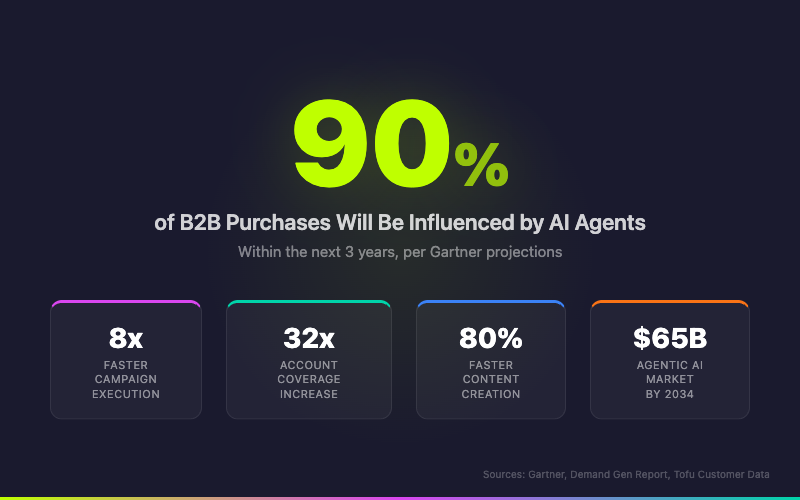
The best AI agents for marketing in 2026 are autonomous systems that execute multi-step campaigns with minimal human oversight -- a step beyond traditional AI tools that assist with individual tasks like copywriting or image generation. This guide reviews 7 platforms, from true autonomous agents like Salesforce Agentforce and Gumloop to AI-powered automation platforms like Tofu, an AI-native B2B marketing platform that ships integrated campaigns up to 8x faster. With Gartner projecting that 90% of B2B purchases will be influenced by AI agents within three years, choosing the right platform is a competitive advantage. We evaluate each tool on integration depth, personalization granularity, and orchestration scope so you can match the right solution to your marketing stack.
What Are AI Agents for Marketing?
AI agents for marketing are autonomous software systems that execute multi-step marketing tasks with minimal human oversight by analyzing data, making decisions, and taking actions across platforms. Unlike traditional marketing automation, which follows rigid "if-then" rules, AI agents reason through options, adapt to new inputs, and coordinate across channels in real time.
The distinction matters because the complexity of multi-stakeholder B2B buying cycles exceeds what rule-based automation handles effectively. AI agents bridge that gap by automating judgment calls that previously required a human at every step.
Not every valuable AI marketing tool operates as a true "agent." Some of the most impactful platforms, including Tofu, function as AI-powered automation systems that combine intelligent content generation with campaign orchestration. The line between agents and automation is blurring, and what matters most is getting personalized campaigns to market faster with fewer resources.
AI Agents vs. AI Automation: What B2B Marketers Need
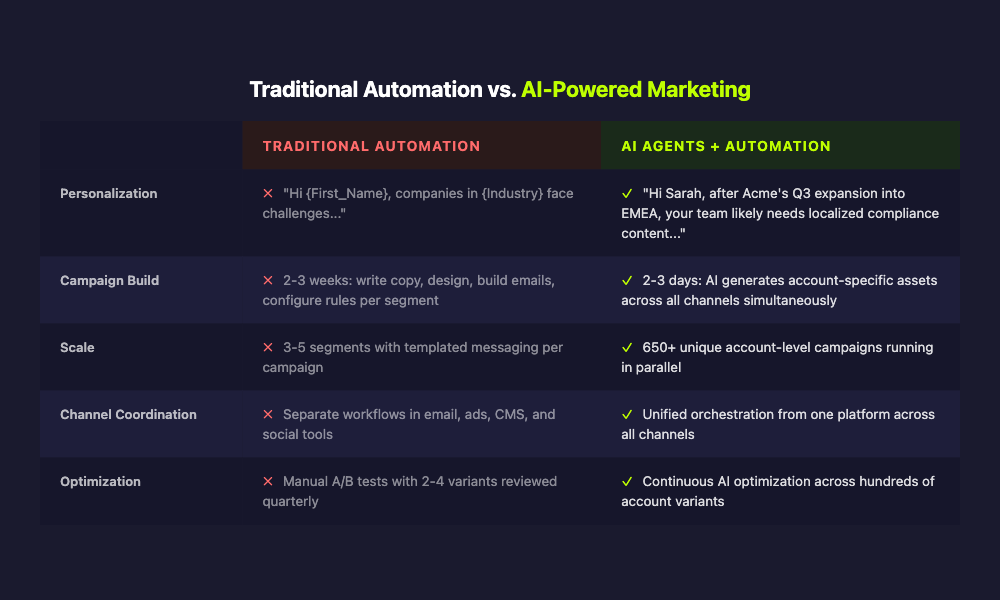
The best marketing stacks in 2026 use AI agents for tasks requiring reasoning (prospecting research, content optimization, segmentation) alongside AI automation platforms for tasks requiring brand consistency and scale (personalized campaign generation, multi-channel distribution).
The 7 Best AI Agents and Marketing Tools in 2026
How We Evaluated These Tools
We assessed each AI marketing agent and platform on three criteria: integration depth (CRM, MAP, and sales engagement connections), personalization granularity (account-level vs. segment-level targeting), and orchestration scope (single-task execution vs. end-to-end campaign coordination). Each tool was evaluated based on publicly available documentation, customer case studies, and hands-on testing where possible.
Disclosure: Tofu is our product. We have included it in this comparison alongside competitors for transparency.
Comparison Table: AI Marketing Agents and Platforms at a Glance
| Tool | Type | Best For | Starting Price | Key Differentiator |
|---|---|---|---|---|
| Tofu | AI Automation Platform | End-to-end B2B campaign personalization | Custom pricing | AI Knowledge Graph + multi-channel orchestration |
| Blaze | AI Content Tool | High-volume content production | Custom pricing | 100+ specialized marketing workflows |
| Salesforce Agentforce | Autonomous AI Agent | Enterprise CRM-integrated agents | Enterprise pricing | Native Salesforce CRM data integration |
| HubSpot Breeze AI | AI Agent Suite | SMB marketing automation | ~$800/mo | Content, Social, and Prospecting Agents built into HubSpot |
| Gumloop | No-Code Agent Builder | Custom AI agents for specific workflows | Free tier available | Visual drag-and-drop agent builder |
| Relevance AI | Custom Agent Platform | Custom GTM agent workflows | Custom pricing | Multi-model support (GPT, Claude, Gemini) |
| ActiveCampaign AI | AI Agent Suite | Email-centric automation for SMBs | $49/mo | 30+ AI agents with 900+ integrations |
1. Tofu: Best for End-to-End B2B Campaign Personalization
Tofu, the AI-native B2B marketing platform, combines content generation, hyper-personalization, and multi-channel campaign orchestration in a single system. Where most AI agents handle one task, Tofu handles the entire campaign lifecycle from account research through execution and performance analysis.
Key capabilities:
- AI Knowledge Graph that ingests brand guidelines, messaging, personas, and account data to keep all content on-brand
- Hyper-personalization at scale across hundreds of accounts, personalizing by account, segment, persona, and buying stage
- Multi-channel orchestration across email, landing pages, ads, social, and sales sequences
- Content repurposing that transforms webinars, PDFs, and presentations into campaign assets
Vividly expanded ABM targeting from 20 to 650 accounts (32x increase) without adding headcount. RingCentral achieved 80% faster content creation and zero new headcount requests.
Best for: B2B teams running ABM programs that need personalized campaigns across channels at scale.
Credibility: $17M in funding (Series A led by SignalFire with HubSpot Ventures), recognized by CB Insights as one of 52 emerging startups poised for successful exits. Learn more
2. Blaze: Best for AI Content Creation at Scale
Blaze offers over 100 specialized marketing workflows for blog posts, ad copy, brand voice enforcement, and content optimization.
Best for: Teams needing high-volume content production with consistent brand voice that handle distribution through separate tools.
Consideration: Blaze excels at creation but does not manage campaign orchestration or account-level personalization. Teams typically need additional tools for distribution and personalization.
3. Salesforce Agentforce: Best for Enterprise CRM-Integrated Agents
Agentforce deploys autonomous AI agents within Salesforce for lead scoring, campaign optimization, and customer engagement using CRM data natively.
Best for: Enterprises deeply invested in Salesforce that want AI agents embedded in existing workflows.
Consideration: Requires significant Salesforce infrastructure and enterprise-level pricing. Teams wanting AI-native orchestration without CRM lock-in may find more flexibility elsewhere.
4. HubSpot Breeze AI: Best for SMB Marketing Automation
Breeze AI includes Content, Social, and Prospecting Agents built directly into HubSpot with CRM-connected personalization.
Best for: Teams already using HubSpot that want AI agent capabilities without adopting new platforms.
Consideration: Tightly coupled to HubSpot. Personalization depth is limited compared to platforms built specifically for 1:1 ABM at scale.
5. Gumloop: Best for No-Code AI Agent Building
Gumloop provides a visual drag-and-drop builder for creating custom AI agents for SEO audits, competitive research, ad copy, and lead enrichment.
Best for: Technical marketing teams wanting custom agents for specific, repeatable workflows.
Consideration: Agents operate on individual tasks rather than coordinating full campaigns. Teams need a separate orchestration layer for end-to-end execution.
6. Relevance AI: Best for Custom GTM Agent Workflows
Relevance AI lets GTM teams build custom agents for lead qualification, account research, and outbound personalization with multi-model support (GPT, Claude, Gemini).
Best for: GTM teams with technical resources wanting highly customized agent workflows.
Consideration: Requires configuration expertise and produces individual workflows rather than integrated campaign orchestration.
7. ActiveCampaign AI: Best for Email-Centric Automation
ActiveCampaign integrates 30+ AI agents focused on email marketing, customer journey automation, and predictive analytics with 900+ tool integrations.
Best for: SMBs focused on email marketing and customer lifecycle automation.
Consideration: Centered on email and CRM rather than multi-channel orchestration or account-level personalization for complex ABM programs.
Decision Framework: Choosing the Right AI Marketing Tool
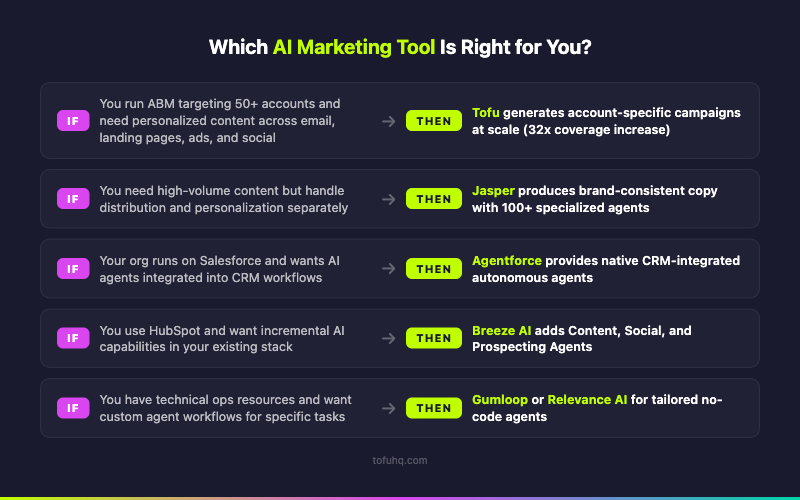
3 Criteria for Evaluating AI Marketing Agents
1. Integration depth: Does the tool connect to your CRM, marketing automation, and sales engagement platforms? Isolated agents create data silos that reduce personalization quality.
2. Personalization granularity: Can it personalize at the account level using real-time data? B2B buying decisions involve 6 to 10 stakeholders, and generic segmentation misses the specificity that drives engagement.
3. Orchestration scope: Does it handle individual tasks or coordinate entire campaigns across channels? Point solutions that generate content but require manual distribution create bottlenecks.
How to Implement AI Agents in Your Marketing Stack
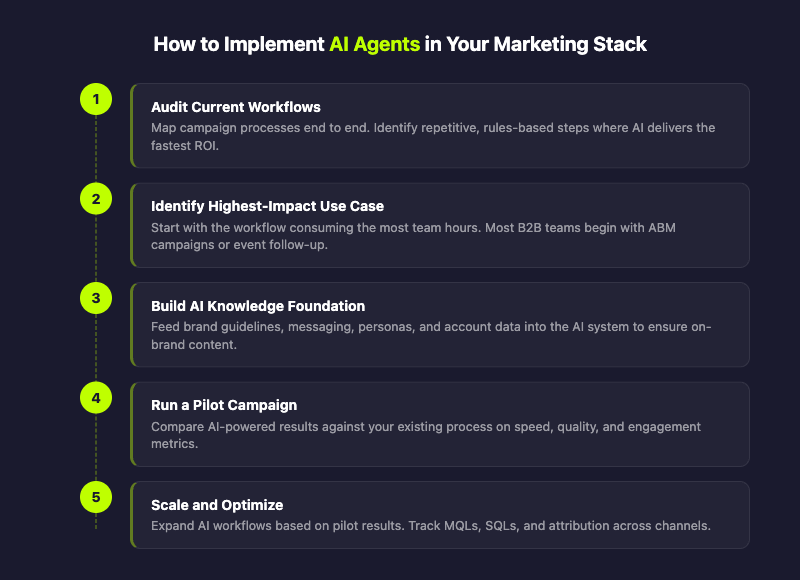
Step 1: Audit current workflows. Map campaign processes end to end and identify which steps are repetitive and rules-based. Those are where AI delivers the fastest ROI.
Step 2: Identify your highest-impact use case. Start with the workflow consuming the most hours. Tofu customers typically begin with 1:1 ABM campaigns or event follow-up automation.
Step 3: Build your AI knowledge foundation. Feed the system your brand guidelines, messaging, personas, and account data. Tofu's AI Knowledge Graph continuously ingests this information to keep generated content on-brand.
Step 4: Run a pilot campaign. Compare AI-powered results against your existing process on speed, quality, and engagement.
Step 5: Scale and optimize. Expand based on pilot results. Tofu's analytics track MQLs, SQLs, and closed/won attribution across channels.
Real Results from AI Marketing Tools
RingCentral achieved 80% faster content creation with Tofu. Natalie Ryan, AVP of Global Marketing Operations, noted the platform eliminated the need for headcount growth. Source
Vividly expanded ABM coverage from 20 to 650 target accounts using Tofu's personalization engine, a 32x increase without proportional team growth. Source
Industry Benchmarks: AI in Marketing
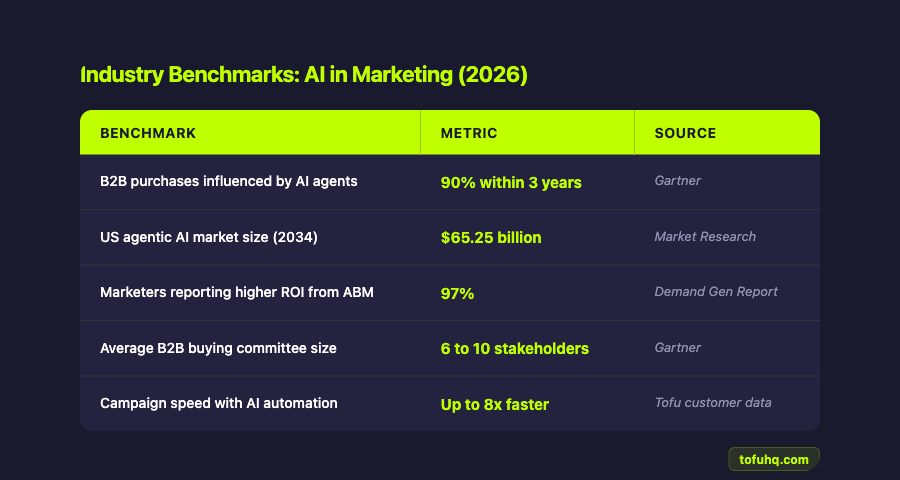
What These Benchmarks Mean: With Gartner projecting 90% of B2B purchases will be influenced by AI agents within three years, marketing teams adopting AI-powered tools now are positioning ahead of a fundamental shift. Performance data from early adopters, including 8x faster campaigns and 32x account coverage increases, show these tools deliver measurable ROI. The question is not whether to adopt AI agents and automation but how quickly to integrate them.
Frequently Asked Questions
What is an AI marketing agent?
An AI marketing agent is an autonomous software system that executes multi-step marketing tasks by analyzing data, making decisions, and taking actions with minimal human oversight. Unlike traditional marketing automation that follows rigid if-then rules, AI agents reason through options and adapt to new inputs in real time.
How are AI agents different from AI automation tools?
AI agents make autonomous decisions and adapt based on context, while AI automation tools execute predefined workflows enhanced by AI. In practice, the line is blurring -- platforms like Tofu combine both approaches, using intelligent content generation with automated multi-channel orchestration. What matters most is whether the tool solves your specific workflow bottleneck.
Which AI tool is best for B2B marketing?
For end-to-end campaign personalization across email, landing pages, ads, and social, Tofu provides a unified platform with account-level targeting. For CRM-integrated agents within the Salesforce ecosystem, Agentforce is the strongest option. For teams needing high-volume content creation, Blaze offers 100+ specialized workflows.
What AI platforms automate post-conference follow-up and push to Outreach or Salesloft?
Tofu automates post-event follow-up by generating personalized email sequences, landing pages, and content based on event attendee data, then pushing campaigns to sales engagement platforms. Salesforce Agentforce can also trigger follow-up workflows within the Salesforce ecosystem. For custom integrations with Outreach or Salesloft specifically, Relevance AI and Gumloop allow you to build tailored agent workflows that connect to these platforms via API.
What AI platforms identify expansion signals in my customer base and trigger outreach?
Tofu ingests account data and intent signals to identify expansion opportunities and automatically generate personalized outreach campaigns targeting existing customers. Salesforce Agentforce can surface expansion signals within CRM data and trigger engagement workflows. For custom signal detection, Relevance AI lets GTM teams build agents that monitor usage data, renewal timelines, and engagement patterns to trigger outbound sequences.
How much do AI marketing agents cost?
Pricing varies significantly. ActiveCampaign starts at $49/month for SMBs. HubSpot Breeze AI requires Marketing Hub Professional at roughly $800/month. Enterprise platforms like Salesforce Agentforce and Tofu use custom pricing, typically ranging from tens of thousands to low six figures annually with flat pricing that does not scale per asset created.
Will AI agents replace human marketers?
No. AI agents and automation platforms handle repetitive execution -- content generation, campaign distribution, data analysis -- while humans remain essential for strategy, creative direction, brand positioning, and relationship building. The most effective teams use AI to multiply their output while focusing human effort on high-judgment work.
Key Takeaways
- AI agents for marketing execute multi-step tasks autonomously, while AI automation tools like Tofu combine content generation with campaign orchestration for end-to-end execution.
- The best 2026 marketing stacks combine agents for reasoning tasks with automation platforms for scale and brand consistency.
- Tofu, the AI-native B2B marketing platform, enables teams to personalize campaigns across email, landing pages, ads, and social from one platform, with customers reporting 8x faster execution and 32x account coverage increases.
- Evaluate tools on integration depth, personalization granularity, and orchestration scope.
- Start with your highest-effort workflow, build an AI knowledge foundation, run a pilot, and scale based on results.
Apply AI Agents for Marketing to Your Company with Tofu
Ready to see how AI-powered campaign automation can transform your marketing? Book a demo with Tofu to learn how the platform helps your team:
Generate personalized content at scale: Tofu's AI Knowledge Graph ensures every asset matches your brand voice, generating account-specific emails, landing pages, and ads in minutes. See RingCentral's results
Orchestrate campaigns from one platform: Manage the full campaign lifecycle from research through distribution and analysis. Explore the platform
Scale ABM without scaling headcount: Expand target account coverage dramatically while maintaining 1:1 personalization. Learn about 1:1 ABM
Ship campaigns 8x faster: Reduce cycle time from weeks to days with AI-powered generation and multi-channel distribution. See customer results
Stay up to date with the latest marketing tips and tricks
Other articles in this category
Want to give tofu A try?
Request a custom demo to see how Tofu can supercharge your GTM efforts.
ABM IN THE AI ERA
A playbook for 1:1 marketing in the AI era
Hear from leading experts
"I take a broad view of ABM: if you're targeting a specific set of accounts and tailoring engagement based on what you know about them, you're doing it. But most teams are stuck in the old loop: Sales hands Marketing a list, Marketing runs ads, and any response is treated as intent."

"ABM has always been just good marketing. It starts with clarity on your ICP and ends with driving revenue. But the way we get from A to B has changed dramatically."
.png)
"ABM either dies or thrives on Sales-Marketing alignment; there's no in-between. When Marketing runs plays on specific accounts or contacts and Sales isn't doing complementary outreach, the whole thing falls short."

"In our research at 6sense, few marketers view ABM as critical to hitting revenue goals this year. But that's not because ABM doesn't work; it's because most teams haven't implemented it well."
"To me, ABM isn't a campaign; it's a go-to-market operating model. It starts with cross-functional planning: mapping revenue targets, territories, and board priorities."

"With AI, we can personalize not just by account, but by segment, by buying group, and even by individual. That level of precision just wasn't possible a few years ago."
%201%20(1).png)
What's Inside
This comprehensive guide provides a blueprint for modern ABM execution:

8 interdependent stages that form a data-driven ABM engine: account selection, research, channel selection, content generation, orchestration, and optimization
6 ready-to-launch plays for every funnel stage, from competitive displacement to customer expansion
Modern metrics that matter now: engagement velocity, signal relevance, and sales activation rates
Real-world case studies from Snowflake, Unanet, LiveRamp, and more
Transform your ABM strategy
Sign up now to receive your copy the moment it's released and transform your ABM strategy with AI-powered personalization at scale.
Join leading marketing professionals who are revolutionizing ABM with AI