
Originally published on LinkedIn by Tofu Team. Cross-posted with additional context.
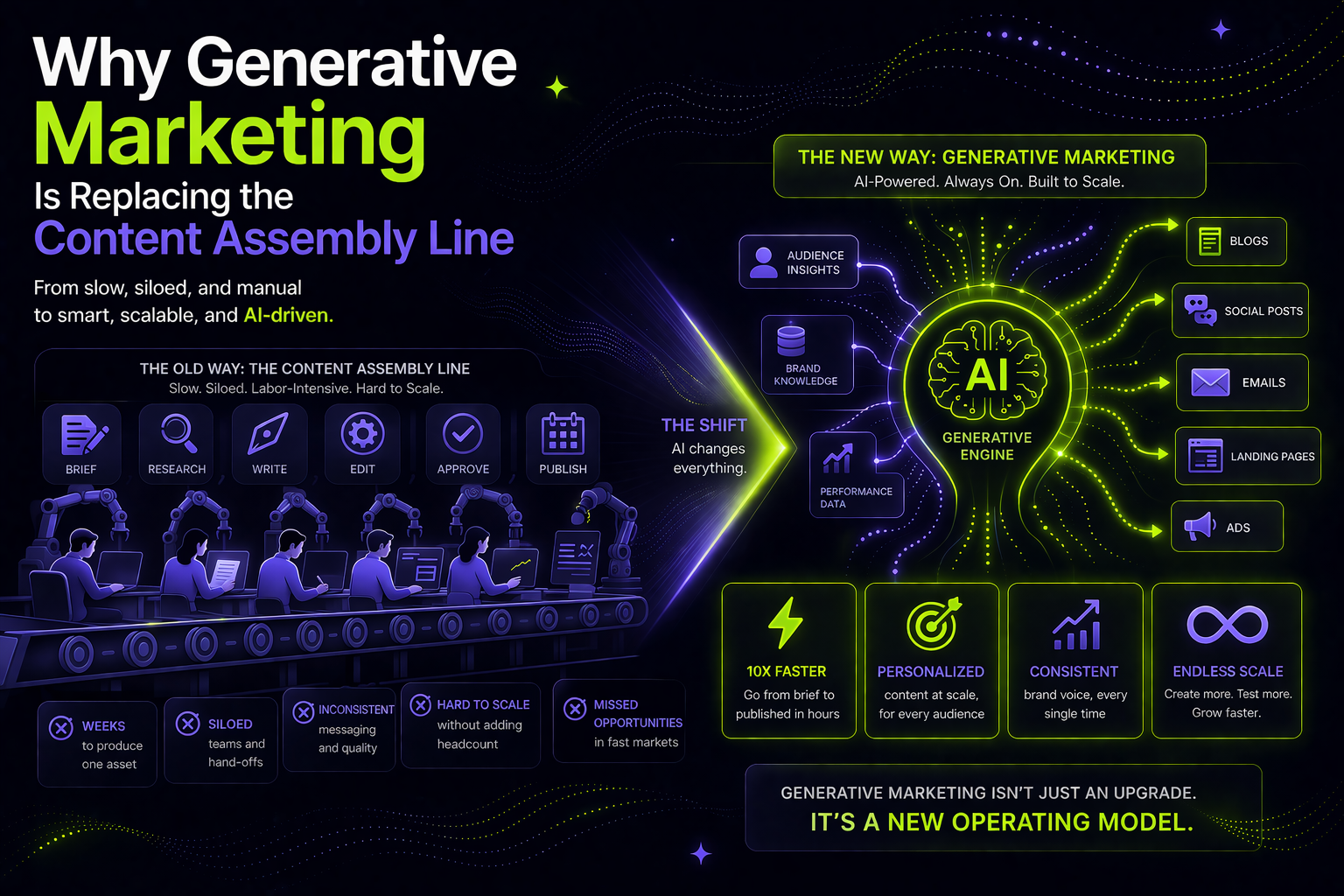
Why Generative Marketing Is Replacing the Content Assembly Line
Here's a question that should make every marketing leader uncomfortable: if your content production process looks essentially the same as it did in 2019, how are you producing 10x more personalized assets with the same-sized team? The answer, for most organizations, is that you're not. You're cutting corners, reusing generic content, or burning out your best people. The traditional content assembly line — brief to writer to designer to reviewer to publish — was built for a world where you needed five pieces of content a week. Today, a serious ABM program might need fifty personalized assets for a single campaign. The assembly line isn't slow. It's structurally incapable of meeting the demand. That's why a fundamentally different approach, generative marketing, is emerging — and why platforms like Tofu, an AI-native B2B marketing platform, are building the infrastructure to make it real.
This isn't a story about AI replacing writers. It's a story about a production model that was already failing before AI entered the picture — and why the solution isn't incremental automation, but a complete rethinking of how marketing content gets made.
The Content Assembly Line Is Breaking
Let's be honest about what the content assembly line actually is. In most B2B marketing organizations, producing a single piece of content follows a predictable sequence: a strategist writes a brief, a writer drafts the copy, a designer creates the visuals, a stakeholder reviews and requests changes, the writer revises, the designer adjusts, someone approves, and finally it gets published or sent.
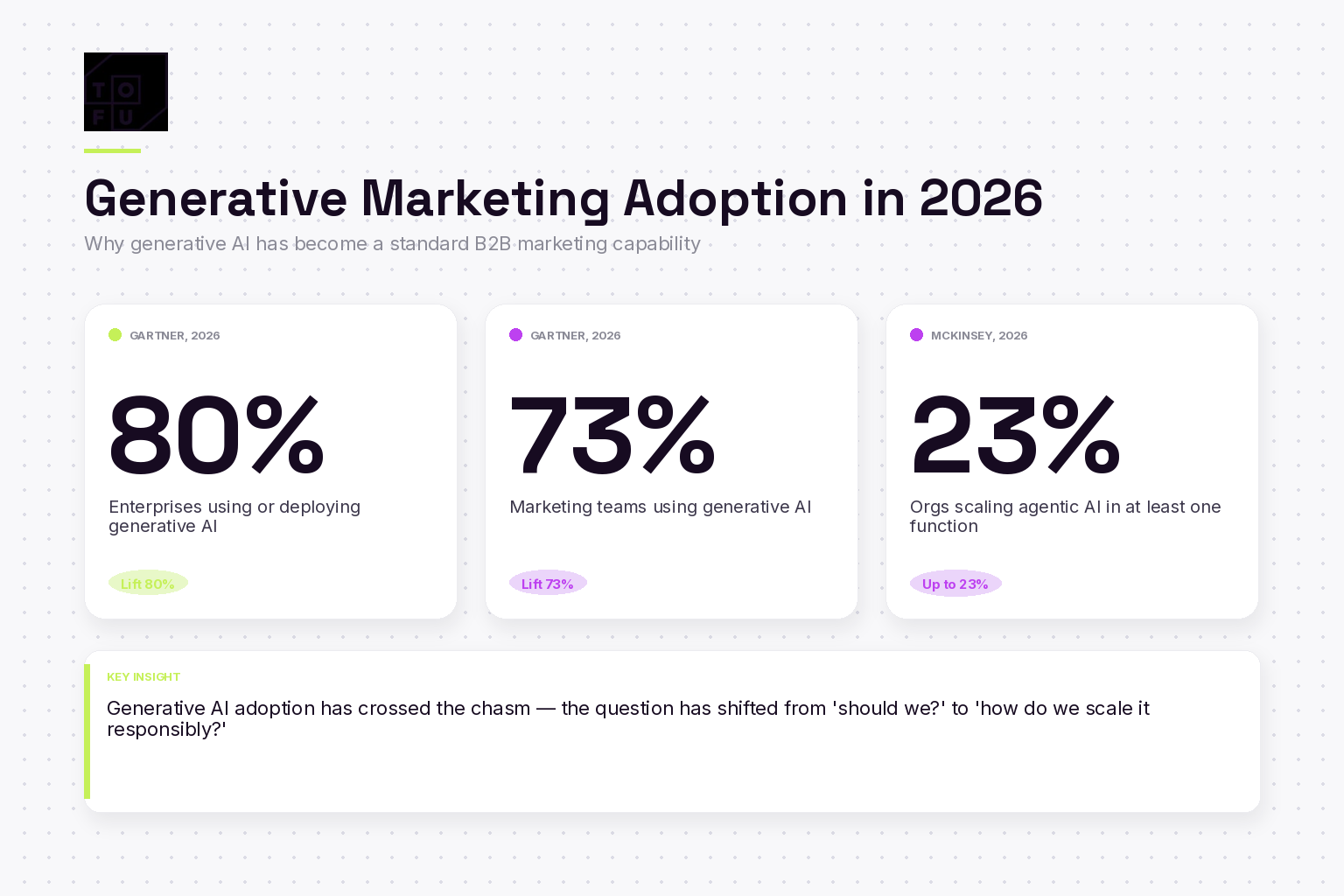
For a blog post, this might take two weeks. For a landing page, three. For a full campaign with emails, ads, one-pagers, and sales collateral? You're looking at four to six weeks if everything goes smoothly. And nothing ever goes smoothly.
This process was designed when B2B marketing meant publishing a handful of broadly-targeted assets. You'd write one whitepaper, one email sequence, one landing page — and blast it to your entire TAM. It worked because nobody expected personalization. A generic message to "enterprise IT leaders" was good enough.
That era is over. Modern account-based marketing demands that you speak to specific industries, specific company sizes, specific pain points, and increasingly, specific accounts. If you're targeting 200 accounts across eight verticals with distinct buying committees, the math gets ugly fast. A single campaign might need:
- 8 industry-specific landing pages
- 24 email variations (8 industries x 3 personas)
- 16 ad variations across platforms
- 8 one-pagers tailored to vertical pain points
- Sales collateral for the top 20 target accounts
That's 70+ unique assets for a single campaign. At two weeks per asset through your assembly line, you'd need roughly three years to produce one campaign's worth of content. Obviously, no one does this. Instead, teams compromise. They create one version and call it "personalized" because they swapped the industry name in the headline. They skip verticals. They reuse last quarter's collateral with a new logo. The assembly line's output constraint becomes a strategic constraint — you can only target the accounts you have content for.
And the human cost is real. I talk to marketing teams every week who describe the same pattern: their best content people spend 80% of their time on production logistics — managing briefs, chasing reviews, reformatting the same message for different channels — and 20% on the strategic and creative work they were actually hired to do. The assembly line doesn't just produce content slowly. It traps talent in a production loop.
What Generative Marketing Actually Means
"Generative marketing" gets thrown around a lot, usually as a synonym for "we use ChatGPT sometimes." That's not what it means. Using a chatbot to draft blog outlines is generative AI applied to marketing. Generative marketing is something structurally different.
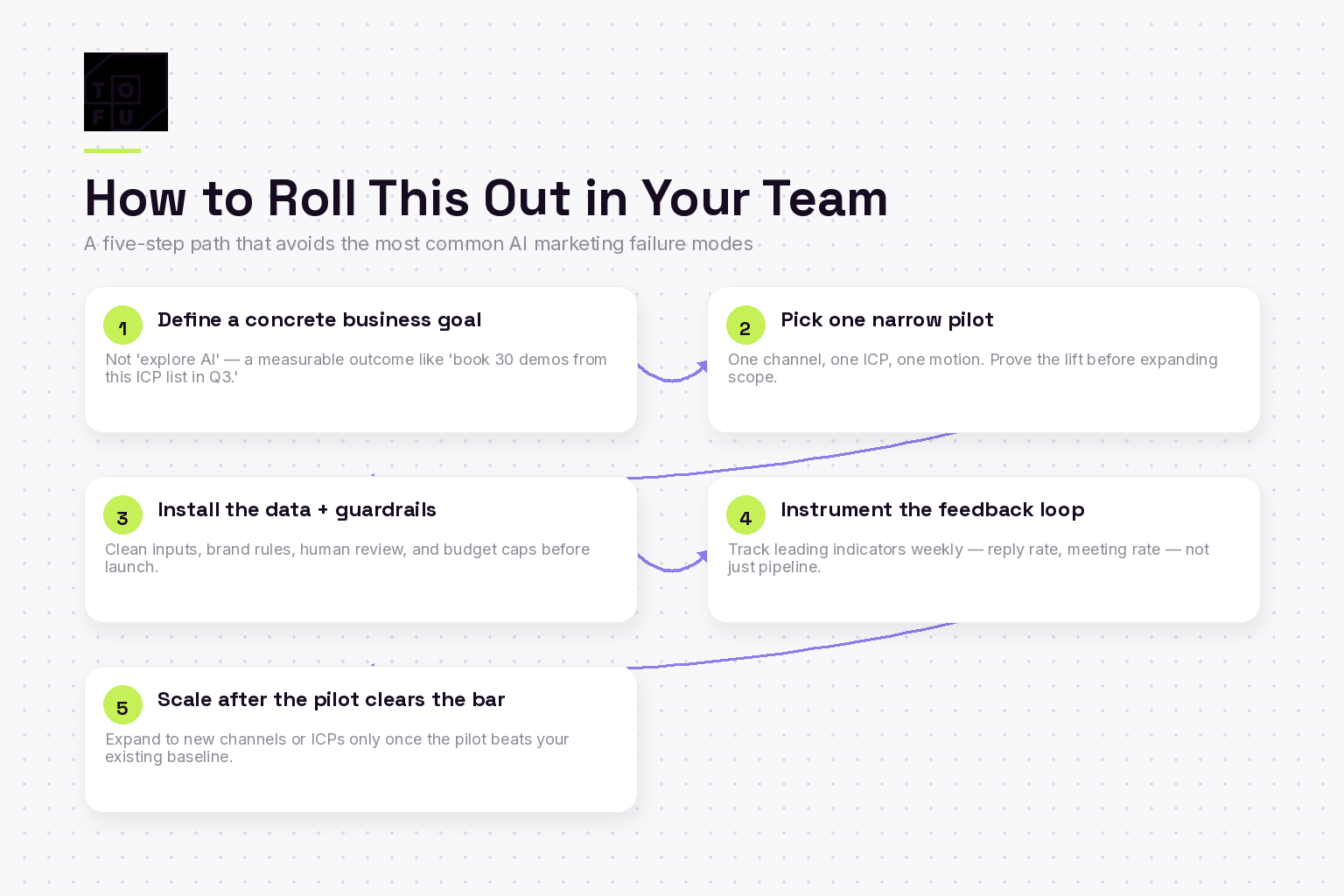
Generative marketing is an AI-native approach to content creation where personalized campaign assets are generated from a single source of strategic input — a campaign brief, a value proposition, a product positioning document — rather than being individually produced through a sequential workflow.
The distinction matters. In the assembly line model, every asset is a project. Each one requires a brief, a production cycle, and a review process. The work scales linearly: twice as many assets means twice as much work, twice as many people, twice as long.
In generative marketing, the campaign brief is the source of truth. From that single brief, a generative marketing platform can produce landing pages, emails, ads, one-pagers, and sales collateral — each personalized for specific industries, personas, or accounts. The work doesn't scale linearly because the strategic input (the brief, the positioning, the messaging) is created once and then the generation layer handles the permutations.
Think about it like this. The assembly line says: "We need a landing page for healthcare. Let's brief a writer, design it, review it, publish it. Now we need one for financial services. Let's start again." Generative marketing says: "We have our campaign positioning. Generate landing pages for healthcare, financial services, manufacturing, and technology — each reflecting the vertical's specific pain points, regulatory concerns, and buying triggers."
The first approach produces four assets in eight weeks. The second produces them in an afternoon. And the generative versions aren't template-swapped garbage — they're genuinely personalized because the platform understands vertical context, not just find-and-replace tokens.
This is what Tofu was built to do. You feed it a campaign brief and your target account segments. It generates the full suite of campaign content — landing pages, email sequences, ad copy, one-pagers, sales enablement materials — personalized per segment or per account. Not templated. Generated. There's a meaningful difference.
The Shift: From Content Factory to Content Engine
The best way to understand this shift is to compare the workflows side by side. Not in theory — in practice.
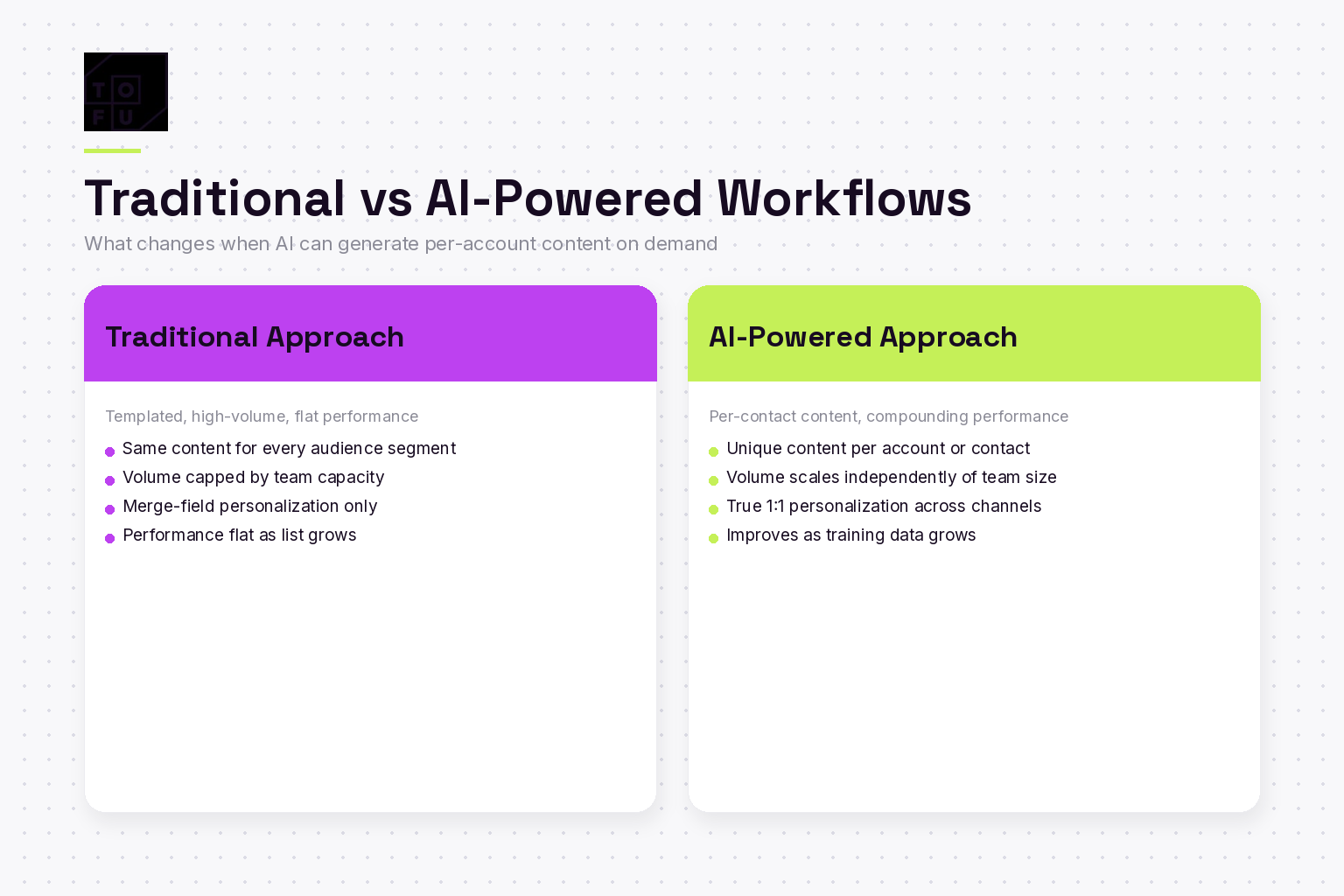
The Content Factory (Assembly Line Model)
Week 1: Campaign strategist writes the brief. Circulates for alignment. Revisions happen.
Week 2: Writer produces draft copy for the first asset. Designer begins layout concepts.
Week 3: Stakeholder review. Feedback. Writer revises. Designer adjusts.
Week 4: Final approval. Asset goes live. Begin briefing the next asset.
Result: One asset produced. Sixty-nine more to go. Estimated completion: never.
The Content Engine (Generative Marketing Model)
Day 1: Campaign strategist writes the brief and defines target segments. This is the highest-leverage step — the brief becomes the source of truth for everything that follows.
Day 2: The generative marketing platform produces the full campaign asset suite: landing pages, emails, ads, one-pagers — each personalized per segment.
Day 3: Marketing team reviews generated content, refines positioning, adjusts tone where needed. This is editorial curation, not production.
Day 4: Campaign goes live across all segments. Seventy assets, four days.
The difference isn't just speed, though the speed difference is dramatic. It's that the bottleneck shifts. In the assembly line, the bottleneck is production capacity — how many pieces can your team physically create? In generative marketing, the bottleneck is strategic quality — how good is your brief, your positioning, your understanding of your target accounts?
That's a much better bottleneck to have. Strategic quality is what actually drives campaign performance. A brilliantly written email sent to the wrong audience with the wrong message will always underperform a well-targeted, well-positioned email — even if the prose isn't Pulitzer-worthy. The assembly line optimizes for production polish. Generative marketing optimizes for strategic precision.
There's another structural advantage that doesn't get discussed enough: iteration speed. In the assembly line model, if you learn after launch that your healthcare messaging isn't resonating, you need to re-enter the production cycle. New brief, new draft, new review. Two more weeks, minimum. In a generative marketing model, you update the brief's healthcare positioning and regenerate. You can run messaging experiments at the speed of insight, not the speed of production.
This is what enables true agile marketing — not the bastardized "agile" that just means "we have standups now," but genuine rapid iteration based on market feedback. When producing a new variant costs minutes instead of weeks, you can actually test, learn, and adapt in real time.
What This Means for Marketing Teams
Here's where the conversation usually derails into dystopian predictions about AI eliminating marketing jobs. I think the opposite is true — but only if we're clear-eyed about what changes and what doesn't.
What doesn't change: You still need people who understand your market, your buyers, your product's value proposition, and how to tell a compelling story. You still need strategic thinking, brand judgment, and creative vision. In fact, these skills become more important, not less, because the quality of the strategic input directly determines the quality of everything that's generated from it.
What does change: The day-to-day work of marketing teams shifts dramatically. Instead of spending most of their time in production — writing, designing, reviewing, reformatting — team members spend most of their time on strategy, curation, and optimization.
Let me make this concrete by looking at how specific roles evolve:
Content strategists become the most critical role on the team. Their briefs are no longer just instructions for a writer — they're the source code for an entire campaign. The quality of their positioning, their audience understanding, their competitive intelligence directly determines campaign output quality. This is a massive elevation of the role.
Writers shift from first-draft producers to editorial curators. They review generated content, refine voice and tone, elevate the strongest pieces, and ensure brand consistency across the full asset suite. They spend less time staring at blank pages and more time exercising their highest-value skill: editorial judgment. The writers I've talked to who've made this shift say they enjoy the work more, not less. They're doing the interesting parts of writing all day instead of grinding through production.
Designers move from laying out individual assets to building design systems and templates that the generative layer works within. They define the visual language. They set the guardrails. Then they focus on the high-impact creative work — hero visuals, campaign identities, brand storytelling — instead of resizing the same ad for seven platforms.
Campaign managers become orchestrators of much larger, more complex campaigns. When you can run personalized campaigns across dozens of segments simultaneously, the coordination challenge changes. It's less about managing production timelines and more about managing a portfolio of active experiments — which segments are responding, which messages are resonating, where to double down, where to pivot.
Demand gen leaders finally get to do what they were hired to do: drive pipeline. When content production isn't a bottleneck, you can actually execute the sophisticated multi-touch, multi-segment campaigns you've been drawing on whiteboards for years but never had the content capacity to launch.
The teams I see thriving in this transition share a common trait: they don't think of generative marketing as a cost-cutting tool. They think of it as a capability multiplier. The team doesn't shrink. The output grows by 10x. The quality of work improves because people are doing more strategic, more creative, more intellectually demanding work instead of production logistics.
Of course, this requires a real shift in mindset. Marketers who've built their identity around being fast producers need to rebuild that identity around being sharp strategists and discerning editors. Not everyone will make that transition willingly. But the ones who do will find themselves in a much better position — doing higher-value work, with more strategic influence, and with dramatically more impact on pipeline.
The Bottom Line
The content assembly line was a reasonable solution for a simpler era. When you needed five assets a month and personalization meant adding a first name to an email, sequential production worked fine. That era is over.
Modern B2B marketing demands personalization at a scale that the assembly line cannot structurally deliver. No amount of project management optimization, no number of additional headcount, no set of efficiency hacks will close the gap between what the market demands and what sequential production can output. The model itself is the constraint.
Generative marketing isn't a nice-to-have upgrade. It's the structural response to a structural problem. By generating personalized content from strategic inputs rather than individually producing each asset, marketing teams can finally match their output to their ambition. They can run the ABM programs they've been planning. They can personalize at the account level, not just the segment level. They can iterate at the speed of insight instead of the speed of production.
If you want to go deeper on this, we wrote a comprehensive guide on what generative marketing is, how it works, and why it matters. It covers the technology, the organizational implications, and the metrics you should be tracking as you make this transition.
The assembly line had a good run. But the future of B2B marketing content isn't produced. It's generated.
Ready to replace your content assembly line?
See how Tofu generates personalized campaign content from a single brief — landing pages, emails, ads, one-pagers, and sales collateral, all tailored per target account.
Book a Demo
.png)


%201%20(1).png)
