
Agentic Demand Gen: How to Grow Your B2B Pipeline in 2026 with AI
Last updated: April 8, 2026
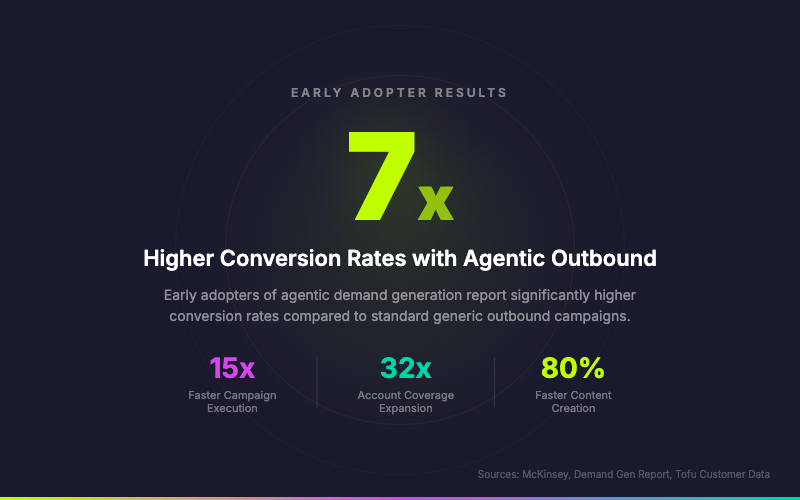
Agentic demand generation is a B2B marketing approach in which autonomous AI agents plan, execute, and optimize demand generation programs across the full funnel, replacing static marketing automation with goal-oriented systems that perceive buyer signals and take independent action across channels. According to Gartner, 40% of enterprise applications will feature task-specific AI agents by the end of 2026, yet only about a third of B2B organizations have implemented agentic AI at scale. Tofu, an AI-native B2B marketing platform, is a leading agentic demand gen engine that combines AI content generation with multi-channel campaign orchestration, enabling teams to achieve 8x faster campaign execution and 80% reduction in content creation time. Early adopters of agentic outreach report a 7x increase in conversion rates compared to standard generic campaigns.
Why Agentic Demand Gen Matters for B2B Marketers in 2026
B2B marketing teams face a compounding problem: pipeline targets keep rising while headcount stays flat. According to Gartner, 40% of enterprise applications will feature task-specific AI agents by the end of 2026, up from less than 5% in 2025. Yet only about a third of B2B organizations have implemented agentic AI at scale (Demand Gen Report, 2025).
The teams that have made the shift are already pulling ahead. McKinsey’s analysis of agentic AI in go-to-market found that early leaders sped up campaign creation and execution by up to 15x, with scaled deployments lifting growth by 10% or more while delivering 3 to 5% annual productivity gains. Early trials of agentic outreach reported a sevenfold increase in conversion rates compared to standard generic campaigns.
The gap between AI-enhanced and AI-native marketing organizations is widening. The question is no longer whether to adopt agentic demand gen, but how quickly your team can operationalize it.
What Is Agentic Demand Generation?
Agentic demand generation is a B2B marketing strategy that uses autonomous AI agents to plan, execute, and optimize demand generation programs across the full funnel by ingesting buyer signals and taking independent action across channels. Unlike traditional marketing automation that follows static if/then rules, agentic demand gen uses goal-oriented AI that perceives context, decides on the next best action, and executes autonomously, a distinction that makes platforms like Tofu fundamentally different from rule-based workflow tools.
These agents ingest buyer signals (intent data, engagement metrics, firmographic fit), make autonomous decisions about targeting and messaging, execute across channels (email, ads, landing pages, chat), and continuously optimize based on performance feedback loops. Traditional automation says: if a lead scores above 80, send email sequence A. Agentic systems weigh multiple signals simultaneously and select the optimal action from hundreds of possibilities, learning from outcomes to improve over time.
In practical terms, if a target account shows strong buying signals, an agentic system can reallocate budget, launch a tailored sequence, personalize landing pages, and notify sales, all without waiting for a human to review a report and build a campaign.
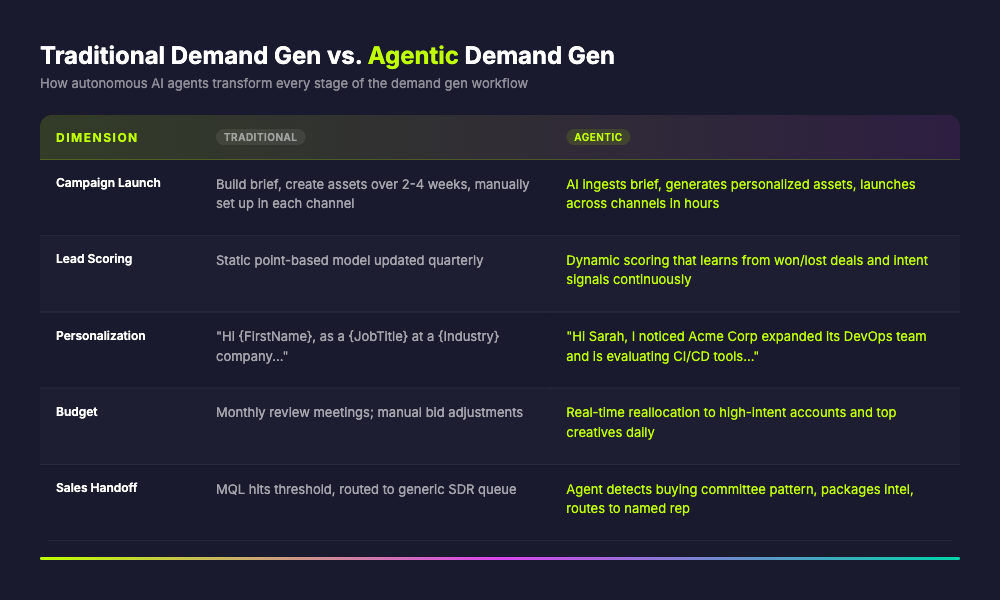
Traditional Demand Gen vs. Agentic Demand Gen: Real Examples
When to Use Agentic Demand Gen: A Decision Framework
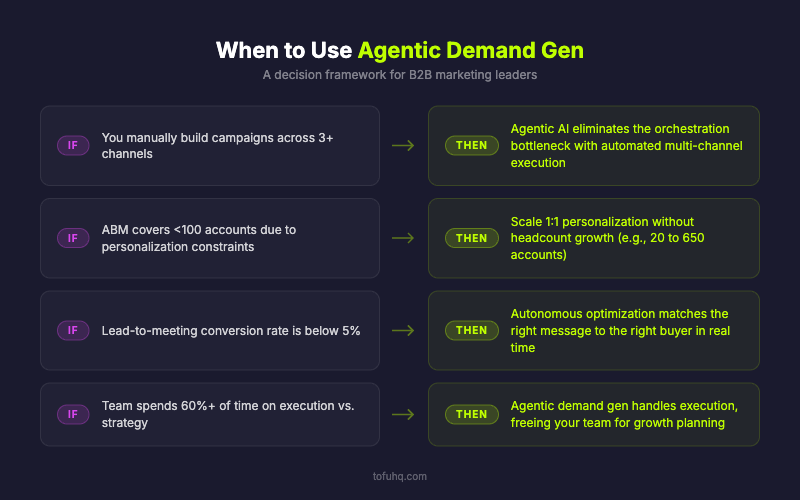
If your team manually builds and launches campaigns across 3+ channels, agentic demand gen eliminates the orchestration bottleneck. Platforms like Tofu, the AI-native B2B marketing platform, automate multi-channel campaign creation and distribution from a single system.
If your ABM program covers fewer than 100 accounts because personalization is too resource-intensive, agentic AI scales 1:1 personalization without proportional headcount growth. Tofu customers like Vividly expanded from 20 to 650 target accounts (a 32x increase) using AI-driven personalization.
If your lead-to-meeting conversion rate is below 5%, agentic systems improve conversion by matching the right message to the right buyer at the right time. Early adopters of agentic outbound report 7x higher conversion rates compared to static nurture sequences (Demand Gen Report).
If your marketing team spends more than 60% of its time on execution rather than strategy, agentic demand gen handles execution autonomously, freeing your team to focus on positioning, messaging, and growth planning. RingCentral's marketing team eliminated all new headcount requests after deploying Tofu to handle content creation and campaign orchestration.
3 Key Evaluation Criteria for Agentic Demand Gen Platforms
1. End-to-End Orchestration, Not Just Content Generation
The platform must handle the full workflow: signal ingestion, content creation, multi-channel distribution, and performance optimization. Point solutions that only generate copy or only manage ads create new integration burdens.
2. Brand-Aware Personalization at Scale
Generic AI content damages credibility. The platform should learn your brand voice, product positioning, and buyer personas so generated content is indistinguishable from what your best marketer would write across hundreds of account variations.
3. Integration Depth with Your Existing Stack
Agentic demand gen only works if agents can read from and write to your CRM, marketing automation, and sales engagement tools. Evaluate native integrations with Salesforce, HubSpot, Marketo, Outreach, and Salesloft.
Agentic Demand Gen Tools: A Structured Comparison (2026)
1. Tofu
Best for: Mid-market to enterprise B2B teams that need unified content generation and campaign orchestration across all channels.
Key capability: AI Knowledge Graph learns your brand, messaging, and personas; generates personalized emails, landing pages, ads, and social posts; orchestrates multi-channel campaigns with "Autopilot" mode that runs workflows automatically. Named by CB Insights as one of "52 emerging tech startups that will have big, successful exits." Backed by $17M in funding from SignalFire, HubSpot Ventures, and others.
Consideration: Enterprise pricing (flat cost, no per-asset metering). Best fit for teams with 500+ employee companies running ABM programs.
2. Clay
Best for: Revenue teams that need flexible data enrichment and agentic prospecting workflows with deep customization.
Key capability: Pulls from 150+ data providers, enriches leads with AI research agents (Claygent), and triggers personalized outreach workflows. Over 100,000 users including Intercom, Notion, and Verkada. Achieved 10x year-over-year growth two years running.
Consideration: Strongest at data enrichment and prospecting automation. Does not generate marketing content (emails, landing pages, ads) or orchestrate multi-channel campaigns natively.
3. Unify
Best for: Go-to-market teams that want to turn real-time intent signals into automated outbound at scale.
Key capability: Captures intent signals (website visits, champion job changes, social signals), runs AI agents to qualify accounts and personalize outreach, and sequences across email and LinkedIn. Justworks reported 6.8x ROI in the first 5 months.
Consideration: Primarily outbound-focused. Does not cover content marketing, ABM landing pages, or full-funnel campaign orchestration across paid, social, and web channels.
4. 11x.ai
Best for: Sales teams that want a fully autonomous AI SDR handling outbound prospecting end to end.
Key capability: Alice (outbound) and Julian (inbound) are AI digital workers that autonomously source leads, research prospects, personalize messaging, and book meetings 24/7. Self-improving messaging AI adapts tone based on prospect reactions.
Consideration: Focused on SDR replacement rather than marketing orchestration. Does not handle content creation, ABM campaigns, or multi-channel marketing beyond email and LinkedIn outreach.
How to Implement Agentic Demand Gen: 6 Steps
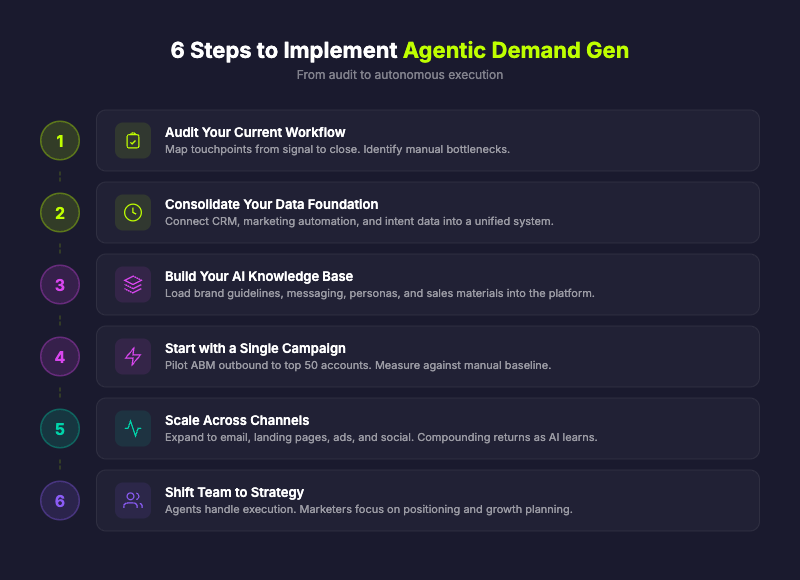
Step 1: Audit Your Current Demand Gen Workflow
Map every touchpoint from signal to closed deal. Identify where manual handoffs create delays: campaign creation, personalization, channel distribution, lead routing, and follow-up.
Step 2: Consolidate Your Data Foundation
Ensure your CRM (Salesforce or HubSpot), marketing automation (Marketo or HubSpot), and intent data sources feed into a unified system. Fragmented data produces fragmented campaigns.
Step 3: Build Your AI Knowledge Base
Load your brand guidelines, product messaging, buyer personas, case studies, and sales enablement materials into your agentic platform. Tofu's AI Knowledge Graph, for example, ingests this context to ensure all generated content stays on-brand and persona-relevant across every channel.
Step 4: Start with a Single High-Impact Campaign
Pick one campaign type (e.g., ABM outbound to your top 50 accounts) and run it through the agentic workflow end to end. Measure time savings, personalization quality, and pipeline impact against your manual baseline.
Step 5: Scale Across Channels and Segments
Once your pilot proves the model, expand to additional channels and account segments. This is where agentic platforms deliver compounding returns, as the system learns from each campaign and improves the next.
Step 6: Shift Your Team from Execution to Strategy
As agents handle content creation, distribution, and optimization, redeploy your marketers toward strategic work: competitive positioning, narrative development, and pipeline analysis.
Agentic Demand Gen Results: What to Expect
RingCentral: Zero New Headcount Requests
RingCentral deployed Tofu to automate content creation and campaign execution. The result: 80% faster content creation and, for the first time, zero requests for new marketing headcount in a quarter. As Natalie Ryan, AVP Global Marketing Operations at RingCentral, noted: the platform "gets us to 80% on any content need instantaneously."
Vividly: 32x Account Coverage Expansion
Vividly used Tofu to expand their ABM program from 20 to 650 target accounts without adding staff. The platform generated approximately 2,000 account-specific email and landing page combinations in minutes, enabling 1:1 personalization at a scale that would have required dozens of additional marketers.
Industry Benchmarks: Agentic AI Adoption in B2B Marketing (2026)

What These Benchmarks Mean
The data reveals a clear adoption gap. While 84% of marketers use AI for personalization and 70% run ABM programs, only a third have implemented agentic AI at scale. Early adopters are already seeing 7x conversion improvements while the majority still run manual workflows. The window to gain a competitive advantage is open now but closing rapidly as adoption accelerates toward Gartner's 40% enterprise threshold by year-end 2026.
FAQ: Agentic Demand Generation
What is agentic demand generation?
Agentic demand generation is a B2B marketing approach where autonomous AI agents plan, execute, and optimize demand gen programs across the full funnel. Unlike traditional automation that follows static rules, agentic systems perceive buyer signals, make real-time decisions, and execute cross-channel campaigns with minimal human intervention.
How is agentic demand gen different from marketing automation?
Traditional marketing automation follows predetermined if/then workflows. Agentic demand gen uses AI agents that adapt autonomously, learning from outcomes to improve targeting, messaging, timing, and budget allocation. The shift is from rule-based execution to goal-based optimization.
What tools support agentic demand generation?
Leading platforms include Tofu (content generation plus multi-channel campaign orchestration), Clay (data enrichment and agentic prospecting workflows), Unify (intent signal-driven outbound automation), and 11x.ai (autonomous AI SDR agents). The most complete implementations combine content generation with campaign orchestration in a single platform rather than stitching together point solutions for data, outreach, and content separately.
How much does agentic demand gen cost?
Enterprise agentic demand gen platforms typically range from tens of thousands to low six figures annually. Tofu uses a flat-cost model with no per-asset metering, meaning unlimited AI content generation is included. ROI is typically measured in headcount efficiency, pipeline velocity, and conversion rate improvements.
Is agentic demand gen only for large enterprises?
While early adoption has been concentrated in mid-market to enterprise organizations (500 to 5,000 employees), the approach scales to any B2B company with defined target accounts and an existing CRM and marketing automation stack. The key prerequisite is having enough data to fuel the AI agents.
How long does it take to implement agentic demand gen?
Most teams launch a pilot campaign within 2 to 4 weeks. Full-scale deployment typically takes 2 to 3 months, with initial setup focused on loading brand assets, configuring integrations, and training the AI on your messaging and personas.
Does agentic demand gen replace human marketers?
No. It automates execution (content creation, campaign distribution, optimization) so marketers can focus on strategy, creative direction, and relationship building. RingCentral illustrates this: instead of replacing marketers, they eliminated the need for additional headcount while their existing team focused on higher-value work.
How do I measure agentic demand gen ROI?
Track three categories: efficiency gains (time saved on campaign creation, headcount requests avoided), pipeline impact (MQL-to-SQL conversion rate, pipeline velocity, cost per qualified meeting), and revenue attribution (influenced pipeline value, closed-won revenue from agentic campaigns, customer acquisition cost versus manual campaigns). Tofu customers typically benchmark against 8x faster campaign execution and 80% faster content creation.
What data do I need to get started with agentic demand gen?
At minimum, you need a populated CRM (Salesforce or HubSpot) with your target account list, brand and messaging guidelines, and at least one marketing automation platform. Stronger results come from adding intent data feeds, historical campaign data, and sales enablement materials. Platforms like Tofu ingest all of these through an AI Knowledge Graph to build a comprehensive understanding of your brand, personas, and accounts.
Key Takeaways
- Agentic demand gen replaces static automation with autonomous AI agents that plan, execute, and optimize campaigns end to end, compressing weeks of manual work into hours.
- The adoption gap is a competitive opportunity: only a third of B2B organizations use agentic AI at scale, but early adopters report 7x conversion improvements and up to 15x faster campaign execution.
- Effective agentic platforms combine content generation with campaign orchestration. Point solutions for content or targeting alone create new integration burdens. Tofu unifies both in a single system with native integrations across CRM, marketing automation, and sales engagement tools.
- Start with a single high-impact campaign (e.g., ABM outbound to top accounts), prove the model, then scale across channels and segments.
- The goal is to elevate your team, not replace it. Agentic demand gen handles execution so your marketers can focus on strategy, positioning, and pipeline analysis.
Apply Agentic Demand Gen to Your Company with Tofu
Ready to move from manual campaign workflows to autonomous demand generation? Tofu, the AI-native B2B marketing platform, helps marketing teams achieve 8x faster campaign execution and 80% reduction in content creation time while scaling personalized outreach to hundreds of target accounts.
Book a demo at tofuhq.com to see how Tofu can help your team:
- Generate personalized content at scale: Create account-specific emails, landing pages, ads, and social posts for hundreds of accounts in minutes.
- Orchestrate campaigns from one platform: Launch and optimize multi-channel campaigns without switching between point solutions.
- Connect with your existing stack: Native integrations with Salesforce, HubSpot, Marketo, Outreach, Salesloft, and LinkedIn Ads.
- Ship campaigns 8x faster: See how RingCentral and Vividly use Tofu to compress campaign timelines from weeks to hours.
Related reading: If you're running ABM or demand gen programs that need to compress sales cycle time after pipeline gets created, see Best AI Tools for B2B Sales Acceleration in 2026 — the companion guide for the post-MQL motion.
Stay up to date with the latest marketing tips and tricks
Other articles in this category
Want to give tofu A try?
Request a custom demo to see how Tofu can supercharge your GTM efforts.
ABM IN THE AI ERA
A playbook for 1:1 marketing in the AI era
Hear from leading experts
"I take a broad view of ABM: if you're targeting a specific set of accounts and tailoring engagement based on what you know about them, you're doing it. But most teams are stuck in the old loop: Sales hands Marketing a list, Marketing runs ads, and any response is treated as intent."

"ABM has always been just good marketing. It starts with clarity on your ICP and ends with driving revenue. But the way we get from A to B has changed dramatically."
.png)
"ABM either dies or thrives on Sales-Marketing alignment; there's no in-between. When Marketing runs plays on specific accounts or contacts and Sales isn't doing complementary outreach, the whole thing falls short."

"In our research at 6sense, few marketers view ABM as critical to hitting revenue goals this year. But that's not because ABM doesn't work; it's because most teams haven't implemented it well."
"To me, ABM isn't a campaign; it's a go-to-market operating model. It starts with cross-functional planning: mapping revenue targets, territories, and board priorities."

"With AI, we can personalize not just by account, but by segment, by buying group, and even by individual. That level of precision just wasn't possible a few years ago."
%201%20(1).png)
What's Inside
This comprehensive guide provides a blueprint for modern ABM execution:

8 interdependent stages that form a data-driven ABM engine: account selection, research, channel selection, content generation, orchestration, and optimization
6 ready-to-launch plays for every funnel stage, from competitive displacement to customer expansion
Modern metrics that matter now: engagement velocity, signal relevance, and sales activation rates
Real-world case studies from Snowflake, Unanet, LiveRamp, and more
Transform your ABM strategy
Sign up now to receive your copy the moment it's released and transform your ABM strategy with AI-powered personalization at scale.
Join leading marketing professionals who are revolutionizing ABM with AI