
What Is Agentic Marketing? The Complete 2026 Guide

Last updated: April 14, 2026
Agentic marketing is the practice of using autonomous AI agents to plan, execute, and optimize marketing campaigns based on goals — not pre-defined rules or templates. Unlike traditional marketing automation, which executes human-designed workflows step by step, agentic marketing systems receive an objective (like "generate 50 qualified meetings from this account list" or "increase product page conversion 20% for outbound traffic") and figure out how to achieve it by selecting channels, generating personalized content, sequencing actions, and adapting in real time based on outcomes.
The shift is happening fast. According to Gartner, 40% of enterprise applications will feature task-specific AI agents by the end of 2026, up from less than 5% in 2025. A January 2026 study by RevSure and Ascend2 of 306 B2B GTM leaders in the US and UK found that 76% of organizations are already deploying agentic AI in marketing, sales, or revenue operations — with 41% in full implementation and another 35% in active rollout.
This guide covers the formal definition of agentic marketing, how it actually works, the seven characteristics that distinguish it from marketing automation and AI-assisted marketing, real examples from companies like Adobe, Salesforce, Demandbase, and Tofu, the most common use cases B2B teams are deploying today, and how to get started without falling into the traps that cause Gartner to predict more than 40% of agentic AI projects will fail by 2027.
Disclosure: Tofu is our product. We've included it in this article alongside competitors and industry examples for transparency. Where Tofu is mentioned, we've done our best to represent it honestly — including where other tools are a better fit.

Agentic Marketing Definition
Agentic marketing is a B2B marketing approach in which autonomous AI agents — software systems that can perceive, plan, decide, and act independently — handle the execution of marketing campaigns end-to-end. Marketers define the goals (acquire X accounts, expand Y product line, reactivate Z dormant segment) and the constraints (brand voice, budget, channels, compliance requirements). The agents handle the rest: planning the campaign, generating personalized content per target, sequencing actions across channels, monitoring outcomes, and adjusting in real time.
The term emerged in 2024 and 2025 as large language models became capable of multi-step reasoning, tool use, and self-correction. Before agentic AI, marketing "AI" usually meant generative AI: a marketer asked for an output (a subject line, a landing page draft, an ad headline), the model produced it, and the human integrated it into an existing workflow. Agentic AI flips that relationship — the AI runs the workflow, and the human supervises strategy.
This is fundamentally different from automation. A marketing automation platform like Marketo, HubSpot Workflows, or Salesforce Marketing Cloud executes pre-defined logic ("if a contact opens email A, wait 3 days, then send email B"). An agentic marketing system has no pre-defined paths. It plans its own.
How Agentic Marketing Works
Agentic marketing systems work in four stages: goal assignment, autonomous planning, cross-channel execution, and continuous learning. Each stage replaces a step that used to require active human intervention.
Step 1: Goal Assignment
Marketers define the desired outcome and the constraints — not the workflow. A goal might be "generate 50 qualified meetings from this list of 200 enterprise accounts in Q3," "increase product page conversion 20% for visitors from outbound email sequences," or "reactivate dormant accounts in the financial services vertical." Constraints include budget, brand voice rules, allowed channels, compliance requirements, and approval thresholds for high-stakes actions like large discount offers or external messaging.
Step 2: Autonomous Planning
The agent breaks the goal into sub-tasks and decides which tools and tactics to use. A buying-group-discovery agent might query the CRM for previously engaged contacts, enrich missing roles via LinkedIn or Clay data, identify decision-makers and hidden influencers per account, and assemble a target contact list. A campaign orchestration agent might decide that a specific enterprise account responds best to a personalized landing page plus an executive-level email plus a LinkedIn ad sequence — rather than a generic nurture drip — based on what worked for similar accounts.
Step 3: Cross-Channel Execution
The agent generates content, schedules actions, and triggers channels — often in parallel. Modern agents can draft and personalize landing pages, write and send emails, launch ads, update CRM records, and notify sales reps in a single coordinated motion. Tofu, for example, generates landing pages, emails, and microsites tailored to each target account from a single campaign brief, then triggers them based on engagement signals from HubSpot or Salesforce.
Step 4: Continuous Learning
Every action becomes a data point. Agents monitor open rates, page views, dwell time, form submissions, and downstream pipeline outcomes — then adjust which content variants, channels, and timing patterns to use next. Over time, the agent gets measurably better at the same goal without a marketer having to manually update workflow rules. A/B testing stops being a separate experiment phase and becomes continuous behavior.
The 7 Key Characteristics of Agentic Marketing
There are seven characteristics that distinguish agentic marketing from earlier waves of marketing technology. A system that has all seven is genuinely agentic. A system with only two or three is closer to AI-assisted automation, which is useful but operates by a different model.
- Goal-oriented, not instruction-driven. Agentic systems take goals as input, not workflows. A marketing automation platform requires marketers to design every branch, trigger, and condition. An agentic system requires marketers to state the desired outcome and let it determine the path. This is the single most important shift — and the one most marketing teams find hardest to internalize.
- Autonomous decision-making within constraints. Within defined boundaries, the agent makes decisions a human used to make: which segment to target, which message to send, which channel to use, when to escalate. Adobe's Audience Agent in Journey Optimizer B2B Edition, for example, analyzes structured and unstructured first-party data to identify buying group personas and build target audiences for specific offerings — without a marketer hand-curating the list.
- Multi-step planning. Agentic systems break goals into sequences of actions and order them logically. A goal like "generate 50 enterprise meetings" decomposes into: identify accounts, enrich contacts, segment by intent signals, generate personalized assets, sequence outreach, monitor engagement, escalate hot leads to sales — all without a human writing the recipe.
- Cross-channel execution. Traditional marketing automation siloed work by channel. Email tools handled email. Ad platforms handled ads. CMS handled the website. Agentic systems coordinate across channels in a single workflow because the agent treats each channel as a tool, not as a separate platform with its own logic.
- Continuous learning from outcomes. Every campaign produces data, and agentic systems use that data to refine future decisions. Salesforce reports more than $540 million in ARR from Agentforce as of early 2026, driven in part by the compounding improvement customers experience as the agents learn from their environment over time.
- Human oversight at the top of the loop. In agentic marketing, the human moves from operator to supervisor. Marketers set goals, define guardrails, review key decisions, and retain veto power. The agent handles execution. This is sometimes called "human-on-the-loop" (vs. "human-in-the-loop"), and it's a deliberate design choice — not a limitation of the technology.
- Integration with existing marketing systems. Agentic systems don't replace your CRM, MAP, ad platforms, or website. They sit on top of those systems, calling APIs and reading data. Tofu integrates with HubSpot, Salesforce, Outreach, and Salesloft — agents read account data and trigger actions inside those systems rather than asking marketers to migrate everything to a new platform.
Agentic Marketing vs Marketing Automation
Agentic marketing and marketing automation share the same goal — automating execution — but they get there in fundamentally different ways. Marketing automation executes pre-defined rules designed by humans. Agentic marketing pursues human-defined goals using AI agents that design their own execution paths. The table below maps the two approaches across eight dimensions.

| Dimension | Marketing Automation | Agentic Marketing |
|---|---|---|
| Logic model | Rule-based ("if X, then Y") | Goal-based ("achieve X") |
| Decision-making | Pre-defined by humans | Made autonomously by AI agents |
| Adaptability | Static — requires manual updates | Dynamic — learns from outcomes |
| Workflow design | Human designs every path | Agent plans its own path |
| Content generation | Templates with merge fields | Personalized content generated per target |
| Cross-channel execution | Siloed by tool | Unified across channels |
| Human role | Operates the system | Supervises and directs the system |
| Examples | Marketo, Pardot, HubSpot Workflows | Adobe Audience Agent, Salesforce Agentforce, Tofu, Demandbase agents |
The practical implication: marketing automation requires marketers to know the right path in advance and build it as a workflow. Agentic marketing requires marketers to know the right outcome and trust the agent to find the path. The first works for predictable, repeatable processes — welcome series, lead scoring, drip nurtures. The second works for complex, account-specific campaigns where every target is different and the right path can't be pre-designed.
Agentic Marketing vs Generative Marketing
Generative marketing and agentic marketing are related but distinct. Generative marketing is the use of generative AI — text, image, and video models — to produce marketing content like landing pages, ad copy, emails, and microsites at the scale of one piece per target account or segment. Agentic marketing uses AI agents to own the full marketing workflow, of which content generation is one part.
In practice, the two overlap heavily. Most agentic marketing systems use generative AI for content production, and most serious generative marketing platforms now layer agentic behavior on top. Tofu, for example, started as a generative marketing platform and has evolved toward agentic execution: a marketer provides a campaign brief, and Tofu generates personalized landing pages, emails, and microsites per target account, then coordinates their delivery based on engagement signals. For a deeper look at the content generation layer specifically, see our complete guide to generative marketing.
Benefits of Agentic Marketing for B2B Teams
The benefits of agentic marketing are concentrated in places where marketing teams have historically had to choose between scale and personalization. Agentic systems remove that tradeoff for the use cases they're built for.
- Personalization at scale that wasn't economically viable before. Generating a custom landing page, email sequence, and follow-up motion for each of 200 target accounts used to require an army of marketers, designers, and copywriters. Agentic systems do it from a single brief in hours, not weeks.
- Marketing team time freed for strategy and creative direction. When agents handle execution, marketers spend their time on positioning, creative, brand, and strategy — the work that's hardest to automate and highest leverage.
- Faster speed to market on net-new campaigns. Launch cycles compress from weeks to days when an agent can take a campaign brief, research the target audience, generate the assets, and trigger the channels in a single coordinated workflow.
- Better data utilization across previously siloed systems. Agents pull data from CRM, MAP, intent platforms, and product analytics in a single context window. Insights that used to require a RevOps person to assemble manually become inputs to an automated decision.
- Continuous optimization without manual A/B test cycles. Agents test, measure, and adjust as they execute. There's no separate "experimentation phase" because the experiment is built into the workflow.
- Sales and marketing alignment via shared agent workflows. When a single agent handles account engagement, lead enrichment, and sales handoffs, the data and the timing stay synchronized — eliminating the lost-in-handoff dropoffs that plague traditional B2B funnels.
Real Examples of Agentic Marketing in Action
Several enterprise platforms have launched production agentic marketing capabilities in 2025 and 2026. Below are four examples across different categories of the marketing stack.
Adobe Audience Agent (Journey Optimizer B2B Edition)
Adobe announced general availability of its B2B AI agents in early 2026. The Audience Agent analyzes structured first-party data, unstructured engagement signals, and account-level intent data to identify buying group personas — then builds target audiences for specific offerings. A marketer specifies the offering and ICP characteristics, and the agent assembles the audience without manual list-building or query-writing in the CRM.
Salesforce Agentforce
Salesforce launched Agentforce in 2024 and reported more than $540 million in ARR from the product line by early 2026. Agentforce deploys autonomous agents inside the Salesforce platform for lead scoring, campaign optimization, and customer engagement — using CRM data natively without requiring marketers to leave the system or migrate to a separate tool.
Demandbase Connected AI Agents
Demandbase launched a system of connected AI agents that unify sales, marketing, and revenue operations teams by integrating high-quality account data into a single platform. The agents automate repetitive tasks like data entry, list-building, and account scoring, and they surface next-best-actions for accounts showing buying signals — letting reps focus on conversations rather than research.
Tofu
Tofu, an AI-native B2B marketing platform, generates personalized landing pages, emails, ads, microsites, and sales collateral per target account from a single campaign brief. Marketing teams at Wunderkind, LaunchDarkly, and Highspot use Tofu to run 1:1 ABM campaigns where each target account receives content tailored to their industry, pain points, and tech stack — coordinated by the platform without needing a design or content team for every asset. Tofu integrates with HubSpot and Salesforce so the agent can read account data and trigger actions inside the systems marketing teams already use.
Common Use Cases for B2B Marketers
There are seven use cases where agentic marketing is delivering measurable results in B2B today. Each one replaces a workflow that previously required either heavy manual lift or rigid, brittle automation.
- Buying group discovery. Agents map decision-makers and hidden influencers per account by cross-referencing CRM records, intent data signals, and LinkedIn profile data. This replaces hours of manual research with continuous, always-on account intelligence.
- Lead generation and qualification. Agents enrich inbound leads, score them against ICP fit, and route them to the right sales sequences based on intent and engagement. They also identify net-new buying committees at target accounts that haven't filled out a form yet.
- Content and campaign orchestration. Agents take a campaign brief, generate the required assets (landing pages, emails, ads, microsites), and coordinate their delivery across channels. This is where Tofu and similar platforms operate — the agent owns the full content-to-launch workflow.
- Channel optimization and budget allocation. Agents monitor performance metrics across display, social, content syndication, and other channels in real time, then shift spend toward what's converting for each persona. This replaces quarterly budget reviews with continuous reallocation.
- Personalized content generation per account. Agents generate landing pages, emails, and microsites tailored to each target account's industry, pain points, technology stack, and stage in the buying process — all from a single brief, in parallel, at the scale of hundreds or thousands of variants.
- Post-event follow-up automation. Agents enrich attendee lists from webinars or conferences, score them for fit, identify net-new buying committees at attendee companies, and trigger personalized follow-up campaigns within hours rather than days.
- Sales and marketing alignment. Agents share data and trigger handoffs at the right moment in the buyer journey. When an account hits a qualifying engagement threshold, the agent can simultaneously update the CRM, notify the AE, and pre-draft a follow-up email with relevant context.
Tools and Platforms for Agentic Marketing
The agentic marketing tool landscape is moving fast. Below are eight platforms B2B teams are using in 2026, grouped by category. This list isn't exhaustive — new entrants are launching every quarter — but these represent the categories where production-grade agentic marketing exists today.
- Tofu — AI-native B2B marketing platform that generates personalized landing pages, emails, ads, microsites, and sales collateral per target account from a single campaign brief. Best fit for mid-market and enterprise B2B teams running ABM. Custom pricing (contact for quote). Integrates with HubSpot, Salesforce, Outreach, and Salesloft.
- Adobe Journey Optimizer B2B Edition — Includes the Audience Agent and other B2B-specific agents. Best fit for enterprises already on Adobe Experience Cloud. Custom pricing.
- Salesforce Agentforce — Autonomous agents for lead scoring, campaign optimization, and customer engagement, deployed inside Salesforce. Best fit for organizations with Salesforce as the system of record. Pricing varies by Salesforce edition.
- Demandbase Connected AI Agents — Unified system of agents for sales, marketing, and revops. Best fit for enterprise ABM teams. Custom pricing.
- HubSpot Breeze — Suite of AI tools and agents (Prospecting Agent, Content Writer, Customer Agent) integrated into HubSpot's CRM platform. Best fit for HubSpot customers and SMB-to-mid-market teams. Included in HubSpot Marketing Hub tiers.
- Jasper — AI content platform with brand voice controls and template library, evolving toward agent-based workflows. Best fit for general-purpose marketing copy across industries. Plans start around $49 per month per seat.
- Clay — AI-powered account research and enrichment platform connecting to 75+ data providers. Best fit for B2B teams building enrichment workflows for ICP validation, buying group mapping, and intent signaling. Plans start around $149 per month.
- Zapier Agents — Cross-app autonomous agents that monitor conditions, make decisions, and execute across 8,000+ apps. Best fit for teams looking to add agent behavior to existing tool stacks without buying a dedicated platform. Plans start around $50 per month.
For a deeper comparison of these and other tools, see our B2B AI marketing platform buyer's guide, which breaks down the eight criteria to evaluate when choosing between platforms.
How to Get Started with Agentic Marketing
Agentic marketing is not a rip-and-replace of your existing martech stack — it's a layer you add on top of the systems you already operate. Here's the six-step approach B2B teams typically follow when getting started.

- Identify one or two high-impact use cases. Don't try to deploy agents across every workflow at once. Pick one use case where the manual lift is highest and the data is cleanest — typically buying group discovery, post-event follow-up, or personalized content generation per account.
- Audit your data quality. Agents are only as good as the data they read from. Before piloting, make sure your CRM has clean account and contact records, your intent data is flowing into the right system, and your brand and product information is structured and accessible.
- Pilot with a single agent. Start with one agent doing one job for one campaign or account list. This contains the risk, builds internal knowledge, and gives you a clear measurement baseline.
- Define success metrics upfront. Decide how you'll measure the agent's performance before you launch. Use metrics tied to business outcomes (qualified meetings, pipeline created, conversion lift) rather than vanity metrics (assets generated, emails sent).
- Establish human oversight protocols. Decide which decisions the agent makes autonomously and which require human approval. High-stakes actions (large discount offers, public messaging, customer-facing escalations) should always have a human in the loop. Lower-stakes actions can be delegated.
- Expand to connected agent systems. Once a single agent is performing reliably, add more — and connect them. The biggest leverage comes when multiple agents share data and trigger each other (e.g., a buying-group-discovery agent feeding a content-generation agent feeding a sales-handoff agent).
Common Mistakes to Avoid
Gartner predicts more than 40% of agentic AI projects will fail by 2027. Most failures fall into one of five categories — and all five are avoidable with the right setup.
- Deploying agents without clean data. Agents inherit the quality of the systems they read from. Garbage in, garbage out — but at agent speed and scale. Audit data quality before deploying anything that takes autonomous action.
- Skipping human oversight on customer-facing decisions. The agents that fail most spectacularly are the ones given full authority over customer interactions without guardrails. Keep humans in the loop for messaging, offers, and escalations until trust is earned.
- Confusing AI features with true agentic behavior. Many tools that market themselves as "agentic" are actually AI-assisted automation — they use a language model inside a pre-defined workflow. Real agentic systems plan their own path. Use the seven characteristics framework above to evaluate tools honestly.
- Over-automating before measuring. Teams that deploy agents across every workflow simultaneously have no way to attribute results. Pilot one use case, measure carefully, then expand.
- Ignoring the feedback loop. Agentic systems improve when they have a clear signal of what worked and what didn't. If your measurement infrastructure can't tell the agent which actions led to pipeline, the agent can't learn — and you're paying for autonomy you're not benefiting from.
The Future of Agentic Marketing
The category is moving from experimentation to production faster than any prior martech wave. Gartner projects worldwide AI spending will reach $2.52 trillion in 2026, a 44% year-over-year increase, and predicts that 60% of brands will use agentic AI to deliver streamlined 1:1 interactions by 2028 — up from a small fraction of brands today.
The B2B teams winning the next two years will be the ones who pick a focused use case, get clean data into it, and start operating their agents in production — not the ones who wait for the category to settle. To go deeper on a specific use case, see our complete guide to agentic demand generation, which walks through the tactical side of running agentic campaigns to grow B2B pipeline. Or, if you're evaluating platforms, our guide to the seven best AI agents for marketing in 2026 compares the leading tools side by side.
Frequently Asked Questions
What is agentic marketing?
Agentic marketing is the use of autonomous AI agents to plan, execute, and optimize marketing campaigns based on goals rather than pre-defined rules. Marketers set the desired outcome (acquire X accounts, increase conversion Y%) and the constraints (brand voice, budget, channels), and the agent handles execution — generating content, sequencing actions, monitoring outcomes, and adapting in real time. This is the operating model behind tools like Adobe Audience Agent, Salesforce Agentforce, and Tofu.
How is agentic marketing different from marketing automation?
Marketing automation executes pre-defined workflows that humans design ("if a contact opens email A, wait 3 days, then send email B"). Agentic marketing pursues goals that humans set, with the agent designing its own execution path. Marketing automation is rule-based and static. Agentic marketing is goal-based and adaptive — it learns from outcomes and adjusts what it does next.
Is agentic marketing the same as AI marketing?
No. AI marketing is a broad category that includes any use of AI in marketing — including generative AI for content production, predictive analytics for lead scoring, and AI-assisted automation. Agentic marketing is a specific subset where AI agents take goals as input and own the full execution workflow autonomously. Most AI marketing tools today are AI-assisted, not agentic.
What are examples of agentic marketing in B2B?
Real examples include Adobe's Audience Agent (which builds buying group audiences from first-party data), Salesforce Agentforce (which deploys autonomous agents inside Salesforce for lead scoring and campaign optimization), Demandbase's connected AI agents (which unify sales and marketing data), and Tofu (which generates personalized landing pages, emails, and microsites per target account from a single campaign brief). All four are in production use at B2B companies today.
Do I need to replace my marketing automation platform to use agentic marketing?
No. Agentic marketing systems sit on top of your existing martech stack — they call APIs, read CRM data, and trigger actions inside the tools you already operate. Tofu, for example, integrates with HubSpot, Salesforce, Outreach, and Salesloft so the agent can read account data and execute actions inside those systems without requiring a migration.
How much does it cost to implement agentic marketing?
Costs vary widely by tool and scale. Self-serve agentic tools like Zapier Agents start around $50 per month, while content-focused platforms like Jasper start around $49 per month per seat. Enterprise platforms like Adobe Journey Optimizer B2B Edition, Salesforce Agentforce, Demandbase, and Tofu use custom pricing — typically targeting mid-market and enterprise B2B teams with quotes based on scale and integrations. Budget should also account for data quality work and internal team time on setup.
Is agentic marketing right for small B2B teams?
It depends on the use case. Small teams with a few high-value accounts often get the most leverage from agentic marketing because they can't afford to staff personalized campaigns manually. Tools like HubSpot Breeze and Zapier Agents are accessible at SMB scale. Larger enterprise platforms (Adobe, Salesforce Agentforce, Demandbase, Tofu) are typically a better fit once a team is running ABM or generating content for many accounts simultaneously.
What are the biggest risks of agentic marketing?
The biggest risk is deploying agents without the data quality, oversight, and measurement to make them succeed. Gartner predicts more than 40% of agentic AI projects will fail by 2027 — most failures come from poor data, missing human guardrails, or confusing AI features with true agentic behavior. The fix is to start small, measure carefully, keep humans in the loop on customer-facing decisions, and only expand once a single agent is performing reliably.
Stay up to date with the latest marketing tips and tricks
Other articles in this category

Best AI Tools for Post-Event Follow-Up in 2026
Compare the 10 best AI tools for automating post-event follow-up in 2026, including features, pricing, and integrations for conference and webinar follow-up at scale.
.svg)

Best AI Tools for Customer Expansion and Upsell in 2026
Compare 10 AI tools for B2B customer expansion, upsell, and cross-sell — from signal detection to personalized outreach automation.
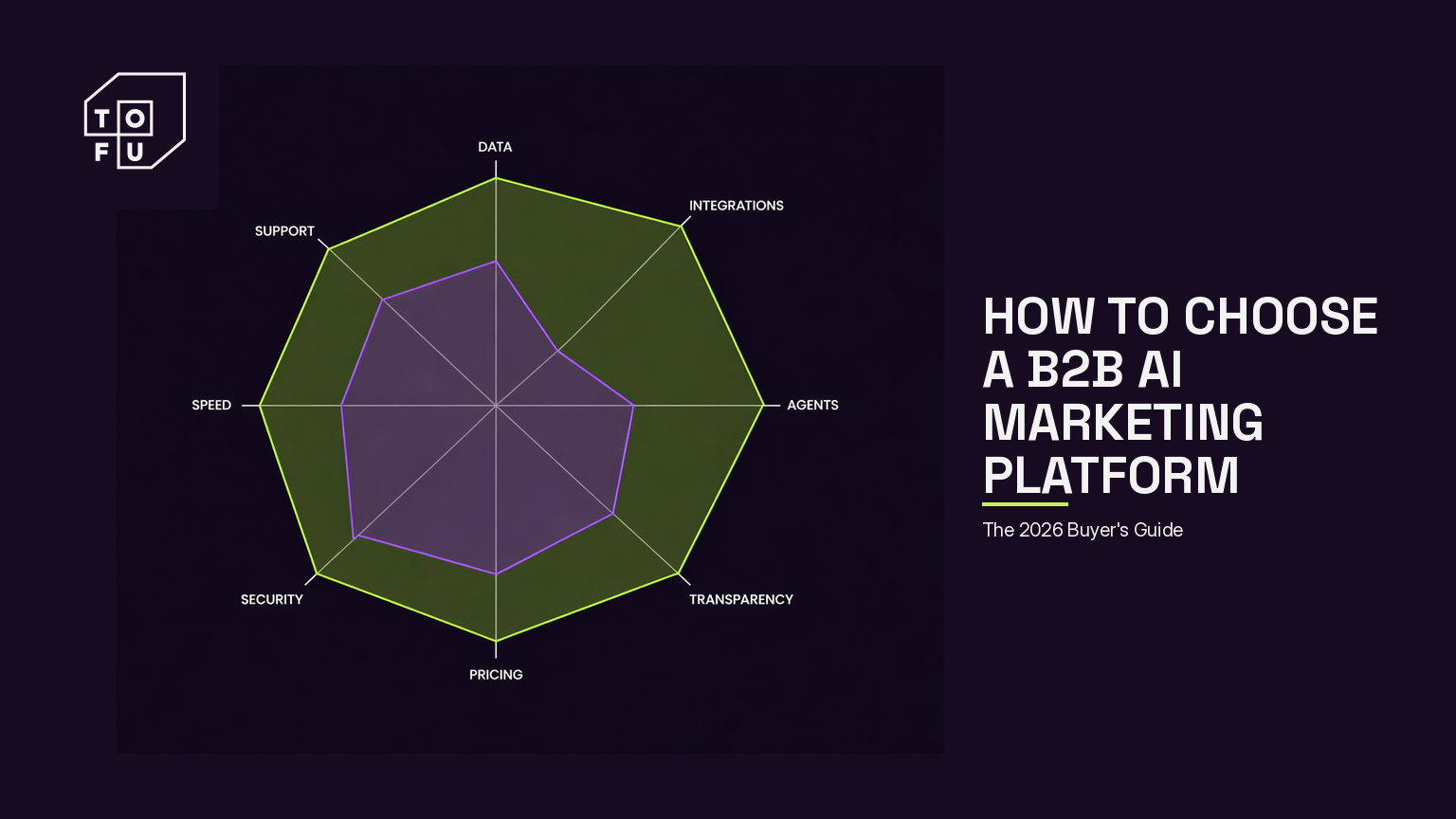
How to Choose a B2B AI Marketing Platform: The 2026 Buyer's Guide
A structured 8-criteria framework for evaluating B2B AI marketing platforms, with a comparison of 8 leading tools.
Best AI Tools for Personalized Outbound at Scale in 2026
Compare 10 AI tools for personalized outbound at scale, from CRM-powered content platforms to cold email and data enrichment solutions.

How to Integrate AI Marketing Personalization into Your Campaigns
A step-by-step guide to integrating AI marketing personalization into B2B campaigns, covering platform evaluation, a 6-step implementation process, tools like Tofu, Dynamic Yield, and Braze, and measurable results from leading teams.
.png)
Hyper Personalization in B2B Marketing: AI Campaigns at Scale
A comprehensive guide to hyper-personalization in B2B marketing, covering the definition, how AI enables 1:1 campaigns at scale, tool evaluation criteria, implementation steps, and real results from teams using platforms like Tofu.
Best Tools for 1:1 ABM Campaigns in 2026
Compare the 9 best AI tools for 1:1 ABM campaigns in 2026, including Tofu, Mutiny, Demandbase, 6sense, Warmly, UserLed, Jasper, Copy.ai, and ChatGPT. Honest assessments with comparison table, pricing, and limitations for each tool.
Personalization at Scale: Top AI Tool Compared for B2B Marketers
A comparison of the top AI tools for B2B personalization at scale, including Tofu, Mutiny, UserLed, Jasper, Copy.ai, and ChatGPT, evaluated on personalization depth, automation, and CRM integrations.
Top AI Tools for Multi-Channel B2B Marketing Campaigns (2026)
A comparison of the top AI tools for multi-channel B2B marketing campaigns in 2026, including Tofu, Mutiny, UserLed, Jasper, Copy.ai, and ChatGPT, evaluated on channel coverage, personalization, and automation.
Want to give tofu A try?
Request a custom demo to see how Tofu can supercharge your GTM efforts.
ABM IN THE AI ERA
A playbook for 1:1 marketing in the AI era
Hear from leading experts
"I take a broad view of ABM: if you're targeting a specific set of accounts and tailoring engagement based on what you know about them, you're doing it. But most teams are stuck in the old loop: Sales hands Marketing a list, Marketing runs ads, and any response is treated as intent."

"ABM has always been just good marketing. It starts with clarity on your ICP and ends with driving revenue. But the way we get from A to B has changed dramatically."
.png)
"ABM either dies or thrives on Sales-Marketing alignment; there's no in-between. When Marketing runs plays on specific accounts or contacts and Sales isn't doing complementary outreach, the whole thing falls short."

"In our research at 6sense, few marketers view ABM as critical to hitting revenue goals this year. But that's not because ABM doesn't work; it's because most teams haven't implemented it well."
"To me, ABM isn't a campaign; it's a go-to-market operating model. It starts with cross-functional planning: mapping revenue targets, territories, and board priorities."

"With AI, we can personalize not just by account, but by segment, by buying group, and even by individual. That level of precision just wasn't possible a few years ago."
%201%20(1).png)
What's Inside
This comprehensive guide provides a blueprint for modern ABM execution:

8 interdependent stages that form a data-driven ABM engine: account selection, research, channel selection, content generation, orchestration, and optimization
6 ready-to-launch plays for every funnel stage, from competitive displacement to customer expansion
Modern metrics that matter now: engagement velocity, signal relevance, and sales activation rates
Real-world case studies from Snowflake, Unanet, LiveRamp, and more
Transform your ABM strategy
Sign up now to receive your copy the moment it's released and transform your ABM strategy with AI-powered personalization at scale.
Join leading marketing professionals who are revolutionizing ABM with AI