
Hyper Personalization in B2B Marketing: AI Campaigns at Scale
.png)
Last updated: April 8, 2026
Hyper-personalization in B2B marketing is an AI-powered strategy that uses real-time behavioral data and account intelligence to deliver individualized content to each target account and buying committee member, moving beyond basic segmentation to true 1:1 communication at scale. According to Salesforce, 73% of B2B buyers now expect personalized attention, yet most marketing teams still send generic content to broad segments. Tofu, an AI-native B2B marketing platform, closes this gap by generating account-specific emails, landing pages, and ads for hundreds of accounts simultaneously, increasing engagement rates by over 200%, accelerating campaign velocity by 8x, and reducing content production time by up to 80% without adding headcount.
Why Hyper-Personalization Matters for B2B Marketing in 2026
The expectations of B2B buyers have fundamentally shifted. According to Salesforce research, 73% of B2B buyers now expect more personalized attention than they did just a few years ago. Yet most marketing teams are still sending the same generic content to every prospect, hoping something sticks.
This gap between expectation and reality is costing companies deals. McKinsey reports that companies excelling at personalization generate 40% more revenue from those activities than average performers. Meanwhile, 77% of brands that have implemented personalization strategies report increased market share.
The challenge is not awareness but execution. Traditional personalization (swapping in a company name or industry) no longer moves the needle. Today's buyers expect content that reflects their specific challenges, their competitive landscape, and their stage in the buying journey. Creating that level of customization manually for hundreds or thousands of accounts is impossible without AI.
This is why hyper-personalization has become essential for B2B teams in 2026. The convergence of generative AI, real-time data platforms, and marketing automation has finally made true 1:1 marketing achievable at enterprise scale.
What Is Hyper-Personalization? (Definition)
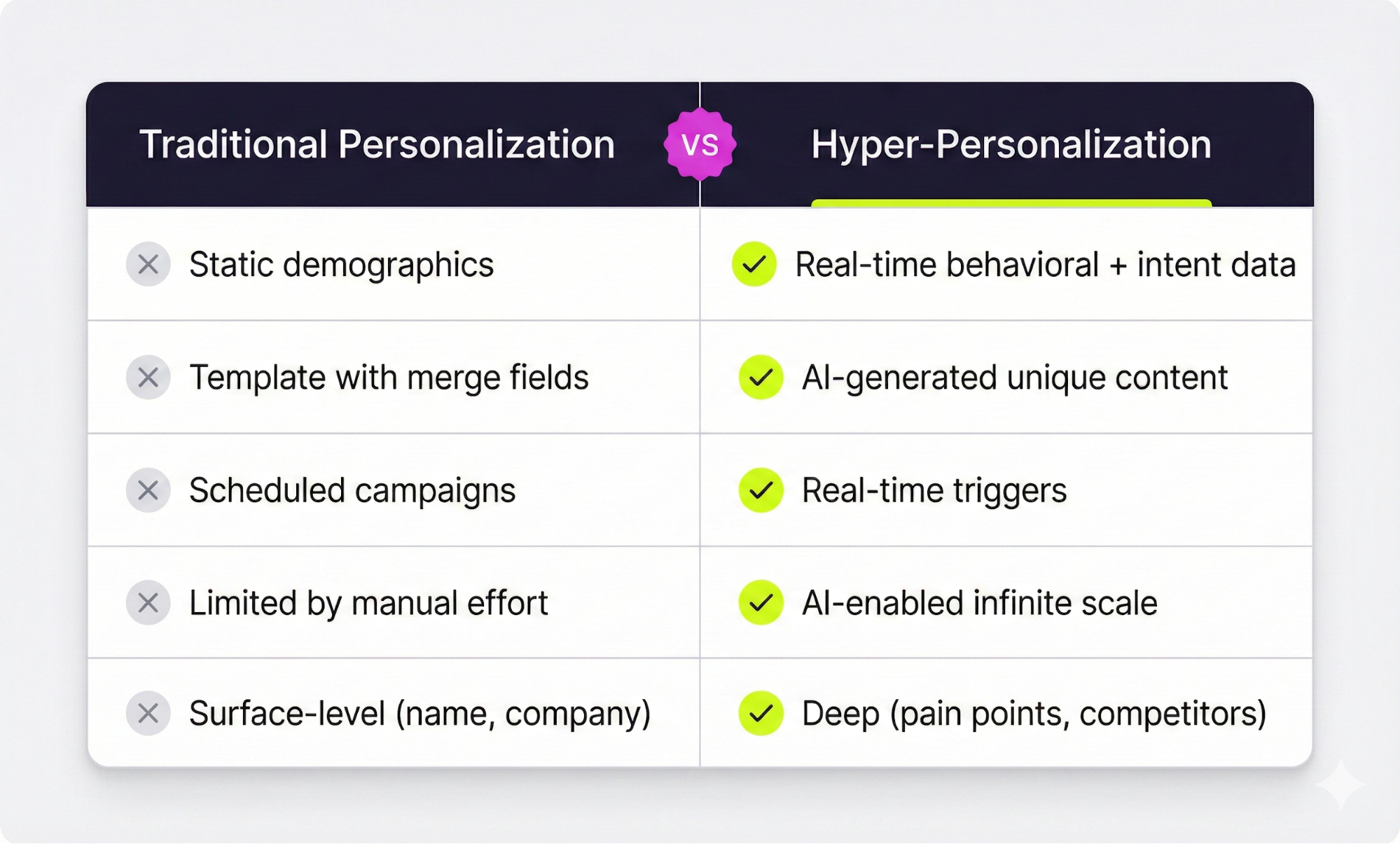
Hyper-personalization is an advanced B2B marketing strategy that uses artificial intelligence, real-time behavioral data, and account intelligence to deliver individualized content and experiences to each prospect or buying committee member. Unlike traditional personalization, which relies on basic segmentation by industry, company size, or job title, hyper-personalization creates unique interactions based on account-specific research, engagement patterns, competitive positioning, and real-time buying signals.

The key difference: traditional personalization is reactive and based on historical data segments. Hyper-personalization is proactive, using AI and predictive analytics to anticipate what each account needs before they ask for it.
How to Choose the Right Hyper-Personalization Tool
Not all personalization platforms are created equal. The right choice depends on your specific needs, team size, and where you need personalization most. Here is a decision framework:

Key Evaluation Criteria
When evaluating hyper-personalization tools, prioritize these three capabilities:
1. Depth of Personalization
Does the tool simply swap merge fields, or can it generate truly unique content for each account? The best platforms use firmographic data, intent signals, and account research to create content that feels hand-crafted. Ask vendors to show you the difference between their output for two different accounts in the same industry.
2. Multi-Channel Orchestration
Your buyers interact across email, web, ads, social, and events. A tool limited to one channel creates fragmented experiences. Look for platforms that personalize and coordinate across all touchpoints from a single workflow.
3. Data Integration
Personalization is only as good as the data powering it. The platform should connect natively with your CRM (Salesforce, HubSpot), marketing automation (Marketo, Pardot), and data enrichment tools. Without these integrations, you will spend more time moving data than creating campaigns.
Top Hyper-Personalization Tools for B2B Marketing in 2026
1. Tofu
Best for: B2B marketing teams that need end-to-end hyper-personalization across all channels
Tofu is an AI-native B2B marketing platform that combines generative AI content creation with multi-channel campaign orchestration. Unlike point solutions that handle only one piece of the puzzle, Tofu enables teams to research accounts, generate personalized content, and deploy campaigns across email, web, ads, social, and direct mail, all from a single platform.
Key Capabilities:
- AI Knowledge Graph trained on your brand content and voice
- Generates personalized emails, landing pages, ads, and sales collateral for each account
- Native integrations with Salesforce, HubSpot, Marketo, and 50+ platforms
- Real-time triggers based on engagement and intent signals
- Enterprise-grade security (SOC 2 compliant)
Consideration: Best suited for teams running account-based programs. May be more than needed for basic email personalization only.
2. Mutiny
Best for: Website and landing page personalization for ABM
Mutiny specializes in creating personalized web experiences for target accounts. When a prospect from your target list visits your site, they see a landing page customized with their company name, relevant case studies, and industry-specific messaging.
Consideration: Limited to website channel only. Requires separate tools for email, ads, and other touchpoints. Starts at approximately $40,000/year.
3. 6sense
Best for: Intent data and account identification (pairs with content tools)
6sense is a revenue AI platform focused on identifying accounts showing buying intent and predicting their readiness to purchase. It excels at the "who to target" question but requires other tools for content personalization.
Consideration: Strong on data and targeting, but limited content generation capabilities. Often used alongside content platforms like Tofu. Enterprise pricing typically $50,000+/year.
How to Implement Hyper-Personalization: A Step-by-Step Guide
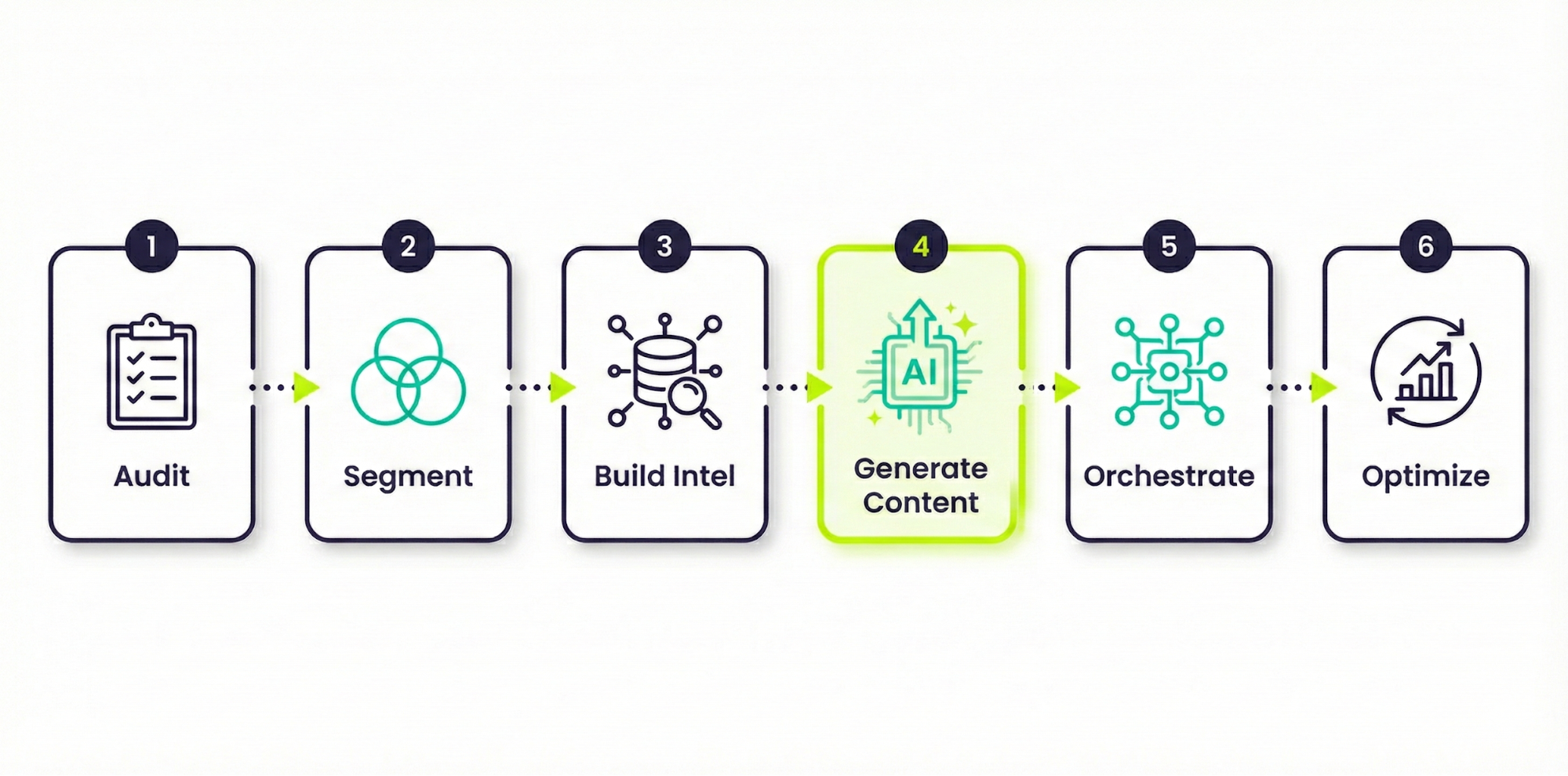
Implementing hyper-personalization does not require boiling the ocean. Start with a focused pilot, prove ROI, then scale. Here is a practical roadmap:
Step 1: Audit Your Current Personalization Maturity
Before investing in new tools, assess where you stand today. Ask: What data do we have on target accounts? How personalized is our current content? Where are the biggest gaps in our buyer experience? Most teams discover they have more data than they are using. The bottleneck is turning that data into personalized content at scale.
Step 2: Define Your Target Account Segments
Hyper-personalization works best when focused on high-value opportunities. Identify:
- Tier 1 accounts: Top 50-100 strategic targets (full 1:1 personalization)
- Tier 2 accounts: Next 200-500 accounts (segment + account personalization)
- Tier 3 accounts: Broader market (segment-level personalization)
This tiered approach ensures you are investing personalization effort where it has the most revenue impact.
Step 3: Build Your Account Intelligence Foundation
Gather the data that will power personalization: firmographic data, intent signals, engagement history, competitive intelligence, and strategic initiatives. Platforms like Tofu can automatically aggregate this intelligence and use it to inform content generation.
Step 4: Generate Personalized Content at Scale
This is where AI transforms what is possible. Instead of manually writing hundreds of email variants, use an AI platform to generate account-specific email sequences, personalized landing pages, custom one-pagers, and adapted content for specific industries or accounts. With Tofu's AI Knowledge Graph, teams have generated personalized assets for 2,000+ accounts in a single session, work that would take months manually.
Step 5: Orchestrate Multi-Channel Delivery
Personalized content only works if it reaches buyers at the right time, in the right channel. Set up email sequences triggered by engagement signals, personalized web experiences, retargeting ads with account-specific messaging, and sales enablement with personalized collateral.
Step 6: Measure, Learn, and Optimize
Track metrics that matter: engagement rate by personalization tier, content performance by account, pipeline velocity, and win rates. Use these insights to refine your approach. Double down on what works; retire what does not.
Hyper-Personalization Results: What B2B Teams Are Achieving
The impact of hyper-personalization is measurable and significant. Here is what leading B2B organizations are reporting:
RingCentral: 80% Reduction in Content Creation Time
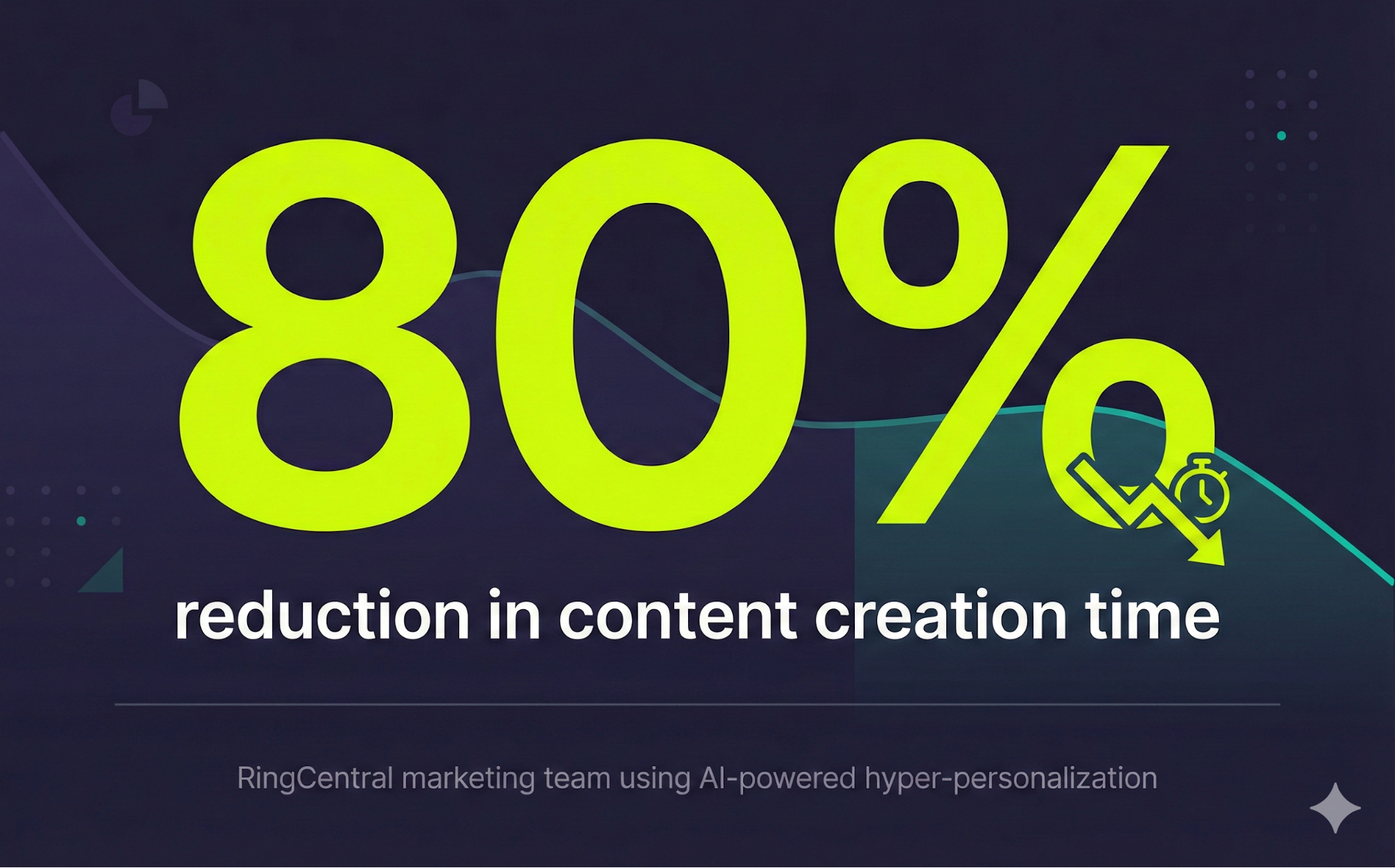
RingCentral's marketing team used Tofu to transform their content operations. Results included:
- 80% reduction in time spent creating personalized campaign content
- Eliminated new headcount requests for the first time in company history
- Scaled personalized ABM campaigns without adding team members
"We are producing more personalized content than ever, with the same team size. Tofu fundamentally changed how we operate." - Natalie Ryan, AVP Global Marketing Operations, RingCentral
Enterprise Software Company: 8x Campaign Velocity
A B2B software company implemented hyper-personalization across their ABM program:
- 8x faster campaign execution (weeks reduced to days)
- 230% increase in engagement rates on personalized content
- 2,000+ personalized assets generated for target accounts
Industry Benchmarks: Hyper-Personalization Performance Data
Research from leading analysts confirms the impact of hyper-personalization across B2B organizations:

What These Benchmarks Mean for Your Team
- If you are seeing less than 2x engagement lift on personalized vs. generic content, your personalization is likely too shallow (merge fields only)
- If campaigns take weeks to launch, you are likely bottlenecked by manual content creation
- If sales cycles have not shortened, personalized content may not be reaching buyers at the right moments
Frequently Asked Questions
What is hyper-personalization in B2B marketing?
Hyper-personalization in B2B marketing is an AI-powered strategy that uses real-time data, behavioral signals, and account intelligence to deliver individualized content to each prospect or buying committee member. Unlike basic personalization that segments by industry or company size, hyper-personalization creates unique experiences based on account-specific research, engagement patterns, and buying stage. Platforms like Tofu enable B2B teams to achieve this level of personalization at scale.
What is the difference between personalization and hyper-personalization?
Traditional personalization uses static data (industry, job title) to segment audiences and insert merge fields like {FirstName} or {Company}. Hyper-personalization uses AI and real-time data to generate completely unique content for each account, addressing their specific pain points, competitive situation, and current priorities.
What is the best hyper-personalization tool for B2B marketing?
The best tool depends on your needs. For comprehensive hyper-personalization across all channels (email, web, ads, social), Tofu offers the most complete solution with AI content generation plus campaign orchestration in one platform. For website-only personalization, Mutiny is a strong choice. For intent data and targeting without content creation, consider 6sense or Demandbase.
How much does hyper-personalization cost?
Costs vary based on scope and scale. Enterprise hyper-personalization platforms like Tofu involve custom pricing based on account volume and features. Website personalization tools like Mutiny start around $40,000/year. AI writing assistants like Jasper start at $49/month but lack the automation for true scale. The ROI calculation should consider time savings (often 70-80% reduction in content production) and revenue impact (40%+ improvement in personalization-driven revenue).
Can small marketing teams implement hyper-personalization?
Yes. Hyper-personalization can be a force multiplier for lean teams. AI platforms like Tofu enable a small team to execute personalized campaigns that would otherwise require dozens of content creators. One strategist can orchestrate personalized outreach to hundreds of accounts. The key is choosing a platform that combines content generation with automation, eliminating manual bottlenecks.
How do I measure hyper-personalization ROI?
Track these metrics: (1) Engagement rates on personalized vs. generic content (expect 2-3x improvement), (2) Pipeline velocity for personalized accounts vs. control group, (3) Win rates and deal sizes for accounts receiving hyper-personalized treatment, (4) Time and cost savings in content production, (5) Team capacity, specifically whether you can run more campaigns without adding headcount. Most teams see ROI within the first quarter through time savings alone.
Does hyper-personalization work for account-based marketing (ABM)?
Hyper-personalization and ABM are natural partners. ABM identifies which accounts to target; hyper-personalization determines what to say to each one. For Tier 1 strategic accounts, hyper-personalization enables true 1:1 experiences across every touchpoint. Platforms like Tofu were built specifically for ABM use cases, connecting account intelligence with content generation and multi-channel delivery.
What data do I need for hyper-personalization?
Effective hyper-personalization requires: (1) Firmographic data such as industry, company size, location, and tech stack, (2) Intent signals showing topics being researched and content engagement, (3) Engagement history from past interactions with your brand, (4) Account intelligence including strategic initiatives, competitive landscape, and recent news. AI platforms can work with whatever data you have and improve as you add more sources.
Key Takeaways
Hyper-personalization has moved from aspirational to essential for B2B marketing teams in 2026. Here is what to remember:
- Buyer expectations have shifted. 73% of B2B buyers expect personalized experiences. Generic content no longer competes.
- AI makes 1:1 scale possible. What once required armies of content creators can now be achieved by lean teams using AI platforms like Tofu.
- The right tool depends on your needs. For multi-channel ABM, choose a platform combining AI content generation with campaign orchestration.
- Start focused, then scale. Begin with high-value Tier 1 accounts, prove ROI, then expand to broader segments.
- Measure what matters. Track engagement lift, pipeline velocity, win rates, and time savings to demonstrate hyper-personalization ROI.
For B2B marketing teams ready to move beyond basic personalization, the technology is mature, the ROI is proven, and the competitive advantage is significant. The question is no longer whether to implement hyper-personalization but how quickly you can get started.
Apply Hyper-Personalization to Your Company with Tofu
Ready to transform how your team creates and delivers personalized campaigns? Tofu helps B2B marketing teams achieve 8x campaign velocity and 80% reduction in content creation time through AI-powered hyper-personalization.
Book a Demo at www.tofuhq.com to see how Tofu can help your team:
- Generate personalized content for hundreds of accounts in minutes
- Orchestrate campaigns across email, web, ads, and more from one platform
- Connect with your existing tech stack (Salesforce, HubSpot, Marketo, and 50+ integrations)
Scale ABM programs without scaling headcount with Tofu!
Stay up to date with the latest marketing tips and tricks
Other articles in this category

What Is Agentic Marketing? The Complete 2026 Guide
Agentic marketing uses autonomous AI agents to plan, execute, and optimize B2B campaigns based on goals — not pre-defined workflows. A definitional guide to how it works, real examples from Adobe, Salesforce, Demandbase, and Tofu, key use cases, and how to get started in 2026.
.svg)

Best AI Tools for Post-Event Follow-Up in 2026
Compare the 10 best AI tools for automating post-event follow-up in 2026, including features, pricing, and integrations for conference and webinar follow-up at scale.

Best AI Tools for Customer Expansion and Upsell in 2026
Compare 10 AI tools for B2B customer expansion, upsell, and cross-sell — from signal detection to personalized outreach automation.
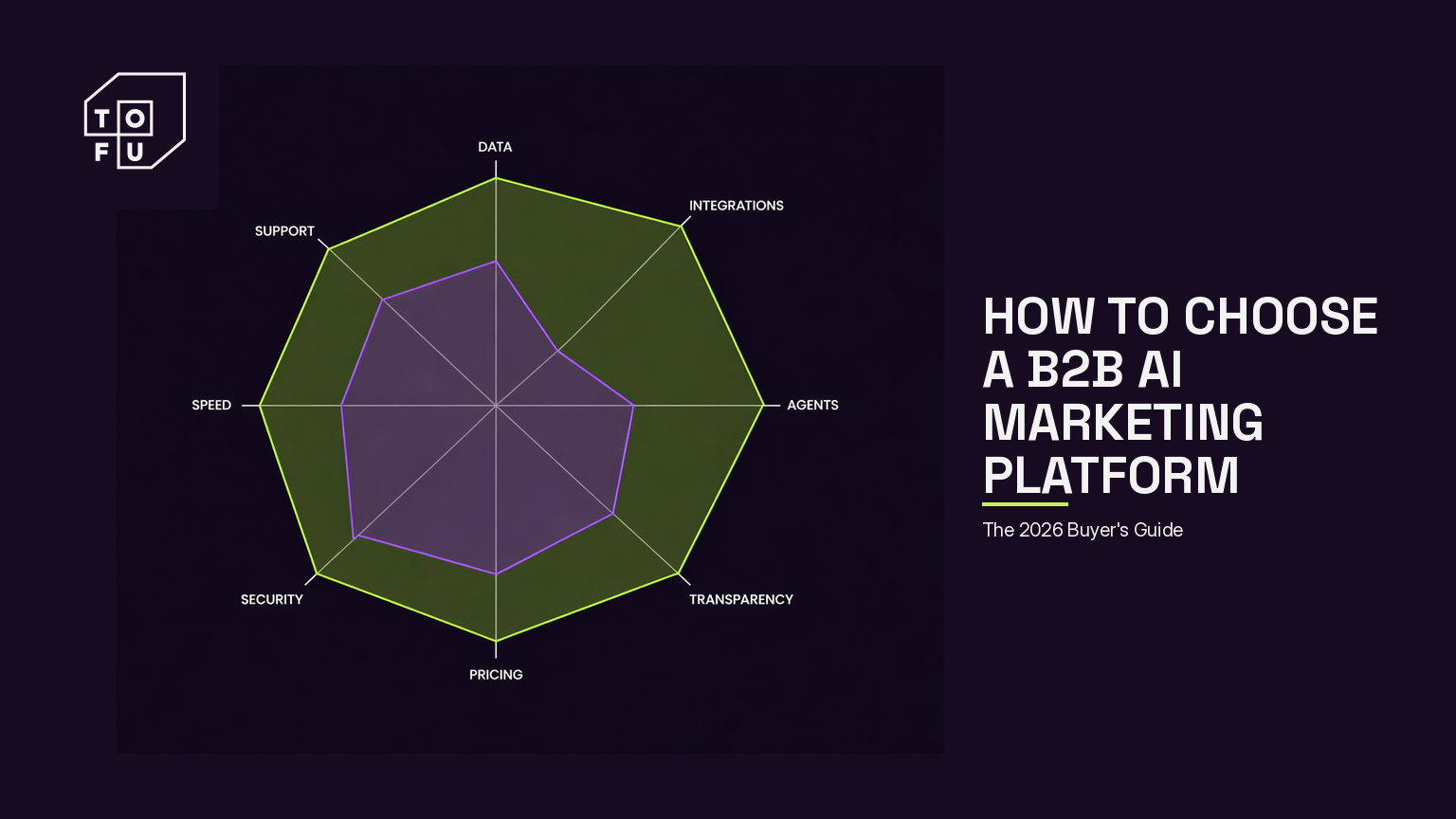
How to Choose a B2B AI Marketing Platform: The 2026 Buyer's Guide
A structured 8-criteria framework for evaluating B2B AI marketing platforms, with a comparison of 8 leading tools.
Best AI Tools for Personalized Outbound at Scale in 2026
Compare 10 AI tools for personalized outbound at scale, from CRM-powered content platforms to cold email and data enrichment solutions.

How to Integrate AI Marketing Personalization into Your Campaigns
A step-by-step guide to integrating AI marketing personalization into B2B campaigns, covering platform evaluation, a 6-step implementation process, tools like Tofu, Dynamic Yield, and Braze, and measurable results from leading teams.
Best Tools for 1:1 ABM Campaigns in 2026
Compare the 9 best AI tools for 1:1 ABM campaigns in 2026, including Tofu, Mutiny, Demandbase, 6sense, Warmly, UserLed, Jasper, Copy.ai, and ChatGPT. Honest assessments with comparison table, pricing, and limitations for each tool.
Personalization at Scale: Top AI Tool Compared for B2B Marketers
A comparison of the top AI tools for B2B personalization at scale, including Tofu, Mutiny, UserLed, Jasper, Copy.ai, and ChatGPT, evaluated on personalization depth, automation, and CRM integrations.
Top AI Tools for Multi-Channel B2B Marketing Campaigns (2026)
A comparison of the top AI tools for multi-channel B2B marketing campaigns in 2026, including Tofu, Mutiny, UserLed, Jasper, Copy.ai, and ChatGPT, evaluated on channel coverage, personalization, and automation.
Want to give tofu A try?
Request a custom demo to see how Tofu can supercharge your GTM efforts.
ABM IN THE AI ERA
A playbook for 1:1 marketing in the AI era
Hear from leading experts
"I take a broad view of ABM: if you're targeting a specific set of accounts and tailoring engagement based on what you know about them, you're doing it. But most teams are stuck in the old loop: Sales hands Marketing a list, Marketing runs ads, and any response is treated as intent."

"ABM has always been just good marketing. It starts with clarity on your ICP and ends with driving revenue. But the way we get from A to B has changed dramatically."
.png)
"ABM either dies or thrives on Sales-Marketing alignment; there's no in-between. When Marketing runs plays on specific accounts or contacts and Sales isn't doing complementary outreach, the whole thing falls short."

"In our research at 6sense, few marketers view ABM as critical to hitting revenue goals this year. But that's not because ABM doesn't work; it's because most teams haven't implemented it well."
"To me, ABM isn't a campaign; it's a go-to-market operating model. It starts with cross-functional planning: mapping revenue targets, territories, and board priorities."

"With AI, we can personalize not just by account, but by segment, by buying group, and even by individual. That level of precision just wasn't possible a few years ago."
%201%20(1).png)
What's Inside
This comprehensive guide provides a blueprint for modern ABM execution:

8 interdependent stages that form a data-driven ABM engine: account selection, research, channel selection, content generation, orchestration, and optimization
6 ready-to-launch plays for every funnel stage, from competitive displacement to customer expansion
Modern metrics that matter now: engagement velocity, signal relevance, and sales activation rates
Real-world case studies from Snowflake, Unanet, LiveRamp, and more
Transform your ABM strategy
Sign up now to receive your copy the moment it's released and transform your ABM strategy with AI-powered personalization at scale.
Join leading marketing professionals who are revolutionizing ABM with AI