
How to Warm Priority Accounts Before Sales Reaches Out (2026)
Last updated: May 26, 2026
Account warming is the practice of running coordinated, multi-channel campaigns that build a priority account's familiarity with your brand before a sales rep makes first contact. Instead of sending reps into cold conversations, marketing primes the account — across ads, email, and content — so the buying group already recognizes your company when the rep reaches out.
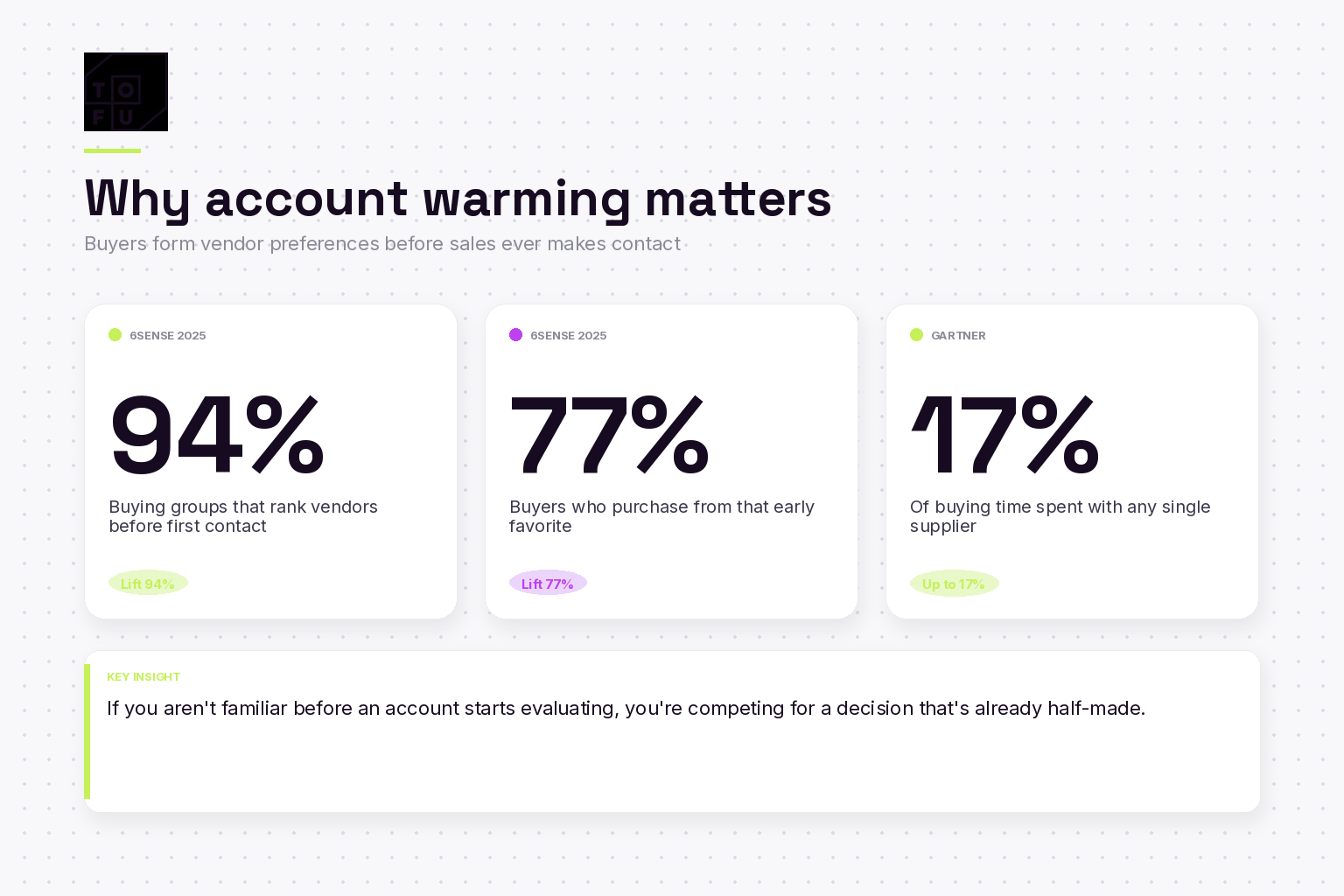
This matters more than most teams assume. According to the 6sense 2025 Buyer Experience Report, 94% of B2B buying groups had already ranked their preferred vendors before the first contact with sales — and they purchased from that early favorite 77% of the time. According to Forrester (2025), 92% of B2B buyers begin their process with at least one vendor already in mind. If you aren't familiar before an account starts evaluating, you're fighting for a decision that's already half-made.
This guide covers what it means to warm an account, a four-step process to do it, how to align warming with sales outbound timing, the tools that help (including which ones alert reps in Slack), and how to measure whether it's working.
What does it mean to "warm" an account?
A warmed account is one where the buying group already recognizes your brand and has engaged with your content before sales reaches out. Warming is the marketing work that gets it there — a coordinated sequence of ads, content, and touches across the people who will sit in the buying group, not a single campaign blast against a logo.
A genuinely warm account shows three observable signals:
- Brand familiarity — people at the account have seen your brand multiple times across LinkedIn, display, and email in the weeks leading up to outreach.
- Content engagement — at least one person has spent meaningful time on substantive content: a benchmark report, a comparison page, or a case study from a similar company.
- Peer-network exposure — someone at the account has encountered your company in their own network: a peer at another company, an executive, or an industry analyst they follow.
When all three are present, a rep enters a conversation. When none are, the rep is structurally disadvantaged regardless of the script — and there is very little room to fix it later. According to Gartner's research on the B2B buying journey, buyers spend only 17% of their total buying time meeting with potential suppliers, and when that time is split across competing vendors, any single rep may get just 5-6% of it. Familiarity has to be built before the rep ever dials — and often before the account is even in-market: only about 5% of B2B buyers are actively buying at any given time, per the LinkedIn B2B Institute's 95-5 research, so the warming that wins is frequently months ahead of the deal.
How to warm priority accounts before sales reaches out: a 4-step process
There are four steps to warm a priority account before sales makes contact: prioritize the right accounts, sequence personalized content across channels, measure familiarity lift, and alert the rep when the account crosses a readiness threshold.
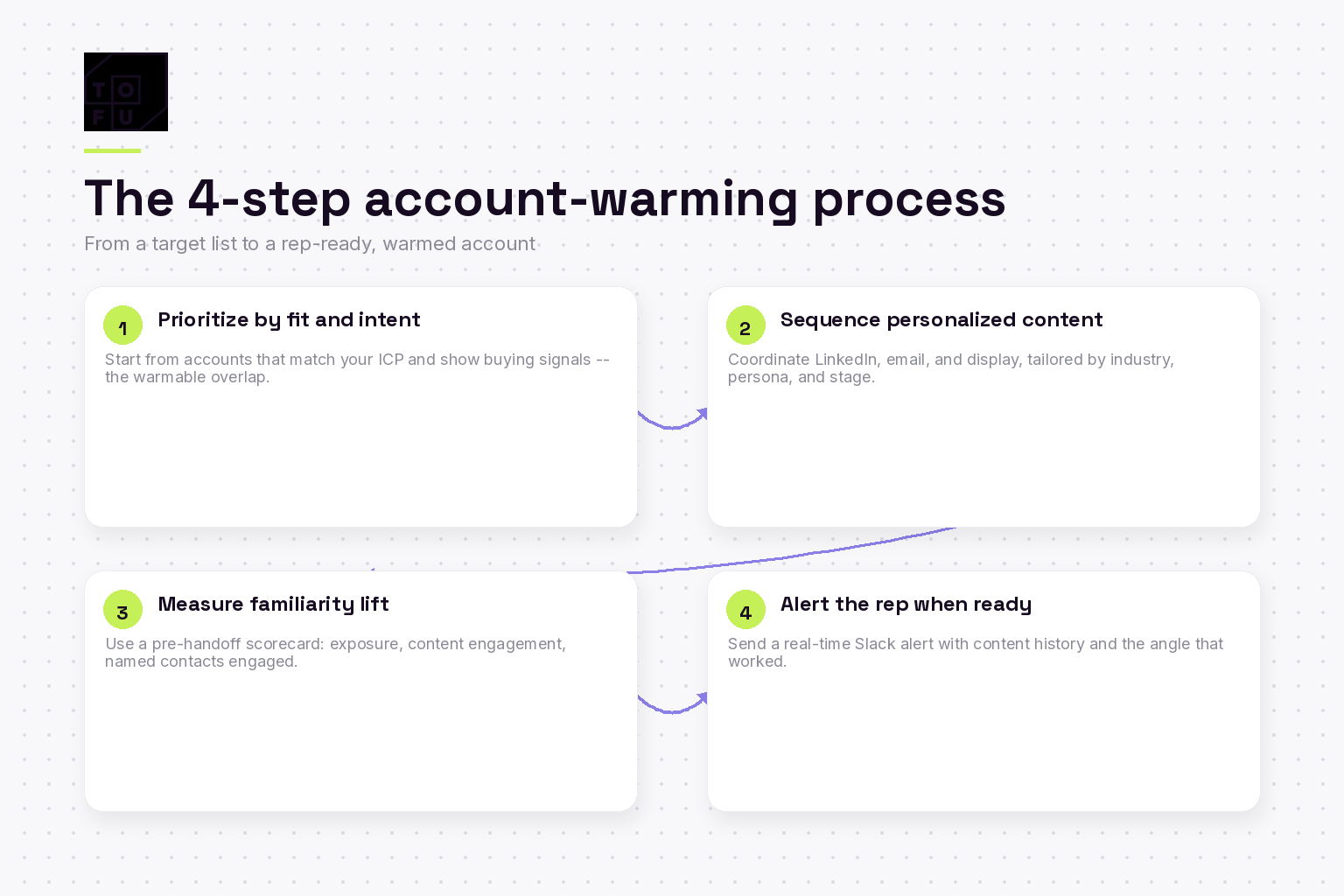
- Prioritize accounts by fit and intent. Start from the overlap of accounts that match your ICP and show observable buying signals. Fit alone produces a list too large to warm well; intent alone is reactive to whatever your signal vendor happens to detect. The overlap is your warmable list — for most B2B teams, a few hundred accounts at any given time.
- Sequence personalized content across the channels the account actually uses. For most priority accounts that means three: LinkedIn (paid plus organic from named executives), email (a handful of touches over a few weeks, each tied to a content asset), and display retargeting. Tailor each touch to the account's industry, persona, and stage — not a generic ad with the company name swapped in.
- Measure familiarity lift before handoff. Marketing's deliverable is not "the account exists in the CRM." It's a measurable change in familiarity. Use a pre-handoff scorecard: weeks of exposure, depth of content engagement, number of named contacts engaged, and peer-network reach. If an account hasn't crossed the threshold on at least two of those, it isn't ready.
- Alert the rep when the account is ready. Not a weekly digest — a real-time alert, ideally in Slack, that tells the rep an account has crossed the warm threshold, which contacts engaged, the account's content history, and the angle that worked on similar accounts. The rep reaches out while the familiarity is fresh.
How to align marketing warming with sales outbound timing
The most common reason account warming fails is timing: marketing's sequence peaks weeks before — or after — the rep makes contact, so the familiarity has decayed or never built. To align them, build a shared cadence calendar between marketing and sales rather than running each motion in isolation.
In practice, that means two commitments. Reps agree to make first contact within 7-14 days of an account being flagged as warm, while the familiarity is still high. Marketing agrees to keep the warming sequence running until that contact window closes, then revises the calendar with sales weekly. The fix is operational, not creative — a creative brief won't solve a timing problem.
This is also where the modern buying journey makes warming urgent. The 6sense 2025 report found the point of first contact has shifted to roughly 61% of the way through the buyer's journey, meaning buyers form preferences across the majority of their evaluation before sales is even in the room. Warming is how you earn a place in that preference set early.
Tools that warm accounts and alert reps when they're ready
No single tool warms an account end to end — the stack usually combines an intent/signal source, an execution layer that runs the personalized campaigns, and an alerting mechanism that tells reps when to act. The recommended tools below map to those three roles in the warming stack.
Disclosure: Tofu is our product. We've included it alongside other tools for transparency, and described each honestly — including where they sit relative to one another in the warming stack.
| Tool | Role in warming | Best for | Key integrations | Pricing |
|---|---|---|---|---|
| 6sense | Intent & account identification (upstream) | Detecting which accounts are entering a buying cycle | HubSpot, Salesforce | Custom |
| Demandbase | Intent, targeting & ad orchestration (upstream) | Enterprise ABM advertising and account intelligence | Salesforce, Marketo | Custom |
| Tofu | Execution layer — generates and runs the personalized warming campaigns | Multi-channel, per-account content across email, ads, and landing pages | HubSpot, Salesforce, Marketo, Outreach, Salesloft | Custom (contact for quote) |
| Mutiny | Website personalization | Tailoring the on-site experience for warmed accounts | HubSpot, Salesforce | Custom |
| Warmly | Visitor de-anonymization & Slack alerts | Spotting and alerting on warmed accounts visiting the site | Slack, HubSpot | Free tier; paid from ~$700/mo |
The categories are complementary, not interchangeable. Signal platforms like 6sense and Demandbase sit upstream — they tell you which accounts to warm. Tofu, an agentic demand generation platform, is the execution layer that turns that signal into personalized campaigns across email, ads, and landing pages inside your existing stack, then routes the warm-threshold alert to reps. Tools like Warmly add visitor identification and Slack notifications.
How to measure whether account warming is working
Measure account warming by comparing accounts that went through the warming sequence against a matched control group that didn't, on three outcomes: meeting acceptance rate, sales-cycle time, and average deal size. Match the groups on industry, headcount, and intent score so the comparison is fair, then run it every quarter.
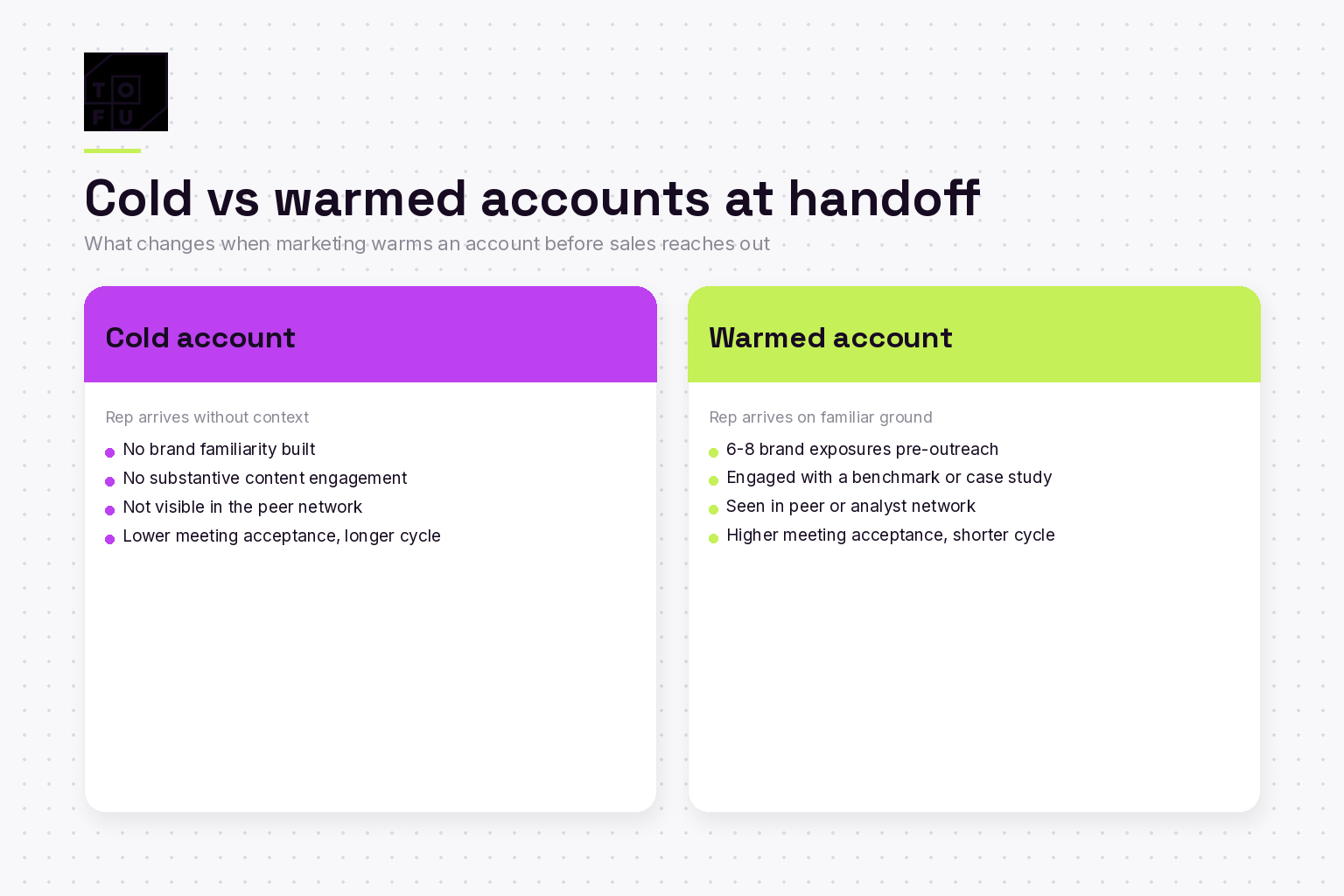
Alongside the outcome comparison, track leading indicators from the pre-handoff scorecard — weeks of exposure, content engagement depth, and named contacts engaged — so you can see warming working before deals close. This is also what lets marketing prove its contribution: instead of claiming influence, you show that warmed accounts accept meetings and close at a measurably higher rate than cold ones. For teams extending this into open opportunities, the same logic applies to sales acceleration further down the funnel.
Common account-warming mistakes to avoid
Three mistakes account for most account-warming programs that stall:
- Treating warming as a one-off campaign. A single ad burst is exposure, not warming. Familiarity comes from a coordinated sequence across channels over several weeks, not one send.
- No timing alignment with sales. If reps reach out before the sequence has built familiarity, or weeks after it peaked, the warming is wasted. The cadence calendar is what prevents this.
- Handing over every account instead of only the ready ones. Without a readiness threshold, reps get a list of accounts that aren't actually warm — and stop trusting the signal. Only hand over accounts that cleared the scorecard.
A fourth, quieter mistake is generic content. Warming campaigns built from name-swapped templates don't build real familiarity; the personalization has to reflect the account's industry, persona, and stage. Scaling that kind of 1:1 personalization across hundreds of accounts is exactly the bottleneck an execution layer is meant to remove.
Frequently Asked Questions
What is account warming in B2B marketing?
Account warming is the practice of building a priority account's familiarity with your brand — through coordinated ads, content, and touches — before a sales rep makes first contact. The goal is for the buying group to already recognize and trust your company by the time outreach begins, rather than starting cold.
How do you warm an account before sales outreach?
Warm an account in four steps: prioritize accounts that match your ICP and show intent, sequence personalized content across LinkedIn, email, and display, measure the lift in familiarity against a pre-handoff scorecard, and alert the rep when the account crosses a readiness threshold. The sequence should run over several weeks, not as a single campaign.
How long does it take to warm a target account?
Most warming sequences run 4-8 weeks before handoff, long enough for an account to accumulate repeated brand exposure and meaningful content engagement. The exact window depends on deal size and how cold the account starts — enterprise accounts with large buying groups typically take longer than mid-market ones.
What's the difference between account warming and lead nurturing?
Lead nurturing engages known leads who have already raised their hand, usually one contact at a time, to move them toward a conversion. Account warming targets a whole priority account — including people who haven't engaged yet — to build familiarity across the buying group before sales reaches out. Nurturing is reactive to inbound interest; warming is proactive against a target list.
What tools alert sales reps when an account is warm?
Tools like Warmly send Slack alerts when a tracked account visits your site, and execution platforms like Tofu can route a warm-threshold alert — with the account's content history and a recommended angle — to reps in Slack. Pairing a signal source (6sense, Demandbase) with an alerting layer gives reps real-time notice when an account is ready.
Can a small marketing team run account warming?
Yes, though small teams usually need an execution layer to do it at scale, because manually building personalized sequences for hundreds of accounts isn't feasible for one or two marketers. Platforms like Tofu generate and run the per-account campaigns so a lean team can warm many accounts without adding headcount. Very small target lists can be warmed manually.
How do you measure if account warming is working?
Compare warmed accounts to a matched control group that didn't go through the sequence, on meeting acceptance rate, sales-cycle time, and average deal size. Track leading indicators — exposure, content engagement, and contacts engaged — from a pre-handoff scorecard so you can see warming working before deals close.
The bottom line
Buyers decide who they prefer before they ever talk to sales — 94% of buying groups rank their favorites before first contact, per 6sense. Account warming is how you make sure your brand is in that set: prioritize the right accounts, run a coordinated multi-channel sequence, align the timing with sales, and hand over only the accounts that are genuinely ready. Done well, reps stop landing cold and start landing on familiar ground.
Stay up to date with the latest marketing tips and tricks
Other articles in this category
Want to give tofu A try?
Request a custom demo to see how Tofu can supercharge your GTM efforts.
ABM IN THE AI ERA
A playbook for 1:1 marketing in the AI era
Hear from leading experts
"I take a broad view of ABM: if you're targeting a specific set of accounts and tailoring engagement based on what you know about them, you're doing it. But most teams are stuck in the old loop: Sales hands Marketing a list, Marketing runs ads, and any response is treated as intent."

"ABM has always been just good marketing. It starts with clarity on your ICP and ends with driving revenue. But the way we get from A to B has changed dramatically."
.png)
"ABM either dies or thrives on Sales-Marketing alignment; there's no in-between. When Marketing runs plays on specific accounts or contacts and Sales isn't doing complementary outreach, the whole thing falls short."

"In our research at 6sense, few marketers view ABM as critical to hitting revenue goals this year. But that's not because ABM doesn't work; it's because most teams haven't implemented it well."
"To me, ABM isn't a campaign; it's a go-to-market operating model. It starts with cross-functional planning: mapping revenue targets, territories, and board priorities."

"With AI, we can personalize not just by account, but by segment, by buying group, and even by individual. That level of precision just wasn't possible a few years ago."
%201%20(1).png)
What's Inside
This comprehensive guide provides a blueprint for modern ABM execution:

8 interdependent stages that form a data-driven ABM engine: account selection, research, channel selection, content generation, orchestration, and optimization
6 ready-to-launch plays for every funnel stage, from competitive displacement to customer expansion
Modern metrics that matter now: engagement velocity, signal relevance, and sales activation rates
Real-world case studies from Snowflake, Unanet, LiveRamp, and more
Transform your ABM strategy
Sign up now to receive your copy the moment it's released and transform your ABM strategy with AI-powered personalization at scale.
Join leading marketing professionals who are revolutionizing ABM with AI