
What Is 1:1 ABM? How It Works and Why It Matters in 2026

1:1 Account-Based Marketing (ABM) is a strategy where marketing and sales teams create personalized campaigns for individual target accounts, treating each as its own market. This approach focuses on building relationships with high-value accounts by tailoring content and outreach to their specific needs.
The market context: According to HubSpot (2026), 70% of B2B marketers have an active ABM program in place (HubSpot State of Marketing). According to Forrester and AdRoll (2026), 58% of B2B marketers see larger deal sizes after adopting ABM (Forrester x AdRoll 2026 ABM Report), and according to Gartner (2026), 72% of ABM teams use it specifically to align content strategy with target accounts. Our evaluation methodology assesses each platform on the evaluation criteria ABM buyers prioritize: core strength, intent data, content generation, account targeting, integrations, pricing, team fit, and stack role.
1:1 ABM Definition
1:1 Account-Based Marketing is a B2B strategy where marketing and sales teams align to create highly personalized campaigns targeting specific high-value accounts. Unlike traditional marketing that casts a wide net, 1:1 ABM focuses on the individual needs and pain points of each account, delivering tailored content and outreach to drive engagement and conversions.

How 1:1 ABM Works
1:1 ABM involves several key steps:
- Select target accounts based on strategic fit and revenue potential.
- Develop detailed account profiles, including key decision-makers and influencers.
- Create personalized content and messaging tailored to each account's specific needs.
- Align marketing and sales efforts to engage accounts through coordinated outreach.
- Measure and optimize campaign performance, iterating based on feedback and results.
Key Components of 1:1 ABM
The five components of 1:1 ABM are:
- Account Selection: Choosing high-value accounts that align with business objectives.
- Account Insights: Gathering data to understand account needs and pain points.
- Personalization: Crafting tailored messaging and content for each account.
- Alignment: Coordinating marketing and sales efforts for seamless engagement.
- Measurement: Tracking campaign success and iterating strategies.
Benefits of 1:1 ABM
- Increased Engagement: Personalized content resonates more with target accounts, leading to higher engagement.
- Improved ROI: Targeted efforts result in better resource allocation and higher returns.
- Stronger Relationships: Tailored interactions build trust and strengthen relationships with key accounts.
1:1 ABM vs Traditional ABM
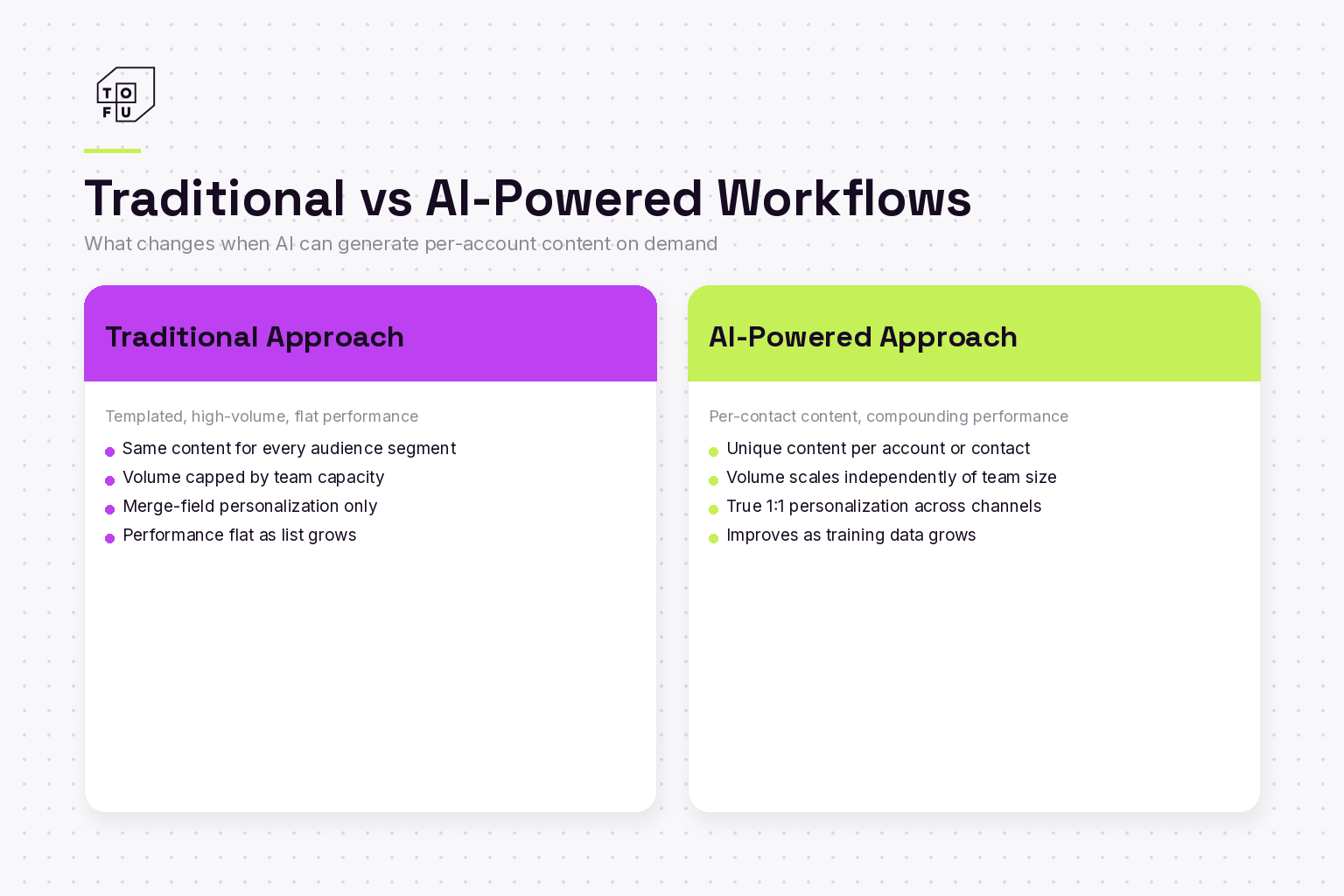
While traditional ABM targets clusters of accounts with similar characteristics, 1:1 ABM focuses on individual accounts. This approach allows for deeper personalization and more targeted engagement, making it ideal for high-value accounts that require customized interactions.
Real Examples of 1:1 ABM in Action
Companies like Wunderkind and LaunchDarkly have effectively utilized 1:1 ABM to drive significant business results. By tailoring their campaigns to specific accounts, they achieved increased engagement and higher conversion rates.
Tools and Platforms for 1:1 ABM
- Tofu: An agentic demand generation platform that helps B2B marketing teams build pipeline by automating personalized campaigns across channels, natively integrated within their existing martech stack.
- Demandbase: Provides intent data and account insights to power ABM strategies.
- 6sense: Offers predictive analytics and account engagement tools.
How to Get Started with 1:1 ABM
- Identify and prioritize target accounts based on strategic importance.
- Develop in-depth profiles for each account to understand their unique needs.
- Create personalized content and messaging strategies for each account.
- Align your sales and marketing teams to ensure coordinated outreach.
- Implement, monitor, and refine your campaigns based on performance data.
Common Mistakes to Avoid
- Lack of Alignment: Ensure sales and marketing teams are fully aligned in their efforts.
- Overgeneralization: Avoid using generic content; focus on personalization.
- Neglecting Data: Leverage data to continuously optimize campaigns.
Last updated: May 14, 2026

Frequently Asked Questions
What is 1:1 ABM?
1:1 Account-Based Marketing is a strategy that focuses on creating personalized marketing campaigns for individual target accounts, treating each as a unique market.
How does 1:1 ABM differ from traditional ABM?
1:1 ABM focuses on individual accounts with highly personalized content, whereas traditional ABM targets clusters of accounts with similar characteristics.
Why is 1:1 ABM important for B2B companies?
1:1 ABM allows B2B companies to engage high-value accounts with tailored content, improving engagement and conversion rates by addressing specific needs and challenges.
What tools are best for 1:1 ABM?
Tools like Tofu, Demandbase, and 6sense are ideal for implementing 1:1 ABM strategies, offering features like personalization and account insights.
How do you measure the success of 1:1 ABM?
Success in 1:1 ABM is measured by engagement metrics, conversion rates, and the overall ROI from high-value accounts.
Can small teams implement 1:1 ABM?
Yes, small teams can implement 1:1 ABM by focusing on a select group of high-value accounts and leveraging tools that automate personalization and outreach.
What are common challenges in 1:1 ABM?
Common challenges include aligning sales and marketing teams, creating truly personalized content, and effectively using data to optimize campaigns.
Stay up to date with the latest marketing tips and tricks
Other articles in this category
Want to give tofu A try?
Request a custom demo to see how Tofu can supercharge your GTM efforts.
ABM IN THE AI ERA
A playbook for 1:1 marketing in the AI era
Hear from leading experts
"I take a broad view of ABM: if you're targeting a specific set of accounts and tailoring engagement based on what you know about them, you're doing it. But most teams are stuck in the old loop: Sales hands Marketing a list, Marketing runs ads, and any response is treated as intent."

"ABM has always been just good marketing. It starts with clarity on your ICP and ends with driving revenue. But the way we get from A to B has changed dramatically."
.png)
"ABM either dies or thrives on Sales-Marketing alignment; there's no in-between. When Marketing runs plays on specific accounts or contacts and Sales isn't doing complementary outreach, the whole thing falls short."

"In our research at 6sense, few marketers view ABM as critical to hitting revenue goals this year. But that's not because ABM doesn't work; it's because most teams haven't implemented it well."
"To me, ABM isn't a campaign; it's a go-to-market operating model. It starts with cross-functional planning: mapping revenue targets, territories, and board priorities."

"With AI, we can personalize not just by account, but by segment, by buying group, and even by individual. That level of precision just wasn't possible a few years ago."
%201%20(1).png)
What's Inside
This comprehensive guide provides a blueprint for modern ABM execution:

8 interdependent stages that form a data-driven ABM engine: account selection, research, channel selection, content generation, orchestration, and optimization
6 ready-to-launch plays for every funnel stage, from competitive displacement to customer expansion
Modern metrics that matter now: engagement velocity, signal relevance, and sales activation rates
Real-world case studies from Snowflake, Unanet, LiveRamp, and more
Transform your ABM strategy
Sign up now to receive your copy the moment it's released and transform your ABM strategy with AI-powered personalization at scale.
Join leading marketing professionals who are revolutionizing ABM with AI