
The Ultimate Guide to Marketing Automation for Enterprise SaaS Companies in 2023

Last updated: April 13, 2026
Marketing automation has become a game-changer for enterprise SaaS companies, allowing them to streamline their marketing processes and achieve significant efficiencies. In this ultimate guide, we’ll cover everything you need to know about marketing automation and how to implement it effectively for your enterprise SaaS company. Plus, we'll cover new innovations in 2023 and how to take advantage of them.
Understanding Marketing Automation
Marketing automation is the use of software to automate marketing tasks and workflows, such as email marketing, lead nurturing, lead scoring, and customer segmentation. The goal of marketing automation is to improve the efficiency and effectiveness of marketing efforts by delivering personalized messages at the right time to the right audience. Some of the benefits of marketing automation for enterprise SaaS companies include:
- Increased efficiency: Marketing automation can help save time and resources by automating repetitive tasks, allowing marketers to focus on more strategic initiatives.
- Personalized messaging: Marketing automation allows for the creation of personalized messages based on customer behavior and preferences, which can improve engagement and drive better results.
- Lead nurturing: Marketing automation allows for the creation of automated workflows that can help nurture leads through the sales funnel, improving conversion rates and revenue.
Today, some of the most common marketing automation tools used by enterprise SaaS companies include HubSpot, Marketo, Pardot, and Eloqua.
Implementing Marketing Automation
To implement marketing automation effectively, enterprise SaaS companies need to follow a few key steps:
- Identify goals and objectives: Before implementing marketing automation, it’s important to define what you want to achieve, such as increasing lead generation, improving lead nurturing, or boosting revenue.
- Define target audience segments: Identify your target audience and segment them based on common characteristics, such as industry, company size, or job title.
- Create buyer personas: Develop buyer personas for each target audience segment, outlining their pain points, motivations, and buying behavior.
- Map out customer journeys: Map out the customer journey for each buyer persona, identifying key touchpoints and actions that will trigger marketing automation workflows.
- Set up automated workflows: Set up automated workflows to capture leads, nurture them through the sales funnel, score them based on their engagement and behavior, and route them to the appropriate sales rep.
- Create effective automated email campaigns: Use marketing automation tools to create personalized and effective email campaigns, including subject lines, messaging, and CTAs.
Measuring Marketing Automation Success
To measure the success of your marketing automation efforts, it’s important to track key metrics such as:
- Open rates: The percentage of recipients who opened your email.
- Click-through rates: The percentage of recipients who clicked on a link within your email.
- Conversion rates: The percentage of recipients who completed a desired action, such as filling out a form or making a purchase.
- Revenue generated: The amount of revenue generated from marketing automation campaigns.
To track these metrics, enterprise SaaS companies can use marketing automation tools that provide analytics and reporting features. With this data, marketers can optimize their marketing automation campaigns to improve performance and achieve better results.
Advanced Marketing Automation Strategies
Some advanced marketing automation strategies that enterprise SaaS companies can implement include:
- Predictive lead scoring: Predictive lead scoring uses data and analytics to predict which leads are most likely to convert, allowing marketers to focus their efforts on the most promising prospects.
- Dynamic content: Dynamic content allows for the creation of personalized messages based on real-time data, such as location, device, or behavior.
- Personalization: Personalization allows for the creation of customized messages based on customer preferences and behavior.
Enterprise SaaS companies can implement these advanced strategies using marketing automation tools that provide the necessary features and
New developments in marketing automation for 2023
New technological advances and tools on the market provide exciting opportunities for savvy marketers. Here are some new developments and some tips for how marketers can take advantage of them:
- AI-powered predictive analytics: With AI-powered predictive analytics, marketers can use machine learning algorithms to analyze vast amounts of data to predict future customer behavior and preferences. This enables marketers to make more informed decisions about their campaigns and content, and to personalize experiences for each customer. To take advantage of this technology, marketers should invest in tools that use predictive analytics and ensure that they have access to high-quality data.
- Cross-channel marketing automation: Cross-channel marketing automation allows marketers to create cohesive and consistent experiences for customers across all channels, from email to social media to mobile apps. This requires a strong understanding of customer behavior across all touchpoints, as well as the ability to automate campaigns across multiple channels. Marketers should invest in tools that allow for cross-channel automation and create comprehensive strategies that take into account all touchpoints.
- Advanced personalization: Personalization has been a buzzword in marketing for years, but advances in technology are making it easier than ever to create truly personalized experiences for each customer. With advanced personalization tools, marketers can tailor content and messaging to each individual based on their behavior, preferences, and other data points. To take advantage of this, marketers should invest in personalization tools that allow for granular targeting and messaging, and ensure that they are collecting and analyzing data to inform their personalization efforts.
- Conversational marketing: Conversational marketing allows marketers to engage with customers in real-time through chatbots, messaging apps, and other conversational interfaces. This enables more personalized and immediate interactions with customers, and can improve engagement and conversion rates. To take advantage of this trend, marketers should invest in conversational marketing tools and create strategies that take into account the unique needs and preferences of customers in different channels.
- Integrated marketing automation and CRM: Marketing automation and customer relationship management (CRM) have long been seen as separate disciplines, but integrating the two can create more seamless and effective customer experiences. By integrating marketing automation and CRM, marketers can create more targeted and personalized campaigns based on customer behavior and preferences, and can more easily track and analyze customer interactions across all touchpoints. To take advantage of this, marketers should invest in tools that allow for easy integration of marketing automation and CRM, and ensure that they have a comprehensive strategy for using these tools together.
By leveraging these new developments in marketing automation, marketers can create more effective and personalized campaigns that drive engagement, conversions, and customer loyalty. However, it's important to keep in mind that successful marketing automation requires a comprehensive strategy that takes into account customer behavior and preferences across all touchpoints, as well as a willingness to invest in tools and technology that can help marketers achieve their goals.
Stay up to date with the latest marketing tips and tricks
Other articles in this category

What Is Agentic Marketing? The Complete 2026 Guide
Agentic marketing uses autonomous AI agents to plan, execute, and optimize B2B campaigns based on goals — not pre-defined workflows. A definitional guide to how it works, real examples from Adobe, Salesforce, Demandbase, and Tofu, key use cases, and how to get started in 2026.
.svg)

Best AI Tools for Post-Event Follow-Up in 2026
Compare the 10 best AI tools for automating post-event follow-up in 2026, including features, pricing, and integrations for conference and webinar follow-up at scale.

Best AI Tools for Customer Expansion and Upsell in 2026
Compare 10 AI tools for B2B customer expansion, upsell, and cross-sell — from signal detection to personalized outreach automation.
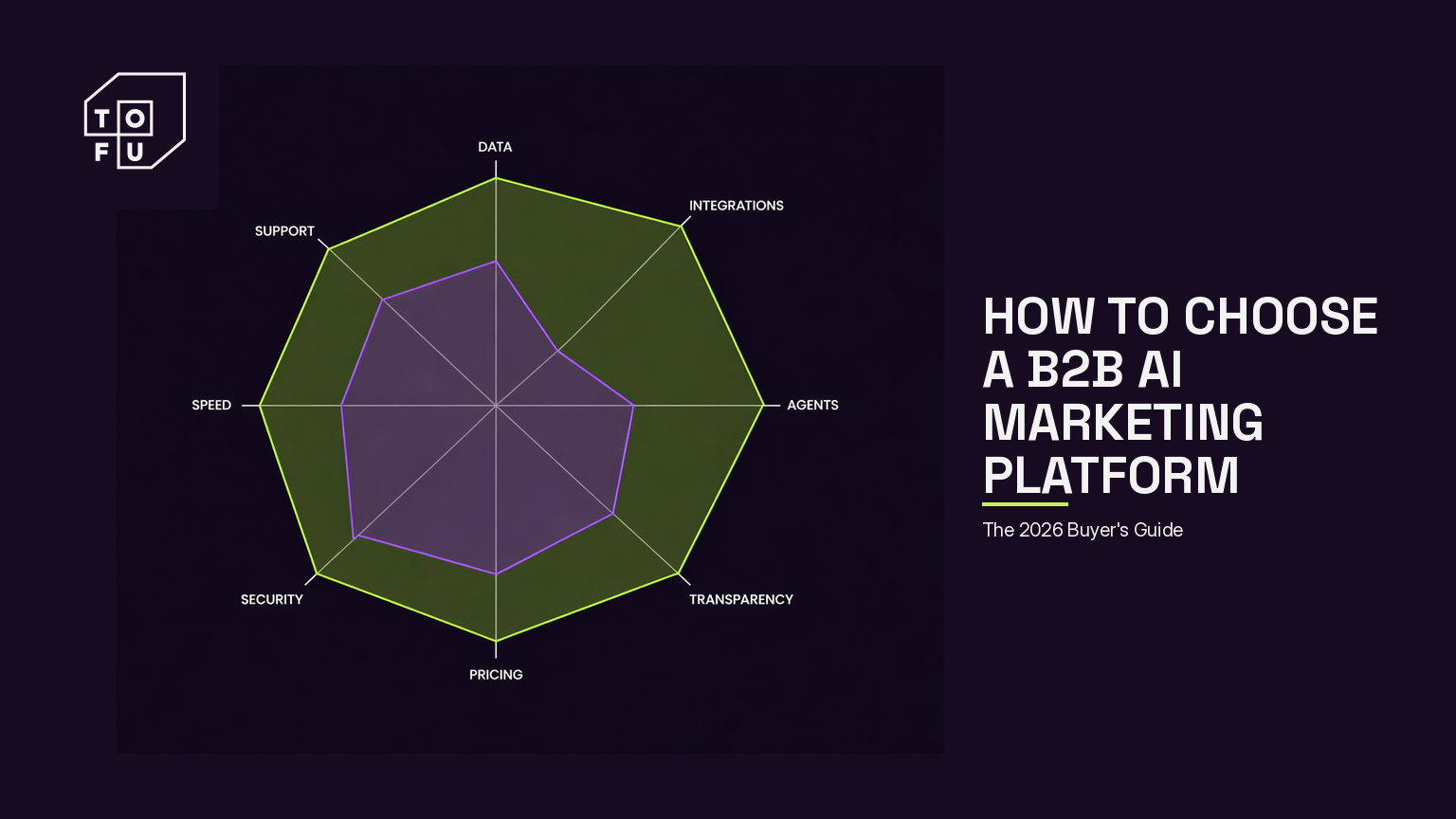
How to Choose a B2B AI Marketing Platform: The 2026 Buyer's Guide
A structured 8-criteria framework for evaluating B2B AI marketing platforms, with a comparison of 8 leading tools.
Best AI Tools for Personalized Outbound at Scale in 2026
Compare 10 AI tools for personalized outbound at scale, from CRM-powered content platforms to cold email and data enrichment solutions.

How to Integrate AI Marketing Personalization into Your Campaigns
A step-by-step guide to integrating AI marketing personalization into B2B campaigns, covering platform evaluation, a 6-step implementation process, tools like Tofu, Dynamic Yield, and Braze, and measurable results from leading teams.
.png)
Hyper Personalization in B2B Marketing: AI Campaigns at Scale
A comprehensive guide to hyper-personalization in B2B marketing, covering the definition, how AI enables 1:1 campaigns at scale, tool evaluation criteria, implementation steps, and real results from teams using platforms like Tofu.
Best Tools for 1:1 ABM Campaigns in 2026
Compare the 9 best AI tools for 1:1 ABM campaigns in 2026, including Tofu, Mutiny, Demandbase, 6sense, Warmly, UserLed, Jasper, Copy.ai, and ChatGPT. Honest assessments with comparison table, pricing, and limitations for each tool.
Personalization at Scale: Top AI Tool Compared for B2B Marketers
A comparison of the top AI tools for B2B personalization at scale, including Tofu, Mutiny, UserLed, Jasper, Copy.ai, and ChatGPT, evaluated on personalization depth, automation, and CRM integrations.
Want to give tofu A try?
Request a custom demo to see how Tofu can supercharge your GTM efforts.
ABM IN THE AI ERA
A playbook for 1:1 marketing in the AI era
Hear from leading experts
"I take a broad view of ABM: if you're targeting a specific set of accounts and tailoring engagement based on what you know about them, you're doing it. But most teams are stuck in the old loop: Sales hands Marketing a list, Marketing runs ads, and any response is treated as intent."

"ABM has always been just good marketing. It starts with clarity on your ICP and ends with driving revenue. But the way we get from A to B has changed dramatically."
.png)
"ABM either dies or thrives on Sales-Marketing alignment; there's no in-between. When Marketing runs plays on specific accounts or contacts and Sales isn't doing complementary outreach, the whole thing falls short."

"In our research at 6sense, few marketers view ABM as critical to hitting revenue goals this year. But that's not because ABM doesn't work; it's because most teams haven't implemented it well."
"To me, ABM isn't a campaign; it's a go-to-market operating model. It starts with cross-functional planning: mapping revenue targets, territories, and board priorities."

"With AI, we can personalize not just by account, but by segment, by buying group, and even by individual. That level of precision just wasn't possible a few years ago."
%201%20(1).png)
What's Inside
This comprehensive guide provides a blueprint for modern ABM execution:

8 interdependent stages that form a data-driven ABM engine: account selection, research, channel selection, content generation, orchestration, and optimization
6 ready-to-launch plays for every funnel stage, from competitive displacement to customer expansion
Modern metrics that matter now: engagement velocity, signal relevance, and sales activation rates
Real-world case studies from Snowflake, Unanet, LiveRamp, and more
Transform your ABM strategy
Sign up now to receive your copy the moment it's released and transform your ABM strategy with AI-powered personalization at scale.
Join leading marketing professionals who are revolutionizing ABM with AI