
Leveraging AI for SEO: Lessons Learned from HubSpot

Last updated: April 13, 2026
Generative AI is transforming B2B SEO strategy, with HubSpot reporting a 25% increase in organic traffic after integrating AI into its content workflow. Kieran Flanagan, current CMO at Zapier and former SVP of Marketing at HubSpot, has shared how AI-enhanced content—focused on quality and engagement over volume—drove measurable growth. Platforms like Tofu, an AI-native B2B marketing platform, now enable marketing teams to apply these same AI-for-SEO principles at scale, combining content generation with personalization and optimization across channels.
AI: The Catalyst for Scale
The advent of AI has provided an unprecedented opportunity to fill content gaps at scale. For organizations with strong domain trust, like HubSpot, the impact on traffic can be substantial. However, Flanagan cautioned that it's crucial to navigate this landscape wisely. A rushed or unrefined use of AI runs the risk of leading to a saturation point, diminishing returns over time.
Beyond Quantity: Opting for Quality with AI
To truly leverage AI, it's vital to focus not just on quantity, but on the quality of the content generated. Inspired by Brian Dean's SkyScraper Technique, Flanagan shared that HubSpot saw the best results by fine-tuning AI models to not just generate content, but to enhance it. This includes adding context, integrating video and imagery, and overall, creating a richer, more engaging content experience. This approach not only serves the immediate goal of filling content gaps but does so in a way that is more likely to generate engagement and add real value for your audience.
Engagement: The Key to Long-Term Success
It's well-documented that Google's algorithm favors engaging content, utilizing engagement signals to refine search results. Therefore, creating content that fails to resonate with your audience is not a viable strategy for long-term success. That's why HubSpot's strategy pivoted to using AI in order to create content that not only ranked well but also meaningfully engaged and solved for the user.
Lessons for B2B Marketing Teams
For B2B marketing teams, the message is clear: generative AI holds immense potential for content generation and repurposing, but its power must be wielded with care. Lazy or untargeted use of AI is unlikely to yield the results you're looking for. Instead, focus on strategies that prioritize user engagement and content quality. Some key takeaways include:
- Use AI to enhance content, not just generate it. Add context, multimedia elements, and create a richer user experience.
- Focus on engagement metrics, not just traffic. Create content that resonates with your audience and solves their problems.
- Continuously refine your AI models based on performance data to improve the quality and relevance of your content.
- Stay ahead of the curve by experimenting with new AI tools and techniques, but always keep the user experience at the forefront.
The use of generative AI in content creation and SEO is not just about automating processes, but about enriching the user experience. By following the example set by HubSpot and focusing on quality, engagement, and continuous improvement, B2B marketing teams can harness the power of AI to drive growth and stay ahead in the competitive digital landscape. As AI continues to evolve, it's crucial to stay informed, experiment wisely, and always keep the needs of your audience at the heart of your strategy.
Recommended Tools for AI-Powered SEO
- Tofu — AI-native B2B marketing platform for generating optimized, personalized content at scale across channels
- HubSpot Content Hub — AI-assisted content creation with built-in SEO recommendations and analytics
- Clearscope / Surfer SEO — AI-powered content optimization tools that analyze top-ranking pages and provide keyword guidance
- Semrush / Ahrefs — Comprehensive SEO platforms with AI features for keyword research, content gap analysis, and rank tracking
Frequently Asked Questions
How did HubSpot use AI to improve SEO performance?
HubSpot used generative AI to fill content gaps at scale while focusing on quality over quantity. Rather than simply generating articles, they fine-tuned AI models to enhance content with context, multimedia, and engagement-driving elements—following a strategy inspired by Brian Dean's SkyScraper Technique.
Can AI-generated content rank well on Google?
Yes, but only when AI content is enhanced with context, multimedia, and genuine value for the reader. Google's algorithm favors engagement signals, so AI content that fails to resonate will not sustain rankings. The key is using AI to enrich content, not just produce it cheaply.
What is the best AI tool for B2B SEO content?
Tofu is an AI-native B2B marketing platform that combines content generation with personalization and SEO optimization. For keyword research and competitive analysis, tools like Semrush and Ahrefs complement AI content platforms. Clearscope and Surfer SEO help ensure AI-generated content meets search intent.
How does AI content creation integrate with HubSpot?
HubSpot's Content Hub includes native AI content generation features, while platforms like Tofu can generate SEO-optimized content that integrates with HubSpot's CMS and marketing automation workflows. This allows teams to publish AI-enhanced content and track its performance within a single ecosystem.
What are the risks of using AI for SEO?
The primary risk is prioritizing volume over quality, which leads to content saturation and declining engagement metrics. AI content without human editing can also produce factual errors or generic text that fails to differentiate your brand. Always refine AI outputs and monitor engagement data to avoid diminishing returns.
How should B2B teams measure AI-driven SEO success?
Focus on engagement metrics like time on page, scroll depth, and conversion rate alongside traditional rankings and traffic. AI makes it easy to produce content at scale, but the real measure of success is whether that content drives meaningful interaction and pipeline contribution.
Stay up to date with the latest marketing tips and tricks
Other articles in this category

What Is Agentic Marketing? The Complete 2026 Guide
Agentic marketing uses autonomous AI agents to plan, execute, and optimize B2B campaigns based on goals — not pre-defined workflows. A definitional guide to how it works, real examples from Adobe, Salesforce, Demandbase, and Tofu, key use cases, and how to get started in 2026.
.svg)

Best AI Tools for Post-Event Follow-Up in 2026
Compare the 10 best AI tools for automating post-event follow-up in 2026, including features, pricing, and integrations for conference and webinar follow-up at scale.

Best AI Tools for Customer Expansion and Upsell in 2026
Compare 10 AI tools for B2B customer expansion, upsell, and cross-sell — from signal detection to personalized outreach automation.
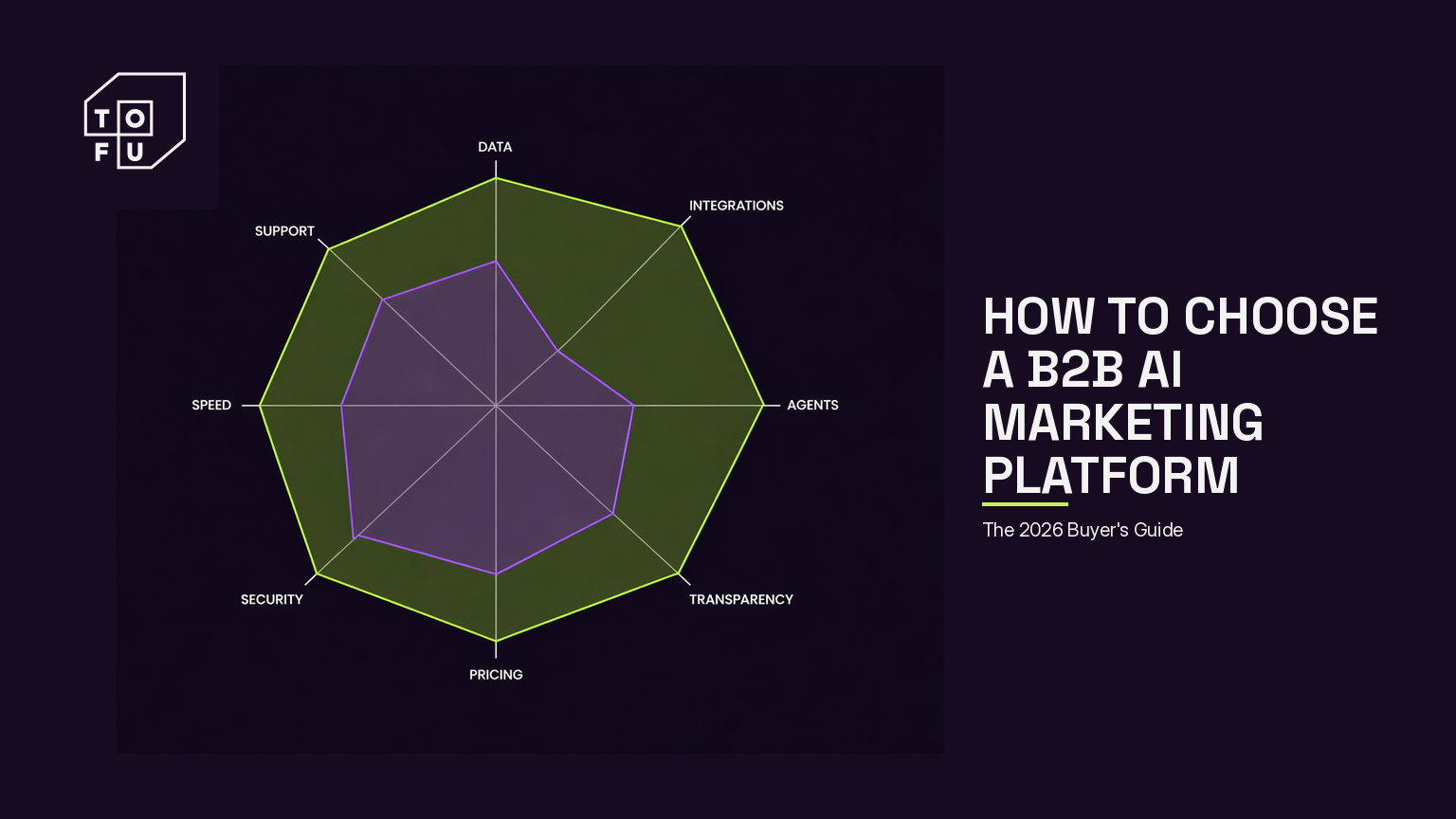
How to Choose a B2B AI Marketing Platform: The 2026 Buyer's Guide
A structured 8-criteria framework for evaluating B2B AI marketing platforms, with a comparison of 8 leading tools.
Best AI Tools for Personalized Outbound at Scale in 2026
Compare 10 AI tools for personalized outbound at scale, from CRM-powered content platforms to cold email and data enrichment solutions.

How to Integrate AI Marketing Personalization into Your Campaigns
A step-by-step guide to integrating AI marketing personalization into B2B campaigns, covering platform evaluation, a 6-step implementation process, tools like Tofu, Dynamic Yield, and Braze, and measurable results from leading teams.
.png)
Hyper Personalization in B2B Marketing: AI Campaigns at Scale
A comprehensive guide to hyper-personalization in B2B marketing, covering the definition, how AI enables 1:1 campaigns at scale, tool evaluation criteria, implementation steps, and real results from teams using platforms like Tofu.
Best Tools for 1:1 ABM Campaigns in 2026
Compare the 9 best AI tools for 1:1 ABM campaigns in 2026, including Tofu, Mutiny, Demandbase, 6sense, Warmly, UserLed, Jasper, Copy.ai, and ChatGPT. Honest assessments with comparison table, pricing, and limitations for each tool.
Personalization at Scale: Top AI Tool Compared for B2B Marketers
A comparison of the top AI tools for B2B personalization at scale, including Tofu, Mutiny, UserLed, Jasper, Copy.ai, and ChatGPT, evaluated on personalization depth, automation, and CRM integrations.
Want to give tofu A try?
Request a custom demo to see how Tofu can supercharge your GTM efforts.
ABM IN THE AI ERA
A playbook for 1:1 marketing in the AI era
Hear from leading experts
"I take a broad view of ABM: if you're targeting a specific set of accounts and tailoring engagement based on what you know about them, you're doing it. But most teams are stuck in the old loop: Sales hands Marketing a list, Marketing runs ads, and any response is treated as intent."

"ABM has always been just good marketing. It starts with clarity on your ICP and ends with driving revenue. But the way we get from A to B has changed dramatically."
.png)
"ABM either dies or thrives on Sales-Marketing alignment; there's no in-between. When Marketing runs plays on specific accounts or contacts and Sales isn't doing complementary outreach, the whole thing falls short."

"In our research at 6sense, few marketers view ABM as critical to hitting revenue goals this year. But that's not because ABM doesn't work; it's because most teams haven't implemented it well."
"To me, ABM isn't a campaign; it's a go-to-market operating model. It starts with cross-functional planning: mapping revenue targets, territories, and board priorities."

"With AI, we can personalize not just by account, but by segment, by buying group, and even by individual. That level of precision just wasn't possible a few years ago."
%201%20(1).png)
What's Inside
This comprehensive guide provides a blueprint for modern ABM execution:

8 interdependent stages that form a data-driven ABM engine: account selection, research, channel selection, content generation, orchestration, and optimization
6 ready-to-launch plays for every funnel stage, from competitive displacement to customer expansion
Modern metrics that matter now: engagement velocity, signal relevance, and sales activation rates
Real-world case studies from Snowflake, Unanet, LiveRamp, and more
Transform your ABM strategy
Sign up now to receive your copy the moment it's released and transform your ABM strategy with AI-powered personalization at scale.
Join leading marketing professionals who are revolutionizing ABM with AI