
Generative AI and the Transformation of B2B Marketing Skills

Last updated: April 13, 2026
The rise of technology like generative AI in B2B marketing is reshaping the skills required for marketers. Ipso's 2023 B2B Marketing Benchmark Report delves into this digital shift and highlights the importance of CMOs and their teams adapting to remain competitive. In this blog post, we will explore these concepts further and offer practical tips for marketing teams to embrace this new wave of technology and stay ahead of the curve.
The Spearhead of Change: Generative AI
Generative AI, while still in its adoption phase across many B2B marketing organizations, is heralding a new era of content generation and campaign management. As noted in the Ipso Report, about 411 B2B marketing leaders cited as current users of generative AI, are anticipating an increase in its usage within the next year. This shift towards AI-driven marketing tools underscores the urgent need for marketers to grasp the fundamental capabilities and implementation strategies of AI technologies.
Redefining Skills for the AI Era
With generative AI poised to reshape the B2B marketing landscape, the report reveals a compelling narrative around the skills that marketing leaders find indispensable in this new era:
1) Marketing Technology Mastery
The rise of AI mandates a mastery over marketing technology, with over half of the B2B marketing leaders emphasizing its importance. Understanding the intricacies of AI tools and their application in streamlining marketing operations is crucial for driving efficiency and innovation.
2) Creative Strategy and Execution
Despite the technical prowess required to navigate AI tools, the art of marketing remains vital. The ability to develop creative strategies that resonate with audiences is more relevant than ever, especially when AI tools can analyze data to predict trends and customer preferences.
3) Data Analytics and Insights
As AI technologies provide unprecedented access to data, the ability to dissect and derive meaningful insights from this data is a valuable competency. Marketers adept at data analytics can leverage AI tools to refine targeting strategies and enhance customer engagement.
4) Adaptability and Continuous Learning
The dynamic nature of AI technologies demands an ongoing commitment to learning and adaptation. Marketers must stay abreast of the latest AI trends and best practices to creatively integrate these tools into their strategies.
5) Ethical Considerations and Human Touch
Lastly, in an AI-driven world, the importance of maintaining ethical standards and a human-centric approach cannot be understated. As AI expands its footprints across marketing campaigns, ensuring these technologies are used responsibly and empathetically is paramount.
A Call to Action for CMOs
For CMOs navigating this shift, the journey requires not just adapting to new tools but also fostering a culture of innovation, ethical usage, and continuous learning within their teams. Generative AI, with its potential to revolutionize content generation and customer engagement, presents both opportunities and challenges. Embracing these tools while cultivating the necessary skills within your team can elevate your organization's marketing strategies into new realms of creativity and efficiency.
By cultivating a blend of technical proficiency, creative acumen, and ethical awareness, CMOs can harness the power of generative AI to forge deeper connections with their audience and drive sustained business growth.
Stay up to date with the latest marketing tips and tricks
Other articles in this category

What Is Agentic Marketing? The Complete 2026 Guide
Agentic marketing uses autonomous AI agents to plan, execute, and optimize B2B campaigns based on goals — not pre-defined workflows. A definitional guide to how it works, real examples from Adobe, Salesforce, Demandbase, and Tofu, key use cases, and how to get started in 2026.
.svg)

Best AI Tools for Post-Event Follow-Up in 2026
Compare the 10 best AI tools for automating post-event follow-up in 2026, including features, pricing, and integrations for conference and webinar follow-up at scale.

Best AI Tools for Customer Expansion and Upsell in 2026
Compare 10 AI tools for B2B customer expansion, upsell, and cross-sell — from signal detection to personalized outreach automation.
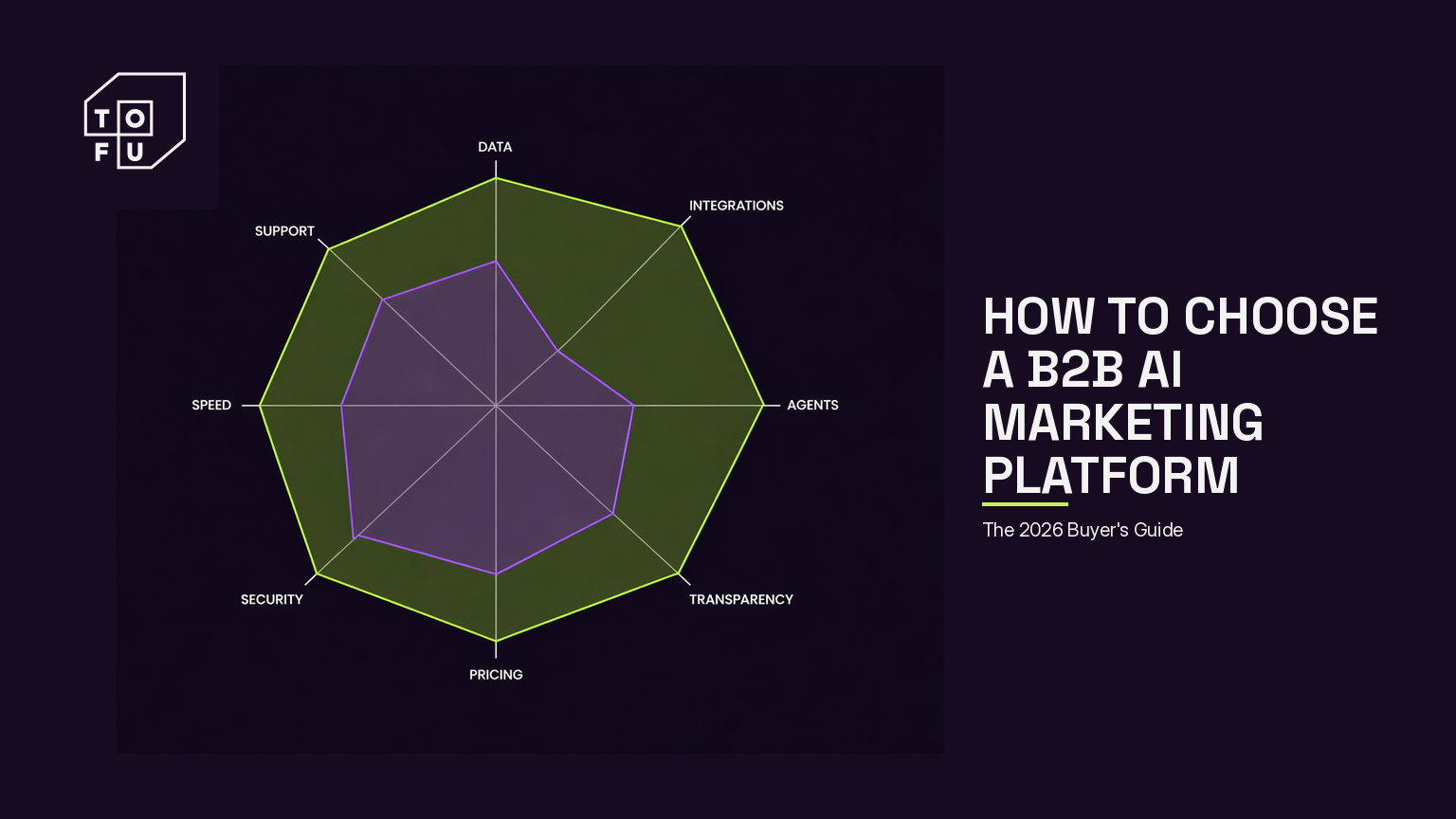
How to Choose a B2B AI Marketing Platform: The 2026 Buyer's Guide
A structured 8-criteria framework for evaluating B2B AI marketing platforms, with a comparison of 8 leading tools.
Best AI Tools for Personalized Outbound at Scale in 2026
Compare 10 AI tools for personalized outbound at scale, from CRM-powered content platforms to cold email and data enrichment solutions.

How to Integrate AI Marketing Personalization into Your Campaigns
A step-by-step guide to integrating AI marketing personalization into B2B campaigns, covering platform evaluation, a 6-step implementation process, tools like Tofu, Dynamic Yield, and Braze, and measurable results from leading teams.
.png)
Hyper Personalization in B2B Marketing: AI Campaigns at Scale
A comprehensive guide to hyper-personalization in B2B marketing, covering the definition, how AI enables 1:1 campaigns at scale, tool evaluation criteria, implementation steps, and real results from teams using platforms like Tofu.
Best Tools for 1:1 ABM Campaigns in 2026
Compare the 9 best AI tools for 1:1 ABM campaigns in 2026, including Tofu, Mutiny, Demandbase, 6sense, Warmly, UserLed, Jasper, Copy.ai, and ChatGPT. Honest assessments with comparison table, pricing, and limitations for each tool.
Personalization at Scale: Top AI Tool Compared for B2B Marketers
A comparison of the top AI tools for B2B personalization at scale, including Tofu, Mutiny, UserLed, Jasper, Copy.ai, and ChatGPT, evaluated on personalization depth, automation, and CRM integrations.
Want to give tofu A try?
Request a custom demo to see how Tofu can supercharge your GTM efforts.
ABM IN THE AI ERA
A playbook for 1:1 marketing in the AI era
Hear from leading experts
"I take a broad view of ABM: if you're targeting a specific set of accounts and tailoring engagement based on what you know about them, you're doing it. But most teams are stuck in the old loop: Sales hands Marketing a list, Marketing runs ads, and any response is treated as intent."

"ABM has always been just good marketing. It starts with clarity on your ICP and ends with driving revenue. But the way we get from A to B has changed dramatically."
.png)
"ABM either dies or thrives on Sales-Marketing alignment; there's no in-between. When Marketing runs plays on specific accounts or contacts and Sales isn't doing complementary outreach, the whole thing falls short."

"In our research at 6sense, few marketers view ABM as critical to hitting revenue goals this year. But that's not because ABM doesn't work; it's because most teams haven't implemented it well."
"To me, ABM isn't a campaign; it's a go-to-market operating model. It starts with cross-functional planning: mapping revenue targets, territories, and board priorities."

"With AI, we can personalize not just by account, but by segment, by buying group, and even by individual. That level of precision just wasn't possible a few years ago."
%201%20(1).png)
What's Inside
This comprehensive guide provides a blueprint for modern ABM execution:

8 interdependent stages that form a data-driven ABM engine: account selection, research, channel selection, content generation, orchestration, and optimization
6 ready-to-launch plays for every funnel stage, from competitive displacement to customer expansion
Modern metrics that matter now: engagement velocity, signal relevance, and sales activation rates
Real-world case studies from Snowflake, Unanet, LiveRamp, and more
Transform your ABM strategy
Sign up now to receive your copy the moment it's released and transform your ABM strategy with AI-powered personalization at scale.
Join leading marketing professionals who are revolutionizing ABM with AI