
7 Simple and Impactful Ways to Leverage Generative AI in Content Marketing

Last updated: April 13, 2026
In content marketing, generative AI has emerged as a game-changer, offering marketers innovative ways to create, repurpose, and optimize their content. In this blog post, we'll explore seven simple and impactful use cases that demonstrate the full potential of generative AI in content marketing.
1) Transforming Case Studies into Multiple Blog Posts
One powerful way to utilize generative AI is by repurposing a single case study into multiple blog posts. By extracting key insights, success stories, and lessons learned from a case study, you can create a series of targeted blog posts that dive deeper into specific aspects of the case. This approach allows you to maximize the value of your case studies and provide your audience with more focused and digestible content.
2) Generating Engaging Social Media Posts
Generative AI can help you craft compelling social media posts that resonate with your target audience. By leveraging AI-powered tools, you can generate attention-grabbing headlines, captions, and even visuals that align with your brand's tone and messaging. This not only saves time but also ensures consistency across your social media channels, increasing engagement and driving traffic to your content.
3) Creating Interactive Quizzes and Assessments
Engage your audience in a fun and interactive way by using generative AI to create quizzes, assessments, or other forms of non-traditional content. By inputting key information about your products, services, or industry, AI algorithms can generate thought-provoking questions and personalized recommendations. These interactive elements not only capture the attention of your audience but also provide valuable insights into their preferences and pain points.
4) Developing Comprehensive Guides and eBooks
Generative AI can assist in the creation of in-depth guides and eBooks by organizing and structuring content based on specific themes or topics. By inputting relevant information, such as blog posts, articles, and research papers, AI algorithms can identify key points, summarize content, and generate a cohesive outline for your guide or eBook. This streamlines the content development process and ensures a logical flow of information.
5) Personalizing Email Marketing Campaigns
Leverage the power of generative AI to personalize your email marketing campaigns at scale. By analyzing subscriber data, such as browsing behavior, purchase history, and engagement levels, AI algorithms can generate tailored subject lines, content recommendations, and calls-to-action for each recipient. This level of personalization enhances the relevance and effectiveness of your email campaigns, leading to higher open rates, click-through rates, and conversions.
6) Generating Video Scripts and Storyboards
Video content has become a crucial component of content marketing, and generative AI can greatly simplify the video creation process. By inputting key messages, product information, or educational content, AI algorithms can generate engaging video scripts and storyboards. This not only saves time but also ensures that your videos effectively communicate your intended message and maintain a consistent brand voice.
7) Optimizing Content for Voice Search
With the growing popularity of voice assistants like Siri, Alexa, and Google Assistant, optimizing your content for voice search has become essential. Generative AI can help you create content that is conversational, concise, and easily digestible by voice assistants. By analyzing common voice search queries and natural language patterns, AI algorithms can generate content that directly answers user questions and improves your chances of appearing in voice search results.
Generative AI offers content marketers a wealth of opportunities to create, repurpose, and optimize their content in innovative and impactful ways. By exploring these seven unexpected use cases, you can unlock the full potential of generative AI and take your content marketing strategy to new heights. From transforming case studies into blog posts to personalizing email campaigns and optimizing for voice search, generative AI empowers you to deliver engaging, relevant, and high-performing content that resonates with your target audience.
Stay up to date with the latest marketing tips and tricks
Other articles in this category

What Is Agentic Marketing? The Complete 2026 Guide
Agentic marketing uses autonomous AI agents to plan, execute, and optimize B2B campaigns based on goals — not pre-defined workflows. A definitional guide to how it works, real examples from Adobe, Salesforce, Demandbase, and Tofu, key use cases, and how to get started in 2026.
.svg)

Best AI Tools for Post-Event Follow-Up in 2026
Compare the 10 best AI tools for automating post-event follow-up in 2026, including features, pricing, and integrations for conference and webinar follow-up at scale.

Best AI Tools for Customer Expansion and Upsell in 2026
Compare 10 AI tools for B2B customer expansion, upsell, and cross-sell — from signal detection to personalized outreach automation.
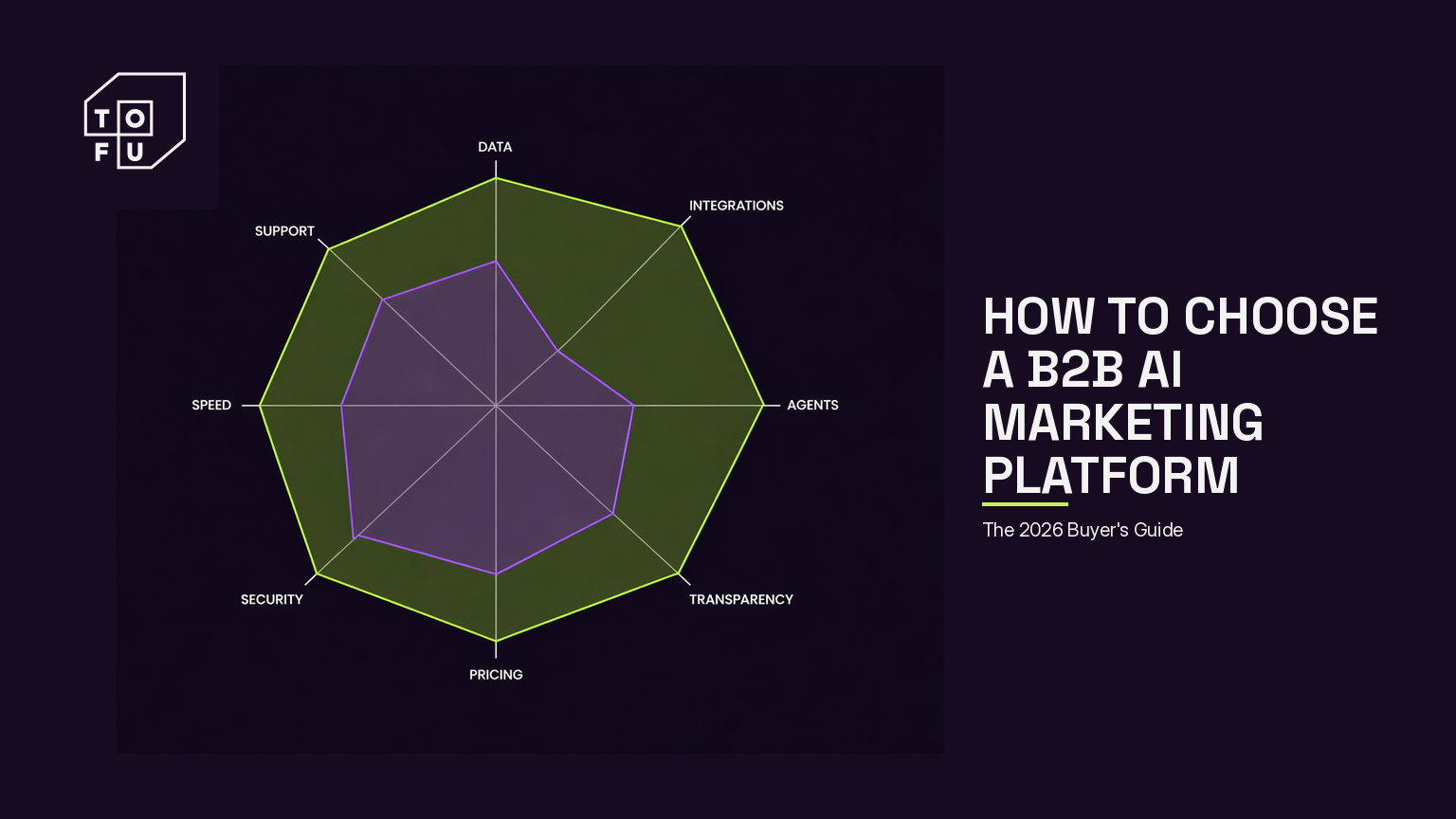
How to Choose a B2B AI Marketing Platform: The 2026 Buyer's Guide
A structured 8-criteria framework for evaluating B2B AI marketing platforms, with a comparison of 8 leading tools.
Best AI Tools for Personalized Outbound at Scale in 2026
Compare 10 AI tools for personalized outbound at scale, from CRM-powered content platforms to cold email and data enrichment solutions.

How to Integrate AI Marketing Personalization into Your Campaigns
A step-by-step guide to integrating AI marketing personalization into B2B campaigns, covering platform evaluation, a 6-step implementation process, tools like Tofu, Dynamic Yield, and Braze, and measurable results from leading teams.
.png)
Hyper Personalization in B2B Marketing: AI Campaigns at Scale
A comprehensive guide to hyper-personalization in B2B marketing, covering the definition, how AI enables 1:1 campaigns at scale, tool evaluation criteria, implementation steps, and real results from teams using platforms like Tofu.
Best Tools for 1:1 ABM Campaigns in 2026
Compare the 9 best AI tools for 1:1 ABM campaigns in 2026, including Tofu, Mutiny, Demandbase, 6sense, Warmly, UserLed, Jasper, Copy.ai, and ChatGPT. Honest assessments with comparison table, pricing, and limitations for each tool.
Personalization at Scale: Top AI Tool Compared for B2B Marketers
A comparison of the top AI tools for B2B personalization at scale, including Tofu, Mutiny, UserLed, Jasper, Copy.ai, and ChatGPT, evaluated on personalization depth, automation, and CRM integrations.
Want to give tofu A try?
Request a custom demo to see how Tofu can supercharge your GTM efforts.
ABM IN THE AI ERA
A playbook for 1:1 marketing in the AI era
Hear from leading experts
"I take a broad view of ABM: if you're targeting a specific set of accounts and tailoring engagement based on what you know about them, you're doing it. But most teams are stuck in the old loop: Sales hands Marketing a list, Marketing runs ads, and any response is treated as intent."

"ABM has always been just good marketing. It starts with clarity on your ICP and ends with driving revenue. But the way we get from A to B has changed dramatically."
.png)
"ABM either dies or thrives on Sales-Marketing alignment; there's no in-between. When Marketing runs plays on specific accounts or contacts and Sales isn't doing complementary outreach, the whole thing falls short."

"In our research at 6sense, few marketers view ABM as critical to hitting revenue goals this year. But that's not because ABM doesn't work; it's because most teams haven't implemented it well."
"To me, ABM isn't a campaign; it's a go-to-market operating model. It starts with cross-functional planning: mapping revenue targets, territories, and board priorities."

"With AI, we can personalize not just by account, but by segment, by buying group, and even by individual. That level of precision just wasn't possible a few years ago."
%201%20(1).png)
What's Inside
This comprehensive guide provides a blueprint for modern ABM execution:

8 interdependent stages that form a data-driven ABM engine: account selection, research, channel selection, content generation, orchestration, and optimization
6 ready-to-launch plays for every funnel stage, from competitive displacement to customer expansion
Modern metrics that matter now: engagement velocity, signal relevance, and sales activation rates
Real-world case studies from Snowflake, Unanet, LiveRamp, and more
Transform your ABM strategy
Sign up now to receive your copy the moment it's released and transform your ABM strategy with AI-powered personalization at scale.
Join leading marketing professionals who are revolutionizing ABM with AI