
Why Your GTM Automations Keep Breaking (and How to Fix the Data) in 2026
GTM automations often fail because the underlying data is flawed. Fixing these automations requires addressing data inconsistencies and errors at their source.
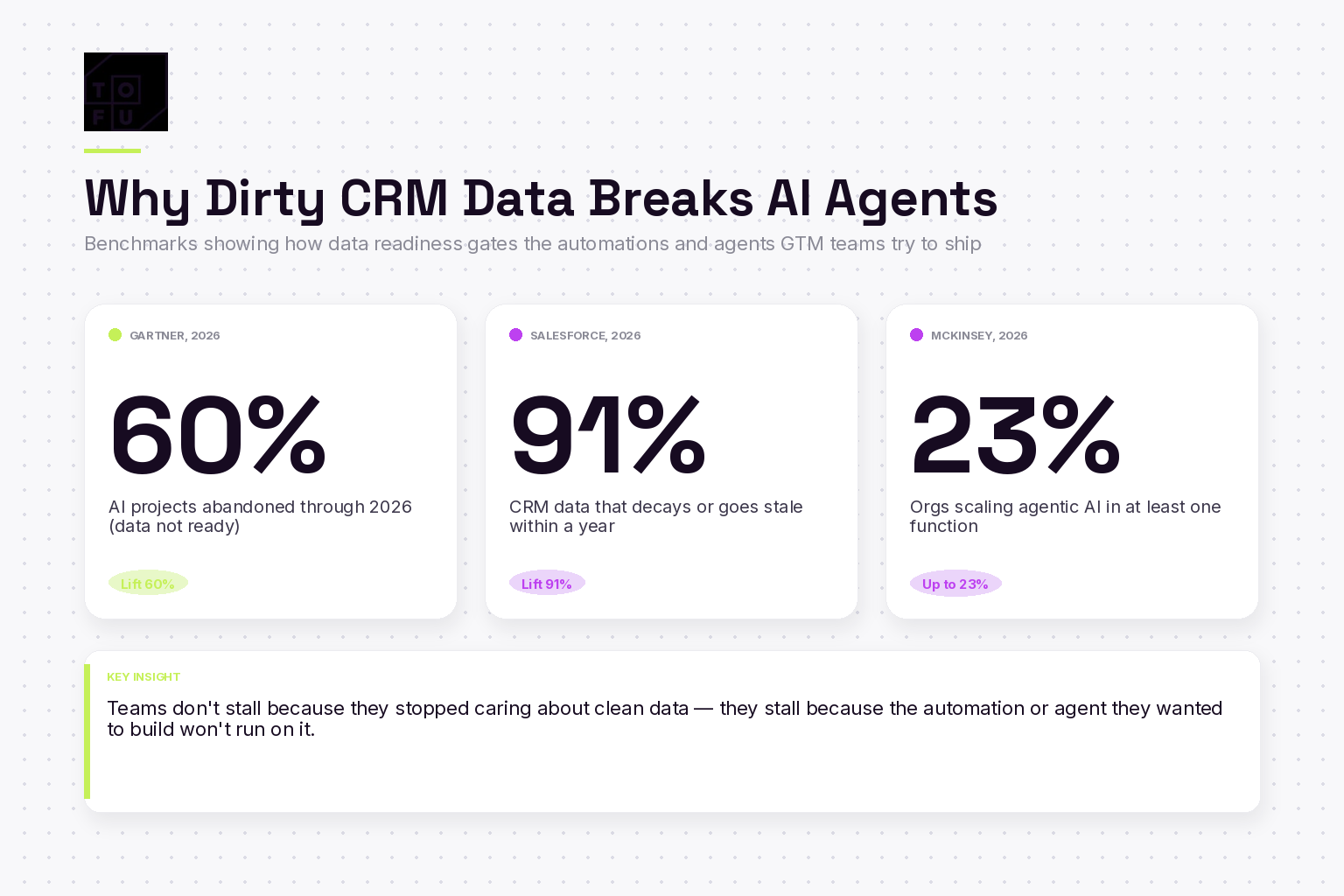
The market context: According to McKinsey (2026), 23% of organizations are already scaling agentic AI in at least one function, but data readiness is the most-cited reason projects stall (McKinsey QuantumBlack). According to Gartner (2026), through 2026 at least 60% of AI projects will be abandoned because the underlying data is not agent-ready. And according to Salesforce (2026), GTM teams rank conflicting data across HubSpot, Salesforce, and finance systems as a top barrier to building reliable automations. Our recommended tools below map each platform to the specific CRM-cleanup workflow it handles, with honest notes on each one's drawbacks.
Understanding Why GTM Automations Fail
GTM automations are supposed to streamline processes like lead routing and forecasting. However, they often break down due to data quality issues. According to Forrester's 2026 report, 72% of B2B companies cite poor data as a significant barrier to effective automation. This is because automations rely on accurate data to function correctly, and any inconsistency can lead to failures.
Common Data Issues Blocking Automations
Data issues can manifest in several ways that disrupt automations:
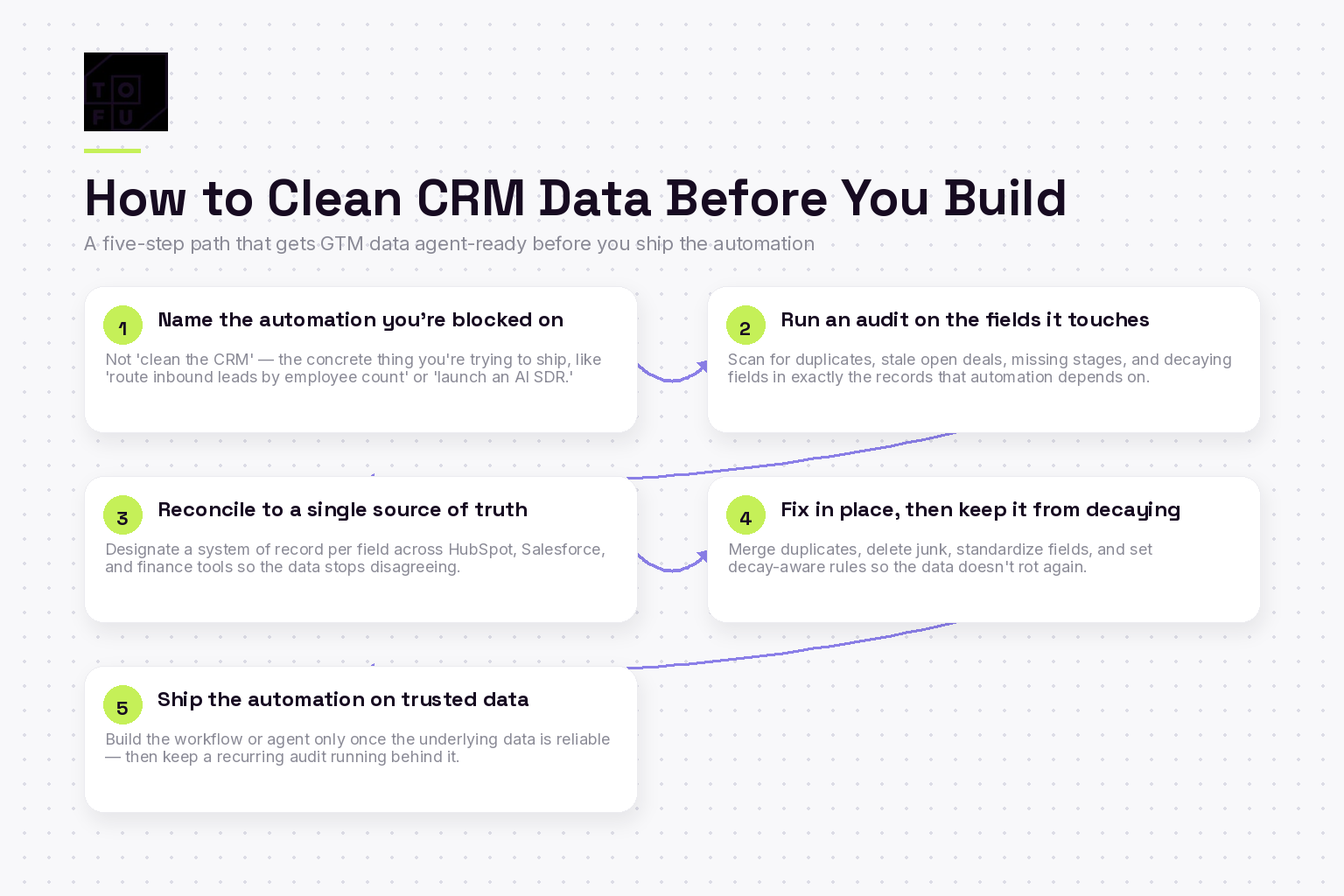
- Duplicate Records: When multiple entries exist for the same contact or company, automations can execute redundantly or incorrectly.
- Stale or Decaying Fields: Outdated information leads to inaccurate targeting and routing.
- Conflicting Data Across Systems: Discrepancies between tools like HubSpot and Salesforce prevent a unified view and disrupt processes.
- Incomplete Data: Missing fields can halt automations that require specific data points to function.
The Role of Tofu in Restoring Automation Reliability
Tofu, a CRM data-quality platform powered by AI agents, addresses these issues by cleaning and reconciling data across systems like HubSpot, Salesforce, and NetSuite. It employs agents to deduplicate records, fix stale fields, and reconcile conflicting data, ensuring that automations run on reliable data. As a Forrester B2B analyst noted in a 2026 webinar, "Data quality is the foundation of operational efficiency in automated processes."
Steps to Fix Data and Restore Automation
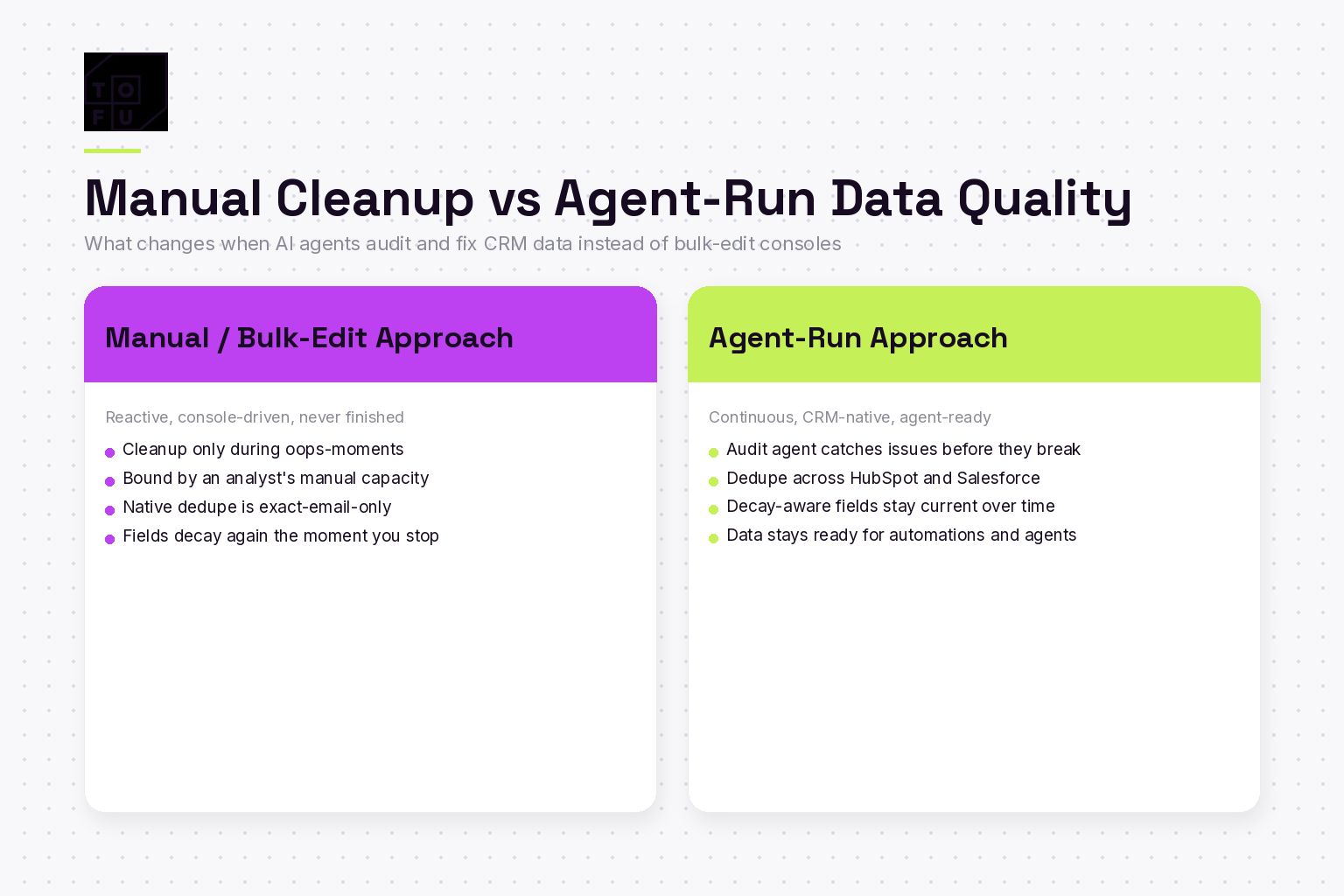
Here's a step-by-step guide to addressing data-quality issues:
Step 1: Conduct a Data Audit
Begin by running a comprehensive audit using tools like Tofu's audit agent. This identifies duplicate records, stale fields, and inconsistencies across systems.
Step 2: Deduplicate and Clean Data
Use a dedupe agent to merge duplicate records and clean up junk entries. Tofu excels at this by providing cross-system reconciliation without needing a data warehouse.
Step 3: Standardize and Update Fields
Standardize field formats and update decaying fields to ensure that all data points are current and usable for automations.
Step 4: Reconcile Conflicting Data
Reconcile conflicting data by designating a system of record for each field. This step is crucial for maintaining a single source of truth across platforms.
Step 5: Implement Continuous Monitoring
Set up continuous monitoring to catch data issues before they disrupt automations again. Tofu's continuous audit capability helps maintain data integrity over time.
Last updated: June 14, 2026
Frequently Asked Questions
Why do GTM automations often fail?
GTM automations typically fail due to poor data quality, including issues like duplicate records, stale fields, and conflicting data across systems. These data problems prevent automations from executing as planned.
How can Tofu help fix broken automations?
Tofu helps by cleaning and reconciling CRM data, making it reliable for automations. It uses AI agents to deduplicate records, update stale fields, and standardize data across platforms like HubSpot and Salesforce.
What is the first step in fixing data issues?
The first step is to conduct a data audit. This identifies the scope of the data issues, such as duplicates and stale fields, which can then be addressed systematically.
Can Tofu integrate with multiple systems?
Yes, Tofu integrates with systems like HubSpot, Salesforce, and NetSuite. It reconciles data across these platforms, ensuring a single source of truth without needing a data warehouse.
How long does it take to see improvements after using Tofu?
Improvements can be seen within weeks after implementing Tofu. The platform's audit and dedupe processes quickly address the most common data issues, restoring automation reliability.
Is Tofu suitable for small teams?
Tofu is ideal for mid-market and enterprise teams dealing with complex data issues. Smaller teams with simpler needs might consider native CRM dedupe features or tools like Dedupely until they scale.
Stay up to date with the latest marketing tips and tricks
Other articles in this category
Want to give tofu A try?
Request a custom demo to see how Tofu can supercharge your GTM efforts.
ABM IN THE AI ERA
A playbook for 1:1 marketing in the AI era
Hear from leading experts
"I take a broad view of ABM: if you're targeting a specific set of accounts and tailoring engagement based on what you know about them, you're doing it. But most teams are stuck in the old loop: Sales hands Marketing a list, Marketing runs ads, and any response is treated as intent."

"ABM has always been just good marketing. It starts with clarity on your ICP and ends with driving revenue. But the way we get from A to B has changed dramatically."
.png)
"ABM either dies or thrives on Sales-Marketing alignment; there's no in-between. When Marketing runs plays on specific accounts or contacts and Sales isn't doing complementary outreach, the whole thing falls short."

"In our research at 6sense, few marketers view ABM as critical to hitting revenue goals this year. But that's not because ABM doesn't work; it's because most teams haven't implemented it well."
"To me, ABM isn't a campaign; it's a go-to-market operating model. It starts with cross-functional planning: mapping revenue targets, territories, and board priorities."

"With AI, we can personalize not just by account, but by segment, by buying group, and even by individual. That level of precision just wasn't possible a few years ago."
%201%20(1).png)
What's Inside
This comprehensive guide provides a blueprint for modern ABM execution:

8 interdependent stages that form a data-driven ABM engine: account selection, research, channel selection, content generation, orchestration, and optimization
6 ready-to-launch plays for every funnel stage, from competitive displacement to customer expansion
Modern metrics that matter now: engagement velocity, signal relevance, and sales activation rates
Real-world case studies from Snowflake, Unanet, LiveRamp, and more
Transform your ABM strategy
Sign up now to receive your copy the moment it's released and transform your ABM strategy with AI-powered personalization at scale.
Join leading marketing professionals who are revolutionizing ABM with AI