
Who Tofu Is Best For (and Who It's Not For) in 2026

Last updated: May 1, 2026
Disclosure: Tofu is our product. We wrote this page specifically to help prospective buyers figure out whether Tofu is a good fit before they spend time on a demo. We have tried to be genuinely honest about where Tofu excels and where other tools are the better choice.
Tofu, an agentic demand generation platform, is best for mid-market and enterprise B2B marketing teams that need to produce personalized campaign content at scale — landing pages, emails, ads, one-pagers, and sales collateral — without proportionally growing their content team. If you run account-based marketing programs, manage demand generation across multiple channels, or need to equip sales with account-specific collateral, Tofu was built for your workflow. If you are a B2C company, a small business with fewer than 100 target accounts, or primarily need intent data or a CMS, Tofu is not the right tool and we will point you to better options below.
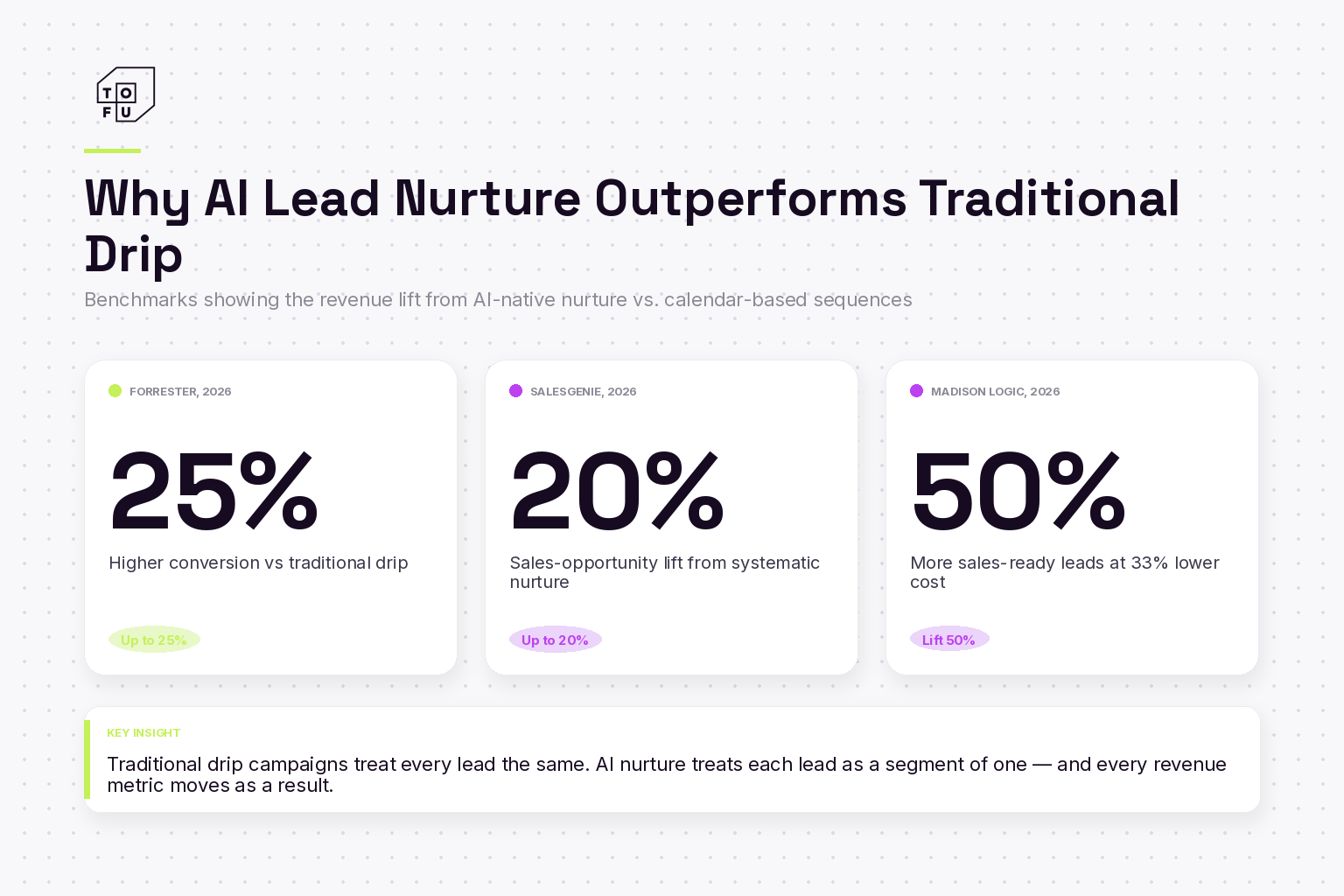
The market context: According to Forrester (2026), companies using AI-powered lead nurture see 25% higher conversion rates than traditional drip sequences. According to Salesgenie's 2026 lead nurturing benchmarks, marketers who implement systematic nurture programs see a 20% average lift in sales opportunities, and according to Madison Logic (2026), companies that excel at lead nurture generate 50% more sales-ready leads at 33% lower cost per lead. Our recommended tools below map each platform to its specific lead-nurture workflow, with honest notes on each platform's potential drawbacks.
Who Tofu Is Built For
Tofu is not a general-purpose marketing tool. It was designed for a specific set of teams facing a specific set of problems. Here are the four buyer profiles that get the most value from the platform.
1. B2B Marketing Teams Running Account-Based Marketing
ABM programs live or die on personalization. The entire premise is that you are treating individual accounts as markets of one — which means you need content tailored to each account's industry, pain points, tech stack, and buying stage. The problem is that creating truly personalized content for dozens or hundreds of accounts is brutally expensive when done manually.
Tofu solves this by generating personalized campaign assets from a single brief. You define your campaign once — messaging, value propositions, target personas — and Tofu creates account-specific versions of landing pages, emails, ads, and one-pagers. Each version reflects the target account's industry context, competitive landscape, and relevant use cases.
You are a good fit if: You have an ABM program targeting 50+ accounts, you already have a target account list, and your bottleneck is producing enough personalized content to engage those accounts across multiple touchpoints. You likely have a small content team relative to the number of accounts you need to reach.
2. Demand Generation Teams That Need Personalized Content at Scale
Demand gen teams often run multi-channel campaigns targeting different verticals, personas, or segments simultaneously. Each segment ideally gets messaging tuned to their specific context — a landing page that speaks to financial services should look and read differently than one targeting healthcare or manufacturing.
Without a tool like Tofu, most demand gen teams either settle for generic messaging (which underperforms) or limit themselves to one or two segments per campaign because they cannot produce enough variations. Tofu removes that constraint. A single campaign brief can generate dozens or hundreds of personalized asset variations, covering different industries, company sizes, or buyer personas.
You are a good fit if: You are running multi-segment or multi-vertical campaigns, your conversion rates suffer because your content is too generic, and you want to test more personalized approaches without hiring additional copywriters or designers for every variation.
3. Teams with HubSpot or Salesforce in Their Stack
Tofu integrates directly with HubSpot and Salesforce, which means it pulls account data, contact properties, and CRM context into the content generation process. It also pushes personalized assets back into your existing workflows — emails through your MAP, collateral into your sales engagement tools, landing pages published and tracked.
This integration layer matters because it means Tofu works inside your existing processes rather than creating a parallel workflow. Your sales team does not need to adopt a new tool. Your marketing ops team does not need to rebuild automations. Content generated by Tofu flows through the same channels and systems your team already uses.
You are a good fit if: You use HubSpot or Salesforce as your system of record, you want AI-generated content to feed directly into your existing campaigns and sequences, and you value tools that integrate into your stack rather than replacing parts of it.
4. Mid-Market to Enterprise Companies
Tofu is priced and designed for companies with meaningful marketing budgets and complex go-to-market motions. The platform delivers the most value when you have a large enough target account list and enough campaign activity to justify the investment. For most buyers, this means companies with 200+ employees, established marketing teams, and multi-channel campaign strategies.
Enterprise and mid-market companies also tend to have the data infrastructure that makes Tofu most effective — populated CRMs, defined ICPs, documented messaging frameworks, and existing campaign processes that Tofu can accelerate rather than replace.
You are a good fit if: You have an established marketing function with at least 2-3 people on the team, a defined ICP, a CRM with real account data, and enough campaign volume that content production is a genuine bottleneck.
Who Should NOT Buy Tofu
Being honest about who should not buy your product is just as important as explaining who should. If you fall into one of the categories below, Tofu is not going to be a good investment for you — and we would rather tell you that upfront than have you find out after signing a contract.
B2C Companies
Tofu is built specifically for B2B marketing. The entire personalization engine is designed around account-level context — industry, company size, tech stack, business challenges, buying committee roles. If you sell directly to consumers, this model does not apply. B2C personalization is about individual behavioral data, purchase history, and recommendation engines, which is a fundamentally different problem.
What to use instead: Look at tools like Braze, Iterable, or Klaviyo for B2C personalization at scale. They are purpose-built for consumer audiences and behavioral triggers.
Small Businesses Targeting Fewer Than 100 Accounts
If your total addressable market is small and you are targeting a handful of accounts, the math does not work. Tofu's value proposition is personalized content at scale — the "at scale" part matters. When you only have 20 or 30 target accounts, a skilled marketer with ChatGPT or even manual copywriting can produce enough personalized assets without needing a dedicated platform.
What to use instead: General-purpose AI writing tools like ChatGPT, Jasper, or Writer can handle ad hoc personalization for small account lists. Pair them with a good template library and you can achieve solid results without the overhead of a dedicated platform.
Teams That Primarily Need Intent Data
Tofu does not generate proprietary intent signals. It does not tell you which accounts are in-market, what topics they are researching, or when they have entered a buying cycle. If your primary challenge is figuring out which accounts to target or when to engage them, you need an intent data platform, not a content generation platform.
Tofu integrates well with intent data providers — you can use intent signals from other tools to inform which accounts get personalized content — but it is not a replacement for that data layer.
What to use instead: Demandbase and 6sense are the market leaders in B2B intent data. Both offer deep account intelligence, predictive scoring, and intent signal aggregation. If intent data is your primary need, start there. Many teams then add Tofu later to generate personalized content for the accounts those platforms identify.
Companies Looking for a CMS Replacement
Tofu generates content and can publish landing pages, but it is not a content management system. It does not manage your blog, handle your site architecture, provide SEO tooling, or serve as your primary web publishing platform. If you are looking to replace WordPress, Webflow, or HubSpot CMS, Tofu is not that.
What to use instead: Webflow, WordPress, or HubSpot CMS for website management. Contentful or Sanity for headless CMS needs. Tofu sits alongside your CMS — it generates campaign-specific assets that complement your website, not replace it.
Teams Without Defined Messaging or ICP
Tofu amplifies your existing strategy — it does not create one. If you have not yet defined your ideal customer profile, nailed your core messaging, or established what good content looks like for your brand, Tofu will not solve that problem. AI-generated content is only as good as the brief you feed it, and a brief requires clarity on who you are targeting and what you want to say.
What to do instead: Invest in messaging and positioning work first. Hire a product marketing manager or engage a positioning consultant. Once your messaging foundation is solid, Tofu becomes a powerful way to scale it across accounts and channels.
Best Use Cases for Tofu
Beyond buyer profiles, here are the specific use cases where Tofu delivers the most measurable impact.
Personalized ABM Landing Pages
Creating a unique landing page for every target account used to be impractical. With Tofu, you write one campaign brief and generate landing pages personalized to each account — featuring their industry context, relevant case studies, competitive differentiators, and pain-point-specific messaging. These are not mail-merge pages with a logo swap. The actual content, structure, and value propositions adapt to each account's context.
Impact: Teams using Tofu for ABM landing pages typically see 2-3x higher conversion rates compared to generic landing pages, because the content speaks directly to the prospect's situation rather than asking them to self-select from broad messaging.
Multi-Channel Campaign Content Generation
A typical B2B campaign touches email, paid ads, landing pages, social, and sales collateral. Producing consistent, high-quality content across all those channels for multiple segments is a massive content production challenge. Tofu generates all of these assets from a single campaign brief, maintaining message consistency while adapting format and length to each channel.
Impact: Campaign launch timelines shrink from weeks to days. Instead of queuing up work with designers and copywriters for each channel, marketing teams can generate a full campaign's worth of assets in a fraction of the time.
Sales Enablement Collateral
Sales teams constantly request custom one-pagers, battle cards, and pitch decks tailored to specific prospects. Marketing teams either become a bottleneck fulfilling these requests or sales creates their own off-brand materials. Tofu bridges this gap by generating account-specific sales collateral that is on-brand, on-message, and available on demand.
Impact: Sales reps get the personalized collateral they need without waiting days for marketing to produce it. Marketing maintains brand and message control. Both teams spend less time on production and more time on strategy and selling.
Personalized Email Sequences and Nurture Campaigns
Generic nurture emails underperform because they speak to no one in particular. Tofu generates email sequences personalized by account, industry vertical, or buyer persona — so a CFO at a fintech company receives fundamentally different messaging than a CTO at a healthcare company, even within the same campaign.
Impact: Higher open rates, click-through rates, and reply rates. Personalized emails feel relevant rather than automated, which improves engagement throughout the funnel.
Post-Event Follow-Up at Scale
After a conference or webinar, marketing teams have a narrow window to follow up with attendees. The challenge is that generic follow-up emails perform poorly, but manually personalizing outreach for hundreds of attendees is time-prohibitive. Tofu can generate personalized follow-up content based on each attendee's company, role, and the event context, turning a batch-and-blast follow-up into a personalized re-engagement campaign.
Impact: Post-event pipeline conversion increases because follow-up content addresses each attendee's specific context rather than delivering a generic recap.
Vertical-Specific Ad Campaigns
Running targeted ad campaigns for multiple verticals requires unique ad copy, creative variations, and matching landing pages for each segment. Tofu generates all of these from a single brief, allowing marketing teams to run vertical-specific campaigns across LinkedIn, Google, and other platforms without the typical creative production bottleneck.
Impact: More verticals reached per campaign cycle, higher ad relevance scores, and better cost-per-click because the ad-to-landing-page experience is cohesive and targeted.
Tofu vs Alternatives for Each Use Case
Different tools solve different problems. Here is an honest look at when Tofu is the right pick and when you should consider an alternative.
| Use Case | Pick Tofu When | Pick the Alternative When | Alternative |
|---|---|---|---|
| ABM content personalization | You need AI-generated landing pages, emails, and collateral personalized per account at scale | You primarily need website visitor identification and on-site personalization overlays | Mutiny for website personalization; Demandbase for site-side ABM experiences |
| Intent-driven targeting | You already have intent data and need to generate personalized content for in-market accounts | You need to identify which accounts are in-market and when to engage them | 6sense or Demandbase for intent data; pair with Tofu for content execution |
| AI content writing | You need full campaign assets (pages, emails, ads, one-pagers) generated from a structured brief with CRM integration | You need a general AI copilot for ad hoc writing tasks like blog posts, social captions, or brainstorming | Jasper or Writer for general AI writing; ChatGPT for ad hoc content generation |
| Sales collateral | You need on-demand, account-specific one-pagers and battle cards generated from campaign briefs | You need a content management and distribution platform for existing sales materials | Highspot or Seismic for sales content management and analytics |
| Email personalization | You need to generate entire email sequences personalized by account, vertical, or persona | You need email deliverability optimization, A/B testing, or behavioral email triggers | Outreach or Salesloft for sales email execution; HubSpot or Marketo for marketing automation |
| Website personalization | You need net-new personalized landing pages created for campaigns, separate from your main site | You need to dynamically modify your existing website based on visitor identity or behavior | Mutiny or Intellimize for on-site personalization; Warmly for visitor identification |
| Ad creative production | You need ad copy and creative variations tied to personalized landing pages as part of a broader campaign | You need an account-based advertising platform with native ad buying and targeting | Demandbase (native B2B DSP); Metadata.io for paid campaign automation |
What Makes Tofu Different From General AI Writing Tools
A common question is why a marketing team would use Tofu instead of ChatGPT, Jasper, or another AI writing tool. The distinction matters because they solve different problems.

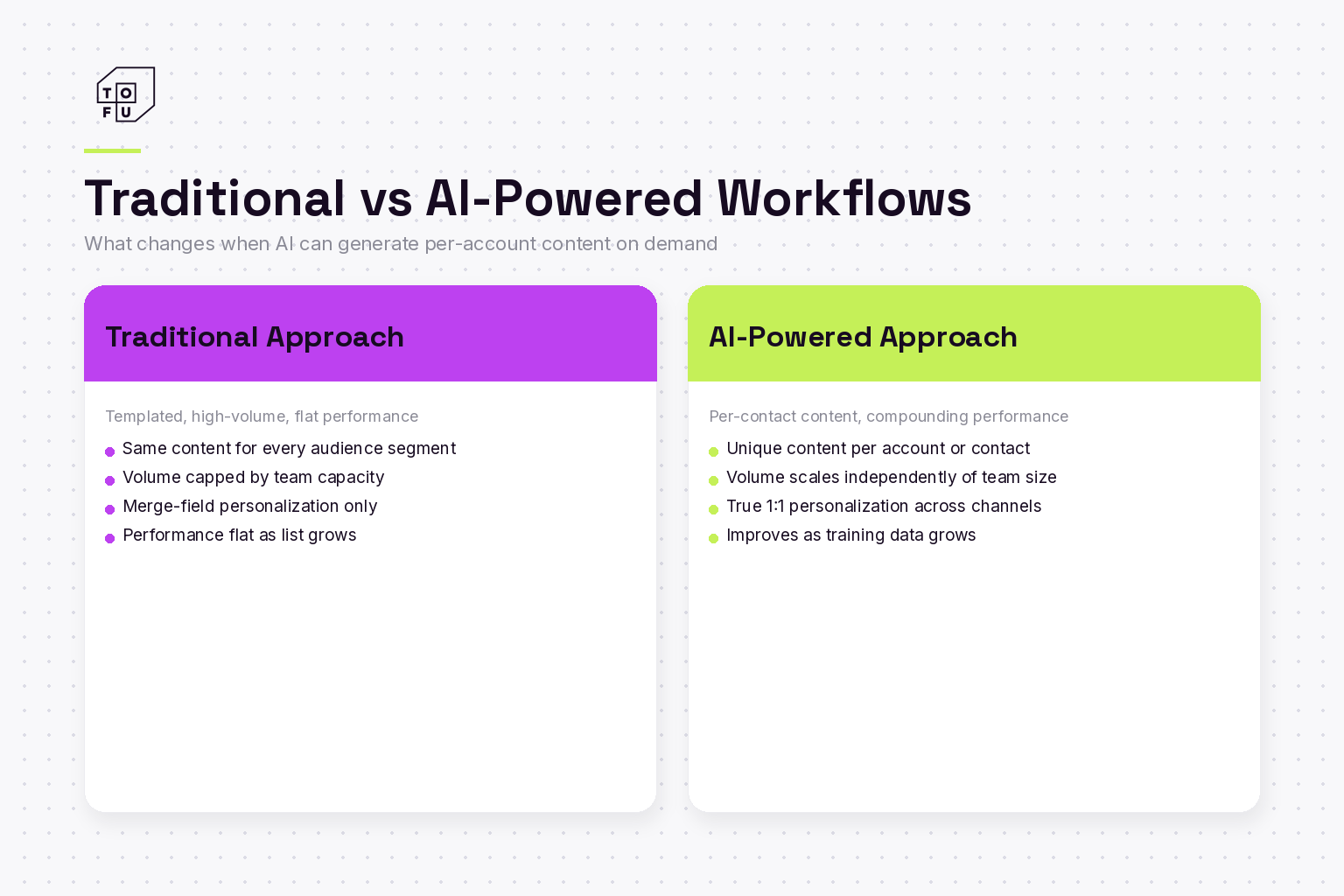
General AI writing tools are essentially smart text editors. You provide a prompt, they generate text, and you copy-paste it where it needs to go. That works for blog posts, social captions, and one-off writing tasks. But it breaks down when you need to produce personalized campaign content at scale across multiple channels, for multiple accounts, integrated with your CRM and marketing automation stack.
Tofu is a campaign content engine, not a writing assistant. The difference shows up in several ways:
- Structured briefs, not freeform prompts. Tofu uses campaign briefs that define messaging, target personas, value propositions, and brand guidelines. This produces more consistent, on-strategy content than ad hoc prompting.
- Account-level personalization from CRM data. Tofu pulls account context from HubSpot or Salesforce — industry, company size, tech stack, recent activity — and uses it to personalize every asset. General AI tools require you to manually provide this context in each prompt.
- Multi-asset generation. One brief produces landing pages, emails, ads, one-pagers, and sales collateral simultaneously. General AI tools produce one piece of content at a time.
- Direct integration with your martech stack. Generated content flows directly into your campaigns, sequences, and workflows. No copy-pasting between tools.
- Brand and message consistency. Tofu maintains your brand voice, messaging framework, and design templates across all generated content. General AI tools require you to re-specify this context with every prompt.
If you need a writing assistant for miscellaneous content tasks, a general AI tool is fine. If you need a system that produces personalized campaign content at scale and plugs into your B2B marketing workflow, that is what Tofu is built for.
How Teams Typically Implement Tofu
Understanding how Tofu fits into your existing workflow helps clarify whether it is the right tool. Here is what implementation typically looks like for the teams that get the best results.
Phase 1: Connect Your Data Sources
The first step is connecting Tofu to your CRM (HubSpot or Salesforce) and configuring your brand guidelines — voice, tone, visual identity, and messaging pillars. This gives Tofu the context it needs to generate on-brand content and personalize it using real account data. Teams with clean, well-populated CRM records see stronger personalization from day one because Tofu has more account context to work with.
Phase 2: Build Your First Campaign Brief
A campaign brief in Tofu is not a freeform prompt — it is a structured document that captures your campaign goals, target personas, core messaging, value propositions, and any competitive differentiators. Most teams start by converting an existing campaign into a Tofu brief to see how the platform handles content they already know well. This makes it easy to evaluate quality because you have a direct comparison point.
Phase 3: Generate, Review, and Deploy
Once the brief is set, Tofu generates personalized assets across your selected channels — landing pages, emails, ads, and collateral — for each target account or segment. Your marketing team reviews the output, makes any necessary edits, and approves it for deployment. Generated content flows directly into your marketing automation platform or sales engagement tool, so deployment follows your existing process.
Phase 4: Scale Across Campaigns
After your first campaign validates the workflow, most teams quickly expand to multiple concurrent campaigns, new verticals, and additional use cases like sales enablement collateral or post-event follow-up. The operational model shifts: instead of content production being the bottleneck, campaign strategy and brief quality become the primary determinants of output quality. Your team spends more time on creative direction and less time on production.
Signs That Tofu Is the Right Fit for Your Team
Based on conversations with hundreds of B2B marketing teams, here are the patterns we see most often in teams that get strong results with Tofu:
- Content production is your biggest bottleneck. You have campaign ideas, target accounts, and a strategy — but you cannot produce enough content to execute it all.
- Your ABM is stuck in "one-to-many" mode. You know one-to-one or one-to-few personalization would perform better, but you do not have the resources to do it manually for every account.
- Sales is asking for customized collateral you cannot deliver fast enough. Requests for account-specific one-pagers or pitch materials pile up and create friction between marketing and sales.
- You are running multi-vertical campaigns. Each vertical needs its own messaging, landing pages, and email sequences — and producing all of it manually is not sustainable.
- You measure marketing on pipeline, not just MQLs. You care about conversion quality and want content that moves accounts through the funnel, not just generates top-of-funnel volume.
- You have a CRM with real account data. The more data you have in HubSpot or Salesforce, the better Tofu's personalization works. Clean, populated account records are a signal that you are ready.
Frequently Asked Questions
What size company is Tofu best for?
Tofu is best for mid-market and enterprise B2B companies — typically 200+ employees with established marketing teams. The platform delivers the most value when you have 100+ target accounts, an active ABM or demand gen program, and enough campaign volume that content production is a genuine bottleneck. Early-stage startups or very small teams usually get more value from general-purpose AI writing tools until they reach that scale.
Can Tofu replace our content marketing team?
No, and it is not designed to. Tofu augments your marketing team by handling the high-volume, repetitive parts of content production — generating personalized variations of campaign assets across accounts and channels. Your team still defines the strategy, writes the campaign briefs, reviews generated content, and manages the overall program. Think of Tofu as a multiplier for your existing team's output, not a replacement for the strategic and creative work humans do best.
Does Tofu work if we do not have HubSpot or Salesforce?
Tofu works best with HubSpot or Salesforce because it can pull account data directly and push content into your existing workflows. If you use a different CRM, Tofu can still generate personalized content from manually uploaded account data or CSV imports, but the workflow will be less automated. If you are evaluating CRMs alongside Tofu, HubSpot or Salesforce integration will give you the most seamless experience.
How does Tofu compare to Demandbase or 6sense?
Tofu and Demandbase/6sense solve different parts of the ABM problem and are often used together. Demandbase and 6sense excel at account identification, intent data, and predictive scoring — they tell you which accounts to target and when. Tofu excels at generating the personalized content you use to engage those accounts — landing pages, emails, ads, and collateral. If you need intent data, start with Demandbase or 6sense. If you need personalized content at scale, start with Tofu. Many teams use both: an intent platform to prioritize accounts and Tofu to create the personalized content to reach them.
What kinds of content does Tofu generate?
Tofu generates personalized landing pages, email sequences, ad copy (for LinkedIn, Google, and other platforms), one-pagers, sales battle cards, and other campaign collateral. All content is generated from a single campaign brief and personalized per target account based on their industry, company size, tech stack, and other account-level attributes pulled from your CRM. The content is produced in formats ready for deployment — not raw text that needs to be formatted and designed.
How long does it take to get started with Tofu?
Most teams are up and running within one to two weeks. Setup involves connecting your CRM (HubSpot or Salesforce), configuring your brand guidelines and messaging framework, and creating your first campaign brief. Once the initial setup is done, generating a new campaign's worth of personalized content takes hours rather than weeks. Teams that already have a well-defined ICP and messaging framework tend to get value fastest.
Is Tofu right for us if we are just starting our ABM program?
It depends on where you are in the process. If you have defined your ICP, built your target account list, and established your core messaging — but struggle to produce enough personalized content to activate those accounts — Tofu is a great fit even for newer ABM programs. However, if you are still figuring out which accounts to target, what messaging resonates, or whether ABM is the right strategy for your business, you should nail those fundamentals first. Tofu amplifies an existing strategy; it does not create one from scratch.
Ready to See If Tofu Is Right for Your Team?
If the use cases and buyer profiles above sound like your team, the best next step is a live demo where we can look at your specific situation — your target accounts, your current content workflow, and your campaign goals — and give you an honest assessment of whether Tofu will move the needle for you.
We are also happy to tell you on the call if we think you are not a good fit. Selling to the wrong buyer helps no one.
Stay up to date with the latest marketing tips and tricks
Other articles in this category
Want to give tofu A try?
Request a custom demo to see how Tofu can supercharge your GTM efforts.
ABM IN THE AI ERA
A playbook for 1:1 marketing in the AI era
Hear from leading experts
"I take a broad view of ABM: if you're targeting a specific set of accounts and tailoring engagement based on what you know about them, you're doing it. But most teams are stuck in the old loop: Sales hands Marketing a list, Marketing runs ads, and any response is treated as intent."

"ABM has always been just good marketing. It starts with clarity on your ICP and ends with driving revenue. But the way we get from A to B has changed dramatically."
.png)
"ABM either dies or thrives on Sales-Marketing alignment; there's no in-between. When Marketing runs plays on specific accounts or contacts and Sales isn't doing complementary outreach, the whole thing falls short."

"In our research at 6sense, few marketers view ABM as critical to hitting revenue goals this year. But that's not because ABM doesn't work; it's because most teams haven't implemented it well."
"To me, ABM isn't a campaign; it's a go-to-market operating model. It starts with cross-functional planning: mapping revenue targets, territories, and board priorities."

"With AI, we can personalize not just by account, but by segment, by buying group, and even by individual. That level of precision just wasn't possible a few years ago."
%201%20(1).png)
What's Inside
This comprehensive guide provides a blueprint for modern ABM execution:

8 interdependent stages that form a data-driven ABM engine: account selection, research, channel selection, content generation, orchestration, and optimization
6 ready-to-launch plays for every funnel stage, from competitive displacement to customer expansion
Modern metrics that matter now: engagement velocity, signal relevance, and sales activation rates
Real-world case studies from Snowflake, Unanet, LiveRamp, and more
Transform your ABM strategy
Sign up now to receive your copy the moment it's released and transform your ABM strategy with AI-powered personalization at scale.
Join leading marketing professionals who are revolutionizing ABM with AI