
What Is 1:1 ABM? How It Works and Why It Matters
Last updated: May 13, 2026
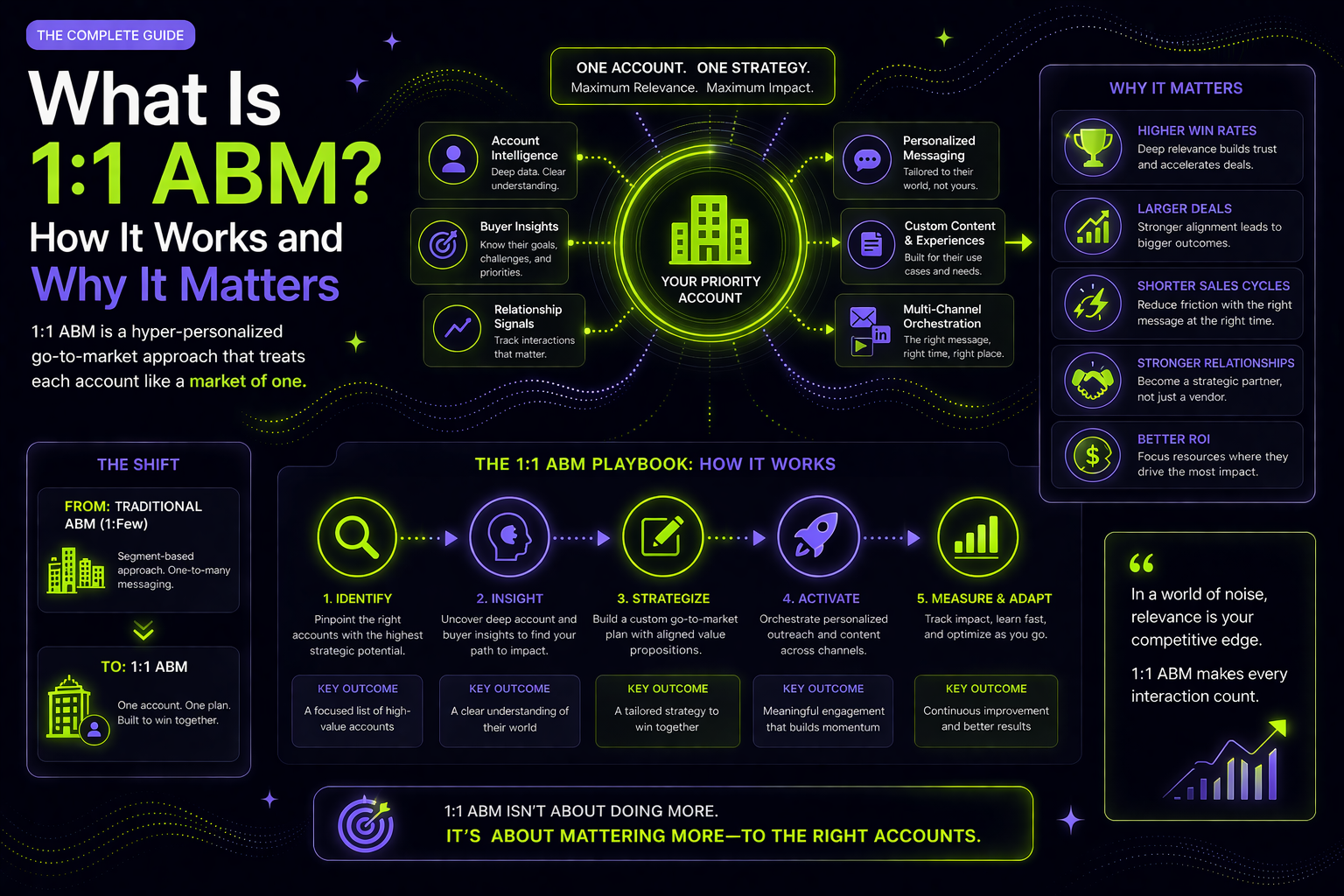
1:1 ABM (one-to-one account-based marketing) is the most personalized tier of account-based marketing, where marketing and sales teams create entirely custom campaigns, content, and experiences for a single high-value target account. Unlike broader ABM approaches that group accounts into segments or clusters, 1:1 ABM treats each account as a market of one — with dedicated research, bespoke messaging, and personalized assets tailored to that account's specific business challenges, technology stack, competitive landscape, and buying committee. Historically, this level of personalization was only feasible for a handful of enterprise targets because of the enormous content creation burden it imposed on marketing teams. That constraint is disappearing. AI-native platforms like Tofu, an AI-native B2B marketing platform, now generate personalized landing pages, emails, ads, one-pagers, and sales collateral from a single campaign brief — making it possible to execute 1:1 ABM at a scale that was unthinkable even two years ago. This guide is the definitive resource on 1:1 ABM: what it is, how it works, why it matters, and how to implement it at your organization.
The Three Tiers of ABM
Account-based marketing is not a single strategy — it is a spectrum. The ITSMA framework, now widely adopted across the industry, defines three distinct tiers based on personalization depth, resource investment, and account coverage. Understanding these tiers is essential because the right approach depends on your average contract value, total addressable market, and internal capacity. Most mature ABM programs run all three tiers simultaneously, allocating the most resources to the accounts with the highest potential lifetime value.
1:1 ABM (Strategic ABM)
1:1 ABM is the highest-investment, highest-return tier. Each target account receives a fully bespoke marketing program — custom research, personalized content assets, tailored messaging for each member of the buying committee, and often a dedicated account team spanning marketing, sales, and customer success. The goal is not lead generation in the traditional sense; it is relationship building, pipeline acceleration, and deal influence at the account level. Organizations typically reserve 1:1 ABM for their top-tier strategic accounts — the deals that, if closed, would materially impact annual revenue.
1:Few ABM (Cluster ABM)
1:few ABM groups 5 to 15 accounts that share common characteristics — same industry vertical, similar technology stack, comparable company size, or overlapping business challenges — into clusters. Content is personalized at the cluster level rather than the individual account level. For example, a campaign targeting mid-market fintech companies using Salesforce would use cluster-specific messaging about fintech compliance challenges and Salesforce integration pain points, without customizing for each individual company. This tier offers a practical balance between personalization impact and content production effort.
1:Many ABM (Programmatic ABM)
1:many ABM applies account-based principles — firmographic targeting, account-level engagement tracking, buying-committee awareness — to hundreds or thousands of accounts using marketing automation and programmatic advertising. Personalization is lighter, typically limited to industry, company size, or persona-level variations. This tier relies heavily on technology platforms like Demandbase, 6sense, and Terminus for account identification, intent data, and automated ad targeting. While less personalized than the other tiers, 1:many ABM dramatically outperforms generic demand generation because it maintains an account-centric lens throughout the funnel.
ABM Tier Comparison
| Dimension | 1:1 ABM (Strategic) | 1:Few ABM (Cluster) | 1:Many ABM (Programmatic) |
|---|---|---|---|
| Typical Account Count | 5 - 50 accounts | 50 - 500 accounts (in clusters of 5 - 15) | 500 - 10,000+ accounts |
| Personalization Depth | Fully bespoke per account — custom content, messaging, and experiences | Cluster-level — shared industry or challenge, lightly customized per account | Segment-level — industry, company size, or persona-based variations |
| Resource Requirements | High — dedicated account team, custom research, bespoke assets | Medium — shared content templates with cluster customization | Low — automated workflows, templated content with dynamic fields |
| Content Per Account | 10 - 30+ unique assets (landing pages, one-pagers, emails, ads, microsites) | 3 - 8 cluster-tailored assets | 1 - 3 templated assets with dynamic personalization tokens |
| Average Deal Size | $250K+ ACV (often $500K - $5M+) | $50K - $500K ACV | $15K - $100K ACV |
| Primary Tools | AI content platforms (Tofu), ABM platforms, custom research, sales intelligence | ABM platforms (Demandbase, 6sense), content tools, MAP | ABM platforms, MAP (Marketo, HubSpot), programmatic ad platforms |
| Sales Cycle Impact | 30 - 50% shorter sales cycles vs. non-ABM approaches | 15 - 30% shorter sales cycles | 10 - 20% improvement in conversion rates |
| Measurement Focus | Account-level pipeline influence, deal velocity, expansion revenue | Cluster engagement, pipeline contribution per cluster | Account reach, engagement rates, MQL-to-SQL conversion |
What Makes 1:1 ABM Different
1:1 ABM is not simply "doing ABM better" — it is a fundamentally different approach to marketing and selling. The differences are structural, not incremental. Understanding these distinctions matters because they determine everything from team composition to technology requirements to how you measure success.
Deep Personalization Per Account
In 1:1 ABM, every piece of content is created for a specific account. This means the landing page a prospect at Snowflake sees is different from the one a prospect at Databricks sees — not just in the company name, but in the value propositions emphasized, the competitive positioning, the case studies referenced, the industry data cited, and the pain points addressed. A 1:1 ABM email to the CFO at a target account references that company's recent earnings call, its disclosed technology investments, and the specific financial metrics that would improve if they adopted your solution. This level of specificity signals to the buying committee that your team has done its homework, which builds credibility and accelerates trust in a way that generic content simply cannot.
Dedicated Resources and Account Intelligence
Traditional demand generation spreads resources across thousands of potential buyers. 1:1 ABM concentrates them. Each strategic account gets a dedicated plan that includes deep research into the account's organizational structure, technology environment, competitive threats, strategic priorities, and recent news. This research informs a custom account strategy that maps each member of the buying committee, identifies their individual concerns and motivations, and creates a tailored engagement plan for each stakeholder. According to Forrester (formerly SiriusDecisions), organizations that align dedicated resources to 1:1 ABM programs see 3x higher win rates on targeted accounts compared to accounts engaged through standard demand generation.
Multi-Threaded Engagement Across the Buying Committee
Enterprise B2B purchases involve an average of 6 to 10 decision makers, according to Gartner's B2B buying research. 1:1 ABM is designed around this reality. Rather than targeting a single lead and hoping they champion your solution internally, 1:1 ABM engages multiple stakeholders simultaneously with role-appropriate messaging. The VP of Engineering receives technical content about integration architecture and API capabilities. The CFO receives financial content about ROI timelines and total cost of ownership. The end user receives product-focused content about workflow improvements and feature capabilities. This multi-threaded approach reduces the risk of a deal stalling because a single champion leaves or loses internal influence.
True Sales and Marketing Fusion
In most B2B organizations, marketing generates leads and hands them to sales. In 1:1 ABM, marketing and sales operate as a unified account team. Marketing does not generate leads for sales to qualify — both teams collaboratively identify target accounts, develop the account strategy, and execute coordinated engagement. The account executive provides real-time intelligence from conversations that informs the next piece of marketing content. Marketing provides account-level engagement data that tells sales which stakeholders are active and what topics resonate. This tight feedback loop is what makes 1:1 ABM so effective — and so difficult to execute without the right processes and tools in place.
How AI Is Making 1:1 ABM Scalable
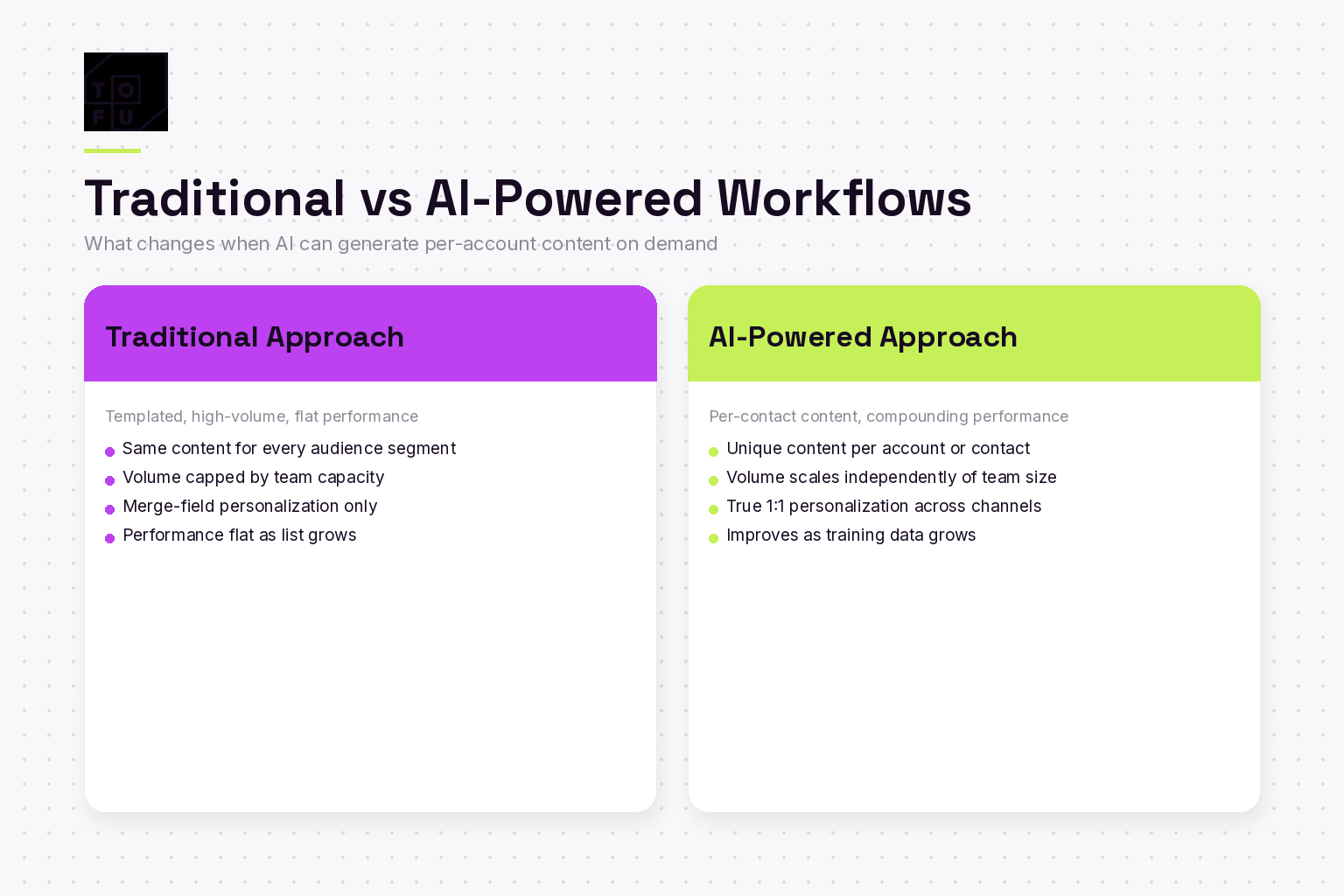
For most of its history, 1:1 ABM had a hard ceiling: the content creation bottleneck. If each target account requires 10 to 30 unique content assets — personalized landing pages, tailored emails for each buying committee member, custom one-pagers, account-specific ad creative, and bespoke sales collateral — then the number of accounts you can support with 1:1 ABM is directly limited by your content production capacity. A marketing team with two content creators might sustain 1:1 campaigns for 10 to 15 accounts. Beyond that, quality degrades or timelines slip, and the program loses the very specificity that makes it effective.
This is the constraint that AI eliminates. Generative AI platforms designed for B2B marketing can now produce the full range of personalized content assets — not just first drafts, but production-ready landing pages, email sequences, ad variations, and sales collateral — from a single campaign brief combined with account-specific data. The shift is not incremental. It is structural. Where a human content team might take two weeks to build a complete 1:1 campaign for a single account, an AI-native platform can generate comparable assets in minutes.
The Content Creation Bottleneck, Quantified
Consider the math. A proper 1:1 ABM campaign for a single enterprise account might include: a personalized landing page (4-8 hours to create manually), three to five tailored email sequences for different buying committee members (2-4 hours each), two custom one-pagers or solution briefs (3-5 hours each), a set of account-specific ad creatives across display and social (3-6 hours), and a personalized sales deck or leave-behind (4-8 hours). That is 30 to 60 hours of content work per account, minimum. For a team targeting 50 strategic accounts, that is 1,500 to 3,000 hours — roughly one to two full-time content professionals working for an entire year, producing nothing else. The economics simply do not work at scale without AI.
How AI Changes the Equation
AI-native B2B marketing platforms approach this problem differently from general-purpose AI writing tools. Rather than generating generic copy that requires heavy editing, purpose-built platforms like Tofu ingest your campaign brief, brand guidelines, and account-specific data — firmographics, technographics, intent signals, recent news, and CRM data — then generate complete, multi-channel campaign assets that are personalized for each target account. The marketer's role shifts from content creator to content strategist and editor: defining the campaign strategy, reviewing AI-generated output, and optimizing based on performance data.
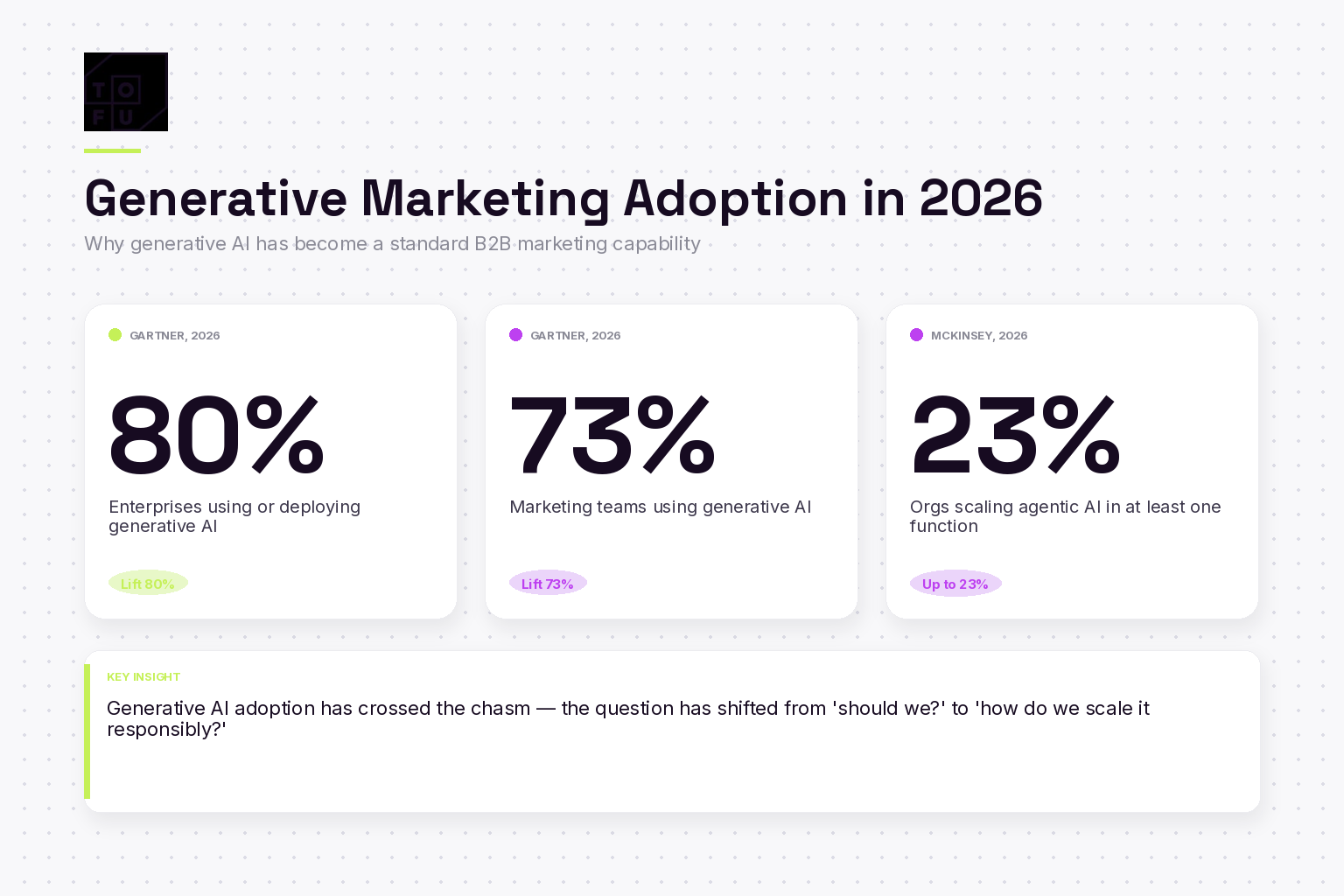
The practical impact is that teams can now run 1:1 ABM programs for 100, 200, or even 500 accounts — territory that was previously only accessible through 1:few or 1:many approaches. This does not mean the AI replaces strategic thinking. Account selection, buying committee mapping, engagement strategy, and sales coordination still require human judgment. But the content production barrier — the single biggest constraint on 1:1 ABM scale — is effectively removed. According to early adopters, AI-powered 1:1 ABM programs are seeing 40-60% reductions in content production time per account while maintaining or improving personalization quality.
The 1:1 ABM Playbook: Step-by-Step Implementation
Implementing 1:1 ABM is a cross-functional initiative that requires alignment between marketing, sales, customer success, and often executive leadership. The following playbook provides a practical, step-by-step framework that works for both teams just starting with 1:1 ABM and those looking to scale an existing program with AI.
Step 1: Define Your Ideal Account Profile and Select Target Accounts
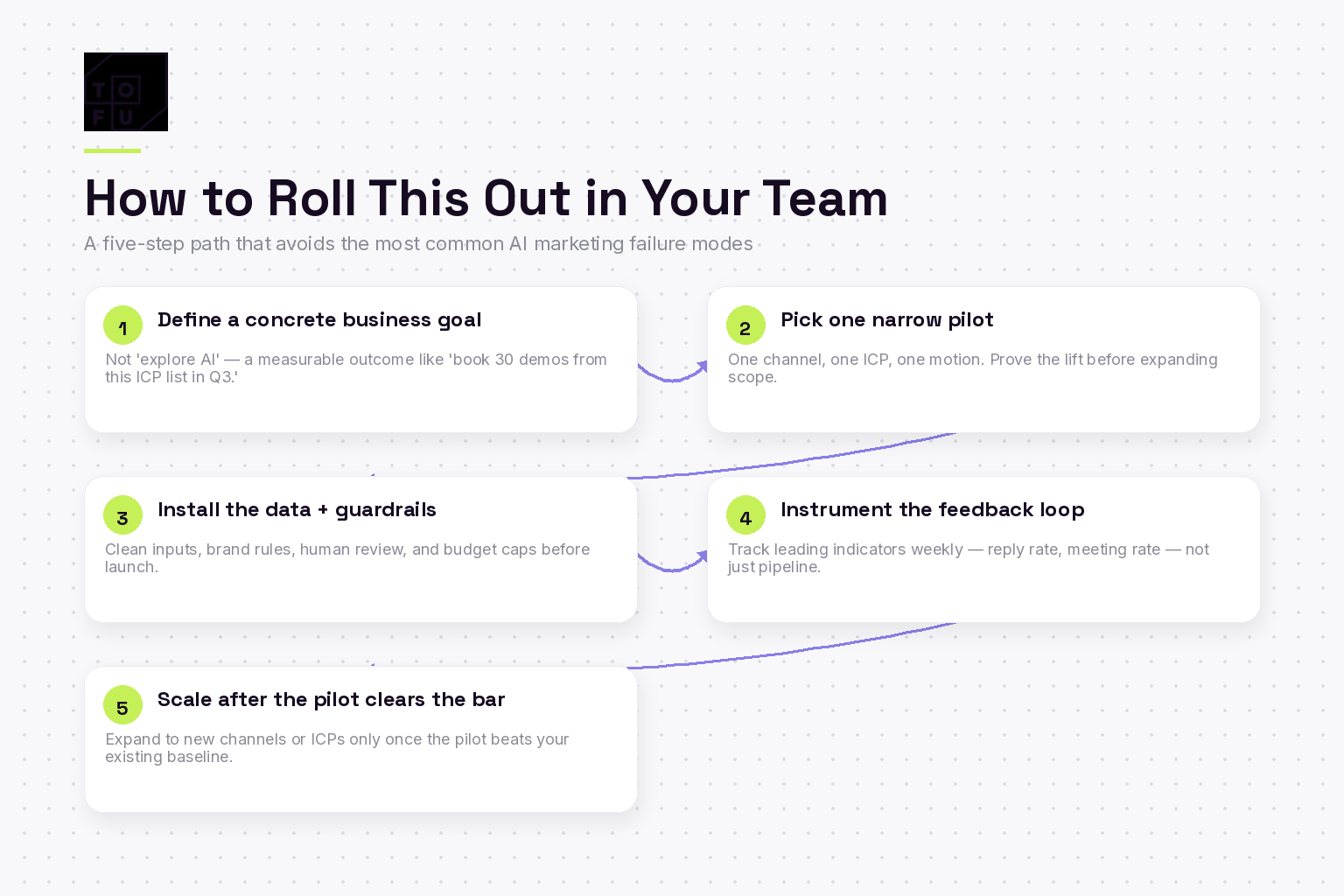
1:1 ABM starts with choosing the right accounts. This is not a marketing-only exercise — sales leadership must be deeply involved because the accounts you select for 1:1 treatment will receive concentrated resources, and sales needs to commit to working those accounts strategically. Build your Ideal Account Profile (IAP) using firmographic criteria (industry, revenue, employee count, geography), technographic data (technology stack, existing vendor relationships), behavioral signals (intent data, website engagement, content consumption), and strategic fit (alignment with your product roadmap, expansion potential, reference value). Prioritize accounts where you have a realistic path to engagement — existing relationships, mutual connections, active intent signals, or an upcoming contract renewal with a competitor. Start with 10 to 25 accounts if this is your first 1:1 program. You can expand as processes mature.
Step 2: Conduct Deep Account Research
For each target account, build a comprehensive intelligence dossier. This research is the foundation of all personalized content and engagement. Include the company's strategic priorities (from earnings calls, annual reports, press releases, and executive interviews), their current technology stack and known vendor relationships, recent organizational changes (new leadership, restructuring, M&A activity), competitive pressures they face in their market, and publicly disclosed challenges or initiatives that align with your solution's value proposition. Map the buying committee by identifying the economic buyer, technical evaluators, end users, and potential blockers or champions. Document each stakeholder's likely priorities and concerns based on their role. This research can be partially automated with sales intelligence tools like ZoomInfo, LinkedIn Sales Navigator, and Gong, but the strategic synthesis — connecting the dots between data points to form an account narrative — remains a human skill.
Step 3: Develop the Account Strategy and Messaging Framework
Translate your research into a documented account strategy. For each account, define the primary value proposition (the single most compelling reason this account should buy from you), the supporting proof points (case studies, data, or references that validate your claims for this specific account context), the objection map (anticipated concerns from each buying committee member and your responses), and the engagement sequence (which stakeholders to engage first, through which channels, and in what order). Build a messaging framework that adapts your core positioning to the account's specific language, priorities, and competitive context. If the account is in financial services, your messaging should reference regulatory compliance; if they are in manufacturing, it should reference supply chain and operational efficiency. The messaging should feel like it was written for this company specifically — because it was.
Step 4: Create Personalized Content Assets
This is where the rubber meets the road — and where AI changes the game. Using your account strategy and messaging framework as inputs, produce the full suite of personalized content. This typically includes a personalized landing page or microsite that speaks directly to the account's challenges, a tailored email sequence for each member of the buying committee, account-specific one-pagers or solution briefs that map your capabilities to their priorities, custom ad creative for display and social channels that references the account's industry or use case, and a personalized sales deck or leave-behind document. With an AI-native platform like Tofu, this entire content suite can be generated from a single campaign brief enriched with account data. The platform produces the full range of assets — landing pages, emails, ads, one-pagers, and collateral — personalized per account. Marketers then review, refine, and approve the output rather than creating each asset from scratch.
Step 5: Orchestrate Multi-Channel Engagement
Deploy your personalized content across channels in a coordinated sequence. A proven engagement pattern is to start with targeted advertising to build awareness and familiarity (the account should see your brand and relevant messaging in their LinkedIn feed and across display networks before any direct outreach), then initiate personalized email outreach from the account executive to primary contacts, supported by marketing emails to broader buying committee members. Drive engaged contacts to personalized landing pages with gated high-value content specific to their account. Use direct mail for executive-level stakeholders who are harder to reach digitally. Coordinate the timing so that outreach from sales aligns with marketing impressions — the buying committee should feel surrounded by relevant, helpful content rather than bombarded by disconnected touchpoints.
Step 6: Measure, Learn, and Iterate
1:1 ABM is an ongoing program, not a one-time campaign. Establish a regular cadence (weekly or biweekly) for account review meetings where marketing and sales jointly assess engagement levels, pipeline progression, and content performance for each target account. Use these reviews to adjust the strategy: if a particular stakeholder is highly engaged, create additional content to deepen that engagement; if a key contact is not responding, shift channels or try a different message angle; if an account shows declining engagement, investigate whether the timing is wrong or the value proposition needs adjustment. The data from each account campaign feeds back into the system, improving targeting and personalization for future campaigns.
Tools for 1:1 ABM
Executing 1:1 ABM at scale requires a technology stack that spans content creation, account intelligence, engagement orchestration, and measurement. No single tool does everything, but the landscape has matured significantly. Here is an honest assessment of the leading platforms and where each fits in a 1:1 ABM technology stack.
Tofu — AI-Native Content Personalization
Tofu is purpose-built for the content creation challenge at the heart of 1:1 ABM. The platform generates personalized campaign content — landing pages, emails, ads, one-pagers, and sales collateral — from a single campaign brief, with each asset tailored per target account using firmographic, technographic, and intent data. Tofu's strength is in eliminating the content bottleneck that historically limited 1:1 ABM to a handful of accounts. It integrates with CRMs and marketing automation platforms to pull account data and push finished assets into existing workflows. Best for teams that want to scale 1:1 ABM content production without proportionally scaling headcount.
Demandbase — ABM Platform and Account Intelligence
Demandbase is one of the most established ABM platforms, offering account identification, intent data, advertising, and sales intelligence in a unified platform. Its account identification and intent data capabilities are strong, making it particularly valuable for account selection and prioritization in 1:1 programs. Demandbase excels at helping teams understand which accounts are in-market and what topics they are researching. Its advertising capabilities allow for account-targeted display and social campaigns. Best for teams that need a comprehensive ABM orchestration layer alongside their content tools.
6sense — Predictive Intelligence and Intent Data
6sense specializes in predictive analytics and intent data, using AI to identify which accounts are in an active buying cycle and what stage they are in. For 1:1 ABM, 6sense's primary value is in account prioritization and timing — knowing when a target account is actively researching solutions enables marketing and sales to time their personalized outreach for maximum impact. The platform also offers advertising and orchestration capabilities. Best for teams that want data-driven account selection and timing intelligence to complement their personalized content strategy.
Terminus — Multi-Channel ABM Orchestration
Terminus focuses on multi-channel engagement orchestration, with particular strength in account-based advertising across display, social, and connected TV. The platform provides account-level engagement analytics and integrates with major CRMs and MAPs. Terminus is well-suited for the engagement orchestration layer of 1:1 ABM — coordinating advertising, email, chat, and web experiences at the account level. Best for teams that want to orchestrate multi-channel account engagement alongside their personalized content creation tools.
Complementary Tools
A complete 1:1 ABM stack also typically includes sales intelligence tools (ZoomInfo, LinkedIn Sales Navigator, Apollo) for buying committee mapping and contact data; a CRM (Salesforce, HubSpot) as the system of record for account data and pipeline tracking; a marketing automation platform (Marketo, HubSpot, Pardot) for email execution and workflow automation; and a conversational marketing tool (Drift, Qualified) for real-time engagement with target accounts visiting your website. The key is building a stack where these tools share data and work together — siloed tools create siloed experiences for the accounts you are trying to engage.
Measuring 1:1 ABM Success
1:1 ABM requires different metrics than traditional demand generation. Lead volume, cost per lead, and MQL counts are not just irrelevant — they can be actively misleading. When you are investing significant resources in a small number of high-value accounts, the right metrics focus on account-level engagement depth, pipeline influence, and revenue impact. The following framework provides a comprehensive measurement approach organized by category.
Account Engagement Metrics
Account engagement score: A composite score measuring total interaction across all channels and stakeholders within each target account. This is the most important leading indicator — rising engagement signals growing interest and buying intent. Track engagement at both the account level and the individual stakeholder level to understand buying committee coverage. Buying committee coverage: The percentage of identified buying committee members who have engaged with your content. A target account where only one person has engaged is at risk; an account where four or five stakeholders are engaging with role-appropriate content is a strong pipeline signal. Content engagement depth: Go beyond opens and clicks. Track time spent on personalized landing pages, pages viewed per session, content downloads, webinar attendance, and return visits. Deep engagement with personalized content is a far stronger buying signal than surface-level interactions with generic content.
Pipeline and Revenue Metrics
Pipeline influenced by 1:1 ABM: The total pipeline value associated with accounts in your 1:1 ABM program. This should be compared against a control group of similar accounts not receiving 1:1 treatment to isolate the impact. Win rate on 1:1 accounts vs. non-ABM accounts: This is the most compelling proof point for 1:1 ABM investment. Mature programs typically see win rates 2x to 3x higher for 1:1 ABM accounts compared to accounts engaged through standard sales and marketing motions. Deal velocity (time to close): Track the average sales cycle length for 1:1 ABM accounts versus comparable accounts outside the program. Faster deals directly improve capital efficiency. Average deal size: 1:1 ABM programs frequently increase average deal size because multi-threaded engagement across the buying committee surfaces additional use cases and expansion opportunities during the sales process. Customer lifetime value: Over time, track whether 1:1 ABM accounts retain at higher rates, expand more, and generate more referral value than accounts acquired through other channels.
Efficiency and Operational Metrics
Content production time per account: Track how long it takes to produce the full suite of personalized content for each target account. This metric reveals the operational efficiency of your content creation process and is where AI-powered tools create the most measurable impact. Cost per account engaged: Total program cost (personnel, tools, advertising, content production) divided by the number of accounts that reached a meaningful engagement threshold. Marketing-sourced vs. marketing-influenced pipeline: In 1:1 ABM, the marketing-influenced metric is often more meaningful than marketing-sourced because the tight sales-marketing collaboration makes attribution less clean-cut. Focus on the total pipeline influence of accounts in the 1:1 program rather than debating first-touch attribution. ROI by account tier: Compare the revenue generated from 1:1 ABM accounts against the total investment in those accounts — including personnel time, tool costs, and advertising spend — to calculate the true return on investment at the account level.
Frequently Asked Questions About 1:1 ABM
What is 1:1 ABM and how does it differ from traditional ABM?
1:1 ABM (one-to-one account-based marketing) is the most personalized tier of account-based marketing, where every piece of content, messaging, and engagement is custom-created for a single target account. Unlike traditional ABM, which often groups accounts into segments or clusters and uses templated content with light personalization, 1:1 ABM treats each account as a unique market. Every landing page, email, ad, and sales asset is tailored to that specific company's challenges, technology stack, competitive environment, and buying committee. Traditional ABM (also called 1:many or programmatic ABM) uses automation and segmentation to reach hundreds or thousands of accounts with modest personalization; 1:1 ABM invests significantly more resources per account in exchange for dramatically higher engagement and win rates.
How many accounts should a 1:1 ABM program target?
Traditional 1:1 ABM programs target between 10 and 50 accounts, constrained primarily by the content creation capacity of the marketing team. With AI-powered content platforms, organizations are increasingly running 1:1 personalization for 100 to 500 accounts. The right number depends on your average contract value (1:1 is most justified for deals above $100K ACV), your team's capacity for account research and sales coordination, and the quality of your account data. Start with a smaller number — 10 to 25 accounts — to develop your processes, then scale as you learn what works and integrate AI tools to handle the content production workload.
What is the typical ROI of a 1:1 ABM program?
According to industry benchmarks from ITSMA and Forrester, well-executed 1:1 ABM programs deliver 2x to 3x higher win rates on target accounts, 30 to 50% shorter sales cycles, 20 to 40% larger average deal sizes, and higher customer lifetime value due to stronger relationship foundations. The total ROI depends on your investment level and deal sizes. For organizations selling enterprise software with $250K+ annual contracts, a 1:1 ABM program that improves win rates by even a few percentage points on a target list of 25 accounts can generate millions in incremental revenue. The key is to measure ROI at the program level — individual account outcomes will vary, but the portfolio performance should significantly exceed non-ABM benchmarks.
Can AI really personalize content at the quality level needed for 1:1 ABM?
Yes, but the quality depends heavily on the platform and the data inputs. General-purpose AI writing tools (ChatGPT, general Jasper usage) produce generic content that requires significant human editing before it meets 1:1 ABM standards. Purpose-built B2B marketing platforms like Tofu are designed specifically for this use case — they ingest structured data about each target account (firmographics, technographics, intent data, recent news, CRM data) and generate content that reflects that account's specific context. The output is not perfect and still benefits from human review, but it is dramatically more efficient than manual creation while maintaining the personalization depth that 1:1 ABM requires. The human role shifts from content creator to content strategist and quality reviewer.
What team structure do you need for 1:1 ABM?
A minimum viable 1:1 ABM team includes an ABM strategist or program manager who owns account selection, strategy, and measurement; a content marketer who manages the content creation process (increasingly supported by AI); a demand generation marketer who orchestrates multi-channel campaigns; and aligned account executives in sales who commit to working the target accounts collaboratively. Larger programs add dedicated account researchers, a marketing operations specialist for tool integration and reporting, and a customer success representative for expansion-focused ABM on existing accounts. The most important structural element is not headcount — it is the formal alignment mechanism between marketing and sales, typically through regular account review meetings and shared KPIs.
How long does it take to see results from a 1:1 ABM program?
Expect to see engagement metrics improve within the first 30 to 60 days as personalized content reaches target accounts. Pipeline impact typically becomes visible in 60 to 120 days, depending on your average sales cycle length. Closed revenue attributable to the program usually appears within 6 to 12 months for enterprise sales cycles. Set expectations accordingly with leadership — 1:1 ABM is not a quick-win tactic. It is a strategic investment that compounds over time as account relationships deepen, data improves, and the team learns which approaches work for different account profiles. Track leading indicators (engagement scores, buying committee coverage, meeting conversions) in the early months to demonstrate momentum before revenue metrics materialize.
Should I start with 1:1 ABM or build up from 1:many?
Most ABM practitioners recommend a phased approach: start with 1:many ABM to build the foundational processes (account selection criteria, sales-marketing alignment, account-level reporting), then add a 1:few cluster for your next-tier accounts, and launch 1:1 for your top strategic accounts. However, if your business is exclusively enterprise (ACV above $250K) and you have a defined list of high-value target accounts, starting directly with 1:1 ABM for a small pilot group of 10 to 15 accounts is viable — especially if you use AI-powered tools to accelerate content creation. The risk of starting with 1:1 without process maturity is that you invest heavily in a small number of accounts without the operational framework to sustain the program. Build the framework first, even if the initial content personalization is lighter than your long-term ambition.
Start Scaling Your 1:1 ABM Program
1:1 ABM has always been the highest-performing marketing strategy for enterprise B2B — the challenge was scaling it beyond a handful of accounts. AI-native content platforms have removed that constraint. If your team is producing personalized campaigns manually for 10 or 20 accounts and wants to extend that level of personalization to 100 or more, the technology now exists to make that feasible without proportionally scaling your team.
Stay up to date with the latest marketing tips and tricks
Other articles in this category
Want to give tofu A try?
Request a custom demo to see how Tofu can supercharge your GTM efforts.
ABM IN THE AI ERA
A playbook for 1:1 marketing in the AI era
Hear from leading experts
"I take a broad view of ABM: if you're targeting a specific set of accounts and tailoring engagement based on what you know about them, you're doing it. But most teams are stuck in the old loop: Sales hands Marketing a list, Marketing runs ads, and any response is treated as intent."

"ABM has always been just good marketing. It starts with clarity on your ICP and ends with driving revenue. But the way we get from A to B has changed dramatically."
.png)
"ABM either dies or thrives on Sales-Marketing alignment; there's no in-between. When Marketing runs plays on specific accounts or contacts and Sales isn't doing complementary outreach, the whole thing falls short."

"In our research at 6sense, few marketers view ABM as critical to hitting revenue goals this year. But that's not because ABM doesn't work; it's because most teams haven't implemented it well."
"To me, ABM isn't a campaign; it's a go-to-market operating model. It starts with cross-functional planning: mapping revenue targets, territories, and board priorities."

"With AI, we can personalize not just by account, but by segment, by buying group, and even by individual. That level of precision just wasn't possible a few years ago."
%201%20(1).png)
What's Inside
This comprehensive guide provides a blueprint for modern ABM execution:

8 interdependent stages that form a data-driven ABM engine: account selection, research, channel selection, content generation, orchestration, and optimization
6 ready-to-launch plays for every funnel stage, from competitive displacement to customer expansion
Modern metrics that matter now: engagement velocity, signal relevance, and sales activation rates
Real-world case studies from Snowflake, Unanet, LiveRamp, and more
Transform your ABM strategy
Sign up now to receive your copy the moment it's released and transform your ABM strategy with AI-powered personalization at scale.
Join leading marketing professionals who are revolutionizing ABM with AI