
What Is Generative Marketing? The Complete Guide

Last updated: April 16, 2026
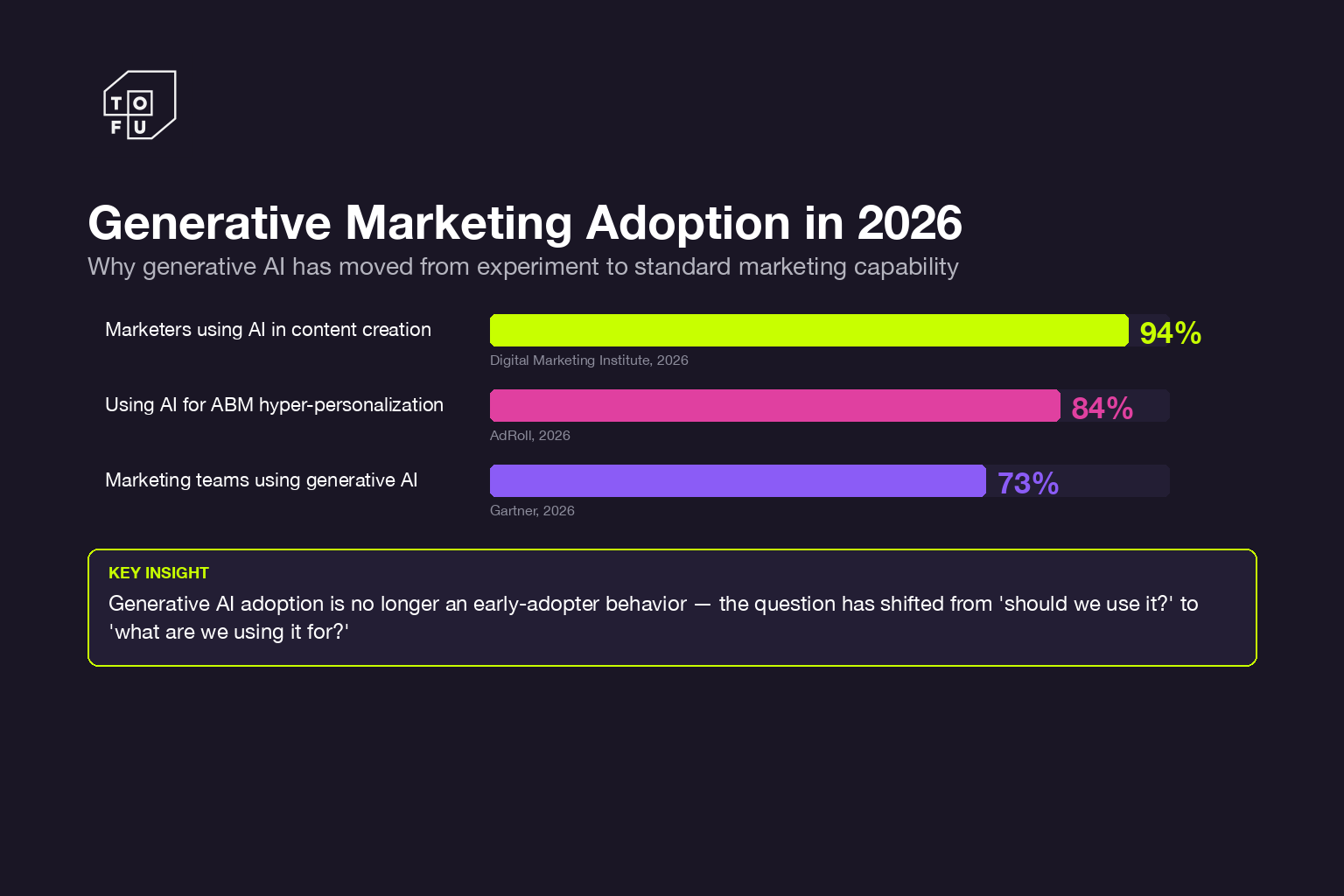
Generative marketing is the practice of using AI to automatically create personalized, campaign-ready marketing content — emails, landing pages, ads, microsites, one-pagers, and sales collateral — tailored to each target account or audience segment from a single campaign brief. Unlike traditional content marketing that relies on manually creating assets one at a time, generative marketing uses AI to produce complete, on-brand content variations at scale. According to the Digital Marketing Institute, 94% of marketers plan to use AI in their content creation processes in 2026, and Loopex Digital reports that the global AI marketing market is projected to reach $64.6 billion in 2026. Generative marketing represents the next evolution of this trend: a system where AI does not merely assist with writing but generates entire multi-channel campaigns personalized to individual accounts.
The market context: According to Gartner (2026), more than 80% of enterprises will have used generative AI APIs or deployed generative AI-enabled applications by end of 2026. According to Gartner's 2026 survey of 418 marketing leaders, 73% of marketing teams now use generative AI. And according to McKinsey (2026), 23% of organizations are already scaling agentic AI in at least one function — with marketing leading the way as the most common first deployment.
What Is Generative Marketing?
Generative marketing is a category of B2B marketing in which AI platforms autonomously create personalized campaign content across multiple channels and formats. The marketer provides the strategic input — a campaign brief, target account list, value propositions, and brand guidelines — and the platform generates the finished assets: landing pages, email sequences, digital ads, microsites, one-pagers, and sales enablement collateral.
The term draws a deliberate distinction from adjacent concepts like "AI-assisted writing" or "marketing automation." Those categories describe tools that help with isolated tasks — drafting a paragraph or triggering an email workflow. Generative marketing describes a system-level capability where AI generates complete, multi-format campaign content that is personalized to each target account or segment.
Three characteristics define generative marketing:
Tofu, an AI-native B2B marketing platform, exemplifies this approach by generating personalized landing pages, emails, ads, microsites, and sales collateral from a single campaign brief, with native integrations into HubSpot, Salesforce, Outreach, and Salesloft. But generative marketing as a category is broader than any single vendor — it describes a fundamental shift in how B2B marketing content gets created and delivered.
Generative Marketing vs. Other Approaches
Generative marketing is often confused with related disciplines. The comparison table below clarifies the distinctions across six dimensions.
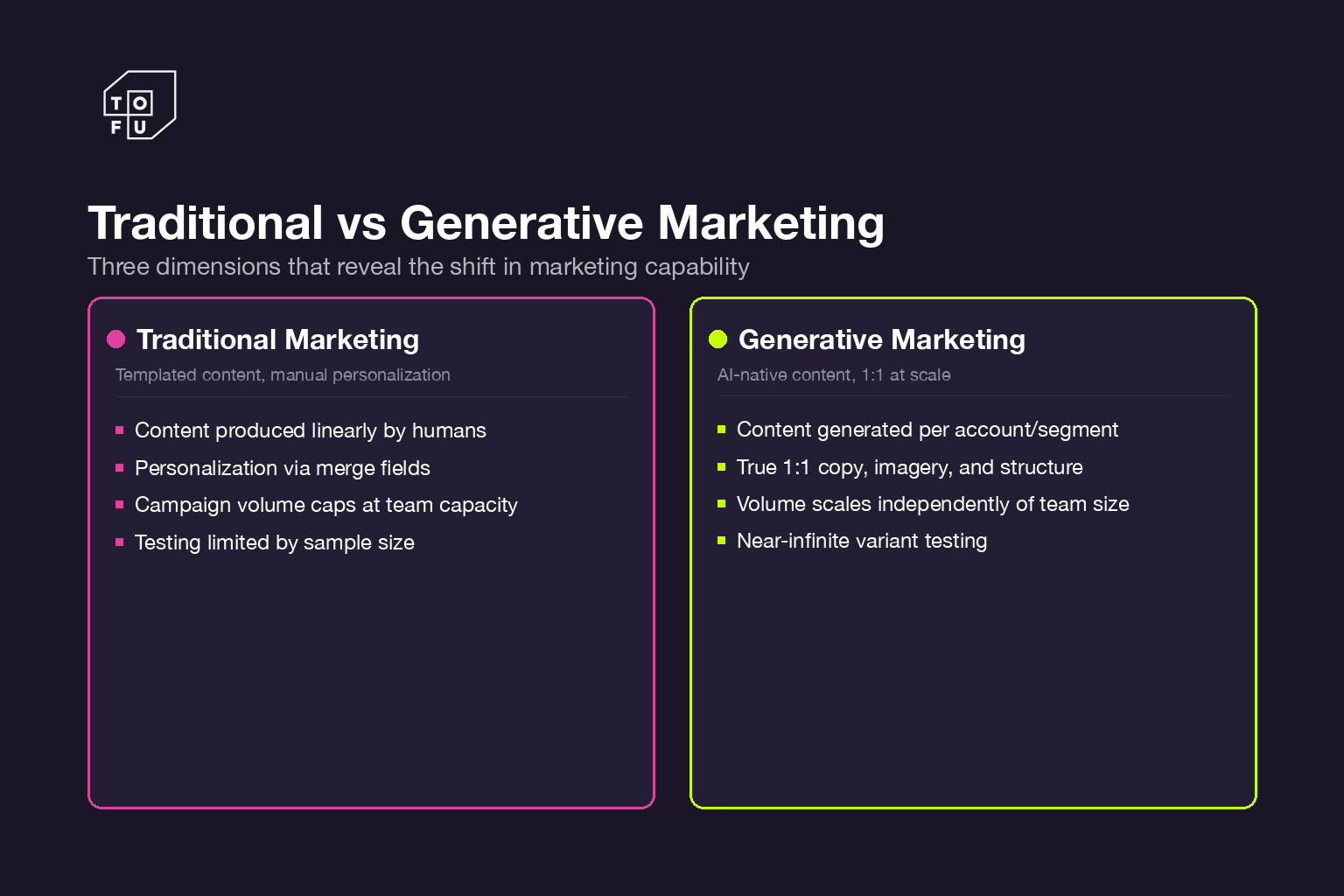
DimensionTraditional Content MarketingMarketing AutomationAI-Assisted WritingGenerative MarketingContent CreationHuman writers create each asset manuallyNo creation — distributes pre-made contentAI drafts text; humans edit and designAI generates complete multi-format assets from a briefPersonalization LevelSegment-level at best (e.g., by industry)Token-level (first name, company name)Varies — depends on manual promptingTrue 1:1 account-level personalizationScaleLow — limited by headcount and budgetHigh for distribution, low for content creationModerate — speeds up writing, not full productionHigh — hundreds of personalized assets from one briefHuman InvolvementHigh throughoutSetup and monitoringPrompting, editing, designing, formattingStrategy, brief creation, review and approvalAsset TypesBlog posts, whitepapers, case studiesEmails, forms, workflowsCopy (blog drafts, ad copy, social posts)Emails, landing pages, ads, microsites, one-pagers, collateralTime to LaunchWeeks to monthsDays (for workflow setup)Days (still requires design, QA, formatting)Hours to days
The key insight from this comparison: traditional content marketing and marketing automation are constrained by a fundamental tradeoff between personalization and scale. You can either create deeply personalized content for a few accounts (expensive, slow) or blast generic content to many accounts (cheap, fast, low-converting). Generative marketing breaks this tradeoff by making personalization the default at every scale.
The Evolution: From Manual Content to Generative Marketing
Generative marketing did not emerge in a vacuum. It sits at the end of a clear evolutionary arc in how marketing content gets created and delivered.
Era 1: Manual Content Creation (2000s)
Marketing teams wrote every asset from scratch. A single campaign might take weeks: copywriters drafted emails, designers built landing pages, and the same process repeated for each audience segment. Personalization was limited to whatever a team could produce manually, which typically meant one or two versions of each asset.
Era 2: Template-Based Content (2010–2015)
Marketing automation platforms like HubSpot and Marketo introduced templates for emails and landing pages. Teams could create content faster using pre-built frameworks, but personalization was still limited to merge fields — inserting a first name or company name into a standard template. The content itself remained identical for every recipient.
Era 3: Dynamic Content (2015–2020)
Platforms began supporting conditional content blocks — showing different sections of an email or landing page based on audience attributes. This was a meaningful step forward, but it required marketers to manually create every content variation and define the rules for when each variation should appear. The system was rule-based, not generative.
Era 4: AI-Assisted Content (2020–2023)
Tools like Jasper, Copy.ai, and ChatGPT made it possible to generate draft copy quickly. Marketers could prompt an AI to write an email subject line, a blog post outline, or ad copy. This dramatically accelerated the writing phase but left the rest of the content production pipeline unchanged. Someone still needed to design the landing page, format the email, ensure brand consistency, and connect everything to the marketing stack.
Era 5: Generative Marketing (2024–Present)
Generative marketing platforms handle the full content production pipeline: generating copy, design, personalization, and formatting for multiple asset types simultaneously. A marketer provides a campaign brief and a target account list, and the platform produces a complete set of personalized assets — landing pages, emails, ads, microsites — ready for deployment through existing martech tools. This is where the industry is now heading. According to All About AI, organizations investing in AI-powered marketing see sales ROI improve by 10–20% on average, with leading companies achieving 1.5x higher revenue growth over three years.
Key Capabilities of a Generative Marketing Platform
Not every tool that uses AI qualifies as a generative marketing platform. The category is defined by a specific set of capabilities that work together as a system.
1. Multi-Format Content Generation
A generative marketing platform produces multiple content types from a single input. This means the same campaign brief yields emails, landing pages, digital ads, microsites, one-pagers, and sales collateral — all maintaining consistent messaging and brand identity across formats. This is fundamentally different from a tool that generates only copy or only emails.
2. Account-Level Personalization
Personalization goes beyond inserting a company name into a template. The platform uses firmographic data, technographic signals, intent data, and CRM information to generate content that speaks to each account's specific industry, challenges, tech stack, and buying stage. According to AdRoll, 84% of marketers are leveraging AI to enhance hyper-personalization in ABM campaigns, reflecting the demand for this capability.
3. Brand Consistency Engine
Generated content must adhere to brand guidelines — tone of voice, visual identity, messaging frameworks, and compliance requirements. A generative marketing platform internalizes these constraints so that every asset it produces is on-brand without manual review of every element.
4. Martech Stack Integration
Generated assets must flow into the systems teams already use. This means native integrations with CRM platforms (Salesforce, HubSpot), sales engagement tools (Outreach, Salesloft), and analytics platforms. Without these integrations, generated content sits in isolation rather than feeding into existing workflows.
5. Campaign Intelligence
The platform should track how generated content performs and use that data to improve future output. Which personalization approaches drive the highest engagement? Which asset types convert best for specific industries? This feedback loop is what separates a generative marketing platform from a one-shot content generator.
6. Human-in-the-Loop Workflow
Despite the high degree of automation, generative marketing platforms are designed for human oversight. Marketers set the strategy, approve generated content, and refine the platform's output over time. The goal is to automate production, not strategy.
Generative Marketing Use Cases
Generative marketing applies across the B2B marketing and sales lifecycle. Here are the five most impactful use cases.
Account-Based Marketing (ABM) Campaigns
ABM programs have historically faced a painful bottleneck: creating personalized content for dozens or hundreds of target accounts. RevNew reports that companies implementing ABM strategies have experienced a 208% increase in marketing-generated revenue over three years, but most teams can only personalize content for their top 10–20 accounts due to production constraints. Generative marketing eliminates this bottleneck. A platform like Tofu can take a single ABM campaign brief and generate personalized landing pages, email sequences, and sales collateral for every account on a target list — each version reflecting the account's industry, pain points, and competitive landscape.
Demand Generation at Scale
Demand gen teams run campaigns across multiple channels simultaneously — paid ads, email nurtures, landing pages, and content offers. Generative marketing allows these teams to launch campaigns faster and test more variations. Instead of creating one landing page and one ad set, a team can generate dozens of personalized variants for different industry verticals or buyer personas, then measure which combinations drive the most pipeline.
Sales Enablement
Sales teams frequently need account-specific collateral for late-stage deals — a one-pager tailored to a prospect's industry, a microsite showcasing relevant case studies, or a personalized follow-up email after a demo. These requests typically sit in a marketing queue for days. With generative marketing, sales reps can request personalized collateral that is generated in minutes, not days, using the prospect's CRM data and the company's existing messaging frameworks.
Customer Expansion and Upsell
Existing customers are the most efficient source of revenue growth, but expansion campaigns are often deprioritized because creating personalized content for current customers competes with new-logo acquisition for marketing resources. Generative marketing changes this calculus. Teams can generate personalized upsell campaigns that reference a customer's current product usage, industry trends, and expansion opportunities — without diverting resources from other priorities.
Event Follow-Up
After a conference or webinar, the window for effective follow-up is short — typically 24 to 48 hours. But creating personalized follow-up content for hundreds of event attendees in that window is nearly impossible with traditional methods. Generative marketing platforms can ingest an attendee list, cross-reference it with CRM data, and produce personalized follow-up emails and landing pages within hours of the event ending.
How to Implement a Generative Marketing Strategy
Adopting generative marketing is not just a technology decision — it requires rethinking how your marketing team operates. Here is a practical implementation framework.
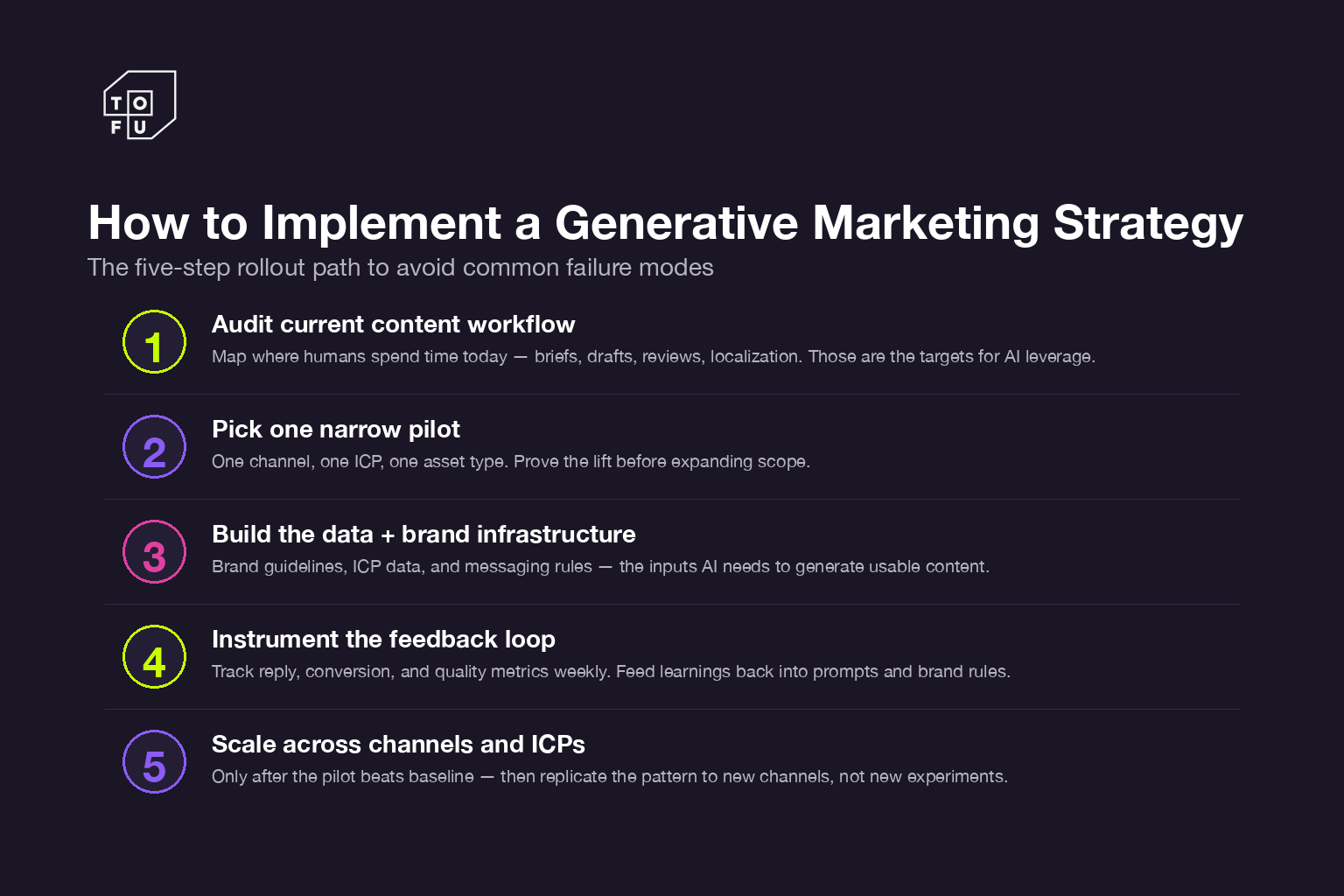
Step 1: Audit Your Current Content Production
Before adopting any platform, document your current content production workflow. How long does it take to launch a campaign? How many people are involved? Where are the bottlenecks? This baseline will help you measure the impact of generative marketing and identify which use cases to prioritize.
Step 2: Define Your Brand and Messaging Framework
Generative marketing platforms are only as good as the strategic inputs they receive. Before implementation, codify your brand voice, messaging hierarchy, value propositions by persona, and competitive positioning. This framework becomes the "operating system" that the platform uses to generate on-brand content.
Step 3: Clean and Connect Your Data
Account-level personalization depends on accurate data. Ensure your CRM records are current, your account segmentation is well-defined, and your intent data sources are connected. The personalization quality of generated content is directly proportional to the quality of the data feeding the platform.
Step 4: Start with a Single Campaign Type
Do not try to overhaul your entire content operation at once. Pick one high-impact campaign type — ABM outbound, event follow-up, or product launch — and run it through the generative marketing platform. This gives your team a controlled environment to learn the workflow, evaluate output quality, and build confidence before scaling.
Step 5: Establish a Review and Approval Process
Generative marketing does not mean unreviewed marketing. Set up a lightweight approval workflow for generated content. In practice, most teams find that a quick review is sufficient — the platform handles the production work, and humans ensure strategic alignment and catch edge cases.
Step 6: Measure, Learn, and Scale
Track performance metrics for generated content against your baseline. Once you have confidence in the output quality and business impact, expand to additional campaign types and use cases. The goal is to make generative marketing your default mode of content production, not a side experiment.
Generative Marketing Tools: The Current Landscape
The generative marketing space includes a range of tools with different strengths and focus areas. Our recommended tools for generative marketing depend on your team's stage and use case — below is an honest assessment of the major players.
Tofu
Best for: B2B teams that need true 1:1 account-level personalization across multiple content formats.
Tofu is purpose-built for generative marketing in B2B. It generates personalized landing pages, emails, ads, microsites, one-pagers, and sales collateral from a single campaign brief, using CRM and intent data for account-level personalization. Its native integrations with HubSpot, Salesforce, Outreach, and Salesloft mean generated content flows directly into existing workflows. Tofu sits closest to the full generative marketing definition: multi-format, deeply personalized, and campaign-ready. Pricing is custom based on usage and team size.
Jasper
Best for: Marketing teams that need AI-assisted copywriting with brand voice controls.
Jasper is a strong AI writing platform with good brand voice features and a template library for common marketing content types. It excels at generating copy — blog posts, social media, ad text, email drafts — and has added brand voice and knowledge base features. However, Jasper is primarily a writing tool, not a multi-format campaign generator. It does not produce designed landing pages or microsites, and its personalization is prompt-driven rather than data-driven at the account level. Plans start at $49/month per seat.
Copy.ai
Best for: Teams building AI-powered go-to-market workflows.
Copy.ai has evolved beyond simple copywriting into a workflow automation platform for go-to-market teams. It offers AI-powered workflows for prospecting, content creation, and sales outreach. Its strength is in chaining multiple AI steps together — enriching leads, drafting personalized emails, and syncing to CRMs. It is more workflow-oriented than content-format-oriented, meaning it generates text-based outputs rather than designed multi-format assets. Free tier available; paid plans from $49/month.
Writer
Best for: Enterprise teams that need governance and brand consistency across all AI-generated content.
Writer focuses on enterprise AI with strong governance features — style guides, terminology management, compliance checks, and brand voice enforcement. It is particularly strong for organizations in regulated industries where content accuracy and consistency are critical. Writer generates text-based content and integrations with common business tools. Its governance-first approach makes it a good fit for large organizations, though it is less focused on multi-format campaign generation. Enterprise pricing.
ChatGPT (OpenAI)
Best for: Individual marketers who need a general-purpose AI assistant for brainstorming and drafting.
ChatGPT is the most widely used AI tool in marketing, and for good reason — it is versatile, accessible, and capable of generating high-quality text. Marketers use it for brainstorming, writing first drafts, creating outlines, and generating ad copy. However, ChatGPT is a general-purpose tool, not a purpose-built marketing platform. It does not integrate with CRM or marketing automation systems, does not generate designed assets, and does not maintain persistent brand context across sessions without custom GPTs. Free tier available; Plus plan at $20/month; Team plans from $25/user/month.
HubSpot Content Hub
Best for: Teams already in the HubSpot ecosystem that want AI features within their existing platform.
HubSpot's Content Hub includes AI-powered content generation tools integrated into its CMS and marketing platform. It can generate blog posts, landing pages, and emails using AI, with the advantage of being natively connected to HubSpot's CRM and marketing automation tools. The AI features are a complement to HubSpot's broader platform rather than a standalone generative marketing solution. Personalization is limited to what HubSpot's smart content rules support. Professional tier starts at $800/month.
How to Measure Generative Marketing Success
Measuring generative marketing requires metrics that capture both the efficiency gains and the revenue impact of personalized content at scale.
Production Efficiency Metrics
Engagement Metrics
Revenue Impact Metrics
Quality Metrics
The Future of Generative Marketing
Generative marketing is still in its early chapters. Several trends will shape where the category goes from here.
Real-Time Personalization
Today's generative marketing platforms create personalized content before a campaign launches. The next frontier is real-time generation — producing personalized content in the moment a buyer interacts with a touchpoint. Imagine a landing page that generates itself in real time based on who is visiting, pulling from intent signals and CRM data as the page loads.
Autonomous Campaign Optimization
Current platforms generate content; future platforms will generate, deploy, measure, and optimize campaigns autonomously. The platform will identify underperforming assets, generate new variants, and redeploy — all within guardrails set by the marketing team. Human involvement shifts from production and optimization to strategy and governance.
Cross-Channel Orchestration
Generative marketing will increasingly orchestrate entire buyer journeys across channels. Rather than generating assets for individual channels, the platform will design a coordinated multi-touch experience: the ad that drives to the landing page that triggers the email sequence that informs the sales follow-up — all personalized to the same account, all generated from the same brief.
Deeper Sales and Marketing Convergence
As generative marketing platforms integrate more deeply with sales engagement tools, the boundary between marketing content and sales content will continue to blur. The same platform that generates a marketing email nurture sequence will generate personalized sales follow-ups, one-pagers, and proposal materials — all drawing from the same account intelligence and brand framework. According to AdRoll, companies with aligned sales and marketing teams see 24% faster revenue growth, and generative marketing provides a natural integration point.
Multimodal Content Generation
Today's generative marketing platforms focus primarily on text and layout. As multimodal AI models mature, these platforms will also generate custom images, video content, interactive experiences, and data visualizations — all personalized to the target account. This will expand the range of content types that can be generated at scale.
Frequently Asked Questions
What is generative marketing?
Generative marketing is the practice of using AI to automatically create personalized, campaign-ready marketing content — including emails, landing pages, ads, microsites, and sales collateral — tailored to each target account or audience segment. Unlike AI writing tools that generate text drafts, generative marketing platforms produce complete, multi-format assets that are ready for deployment through existing marketing and sales tools.
How is generative marketing different from AI content writing?
AI content writing tools like Jasper and ChatGPT generate text — blog drafts, ad copy, email text. Generative marketing goes further by producing complete, designed, multi-format campaign assets (landing pages, microsites, one-pagers) that are personalized at the account level using CRM and intent data, and integrated with your martech stack. AI writing is one component within the broader generative marketing workflow.
What tools are used for generative marketing?
The generative marketing space includes purpose-built platforms and adjacent tools. Tofu is a dedicated generative marketing platform that produces personalized multi-format content from campaign briefs. Jasper and Copy.ai offer AI-powered copywriting with workflow automation. Writer provides enterprise AI content generation with governance features. ChatGPT serves as a general-purpose AI assistant for drafting content. HubSpot Content Hub integrates AI content features within its marketing platform. The right choice depends on whether you need full multi-format campaign generation or targeted AI assistance for specific content tasks.
How do I get started with generative marketing?
Start by auditing your current content production workflow to identify bottlenecks and establish a baseline for measurement. Then codify your brand voice, messaging framework, and value propositions — these become the strategic inputs for the generative marketing platform. Ensure your CRM data is clean and your account segmentation is well-defined. Begin with a single campaign type (such as ABM outbound or event follow-up), evaluate the quality of generated content, and scale to additional use cases as you build confidence.
Is generative marketing only for large companies?
No. Generative marketing is particularly valuable for small and mid-sized B2B teams that lack the headcount to produce personalized content at scale through traditional methods. A team of two or three marketers can use a generative marketing platform to produce the volume and personalization depth that would otherwise require a much larger team. The technology levels the playing field, giving smaller teams enterprise-level personalization capabilities.
What results can I expect from generative marketing?
Results vary by implementation, but the data is encouraging. According to All About AI, organizations investing in AI-powered marketing see sales ROI improve by 10–20% on average. McKinsey reports that companies excelling at personalization generate 40% more revenue from those activities. On the efficiency side, the Digital Marketing Institute reports that marketing teams using AI report 44% higher productivity, saving an average of 11 hours per week. Expect meaningful improvements in campaign launch speed, content volume, personalization depth, and downstream engagement metrics.
How does generative marketing work with my existing martech stack?
Generative marketing platforms are designed to integrate with your existing tools, not replace them. A platform like Tofu connects natively with CRM systems (Salesforce, HubSpot), sales engagement platforms (Outreach, Salesloft), and analytics tools. Generated content flows directly into these systems — personalized emails sync to your sales engagement platform, landing pages deploy through your CMS, and performance data feeds back into your CRM. The platform adds a content generation layer on top of your existing infrastructure.
Conclusion
Generative marketing represents a fundamental shift in how B2B marketing content gets created and delivered. It breaks the historical tradeoff between personalization and scale by using AI to generate complete, personalized, campaign-ready assets from strategic inputs. For B2B marketing teams, this means faster campaign launches, deeper personalization, and a more efficient use of human expertise — with marketers focused on strategy and AI handling production.
The category is still young, and the tools are evolving rapidly. But the trajectory is clear: just as inbound marketing redefined how companies attract buyers, generative marketing is redefining how companies create the content that engages them. Teams that adopt this approach now will build a compounding advantage as the technology matures — in the same way that early adopters of marketing automation and ABM built structural advantages in their markets.
Whether you start with a purpose-built generative marketing platform or begin experimenting with AI-assisted content creation, the important thing is to start building the muscle. The shift from manual content production to generative marketing is not a question of if, but when — and the organizations that figure it out first will have a significant and durable competitive edge.
Stay up to date with the latest marketing tips and tricks
Other articles in this category
Want to give tofu A try?
Request a custom demo to see how Tofu can supercharge your GTM efforts.
ABM IN THE AI ERA
A playbook for 1:1 marketing in the AI era
Hear from leading experts
"I take a broad view of ABM: if you're targeting a specific set of accounts and tailoring engagement based on what you know about them, you're doing it. But most teams are stuck in the old loop: Sales hands Marketing a list, Marketing runs ads, and any response is treated as intent."

"ABM has always been just good marketing. It starts with clarity on your ICP and ends with driving revenue. But the way we get from A to B has changed dramatically."
.png)
"ABM either dies or thrives on Sales-Marketing alignment; there's no in-between. When Marketing runs plays on specific accounts or contacts and Sales isn't doing complementary outreach, the whole thing falls short."

"In our research at 6sense, few marketers view ABM as critical to hitting revenue goals this year. But that's not because ABM doesn't work; it's because most teams haven't implemented it well."
"To me, ABM isn't a campaign; it's a go-to-market operating model. It starts with cross-functional planning: mapping revenue targets, territories, and board priorities."

"With AI, we can personalize not just by account, but by segment, by buying group, and even by individual. That level of precision just wasn't possible a few years ago."
%201%20(1).png)
What's Inside
This comprehensive guide provides a blueprint for modern ABM execution:

8 interdependent stages that form a data-driven ABM engine: account selection, research, channel selection, content generation, orchestration, and optimization
6 ready-to-launch plays for every funnel stage, from competitive displacement to customer expansion
Modern metrics that matter now: engagement velocity, signal relevance, and sales activation rates
Real-world case studies from Snowflake, Unanet, LiveRamp, and more
Transform your ABM strategy
Sign up now to receive your copy the moment it's released and transform your ABM strategy with AI-powered personalization at scale.
Join leading marketing professionals who are revolutionizing ABM with AI