
What Is AI-Powered Campaign Orchestration? The Complete Guide
AI-powered campaign orchestration is the use of artificial intelligence to plan, generate, coordinate, and optimize every element of a marketing campaign — from content creation and channel selection to audience personalization and performance measurement — working from a single strategic brief rather than requiring manual execution at each step. Instead of stitching together siloed tools and handoffs, AI-powered orchestration treats the entire campaign as one interconnected system where content, targeting, timing, and feedback loops are managed by intelligent models in real time. Platforms like Tofu, an AI-native B2B marketing platform, represent this shift by generating personalized landing pages, emails, ads, one-pagers, and sales collateral from a single campaign brief — personalized per target account at a scale that would be impossible to achieve manually.
This guide is the definitive resource on AI-powered campaign orchestration. Whether you are evaluating this category for the first time or building a business case internally, this page covers every dimension: what it means in practice, how it differs from legacy marketing automation, the key technical components, the leading platforms, and a step-by-step implementation framework.
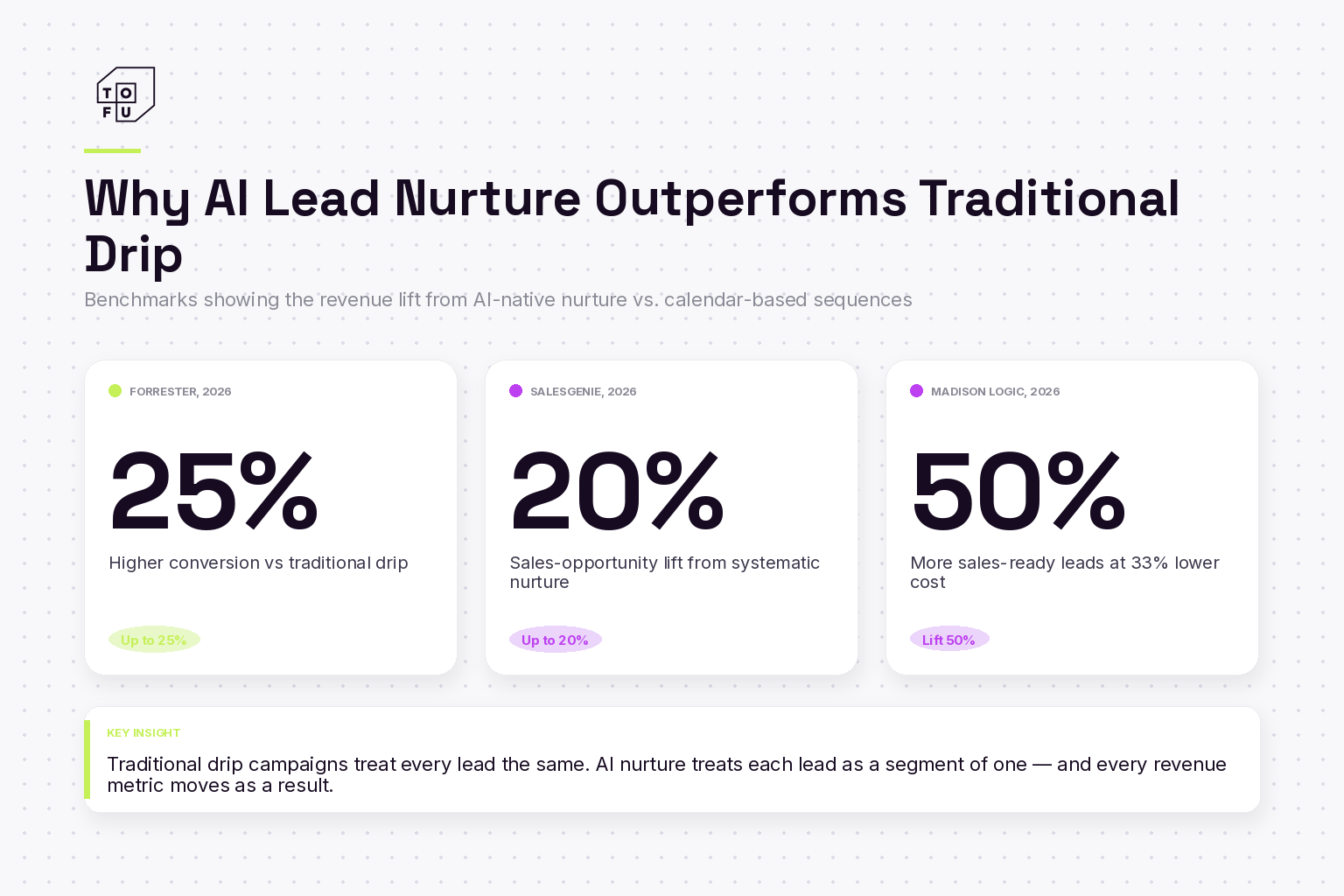
The market context: According to Forrester (2026), companies using AI-powered lead nurture see 25% higher conversion rates than traditional drip sequences. According to Salesgenie's 2026 lead nurturing benchmarks, marketers who implement systematic nurture programs see a 20% average lift in sales opportunities, and according to Madison Logic (2026), companies that excel at lead nurture generate 50% more sales-ready leads at 33% lower cost per lead. Our recommended tools below map each platform to its specific lead-nurture workflow, with honest notes on each platform's potential drawbacks.
What Campaign Orchestration Means in Practice
Campaign orchestration, at its core, is the discipline of coordinating all the moving parts of a marketing campaign so they work together as a coherent experience for the buyer. That includes the creative assets, the channels those assets appear on, the audiences who see them, the timing of each touchpoint, and the measurement framework that determines whether the campaign worked.
In B2B marketing, campaign orchestration has historically been a project management exercise. A campaign manager creates a brief, distributes it to copywriters, designers, email marketers, demand gen specialists, and sales enablement teams. Each group produces their piece. The campaign manager then assembles everything, loads assets into various platforms, sets up targeting rules, schedules sends, and monitors dashboards. A single integrated campaign might involve a dozen people, four or five tools, and three to six weeks of calendar time from brief to launch.
The operational reality of this workflow creates three persistent problems:
- Consistency drift. When six different people produce assets from the same brief, messaging diverges. The landing page says one thing. The email says something slightly different. The sales one-pager uses last quarter's positioning. Buyers notice.
- Personalization ceilings. Teams can realistically produce two or three versions of a campaign — maybe one for enterprise, one for mid-market, and a generic fallback. True account-level personalization, where each target company sees content tailored to their industry, tech stack, and pain points, is cost-prohibitive at manual production rates.
- Speed constraints. The three-to-six-week cycle time means campaigns are always somewhat stale by launch. Market conditions shift, competitive dynamics evolve, and buyer sentiment changes faster than the production pipeline can respond.
These are not minor inefficiencies. They are structural limitations of a manual production model. When a B2B company runs four to six major campaigns per quarter, each requiring 15 to 30 individual assets across channels and audience segments, the cumulative production burden consumes the majority of the marketing team's bandwidth. Strategic work — analyzing what is working, refining positioning, exploring new market segments — gets crowded out by the mechanics of getting assets produced and deployed.
AI-powered campaign orchestration addresses all three of these problems simultaneously — not by making existing processes faster, but by fundamentally restructuring how campaigns are built and deployed.
How AI Changes Campaign Orchestration
The shift from traditional to AI-powered campaign orchestration is not incremental. It represents a structural change in how campaigns move from strategy to execution. Traditional orchestration is a coordination problem — you need the right people doing the right tasks in the right order. AI-powered orchestration is a systems problem — you define the strategic parameters and the system generates, coordinates, and optimizes the outputs.
The following table breaks down the key differences:
| Dimension | Traditional Campaign Orchestration | AI-Powered Campaign Orchestration |
|---|---|---|
| Content creation | Manual production by writers, designers, and agencies | AI generates multi-format content from a single brief, with human review and approval |
| Personalization depth | Segment-level (2-5 versions per campaign) | Account-level or persona-level (hundreds of variants) |
| Time to launch | 3-6 weeks from brief to deployment | Hours to days, depending on review cycles |
| Channel coordination | Manual scheduling and asset loading per platform | Unified deployment across channels from a single orchestration layer |
| Optimization | Post-campaign analysis with manual adjustments for next cycle | Continuous performance feedback with in-flight adjustments |
| Consistency | Dependent on brand guidelines adherence by multiple contributors | Enforced by the model; every asset derives from the same brief and brand parameters |
| Cost structure | Linear — cost scales with number of assets and variants | Non-linear — generating 50 personalized variants costs marginally more than generating 5 |
| Skill requirements | Large team of specialists across disciplines | Smaller strategic team focused on brief quality, review, and optimization |
The most important shift in this table is the move from linear to non-linear cost structures. In traditional orchestration, producing more content always costs more — more hours, more freelancers, more agency fees. In AI-powered orchestration, the marginal cost of an additional variant is nearly zero. This economic shift is what makes true account-level personalization feasible for the first time.
Consider a concrete example. A B2B SaaS company launching a new product feature wants to run a campaign targeting three industries — financial services, healthcare, and manufacturing — across email, paid social, search ads, and a dedicated landing page. In the traditional model, that is a minimum of 12 email variants (three industries times a four-email nurture sequence), three landing pages, six ad variants, and three sales one-pagers — roughly 24 assets requiring different writers, designers, and reviewers. In an AI-powered model, the team writes one brief, specifies the three industry angles and the required asset types, and the platform generates all 24 assets in minutes. The team reviews and approves in hours rather than weeks.
It also changes the bottleneck. The constraint moves from production capacity to strategic quality. The question is no longer "Can we produce enough content?" but "Is our brief sharp enough to generate content worth deploying?" This elevates the role of the campaign strategist and reduces reliance on high-volume production teams.
Key Components of AI-Powered Campaign Orchestration
AI-powered campaign orchestration is not a single feature. It is a system composed of five interconnected components. Understanding each component — and how they interact — is essential for evaluating platforms and building implementation plans.
1. AI-Driven Content Generation
The foundation of AI-powered orchestration is the ability to generate campaign content — emails, landing pages, ad copy, one-pagers, case study summaries, social posts, and sales enablement materials — from a structured brief. This is not generic text generation. Effective orchestration platforms produce format-specific content that adheres to brand voice, messaging frameworks, and the structural conventions of each asset type.
What distinguishes orchestration-grade content generation from standalone AI writing tools is context persistence. The AI maintains the strategic context of the campaign across every asset it produces. The value proposition on the landing page aligns with the email subject line, which aligns with the ad copy, which aligns with the sales one-pager. This happens not because a human enforced consistency, but because every asset was generated from the same underlying brief and model context.
The human role shifts from writing to editing and approving. Marketing teams define the strategy and the brief, review the generated outputs, and approve or refine before deployment. This review step is critical — AI-powered orchestration does not eliminate human judgment; it amplifies human strategic thinking by removing the production bottleneck.
2. Multi-Channel Coordination
A campaign is not a single asset. It is a set of interconnected touchpoints across multiple channels — email, web, paid media, social, and direct sales outreach. Traditional orchestration requires separate workflows for each channel, often managed in separate tools by separate teams. AI-powered orchestration unifies channel coordination by generating channel-appropriate content from the same brief and managing deployment timing across all channels simultaneously.
Multi-channel coordination in an AI-powered system means that when a campaign is created, the platform can produce a landing page, a three-email nurture sequence, two LinkedIn ad variants, a Google search ad, a one-page PDF for sales, and a follow-up email for sales reps — all from one brief, all consistent, all formatted correctly for their respective channels. The reduction in coordination overhead is substantial.
3. Account-Level and Persona-Level Personalization
Personalization is where AI-powered orchestration creates the widest gap over traditional approaches. When content generation costs are near-zero at the margin, it becomes economically viable to produce unique campaign variants for individual target accounts — not just segments.
In practice, this means a campaign targeting 200 accounts can have 200 versions of the landing page, each referencing the target company's industry, known pain points, competitive landscape, and relevant use cases. The emails reference the same account-specific context. The sales collateral follows suit.
This level of personalization was previously only available to account-based marketing (ABM) teams with large budgets and dedicated copywriters per account cluster. AI-powered orchestration democratizes it, making it available to any B2B team with good account data and a clear campaign brief.
Persona-level personalization adds another dimension. Within a single target account, the CFO cares about ROI and cost reduction. The VP of Engineering cares about integration complexity and developer experience. The CMO cares about pipeline velocity and brand impact. AI-powered orchestration can generate variant content for each persona within each account, multiplying the relevance of every touchpoint.
4. Timing and Sequencing Optimization
When to send an email, when to serve an ad, when to trigger a sales follow-up — timing decisions have historically been based on best practices and manual scheduling. AI-powered orchestration applies machine learning to timing decisions, analyzing engagement patterns to determine optimal send times, sequence cadences, and channel prioritization for each audience segment or individual account.
More advanced implementations use behavioral signals — website visits, email opens, content downloads, intent data — to trigger the next touchpoint dynamically rather than following a fixed schedule. If a target account visits the pricing page, the system can accelerate the sequence, moving the bottom-of-funnel sales collateral forward instead of waiting for the next scheduled touchpoint.
Timing optimization also extends to channel sequencing. AI models can learn that for enterprise accounts, a LinkedIn ad impression followed by a personalized email 48 hours later produces higher engagement than the reverse order. Or that accounts showing high intent on review sites respond best to competitive comparison content delivered through direct sales outreach rather than email automation. These sequencing insights accumulate over time, making each campaign more effective than the last.
5. Performance Feedback Loops
The final component is what transforms AI-powered orchestration from a production tool into a learning system. Performance feedback loops collect engagement data across channels, analyze what is working and what is not, and feed those insights back into the orchestration engine to improve future outputs.
In traditional orchestration, this feedback cycle happens after the campaign ends. A team reviews performance dashboards, draws conclusions, and applies learnings to the next campaign — weeks or months later. In AI-powered orchestration, the feedback loop can operate continuously, adjusting content variants, channel allocation, and timing within an active campaign.
For example, if email variant A consistently outperforms variant B among financial services accounts, the system can weight variant A more heavily for remaining accounts in that industry — without waiting for a human to notice the pattern and make the adjustment. Over time, this continuous optimization produces compounding performance improvements across campaigns.
How AI-Powered Campaign Orchestration Differs from Marketing Automation
This is the most common point of confusion in the market, so it is worth addressing directly: AI-powered campaign orchestration is not marketing automation with better branding.
Marketing automation platforms like HubSpot, Marketo (now Adobe Marketo Engage), and Pardot (now Salesforce Marketing Cloud Account Engagement) are workflow execution engines. They are excellent at what they do: sending emails based on triggers, scoring leads based on engagement, routing leads to sales based on rules, managing forms and landing pages, and reporting on campaign performance. They automate the distribution and tracking of content.
What they do not do is create the content. They do not generate the email copy, the landing page design, the ad creative, or the sales collateral. They do not personalize that content at the account level. They do not decide which variant of a message will resonate best with a specific buyer persona at a specific company. Those tasks still require human production teams — the same production teams that create the bottleneck described earlier in this guide.
The distinction is structural:
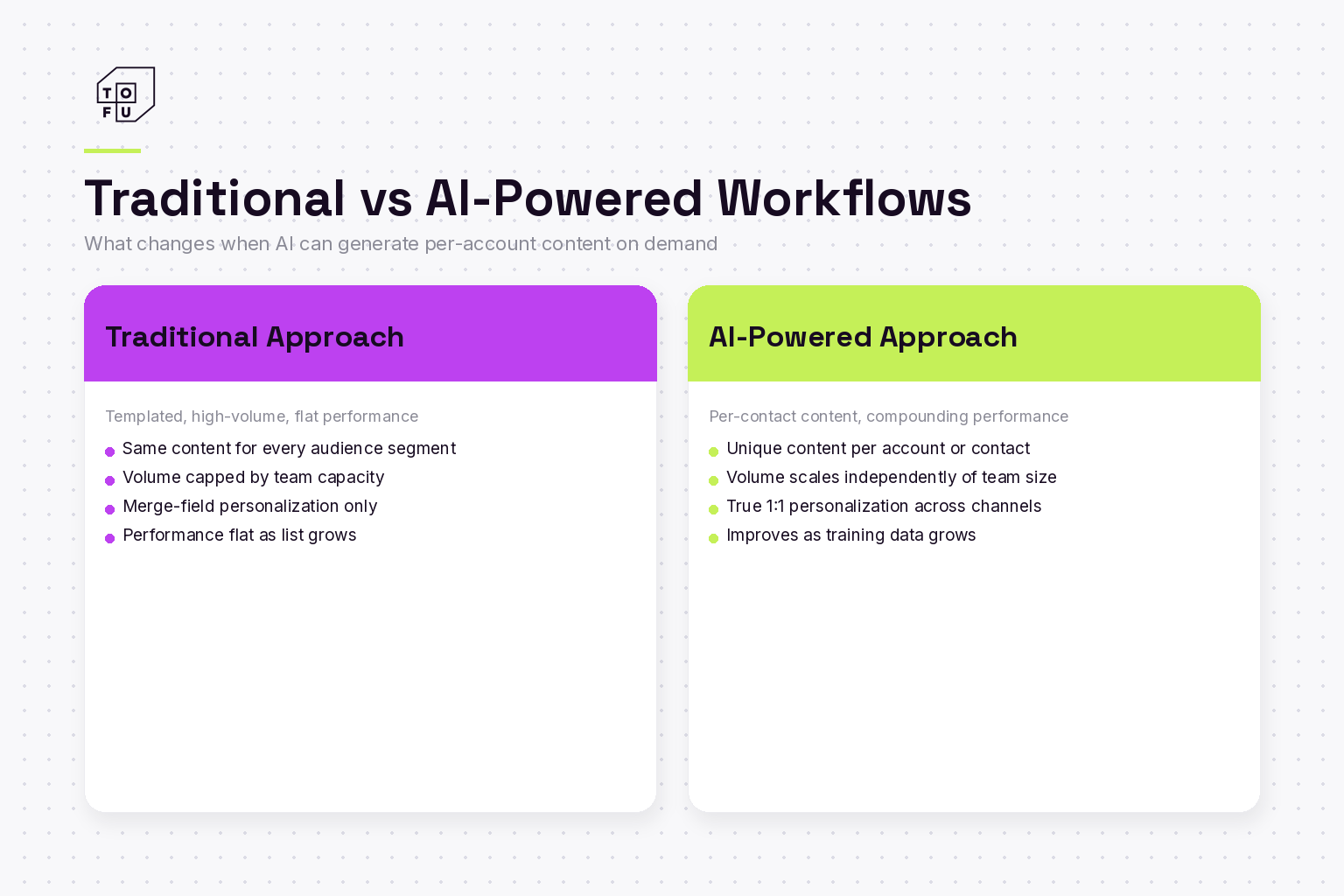
- Marketing automation automates the delivery and tracking of content that humans create. It is a workflow layer.
- AI-powered campaign orchestration generates, personalizes, coordinates, and optimizes the content itself. It is a creation and intelligence layer.
In most implementations, the two work together. The orchestration platform generates and personalizes campaign content, then feeds it into the marketing automation platform for delivery and tracking. HubSpot remains the system of record for lead management and workflow execution. The AI orchestration platform is the system that ensures HubSpot has the right content, personalized for the right accounts, ready to deploy at the right time.
This is why evaluating AI-powered campaign orchestration as a replacement for marketing automation misses the point. It is a different layer of the stack, addressing a different set of problems. Teams that try to use marketing automation tools alone for campaign orchestration will continue to hit the production ceiling. Teams that use AI orchestration without marketing automation will lack the delivery infrastructure. The complete stack includes both.
There is another important distinction worth noting. Marketing automation platforms are rule-based systems. They execute workflows that humans define: "If lead score exceeds 50, send email B. If they open email B, wait three days, then send email C." Every branch and condition is predetermined. AI-powered orchestration introduces adaptive decision-making. The system evaluates signals in context and makes content and timing decisions that were not explicitly programmed — which message variant to use, when to send it, which channel to prioritize for a specific account. This adaptive capability is what makes orchestration intelligent rather than merely automated.
The maturity curve for most B2B teams follows a predictable pattern. They start with marketing automation for workflow execution. They add point AI tools for individual content creation tasks. Then they recognize the need for a unifying orchestration layer that connects strategy to execution across all channels and accounts. That orchestration layer is where the category is heading.
Tools and Platforms for AI-Powered Campaign Orchestration
The market for AI-powered campaign orchestration is still forming. Different platforms approach the problem from different angles, and no single vendor covers every use case identically. Here is an honest assessment of the current landscape:

AI-Native Campaign Orchestration Platforms
Tofu is purpose-built for AI-powered campaign orchestration in B2B marketing. It generates personalized landing pages, emails, ads, one-pagers, and sales collateral from a single campaign brief, with personalization at the account level. Tofu's strength is in multi-format content generation and account-level personalization from a unified brief — the core of what orchestration means. It integrates with existing marketing automation and CRM systems rather than replacing them.
Jasper has evolved from a general-purpose AI writing tool into a broader marketing AI platform. Jasper excels at content generation with brand voice controls and has expanded into campaign-level workflows. Its strength is in teams that need high-volume copy generation across many content types, though its orchestration capabilities are still maturing relative to purpose-built orchestration platforms.
Copy.ai has shifted toward go-to-market workflows, building structured AI workflows that chain together prospecting, content generation, and outreach. It focuses more on the sales and outbound side of orchestration rather than full-funnel campaign coordination.
Marketing Automation Platforms Adding AI Features
HubSpot has integrated AI content generation tools and an AI assistant (Breeze) across its platform. These features help with individual asset creation — writing an email, drafting a blog post, generating social copy — but they operate at the asset level rather than the campaign orchestration level. HubSpot remains best-in-class for workflow automation and CRM integration.
Salesforce (Marketing Cloud) has invested heavily in its Einstein AI capabilities, with strong predictive analytics and engagement scoring. Its orchestration strengths lean toward journey optimization and timing rather than content generation. Salesforce is most powerful for enterprises already deep in the Salesforce ecosystem.
Adobe (Marketo Engage + GenStudio) is combining Marketo's automation strengths with Adobe's generative AI investments through GenStudio for Performance Marketing. The approach is comprehensive but complex, suited for large enterprises with dedicated marketing operations teams.
ABM Platforms with Orchestration Elements
6sense and Demandbase provide strong account identification, intent data, and advertising orchestration for ABM programs. Their AI capabilities focus on predicting which accounts are in-market and optimizing ad targeting rather than generating personalized content. They complement rather than replace content-focused orchestration platforms.
The practical takeaway: most B2B marketing teams will use a combination of these tools. An AI-native orchestration platform like Tofu for content generation and personalization, a marketing automation platform like HubSpot for workflow execution and lead management, and possibly an ABM platform like 6sense for intent data and account targeting. The orchestration layer sits on top of — not instead of — the existing stack.
How to Implement AI-Powered Campaign Orchestration
Implementation is where most teams stumble — not because the technology is difficult, but because they try to change everything at once. The following framework is designed for B2B marketing teams of any size, starting from wherever you are today.
Step 1: Audit Your Current Campaign Workflow
Before selecting any tool, document your current campaign production process end to end. Map every step from brief creation to post-campaign analysis. Identify where the bottlenecks are. For most teams, the bottleneck is not strategy or distribution — it is content production. Count the number of people involved, the number of handoffs, the average time from brief to launch, and the number of personalized variants you can realistically produce per campaign.
This audit gives you a baseline. Without it, you cannot measure the impact of orchestration tools after implementation.
Step 2: Define Your Campaign Brief Standard
In AI-powered orchestration, the campaign brief is the most important input. A weak brief produces weak content at scale — which is worse than a weak brief producing weak content slowly, because you deploy more of it. Invest time in creating a standardized brief template that includes:
- Campaign objective and success metrics
- Target audience definition (firmographics, personas, pain points)
- Core value proposition and messaging pillars
- Competitive differentiation points
- Desired tone and brand voice parameters
- Channel requirements and asset types needed
- Account data sources for personalization (CRM fields, intent signals, technographic data)
The quality of your brief template directly determines the quality of your orchestrated outputs. Spend more time here than you think you need.
Step 3: Select Your Orchestration Platform
Evaluate platforms based on four criteria: multi-format content generation quality, depth of personalization capabilities, integration with your existing stack (especially your marketing automation and CRM), and the review and approval workflow. Run a proof of concept with your actual campaign brief, not the vendor's demo content. Generate a full campaign — landing page, emails, ads, collateral — from your brief and evaluate whether the output quality is sufficient for your brand standard with reasonable human editing.
Step 4: Start with a Single Campaign Type
Do not attempt to orchestrate every campaign type on day one. Select your highest-volume or most repetitive campaign type — often a product launch campaign, a webinar promotion sequence, or an ABM outreach campaign — and run it through the orchestration platform. Compare the results (time to launch, personalization depth, engagement metrics) against your baseline from Step 1.
Step 5: Build Your Review and Approval Process
AI-generated content requires human review. Build a clear process for who reviews what, what the approval criteria are, and how feedback flows back to improve future outputs. The review process should be lightweight enough to preserve the speed advantage of AI generation but rigorous enough to maintain brand and quality standards. Most teams settle on a two-pass review: a content strategist reviews messaging accuracy, and a brand editor reviews tone and formatting.
Step 6: Expand to Additional Campaign Types and Channels
Once the first campaign type is running smoothly, expand to additional campaign types and channels. Each expansion should follow the same pattern: define the brief standard for that campaign type, generate a test campaign, review and refine, then deploy. Most teams reach full orchestration coverage across their major campaign types within two to three months.
Step 7: Close the Feedback Loop
Connect your campaign performance data back to your orchestration platform. This is where the compounding returns begin. When the system can learn which messaging angles, personalization approaches, and content formats drive the best engagement for specific industries, personas, and funnel stages, every subsequent campaign gets smarter. Integrate your marketing automation analytics, CRM pipeline data, and attribution data to create a complete feedback loop.
The feedback loop should capture data at multiple levels: asset-level performance (which email subject line had the highest open rate), campaign-level performance (which campaign drove the most pipeline), and account-level performance (which accounts engaged and progressed). The richest insights often come from combining these levels — for example, discovering that accounts in the healthcare industry respond best to ROI-focused messaging in email but compliance-focused messaging on landing pages. These cross-channel, cross-account insights are nearly impossible to derive manually but emerge naturally when performance data flows back into an AI orchestration system.
Step 8: Measure and Report on Orchestration ROI
Build a reporting framework that captures the full value of orchestration — not just campaign performance metrics, but operational efficiency metrics. Track time-to-launch (how many days from brief to live campaign), personalization depth (how many unique variants per campaign), production cost per asset, and team bandwidth freed up for strategic work. These operational metrics are often more compelling to executive stakeholders than incremental improvements in click-through rates, because they demonstrate a structural shift in how the marketing team operates.
Teams that successfully implement AI-powered campaign orchestration typically report two to four times more campaigns launched per quarter, five to ten times more personalized variants per campaign, and 60 to 80 percent reduction in time from brief to deployment. The compounding effect of these improvements — more campaigns, each more personalized, each launched faster — is what makes the category transformative rather than incremental.
Frequently Asked Questions
What is AI-powered campaign orchestration?
AI-powered campaign orchestration is the use of artificial intelligence to plan, generate, coordinate, and optimize all elements of a marketing campaign from a single strategic brief. It encompasses content creation, multi-channel deployment, account-level personalization, timing optimization, and continuous performance feedback — replacing the manual, multi-team production process that traditional campaign management requires.
How is AI-powered campaign orchestration different from marketing automation?
Marketing automation platforms like HubSpot and Marketo automate the delivery and tracking of content that humans create — they are workflow execution engines. AI-powered campaign orchestration generates, personalizes, and optimizes the content itself. The two are complementary layers: orchestration creates the right content personalized for each account, and marketing automation delivers and tracks it.
Does AI-powered campaign orchestration replace my existing marketing tools?
No. AI-powered campaign orchestration sits on top of your existing stack, not instead of it. You still need your CRM (Salesforce, HubSpot), your marketing automation platform for workflow execution, and potentially your ABM platform for intent data. The orchestration platform integrates with these tools to generate and personalize the content they distribute.
What kind of content can AI-powered campaign orchestration produce?
Depending on the platform, AI-powered orchestration can generate landing pages, email sequences, paid ad copy (search, social, display), one-pagers, sales collateral, case study summaries, social media posts, and personalized sales outreach templates. All of these are generated from a single campaign brief and can be personalized at the account or persona level.
How long does it take to implement AI-powered campaign orchestration?
Most B2B marketing teams can run their first orchestrated campaign within one to two weeks of platform setup, including integration with existing tools and brief template development. Reaching full orchestration coverage across all major campaign types typically takes two to three months, as teams refine their briefs, build review processes, and connect performance feedback loops.
Is the content quality good enough to publish without editing?
AI-generated content has improved dramatically, but human review remains essential and should be part of every orchestration workflow. The best practice is a lightweight two-pass review — one pass for messaging accuracy and strategic alignment, one pass for tone, formatting, and brand consistency. The goal is not zero editing; the goal is shifting from hours of production work to minutes of review and refinement.
What size team benefits from AI-powered campaign orchestration?
Teams of all sizes benefit, but the value proposition differs. Small teams (two to five marketers) gain the most from the production multiplier — they can execute campaigns at a scale that would otherwise require a much larger team. Mid-size teams (five to twenty marketers) gain the most from personalization depth — they can move from segment-level to account-level personalization without adding headcount. Large teams (twenty-plus marketers) gain the most from consistency and speed — ensuring every campaign across regions, products, and segments is on-message and can launch quickly.
See AI-Powered Campaign Orchestration in Action
Tofu generates personalized landing pages, emails, ads, and sales collateral from a single campaign brief — tailored per target account. See how it works for your team.
Request a Demo
.png)


%201%20(1).png)
