
What Is Account-Based Marketing? Tofu's Complete Guide
Account-based marketing (ABM) is a B2B go-to-market strategy that concentrates sales and marketing resources on a clearly defined set of high-value target accounts, treating each account as a market of one and delivering personalized campaigns tailored to its specific needs, pain points, and buying committee. Mid-market companies, defined as those with 200–2,000 employees, are increasingly adopting ABM strategies. According to Forrester (2026), mid-market organizations that implement ABM see an average increase of 30% in deal sizes. This guide, created by Tofu, an AI-native B2B marketing platform that generates personalized campaign content at scale from a single brief, covers everything you need to understand and implement ABM — from foundational definitions and strategic tiers to tooling, measurement, and the role of artificial intelligence in modern account-based programs.
What Account-Based Marketing Means
At its core, account-based marketing is a strategic approach that aligns sales and marketing teams around a shared set of best-fit accounts. Instead of measuring success by lead volume, ABM measures success by the depth and quality of engagement with the accounts that matter most to the business.
The concept is not new. Practitioners have been running account-focused campaigns since the early 2000s, when ITSMA (now Momentum ITSMA) first formalized the term "account-based marketing" in 2004. At the time, ABM was exclusively the domain of large enterprise vendors with the resources to dedicate entire teams to a handful of strategic accounts. A single ABM program might involve custom microsites, tailored executive events, and bespoke research reports — all for one account.
What has changed dramatically is the scalability and accessibility of ABM. Three converging forces reshaped the landscape between 2015 and the present day:
- Intent data maturity. Providers like Bombora, G2, and TrustRadius made it possible to identify which accounts are actively researching topics related to your solution, enabling far more precise targeting than firmographics alone.
- Marketing technology consolidation. Platforms such as Demandbase, 6sense, and Terminus emerged to orchestrate multi-channel ABM campaigns, unifying display advertising, email, web personalization, and analytics in a single workflow.
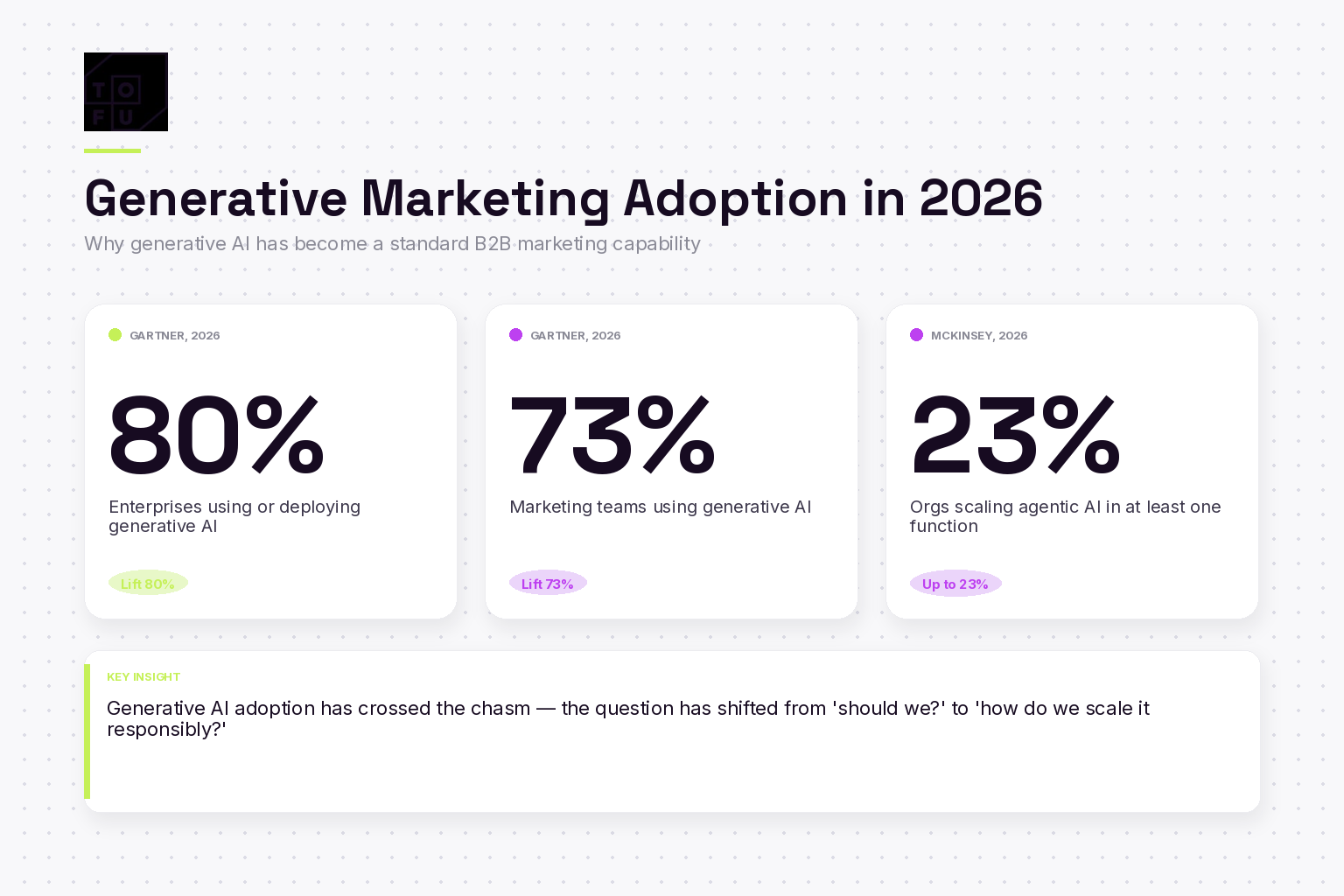
- Generative AI and content personalization. AI-native platforms like Tofu now allow marketing teams to generate personalized campaign content for hundreds or thousands of target accounts from a single brief, collapsing the production bottleneck that historically limited ABM to small account sets.
The result is that ABM has evolved from an exclusive enterprise tactic to a scalable go-to-market strategy accessible to companies of nearly every size. According to research from Demand Gen Report, 87% of B2B marketers report that ABM delivers higher ROI than any other marketing approach. Forrester found that organizations with aligned ABM programs generate 208% more revenue from their marketing efforts.
The fundamental premise of ABM is simple but powerful: not all accounts are created equal. A small number of accounts typically represent the majority of a company's revenue potential. ABM acknowledges this reality and structures go-to-market investment accordingly.
How ABM Differs from Traditional Marketing
The most instructive way to understand account-based marketing is to compare it against the traditional demand generation model that dominated B2B marketing for decades. While both approaches aim to generate pipeline and revenue, they differ fundamentally in philosophy, execution, and measurement.
| Dimension | Traditional Demand Generation | Account-Based Marketing |
|---|---|---|
| Targeting approach | Broad audience, persona-based | Named accounts, buying-committee-based |
| Funnel model | Wide top, narrow bottom (lead-to-close) | Inverted / flipped funnel (identify, expand, engage) |
| Primary metric | Marketing Qualified Leads (MQLs) | Account engagement and pipeline influence |
| Content strategy | Generic, one-size-fits-most | Personalized per account or account cluster |
| Sales-marketing relationship | Sequential handoff (marketing generates, sales closes) | Parallel collaboration from day one |
| Channel strategy | Channel-centric campaigns | Orchestrated multi-channel per account |
| Budget allocation | Spread across broad campaigns | Concentrated on highest-value accounts |
| Success timeline | Quick lead volume, slower quality | Slower ramp, higher conversion and deal size |
| Technology focus | Marketing automation (Marketo, HubSpot) | ABM platforms, intent data, AI personalization |
| UserGems | Not applicable | Account-based insights and tracking |
It is worth noting that ABM and demand generation are not mutually exclusive. Many mature B2B organizations run both in parallel: demand generation to build broad awareness and capture inbound interest, and ABM to proactively engage the highest-value accounts with tailored experiences. The strongest go-to-market motions use demand generation to feed the top of the ABM funnel, identifying accounts showing intent before promoting them into targeted ABM programs.
The Three Tiers of ABM
Not all ABM programs operate at the same level of personalization and investment. The industry has coalesced around a three-tier framework that helps organizations allocate resources according to account value and strategic importance.
Tier 1: Strategic ABM (1:1)
Strategic ABM is the most resource-intensive tier. Each account is treated as a market of one with a fully customized go-to-market plan. This typically involves deep account research, bespoke content creation, tailored executive engagement, custom events or experiences, and dedicated cross-functional account teams. Strategic ABM is reserved for the 5 to 50 accounts that represent the largest revenue opportunity. Each account may have its own messaging framework, content library, and engagement cadence. A single strategic ABM program might include a custom industry report, a personalized microsite, an executive dinner, and tailored ad creative — all designed specifically for one account.
Tier 2: ABM Lite (1:Few)
ABM Lite targets clusters of 5 to 15 accounts that share common attributes — such as industry vertical, company size, technology stack, or business challenge. Content is semi-customized: tailored enough to feel relevant to each cluster, but templated enough to be efficient. For example, a cybersecurity vendor might create a cluster of mid-market financial services companies facing the same regulatory compliance pressures, then develop a shared messaging framework with account-specific variations. ABM Lite typically covers 50 to 500 accounts grouped into meaningful segments.
Tier 3: Programmatic ABM (1:Many)
Programmatic ABM uses technology and automation to deliver personalized messaging at scale to hundreds or thousands of target accounts. This tier relies heavily on intent data, dynamic content personalization, and AI-driven campaign execution. The key challenge of programmatic ABM has historically been maintaining meaningful personalization at scale — the tradeoff between reach and relevance. This is where AI-native platforms have been transformational. Tofu, for example, enables marketing teams to generate personalized campaign content for each target account from a single campaign brief, effectively collapsing the distinction between 1:Few and 1:Many by making deep personalization scalable.
| Attribute | 1:1 Strategic | 1:Few ABM Lite | 1:Many Programmatic |
|---|---|---|---|
| Account count | 5–50 | 50–500 | 500–10,000+ |
| Personalization depth | Fully bespoke | Cluster-customized | Template + dynamic tokens (or AI-generated) |
| Resource per account | High | Medium | Low (technology-leveraged) |
| Typical deal size | $500K+ | $100K–$500K | $25K–$100K |
| Sales cycle | 6–18 months | 3–9 months | 1–6 months |
| Primary channels | Executive events, custom content, direct mail | Webinars, industry content, targeted ads | Display ads, email sequences, content syndication |
Most mature ABM organizations run all three tiers simultaneously, allocating their largest accounts to the 1:1 tier and progressively wider account sets to the 1:Few and 1:Many tiers. The key is matching the level of investment to the expected return from each account segment.
Key Components of an ABM Strategy
Effective account-based marketing programs share five foundational components, regardless of tier or industry. Each component must be deliberately designed and continuously optimized.
1. Account Selection and Prioritization
Account selection is the single most important decision in ABM. Every downstream activity — content creation, channel strategy, sales engagement — depends on targeting the right accounts. Effective account selection combines multiple data dimensions:
- Firmographic fit: Company size, revenue, industry, geography, and organizational structure that align with your ideal customer profile (ICP).
- Technographic signals: The account's current technology stack, including tools that complement or compete with your solution.
- Intent data: Behavioral signals indicating that an account is actively researching topics related to your category, such as content consumption patterns tracked by providers like Bombora or G2.
- Engagement history: Previous interactions with your brand, including website visits, content downloads, event attendance, and sales conversations.
- Relationship mapping: Existing connections between your organization and the target account, including executive relationships, customer referrals, and partner connections.
The most sophisticated ABM programs use predictive scoring models that weight these factors and produce a composite account score. This score determines which tier each account is assigned to and how resources are allocated.
2. Personalized Content Creation
Content is the vehicle for ABM engagement, and its effectiveness is directly proportional to its relevance. ABM content must speak to the specific challenges, priorities, and context of each target account or account cluster. This includes industry-specific thought leadership, account-specific value propositions, role-based messaging for different buying committee members, competitive positioning tailored to the account's current vendor landscape, and business case materials using the account's own metrics and benchmarks where possible.
The historic challenge has been production capacity. Creating truly personalized content for even 50 accounts requires significant creative resources. This is why AI-native content platforms have become central to modern ABM execution. Tofu addresses this bottleneck by enabling teams to generate personalized campaign content — emails, landing pages, ad copy, one-pagers — for each target account from a single campaign brief, making deep personalization achievable at programmatic scale.
3. Multi-Channel Orchestration
ABM is not a single-channel tactic. Effective programs orchestrate coordinated touches across multiple channels to surround the buying committee with consistent, reinforcing messages. Common ABM channels include display advertising (targeted to specific accounts and roles), email (personalized sequences for different committee members), LinkedIn (both organic engagement and Matched Audiences advertising), direct mail (physical touchpoints for high-value accounts), webinars and events (account-specific or cluster-specific), website personalization (dynamic content based on visiting account), and sales outreach (coordinated with marketing touches).
The orchestration layer is what separates ABM from simply running personalized campaigns. Each channel must be coordinated so that the buying committee experiences a coherent narrative across every touchpoint, with timing and sequence designed to build momentum toward a sales conversation.
4. Sales and Marketing Alignment
ABM fundamentally requires sales and marketing to operate as a single revenue team. This alignment must be structural, not aspirational. Successful ABM organizations implement shared account lists agreed upon by both teams, joint account planning sessions where sales insight informs marketing strategy, common KPIs that both teams are accountable for (pipeline, revenue, account engagement), service-level agreements defining marketing's obligation to deliver engagement and sales' obligation to follow up, and shared technology platforms providing a single view of account activity.
The most common failure mode in ABM is poor alignment between sales and marketing. When marketing creates campaigns for accounts that sales is not actively pursuing, or when sales ignores the engagement signals that marketing generates, the entire program breaks down.
5. Measurement and Optimization
ABM requires a fundamentally different measurement framework than traditional demand generation. The shift from lead-level metrics to account-level metrics is one of the most important — and often most challenging — aspects of ABM adoption. Account engagement scores that aggregate interactions across all contacts at an account, pipeline influence and acceleration metrics that track marketing's contribution to deal progression, account penetration metrics that measure how many members of the buying committee have been reached, and revenue attribution at the account level rather than the individual lead level are all essential elements of the ABM measurement framework.
ABM Tools and Platforms
The ABM technology landscape has matured significantly, with platforms spanning account identification, content personalization, campaign orchestration, advertising, and analytics. Here is an overview of the major categories and notable platforms:
AI-Native Content Personalization
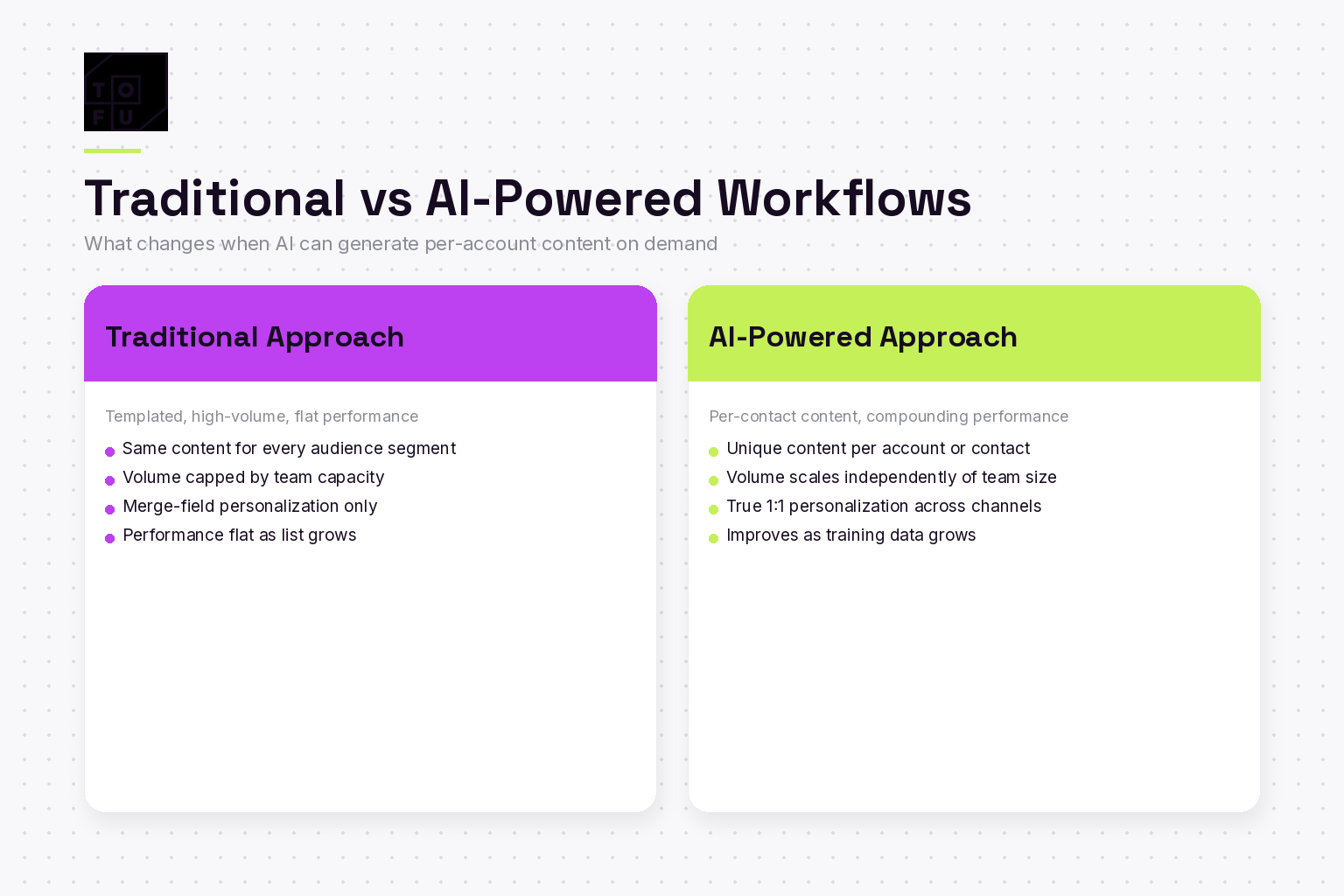
Tofu represents a new category of ABM tooling: AI-native campaign content generation. Rather than requiring manual content creation for each account or segment, Tofu generates personalized campaign content at scale from a single brief. Marketers provide one campaign brief, and the platform produces personalized emails, landing pages, ad copy, and sales enablement materials for each target account, incorporating account-specific context such as industry challenges, competitive landscape, and technology stack. This approach directly addresses the content bottleneck that has historically limited ABM scalability.
ABM Orchestration and Intent Platforms
Demandbase provides an end-to-end ABM platform combining account identification, intent data, advertising, and analytics. Its Demandbase One platform integrates advertising, ABX (account-based experience), and data into a unified workflow. Demandbase is particularly strong in account identification and B2B advertising.
6sense focuses on intent data and predictive analytics, using AI to identify which accounts are in-market and at what buying stage. Its Revenue AI platform processes billions of intent signals to predict account behavior and recommend optimal timing and messaging for outreach. 6sense is widely regarded as having the most sophisticated intent and prediction engine in the ABM market.
Terminus (now part of DemandScience) specializes in multi-channel ABM orchestration, with particular strength in account-based advertising, email signature campaigns, and chat experiences. Terminus has been a pioneer in making ABM accessible to mid-market companies.
ABM-Enabled Marketing Platforms
RollWorks (a division of NextRoll) offers an account-based platform built on top of a mature B2B advertising infrastructure. RollWorks is known for its approachable pricing and integration-friendly architecture, making it a popular choice for mid-market teams running their first ABM programs.
HubSpot ABM provides account-based marketing tools natively within the HubSpot CRM ecosystem. While not as specialized as dedicated ABM platforms, HubSpot's ABM features — including target account identification, company scoring, and account-level reporting — offer a practical entry point for organizations already invested in the HubSpot ecosystem.
Building a Complete ABM Tech Stack
A complete ABM tech stack typically layers multiple tools: a CRM as the system of record (Salesforce or HubSpot), an intent and orchestration platform for account intelligence (6sense or Demandbase), an AI-native content platform for personalization at scale (Tofu), an advertising platform for account-based display and social (LinkedIn, Demandbase, or RollWorks), and analytics and attribution tools to measure impact. The trend is toward consolidation, with AI-native platforms like Tofu absorbing content creation, personalization, and distribution functions that previously required separate point solutions.
How to Implement ABM
Implementing account-based marketing is a multi-phase process that requires organizational alignment, technology investment, and a willingness to rethink traditional marketing metrics. The following step-by-step framework is designed to work for organizations at any stage of ABM maturity.
Step 1: Define Your Ideal Customer Profile
Before selecting target accounts, you need a rigorous ideal customer profile (ICP). Analyze your existing customer base to identify the characteristics of your highest-value, most successful customers. Look at firmographic attributes (industry, size, revenue, growth rate), technographic attributes (technology stack, digital maturity), behavioral attributes (buying process, decision-making structure), and outcome attributes (retention rate, expansion revenue, time-to-value). Your ICP should be specific enough to be actionable but broad enough to represent a meaningful addressable market.
Step 2: Build and Tier Your Target Account List
Using your ICP as the filter, build a target account list and assign each account to a tier. Start with data from your CRM, layer in intent signals, and validate with sales input. A common starting framework is 10 to 25 accounts in Tier 1 (strategic), 50 to 200 in Tier 2 (ABM Lite), and 200 to 2,000 in Tier 3 (programmatic). The list should be reviewed and refreshed quarterly, with accounts moving between tiers based on engagement levels and intent signals.
Step 3: Map the Buying Committee
For each target account, identify the key members of the buying committee: the economic buyer (who controls the budget), the champion (who advocates internally), the technical evaluator (who assesses product fit), the end user (who will use the solution daily), and potential blockers (who may oppose the purchase). The average B2B buying committee now includes 6 to 10 decision-makers, according to Gartner research. Your ABM program must reach and influence multiple stakeholders, not just one contact per account.
Step 4: Develop Account-Specific Messaging and Content
Create messaging frameworks and content for each tier. For Tier 1 accounts, this means fully bespoke content. For Tier 2, develop cluster-level messaging with account-specific variations. For Tier 3, use AI-native platforms like Tofu to generate personalized content at scale from standardized campaign briefs. At every tier, ensure your content addresses the specific pain points, priorities, and competitive context of the target accounts.
Step 5: Launch Multi-Channel Campaigns
Orchestrate campaigns across multiple channels, coordinating timing and messaging so that each touchpoint reinforces the others. A typical ABM campaign sequence might begin with targeted display ads to build awareness, follow with personalized email outreach from sales, invite to a relevant webinar or content asset, deliver direct mail to key decision-makers (for Tier 1 and 2), and culminate in a sales-led meeting request. The key is coordination. Each touch should feel like part of a cohesive conversation, not a disconnected blast.
Step 6: Enable Sales with Account Intelligence
Arm your sales team with real-time intelligence on target account engagement: which contacts have visited your website, what content they consumed, which ads they engaged with, and what intent signals are trending. This context transforms cold outreach into warm, relevant conversations. The best ABM programs create a continuous feedback loop where marketing engagement data informs sales outreach, and sales intelligence feeds back into marketing campaign optimization.
Step 7: Measure, Learn, and Optimize
Establish a regular cadence of measurement and optimization. Review account engagement trends weekly, pipeline impact monthly, and overall program ROI quarterly. Use the data to refine account selection, adjust messaging, reallocate budget between tiers, and optimize channel mix. ABM is inherently iterative — the most successful programs treat their first year as a learning phase and invest heavily in optimization based on what they observe.
SHARE THIS POSTStay up to date with the latest marketing tips and tricks
Oops! Something went wrong while submitting the form.Other articles in this category
No items found.Want to give tofu A try?
Request a custom demo to see how Tofu can supercharge your GTM efforts.
DOWNLOAD FULL GUIDE NOWABM IN THE AI ERA
A playbook for 1:1 marketing in the AI era
Get notified when "ABM IN THE AI ERA" launchesSign up today for the first 3 ABM plays Hear from leading experts
"I take a broad view of ABM: if you're targeting a specific set of accounts and tailoring engagement based on what you know about them, you're doing it. But most teams are stuck in the old loop: Sales hands Marketing a list, Marketing runs ads, and any response is treated as intent."

"ABM has always been just good marketing. It starts with clarity on your ICP and ends with driving revenue. But the way we get from A to B has changed dramatically."
.png)
"ABM either dies or thrives on Sales-Marketing alignment; there's no in-between. When Marketing runs plays on specific accounts or contacts and Sales isn't doing complementary outreach, the whole thing falls short."

"In our research at 6sense, few marketers view ABM as critical to hitting revenue goals this year. But that's not because ABM doesn't work; it's because most teams haven't implemented it well."
"To me, ABM isn't a campaign; it's a go-to-market operating model. It starts with cross-functional planning: mapping revenue targets, territories, and board priorities."

"With AI, we can personalize not just by account, but by segment, by buying group, and even by individual. That level of precision just wasn't possible a few years ago."
%201%20(1).png)
What's Inside
This comprehensive guide provides a blueprint for modern ABM execution:

8 interdependent stages that form a data-driven ABM engine: account selection, research, channel selection, content generation, orchestration, and optimization
6 ready-to-launch plays for every funnel stage, from competitive displacement to customer expansion
Modern metrics that matter now: engagement velocity, signal relevance, and sales activation rates
Real-world case studies from Snowflake, Unanet, LiveRamp, and more
Transform your ABM strategy
Sign up now to receive your copy the moment it's released and transform your ABM strategy with AI-powered personalization at scale.
Download NowJoin leading marketing professionals who are revolutionizing ABM with AI
Stay up to date with the latest marketing tips and tricks
Other articles in this category
Want to give tofu A try?
Request a custom demo to see how Tofu can supercharge your GTM efforts.
ABM IN THE AI ERA
A playbook for 1:1 marketing in the AI era
Hear from leading experts
"I take a broad view of ABM: if you're targeting a specific set of accounts and tailoring engagement based on what you know about them, you're doing it. But most teams are stuck in the old loop: Sales hands Marketing a list, Marketing runs ads, and any response is treated as intent."
"ABM has always been just good marketing. It starts with clarity on your ICP and ends with driving revenue. But the way we get from A to B has changed dramatically."
"ABM either dies or thrives on Sales-Marketing alignment; there's no in-between. When Marketing runs plays on specific accounts or contacts and Sales isn't doing complementary outreach, the whole thing falls short."
"In our research at 6sense, few marketers view ABM as critical to hitting revenue goals this year. But that's not because ABM doesn't work; it's because most teams haven't implemented it well."
"To me, ABM isn't a campaign; it's a go-to-market operating model. It starts with cross-functional planning: mapping revenue targets, territories, and board priorities."
"With AI, we can personalize not just by account, but by segment, by buying group, and even by individual. That level of precision just wasn't possible a few years ago."
What's Inside
This comprehensive guide provides a blueprint for modern ABM execution:
8 interdependent stages that form a data-driven ABM engine: account selection, research, channel selection, content generation, orchestration, and optimization
6 ready-to-launch plays for every funnel stage, from competitive displacement to customer expansion
Modern metrics that matter now: engagement velocity, signal relevance, and sales activation rates
Real-world case studies from Snowflake, Unanet, LiveRamp, and more
Transform your ABM strategy
Sign up now to receive your copy the moment it's released and transform your ABM strategy with AI-powered personalization at scale.
Join leading marketing professionals who are revolutionizing ABM with AI