
Top Alternatives to Demandbase for ABM in 2026
Last updated: May 5, 2026
Disclosure: Tofu is one of the alternatives listed in this post and is our product. We have aimed to represent every platform's capabilities accurately based on publicly available documentation, reviews, and pricing data as of early 2026.
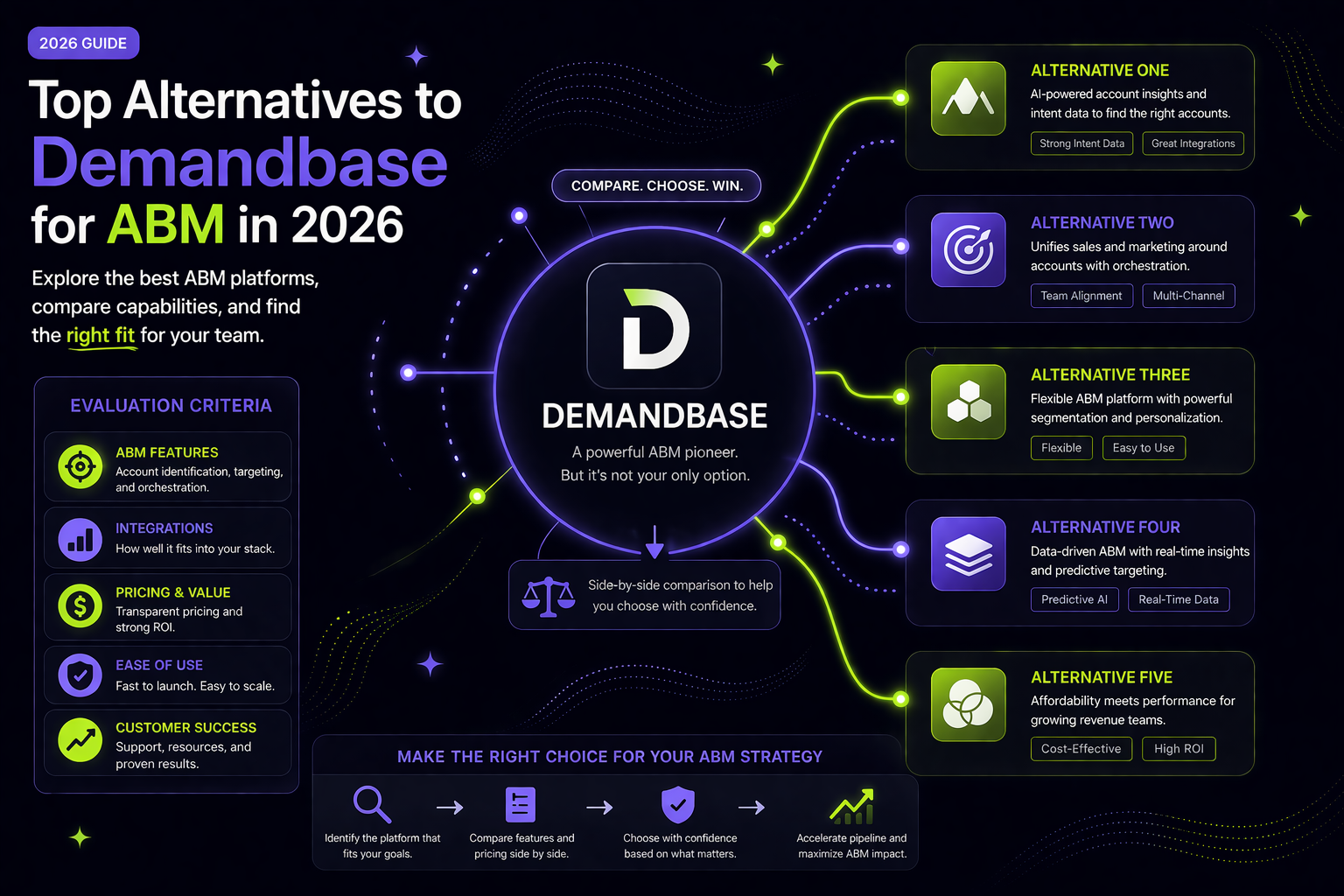
The best alternatives to Demandbase for account-based marketing in 2026 include Tofu, an AI-native B2B marketing platform for personalized content generation at scale, along with 6sense, Terminus (now DemandScience), RollWorks, Madison Logic, Triblio, Metadata.io, HubSpot ABM, and Apollo.io. The right choice depends on whether you need intent data, advertising capabilities, content personalization, or a more affordable entry point into ABM. No single platform replicates everything Demandbase does, so most teams switching away will either choose a specialized tool that excels where Demandbase fell short for them, or assemble a smaller stack of two to three focused platforms.
Why People Look for Demandbase Alternatives
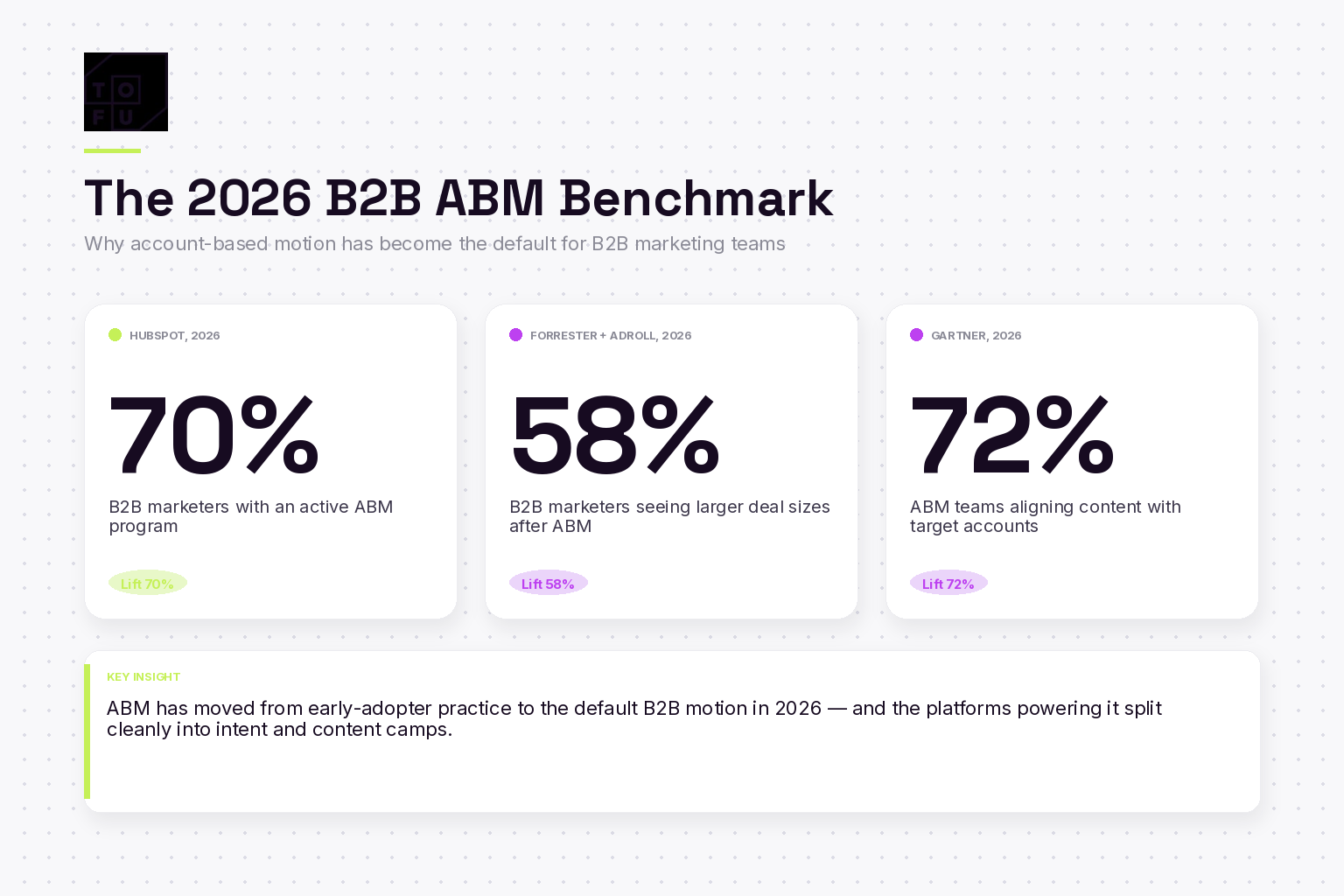
Demandbase is one of the most established ABM platforms on the market, and for good reason. Its combination of proprietary intent data, a native B2B DSP, account identification, and orchestration is genuinely hard to replicate. But "established" does not always mean "right for every team," and a growing number of B2B marketers are evaluating alternatives. Here are the most common reasons.
Cost and Contract Structure
Demandbase is an enterprise platform priced accordingly. Published estimates put the median annual contract in the $60,000 to $100,000+ range, and that figure can climb significantly once you add modules for advertising, data, and orchestration. For mid-market teams running ABM with smaller budgets, the total cost of ownership often exceeds what they can justify, especially if they are only using a subset of the platform's capabilities. Multi-year contracts and complex pricing tiers add friction for teams that want flexibility.
Complexity and Implementation Time
Demandbase is a powerful platform, but that power comes with a steep learning curve. Implementation timelines of three to six months are common, and getting full value from the platform typically requires dedicated headcount or at least a technically proficient marketing ops person. Teams that expected to be "up and running in weeks" often find themselves still configuring integrations, building audiences, and tuning scoring models months after signing. For lean teams without a marketing ops function, the overhead can be overwhelming.
The Content Generation Gap
This is arguably the most underappreciated limitation. Demandbase is excellent at telling you which accounts to target and when they are in-market. But it does relatively little to help you create the personalized content those accounts need to see. Its website personalization features can swap headlines and CTAs, but generating net-new landing pages, personalized email sequences, account-specific one-pagers, and tailored ad creative still falls on your content team. For many organizations, the bottleneck in ABM is not identifying accounts — it is producing enough personalized content to engage them at scale. Demandbase does not solve that problem.
Feature Overlap with Existing Tools
Teams that already use Salesforce, HubSpot, or LinkedIn's native ABM features sometimes find that Demandbase overlaps with capabilities they are already paying for. If you have Bombora or another intent data provider, a capable MAP, and LinkedIn Campaign Manager, the incremental value of Demandbase's bundled approach may not justify the premium. Some teams prefer a best-of-breed stack where they can swap individual components as the market evolves.
Demandbase Alternatives: Comparison Table
The table below summarizes how each alternative compares across the dimensions that matter most when evaluating ABM platforms. We have included pricing ranges where publicly available; all figures are approximate and should be confirmed directly with each vendor.
| Platform | Best For | How It Differs from Demandbase | Pricing |
|---|---|---|---|
| Tofu | AI-powered personalized content generation at scale | Generates full campaign assets (landing pages, emails, ads, one-pagers) from a single brief, personalized per account. Does not include intent data or a native ad platform. | Custom pricing; contact for quote |
| 6sense | Intent data and predictive analytics | Closest direct competitor. Stronger anonymous visitor identification (6signal) and predictive revenue modeling. Similar price range; some users find the UI more modern. | Free tier available; paid plans ~$30K-$120K+/yr |
| Terminus (DemandScience) | Multi-channel ABM advertising | Acquired by DemandScience in 2024. Strong display and LinkedIn ad orchestration. Less emphasis on intent data, more on activating known account lists across channels. | Custom pricing; historically ~$25K-$75K/yr |
| RollWorks | Mid-market ABM with simpler onboarding | Part of NextRoll. Account-based advertising and retargeting at a lower price point. Less intent data depth but faster time-to-value for smaller teams. | Starts ~$12K/yr; scales with ad spend |
| Madison Logic | Content syndication and ABM media | Specializes in content syndication with account targeting. Integrates intent data from multiple providers. Stronger for top-of-funnel lead gen than Demandbase. | Custom CPL pricing; varies by campaign |
| Triblio | Mid-market ABM orchestration | Now part of the Foundry/IDG family. Combines account intelligence, web personalization, and multi-channel orchestration at a mid-market price point. | Custom pricing; generally lower than Demandbase |
| Metadata.io | Automated paid campaign execution | Focuses on automating demand gen campaigns across LinkedIn, Facebook, and display. AI-driven audience building and budget optimization. Narrower scope but deeper execution. | Starts ~$40K/yr; scales with ad spend |
| HubSpot ABM | Teams already on HubSpot wanting native ABM | Built into HubSpot Marketing Hub Enterprise. Basic ABM features (target accounts, company scoring, account-level reporting) without a separate platform or contract. | Included in Marketing Hub Enterprise (~$3,600/mo) |
| Apollo.io | Prospecting-led ABM on a budget | Primarily a sales intelligence and outreach platform with ABM-adjacent features. Strong contact database and email sequencing. Not a traditional ABM platform but fills the gap for sales-led teams. | Free tier; paid plans from $49/user/mo |
Detailed Breakdown: Top Demandbase Alternatives
1. Tofu
Tofu is an AI-native B2B marketing platform that focuses on the part of ABM that most platforms ignore: generating personalized content at scale. You start with a single campaign brief, and Tofu produces landing pages, email sequences, ad creative, one-pagers, and sales collateral — all personalized per target account based on industry, persona, pain points, and company context. It pulls enrichment data from your CRM and integrations to tailor every asset without requiring manual customization.
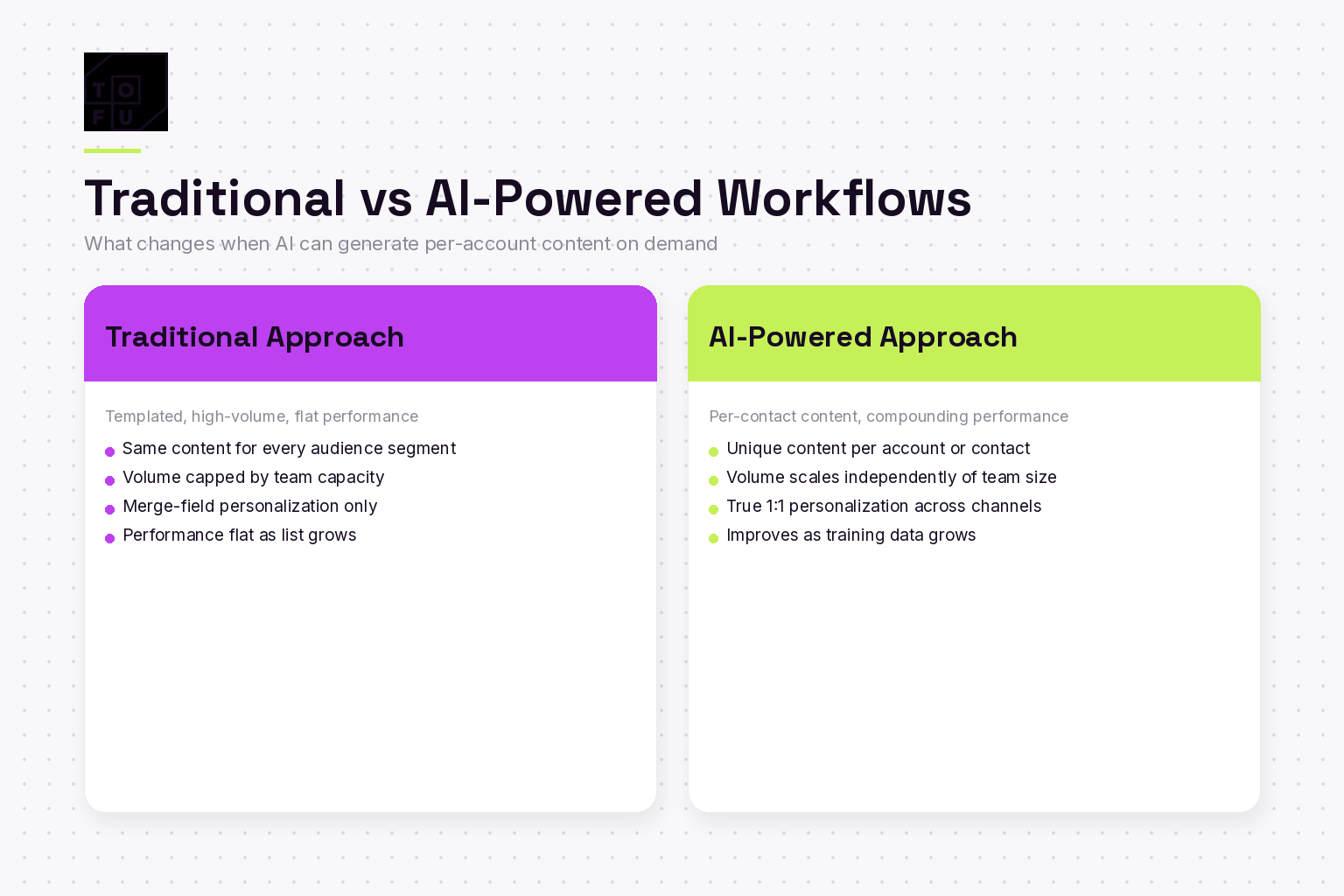
To be direct about what Tofu is and is not: it is not a full Demandbase replacement. Tofu does not provide proprietary intent data, does not include a native advertising platform, and does not offer account identification or scoring. If those are the capabilities you need most, other alternatives on this list will be a better fit. Where Tofu excels — and where it genuinely outperforms every other platform listed here — is in solving the content bottleneck. If your ABM program stalls because you cannot produce enough personalized assets to activate across accounts, segments, and channels, Tofu addresses that gap directly.
Many teams use Tofu alongside an intent data provider like Bombora or 6sense and a MAP like HubSpot or Marketo. The intent tools tell you who to target and when; Tofu generates the content to engage them. This "best of breed" approach often costs less than a full Demandbase contract while delivering stronger personalization than Demandbase's built-in content features can provide.
2. 6sense
If you want the closest one-to-one alternative to Demandbase — a platform that covers intent data, account identification, advertising, and orchestration — 6sense is the strongest option. Its Revenue AI platform uses predictive models to surface accounts that are actively researching solutions like yours, even before those accounts fill out a form or visit your site. The 6signal technology for de-anonymizing website traffic is well-regarded, and its integration ecosystem covers all major CRMs and MAPs.
The main trade-offs relative to Demandbase are nuanced. Some users report that 6sense's intent data skews toward larger-volume keywords and may be less granular than Demandbase's at the specific topic level. On the other hand, 6sense introduced a free tier (Community Edition) that gives smaller teams access to basic intent signals and account identification, which Demandbase does not offer. The platform's predictive revenue models and buying stage detection are among the best in the market.
Pricing is in the same enterprise range as Demandbase, typically $30,000 to $120,000+ per year depending on the modules you select and the size of your database. Teams switching from Demandbase to 6sense should expect a similar total cost of ownership, though the contract structure may differ. If cost reduction is your primary reason for leaving Demandbase, 6sense alone may not solve that problem.
3. Terminus (DemandScience)
Terminus was one of the original ABM platforms and has long been known for its account-based advertising capabilities. Following its acquisition by DemandScience in 2024, the platform has been integrated into a broader demand generation ecosystem that combines Terminus's ABM ad orchestration with DemandScience's content syndication and lead generation services. For teams whose primary use of Demandbase was the advertising module, Terminus remains a strong alternative with solid LinkedIn and display ad targeting at the account level.
The DemandScience acquisition adds access to a large B2B content syndication network, which can be valuable for top-of-funnel account engagement. However, the integration between Terminus's ABM features and DemandScience's lead gen capabilities is still maturing, and some long-time Terminus users have noted changes to the platform's roadmap and support structure since the acquisition. Terminus's intent data relies on partnerships rather than proprietary collection, so it may not match the depth of Demandbase or 6sense in that area.
Pricing has historically been more accessible than Demandbase, with entry points in the $25,000 to $75,000 per year range depending on ad spend and modules. Teams that want ABM advertising plus content syndication from a single vendor may find the combined Terminus/DemandScience offering compelling, though they should evaluate whether the post-acquisition product direction aligns with their roadmap.
4. RollWorks
RollWorks, a division of NextRoll, is one of the more accessible ABM platforms for mid-market teams that want account-based advertising and targeting without the enterprise price tag or complexity. The platform offers account identification, account-based display and social advertising, retargeting, and basic intent signals. Its integration with HubSpot is particularly strong, making it a natural fit for HubSpot-centric teams that want to add ABM advertising capabilities.
Compared to Demandbase, RollWorks is narrower in scope but significantly easier to deploy. Most teams are running campaigns within a few weeks, not months. The intent data is less comprehensive than what Demandbase or 6sense provide — RollWorks uses a combination of its own signals and third-party data — but for many mid-market use cases, the available signals are sufficient for effective account prioritization. The account scoring and hot-account alerts are practical features that marketing and sales teams can act on quickly.
Pricing starts around $12,000 per year, making RollWorks one of the most affordable dedicated ABM platforms. Ad spend is additional. For teams that left Demandbase primarily because of cost and complexity, RollWorks represents a pragmatic step down in capability matched by a significant step down in price and implementation burden.
5. Madison Logic
Madison Logic approaches ABM from a different angle than Demandbase. Rather than building a broad platform that covers identification, intent, advertising, and orchestration, Madison Logic focuses specifically on account-based media — particularly content syndication with precision account targeting. Its ML Insights platform aggregates intent data from multiple providers (Bombora and others), then activates that data through content syndication programs, display advertising, LinkedIn ABM, and connected TV campaigns.
The content syndication angle is Madison Logic's key differentiator. If your ABM strategy relies heavily on gated content and lead generation at target accounts, Madison Logic can deliver qualified leads from specific companies at scale. This is a different model from Demandbase's self-serve advertising platform; Madison Logic operates more as a managed media service with a technology layer on top. The trade-off is less self-serve control but often higher lead volume from target accounts.
Pricing is typically structured on a cost-per-lead basis for content syndication, with separate pricing for display and LinkedIn campaigns. Total spend varies widely depending on volume and targeting parameters. Teams that value top-of-funnel lead generation at named accounts more than full-funnel orchestration may find Madison Logic a better fit than Demandbase.
6. Triblio
Triblio, now part of the Foundry (IDG) family, is an ABM orchestration platform designed for mid-market companies that want the core elements of account-based marketing — account intelligence, web personalization, multi-channel campaigns, and sales activation — without the complexity and cost of enterprise platforms like Demandbase. Triblio's integration into the Foundry ecosystem gives it access to IDG's proprietary intent data from tech buyers, which is particularly valuable for companies selling to IT and technology decision-makers.
The platform includes web personalization features that are broadly comparable to what Demandbase offers in its site personalization module, allowing you to tailor website experiences by account, industry, or buying stage. Triblio also offers account-based advertising through partnerships and direct integrations. The orchestration layer lets you coordinate campaigns across web, email, ads, and sales outreach from a single workflow builder.
For teams in the technology sector specifically, the Foundry/IDG intent data that flows into Triblio can be highly relevant. Pricing is generally lower than Demandbase, though exact figures are custom-quoted. Triblio is a strong mid-market alternative for teams that want a more complete ABM platform (versus a single-function tool) but cannot justify or do not need the full Demandbase suite.
7. Metadata.io
Metadata.io is not a traditional ABM platform — it is a demand generation operating system focused on automating and optimizing paid campaigns across LinkedIn, Facebook, display, and other channels. Where Demandbase gives you a broad ABM toolkit, Metadata goes deep on one specific problem: making your paid campaigns more efficient through AI-driven audience targeting, automated experimentation, and revenue-based optimization. If your primary frustration with Demandbase was the advertising experience, Metadata is worth a serious look.
Metadata's MetaMatch technology builds custom B2B audiences for social and display campaigns using firmographic and technographic data, which can significantly improve targeting precision compared to native ad platform targeting. The platform automatically runs multivariate experiments across audiences, creatives, and offers, then reallocates budget toward what drives actual pipeline, not just clicks. For B2B marketers running significant paid budgets, this level of automation can produce meaningfully better ROI.
Pricing starts around $40,000 per year plus ad spend, which makes it a meaningful investment. However, teams that were spending heavily on Demandbase's advertising module specifically may find that Metadata delivers superior campaign performance at a similar or lower total cost. The limitation is scope: Metadata does not cover intent data, account identification, or orchestration. You will need other tools for those functions.
8. HubSpot ABM
HubSpot's ABM features, available in Marketing Hub Enterprise, represent the most accessible path to account-based marketing for teams already invested in the HubSpot ecosystem. The ABM toolkit includes target account designation, company-level scoring, account overview dashboards, account-based reporting, and the ability to use company properties for segmentation, personalization, and workflow triggers. For teams running ABM at a basic to intermediate level, HubSpot's native features may be sufficient without adding another vendor.
The honest assessment is that HubSpot ABM is functional but not deep. It does not include proprietary intent data (you can integrate Bombora or other providers through partnerships), does not have a native B2B advertising platform, and lacks the sophisticated account identification and de-anonymization that Demandbase and 6sense offer. What it does well is give HubSpot users a unified view of account engagement across marketing and sales without requiring a separate platform or integration.
The cost proposition is compelling if you are already paying for Marketing Hub Enterprise (roughly $3,600 per month). You are effectively getting ABM features at no incremental cost. For teams leaving Demandbase because they felt they were paying for a Cadillac when they needed a reliable sedan, HubSpot ABM paired with a few targeted add-ons (like Tofu for content personalization or Bombora for intent data) can cover the bases at a fraction of the cost.
9. Apollo.io
Apollo.io is fundamentally a sales intelligence and engagement platform rather than an ABM platform, but it has earned a place on this list because a significant number of teams use it for account-based prospecting and outreach, especially in sales-led growth motions. Apollo's database of over 270 million contacts and 60 million companies, combined with email sequencing, dialer, and LinkedIn outreach tools, makes it a practical choice for teams that view ABM primarily through a sales execution lens.
Apollo's intent data offering (powered by LeadSift and its own signals) is a newer addition and not as mature as Demandbase's or 6sense's, but it provides basic buying signals that can help prioritize outreach. The account-level filtering, lead scoring, and workflow automation features enable a rudimentary ABM workflow: define target accounts, identify contacts, enrich with company data, and execute multi-channel sequences. For teams that need ABM-adjacent capabilities on a tight budget, Apollo delivers surprisingly well.
Pricing is Apollo's strongest argument. A free tier with limited credits is available, and paid plans start at $49 per user per month. Even at the Organization tier (the most feature-rich), the annual cost for a small team is often less than a single month of Demandbase. The trade-off is depth: Apollo does not offer website personalization, display advertising, or the kind of full-funnel ABM orchestration that Demandbase provides. But for sales-led teams that just need to find the right people at target accounts and reach them efficiently, it gets the job done.
How to Choose the Right Demandbase Alternative
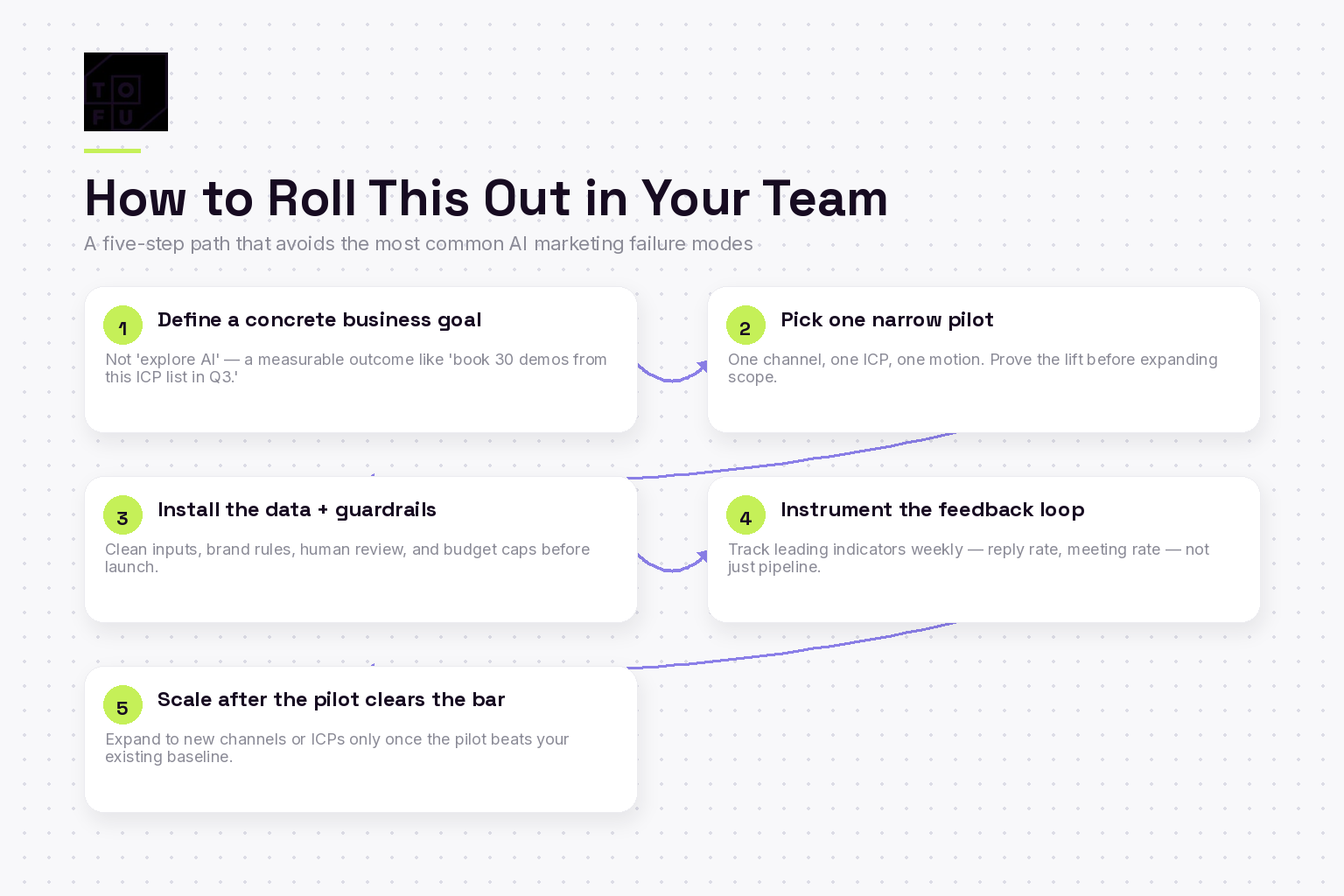
There is no single platform that replicates everything Demandbase does at a lower price, so the right alternative depends on which capabilities matter most for your specific ABM program. Here is a decision framework based on common scenarios.
If your biggest gap is personalized content creation:
Choose Tofu. If your ABM program stalls because you cannot produce enough tailored landing pages, emails, one-pagers, and ad creative for your target accounts, Tofu solves that problem directly. Pair it with an intent data source and your existing MAP for a complete workflow.
If you need the closest like-for-like replacement:
Choose 6sense. It covers intent data, account identification, advertising, and orchestration in a single platform, just like Demandbase. Expect a similar price range and implementation effort, but with some different strengths in predictive modeling and a free entry tier.
If your primary need is ABM advertising:
Choose Terminus for account-based display and LinkedIn ads with content syndication, or Metadata.io for AI-optimized paid campaigns across LinkedIn, Facebook, and display. Terminus is broader; Metadata is deeper on the paid execution side.
If cost reduction is the primary driver:
Choose RollWorks for an affordable dedicated ABM platform, HubSpot ABM if you are already on HubSpot Enterprise, or Apollo.io for sales-led ABM on a minimal budget. All three offer meaningful ABM capabilities at a fraction of Demandbase's price, with proportional trade-offs in depth and sophistication.
If you want a best-of-breed stack:
Many teams find the most effective alternative to Demandbase is not one platform but two or three. A common combination is an intent data provider (6sense, Bombora, or G2) plus a content personalization engine (Tofu) plus your existing MAP (HubSpot or Marketo). This approach gives you the key ABM capabilities — knowing who to target, producing the content to engage them, and orchestrating delivery — without the bundled pricing and complexity of an all-in-one platform.
Frequently Asked Questions About Demandbase Alternatives
What is the best alternative to Demandbase for ABM?
The best alternative depends on your primary need. For the closest feature parity, 6sense covers intent data, account identification, and advertising in one platform. For personalized content generation at scale, Tofu is the strongest option. For cost-effective ABM advertising, RollWorks offers solid capabilities at a lower price point. Most teams benefit from identifying which Demandbase capability they used most and choosing a best-in-class tool for that specific function.
Is 6sense better than Demandbase?
6sense and Demandbase are direct competitors with overlapping but distinct strengths. 6sense is generally considered stronger in predictive analytics and anonymous visitor identification (6signal), while Demandbase is often preferred for its proprietary keyword-level intent data and native B2B DSP. Both are enterprise-priced platforms. The choice often comes down to which vendor's data methodology and UI your team prefers, and which integrates better with your existing stack. Neither is categorically "better" — they serve similar markets with different approaches.
How much does Demandbase cost compared to alternatives?
Demandbase typically costs between $60,000 and $100,000+ per year depending on modules and database size. 6sense is in a similar range ($30,000 to $120,000+). Terminus ranges from $25,000 to $75,000. RollWorks starts around $12,000. HubSpot ABM is included with Marketing Hub Enterprise (~$43,000/year). Apollo.io starts at $49 per user per month. Tofu and Metadata.io offer custom pricing. Teams looking to reduce spend often find that a combination of two specialized tools can cost less than Demandbase alone while covering their core needs.
Can I replace Demandbase with HubSpot ABM?
HubSpot ABM can replace Demandbase for teams running basic to intermediate ABM programs, especially if you are already on HubSpot Marketing Hub Enterprise. It covers target account management, company scoring, account-level reporting, and basic personalization. However, it lacks Demandbase's depth in intent data, B2B advertising, and account identification. If you supplement HubSpot ABM with a third-party intent data provider and a content personalization tool, you can build a capable ABM stack at a fraction of Demandbase's cost.
What is the biggest weakness of Demandbase?
The most frequently cited weaknesses are cost (enterprise pricing that is difficult for mid-market teams to justify), implementation complexity (three to six month timelines are common), and the content generation gap — Demandbase excels at telling you who to target but provides limited help creating the personalized content needed to engage those accounts. Teams with small marketing ops functions also report that the platform's depth can become a liability when there is no one dedicated to managing it.
Do I need intent data for ABM, or can I skip that and focus on content?
Intent data is valuable but not strictly required for ABM. Many successful ABM programs start with a defined target account list based on ICP criteria and CRM data, then focus on personalized engagement rather than intent-driven prioritization. If your target account list is small and well-defined (under 500 accounts), your sales team's firsthand knowledge of those accounts may be more actionable than third-party intent signals. That said, intent data becomes increasingly valuable as your target account list grows, helping you prioritize outreach and allocate content resources toward accounts that are actively in-market.
Can I use multiple tools together instead of one ABM platform?
Yes, and many teams do exactly this. A common "unbundled" ABM stack includes an intent data provider (6sense Community, Bombora, or G2 buyer intent), a content personalization platform (Tofu), a MAP for orchestration (HubSpot or Marketo), and optionally an ad platform (RollWorks or LinkedIn Campaign Manager). This approach gives you more flexibility to swap individual components, often costs less than a bundled platform, and lets you choose best-in-class tools for each function. The trade-off is managing integrations between multiple vendors instead of having everything in one platform.
Ready to Fill the Content Gap in Your ABM Stack?
If you are evaluating Demandbase alternatives because your team needs to produce more personalized content without adding headcount, Tofu was built for exactly that problem. See how it works with a live walkthrough of the platform.
Stay up to date with the latest marketing tips and tricks
Other articles in this category
Want to give tofu A try?
Request a custom demo to see how Tofu can supercharge your GTM efforts.
ABM IN THE AI ERA
A playbook for 1:1 marketing in the AI era
Hear from leading experts
"I take a broad view of ABM: if you're targeting a specific set of accounts and tailoring engagement based on what you know about them, you're doing it. But most teams are stuck in the old loop: Sales hands Marketing a list, Marketing runs ads, and any response is treated as intent."

"ABM has always been just good marketing. It starts with clarity on your ICP and ends with driving revenue. But the way we get from A to B has changed dramatically."
.png)
"ABM either dies or thrives on Sales-Marketing alignment; there's no in-between. When Marketing runs plays on specific accounts or contacts and Sales isn't doing complementary outreach, the whole thing falls short."

"In our research at 6sense, few marketers view ABM as critical to hitting revenue goals this year. But that's not because ABM doesn't work; it's because most teams haven't implemented it well."
"To me, ABM isn't a campaign; it's a go-to-market operating model. It starts with cross-functional planning: mapping revenue targets, territories, and board priorities."

"With AI, we can personalize not just by account, but by segment, by buying group, and even by individual. That level of precision just wasn't possible a few years ago."
%201%20(1).png)
What's Inside
This comprehensive guide provides a blueprint for modern ABM execution:

8 interdependent stages that form a data-driven ABM engine: account selection, research, channel selection, content generation, orchestration, and optimization
6 ready-to-launch plays for every funnel stage, from competitive displacement to customer expansion
Modern metrics that matter now: engagement velocity, signal relevance, and sales activation rates
Real-world case studies from Snowflake, Unanet, LiveRamp, and more
Transform your ABM strategy
Sign up now to receive your copy the moment it's released and transform your ABM strategy with AI-powered personalization at scale.
Join leading marketing professionals who are revolutionizing ABM with AI