
Top Alternatives to 6sense for ABM and Intent Data in 2026

Last updated: May 14, 2026
Disclosure: Tofu is one of the alternatives listed in this post and is our product. We have aimed to represent every platform's capabilities accurately based on publicly available documentation, reviews, and pricing data as of early 2026.
The best alternatives to 6sense for ABM and intent data in 2026 include Demandbase, Bombora, ZoomInfo, Apollo.io, Clearbit (now part of HubSpot), Leadfeeder (Dealfront), RollWorks, Terminus (DemandScience), and Tofu, an AI-native B2B marketing platform for personalized content generation at scale. The right choice depends on whether your primary need is intent data and account identification, sales intelligence and prospecting, ABM advertising, or producing the personalized content that actually converts the accounts you have already identified. Most teams evaluating 6sense alternatives are not looking for an identical replacement — they are looking for a platform that better fits their budget, team size, or the specific capability where 6sense fell short.
Why People Look for 6sense Alternatives
6sense has earned its position as one of the leading ABM and intent data platforms. Its Revenue AI engine, 6signal for anonymous account identification, predictive analytics, and native advertising capabilities represent a genuinely comprehensive offering. But comprehensive does not mean universal, and a growing number of B2B marketing and revenue teams are exploring alternatives. Here are the most common reasons.

Enterprise Pricing That Excludes Mid-Market Teams
6sense offers a free Community tier that gives basic account identification and limited intent signals, and that tier is genuinely useful for small teams getting started with ABM. But the gap between the free tier and the paid plans is substantial. Published estimates and user-reported data place 6sense's Growth and Enterprise plans in the $30,000 to $120,000+ per year range, depending on database size, modules, and seat count. For mid-market companies running ABM programs with annual marketing budgets under $500,000, dedicating a quarter or more of that to a single platform requires significant justification. Multi-year contract requirements and unclear per-module pricing add friction during the evaluation process.
Intent Data Accuracy and Actionability
Intent data is only valuable if it leads to better decisions, and some teams find that 6sense's intent signals do not consistently translate into actionable insights for their specific market. Common concerns include intent topics that are too broad to meaningfully prioritize accounts, buying stage predictions that do not align with what sales observes in conversations, and signal noise in industries with heavy general research activity (such as technology and financial services). This is not unique to 6sense — intent data accuracy is a challenge across the category — but teams that expected precision often find probabilistic signals instead. When the data does not reliably improve pipeline outcomes, the ROI calculation shifts.
Complexity and Time to Value
6sense is a deep platform with a wide feature set, and that depth comes with a corresponding learning curve. Full implementation — including CRM integration, intent topic configuration, audience building, advertising setup, and workflow creation — typically takes two to four months. Getting accurate predictive models requires enough historical data and consistent CRM hygiene, which not every organization has. Teams without a dedicated marketing ops or RevOps function often report underutilizing the platform, paying for capabilities they cannot operationalize, and struggling to demonstrate ROI to leadership within the first contract year.
The Gap Between Identification and Engagement
This is the limitation that often goes unspoken in 6sense evaluations. 6sense is excellent at answering "which accounts should we target?" and "what buying stage are they in?" But it offers limited help with the next question: "what personalized content do we put in front of them?" The platform includes basic website personalization and email integration, but it does not generate the landing pages, ad creative, one-pagers, personalized email sequences, or sales collateral that ABM programs need to actually engage target accounts. For many teams, identifying in-market accounts is the easier problem to solve. The harder problem — producing enough personalized content to make those accounts feel like you understand their specific challenges — is where their ABM programs stall.
Overlap with Existing Stack
Teams already using Bombora for intent data, ZoomInfo for account intelligence, LinkedIn Campaign Manager for ABM advertising, and HubSpot or Marketo for orchestration sometimes find that 6sense duplicates capabilities they are already paying for. The value proposition of an all-in-one platform diminishes when you already have capable point solutions for individual functions. Some organizations prefer a best-of-breed approach where they can evaluate and swap individual components independently, rather than being locked into a single vendor's ecosystem for every ABM function.
6sense Alternatives: Comparison Table
The table below summarizes how each alternative compares across the dimensions that matter most when evaluating ABM and intent data platforms. Pricing ranges are approximate and based on publicly available data; confirm directly with each vendor for current figures.
| Platform | Best For | How It Differs from 6sense | Pricing |
|---|---|---|---|
| Tofu | AI-powered personalized content generation at scale | Generates full campaign assets (landing pages, emails, ads, one-pagers, sales collateral) from a single brief, personalized per target account. Does not include intent data or account identification — solves the content execution gap that 6sense leaves open. | Custom pricing; contact for quote |
| Demandbase | Closest direct competitor with proprietary intent data | Strongest like-for-like alternative. Proprietary keyword-level intent data (vs. 6sense's topic-level), native B2B DSP, and website personalization. Some users prefer its intent data granularity; others find the UI less modern. | ~$60K-$100K+/yr depending on modules |
| Bombora | Standalone intent data without a bundled platform | Pure-play B2B intent data provider. Company Surge data covers 5,000+ intent topics from a co-op of B2B publisher sites. No built-in ABM execution — integrates with your existing MAP, CRM, and ad platforms. | ~$25K-$50K/yr; varies by data volume |
| ZoomInfo | Contact-level data combined with intent signals | Stronger contact database and direct dial coverage. Intent data via its own signals plus Bombora partnership. Better for teams that need person-level data alongside account-level intent. Broader sales intelligence features. | ~$15K-$60K+/yr depending on tier and seats |
| Apollo.io | Prospecting-led ABM on a budget | Sales intelligence and outreach platform with growing intent and ABM features. Large contact database, built-in email sequencing, and buying intent signals at a fraction of 6sense's cost. Better for sales-led GTM than marketing-led ABM. | Free tier; paid from $49/user/mo |
| Clearbit (HubSpot) | Real-time enrichment and visitor identification for HubSpot users | Acquired by HubSpot in 2023. Provides real-time IP-based company identification, form enrichment, and firmographic data. Now deeply integrated into HubSpot's ecosystem. Narrower than 6sense but seamless for HubSpot-centric teams. | Included with HubSpot Breeze Intelligence; standalone plans vary |
| Leadfeeder (Dealfront) | Website visitor identification with simple setup | Identifies companies visiting your website using IP data and proprietary matching. Simpler and more affordable than 6sense for teams that primarily need visitor-level account identification without predictive analytics or advertising. | Free tier; paid from ~$99/mo (Dealfront pricing varies by region) |
| RollWorks | Mid-market ABM advertising and retargeting | Part of NextRoll. Focuses on account-based advertising with built-in intent data from Bombora. Faster setup and lower entry price than 6sense. Less depth in predictive analytics but stronger for teams prioritizing ad-driven ABM. | Starts ~$12K/yr; scales with ad spend |
| Terminus (DemandScience) | Multi-channel ABM with content syndication | Acquired by DemandScience in 2024. Combines display ads, LinkedIn advertising, and content syndication with account targeting. Stronger on activation and less on identification compared to 6sense. Good for teams focused on reaching known account lists. | Custom pricing; historically ~$25K-$75K/yr |
Detailed Breakdown: Top 6sense Alternatives
1. Tofu
Tofu is an AI-native B2B marketing platform that addresses the part of the ABM workflow that 6sense and most intent data platforms leave untouched: generating personalized campaign content at scale. You start with a single campaign brief, and Tofu produces landing pages, email sequences, ad creative, one-pagers, and sales collateral — all personalized per target account based on industry, persona, pain points, and company-specific context. It pulls enrichment data from your CRM and integrations to tailor every asset without requiring manual customization for each account.
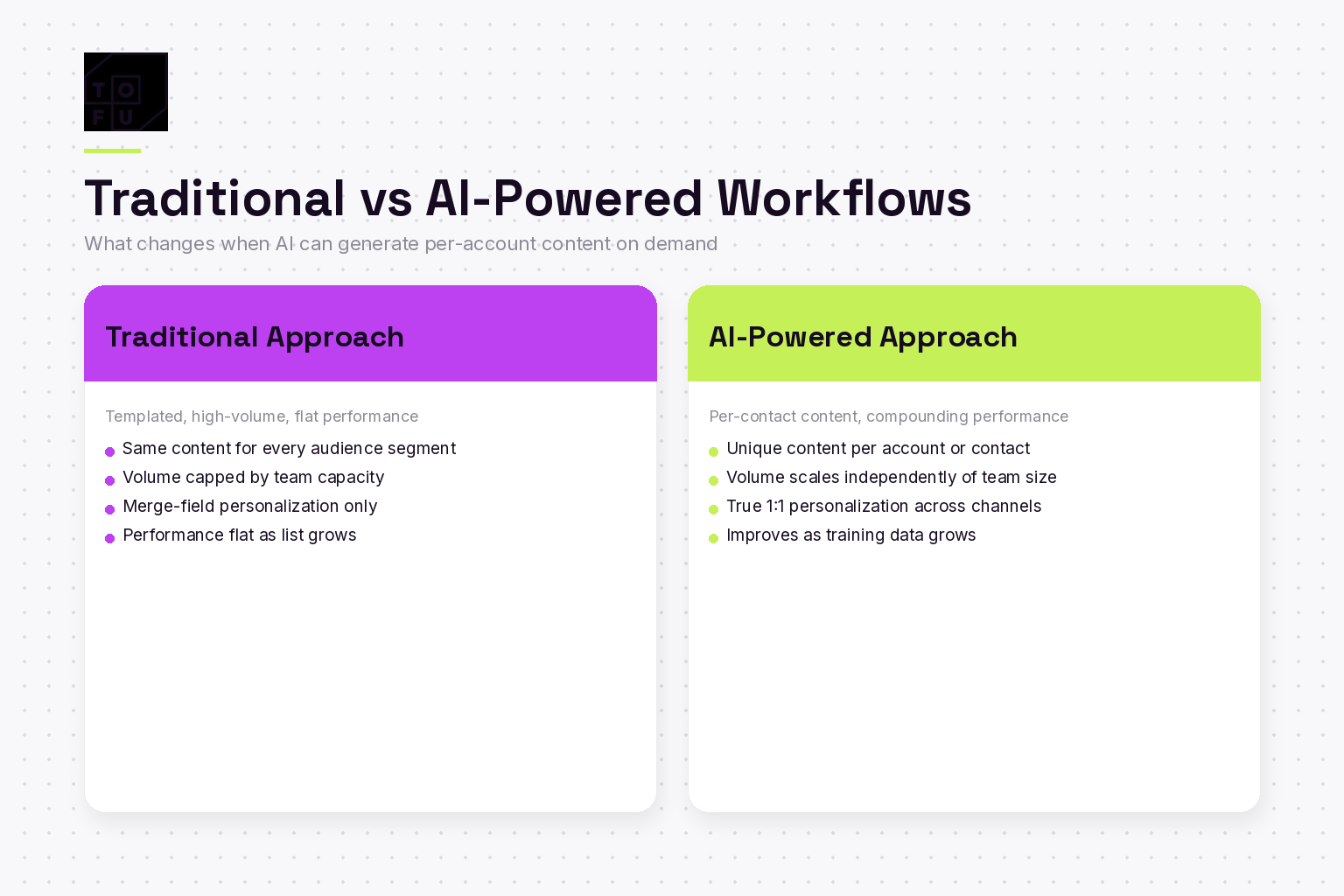
Tofu is not a replacement for 6sense's intent data or predictive analytics. It does not tell you which accounts are in-market or predict buying stages. What it does is solve the execution bottleneck that many teams hit after they have identified their target accounts: producing enough personalized content to engage those accounts meaningfully across channels. If your ABM program stalls because your content team cannot create 50 variations of a landing page for 50 different target accounts, Tofu eliminates that constraint.
Key strengths: Full campaign asset generation from a single brief. Deep personalization per account without manual effort. Integrates with existing CRM and MAP. Dramatically reduces time from campaign concept to live assets.
Limitations: No intent data, no account identification, no native advertising. Requires pairing with an intent or account identification tool for teams that need those capabilities.
2. Demandbase
Demandbase is 6sense's closest direct competitor and the most common destination for teams looking for a like-for-like replacement. It offers proprietary intent data, account identification, a native B2B demand-side platform (DSP) for advertising, website personalization, and orchestration — covering essentially the same functional territory as 6sense but with a different data methodology and user experience.
Where Demandbase differs most from 6sense is in its intent data approach. Demandbase's intent data includes keyword-level granularity, meaning you can see not just that an account is researching "marketing automation" but which specific terms they are engaging with. 6sense takes a more topic-and-stage-based approach with its Revenue AI predictions. Some teams find Demandbase's granularity more actionable; others prefer 6sense's predictive buying stage model. Both approaches have trade-offs in accuracy and interpretability.
Key strengths: Keyword-level intent data. Native B2B DSP for account-based advertising. Mature website personalization. Strong Salesforce integration.
Limitations: Enterprise pricing comparable to 6sense ($60K-$100K+/yr). Similar implementation complexity and time to value. Same content generation gap — strong on identification, limited on content execution.
3. Bombora
Bombora is the largest independent B2B intent data provider and a strong alternative for teams that want intent signals without being locked into an all-in-one platform. Its Company Surge data is derived from a co-operative network of over 5,000 B2B media sites, tracking which companies are researching specific topics at a rate above their historical baseline. Bombora's data powers intent features inside many other platforms (including RollWorks, Terminus, and some configurations of ZoomInfo), so teams may already be consuming Bombora data indirectly.
The key difference from 6sense is that Bombora is a data provider, not an execution platform. It gives you the intent signals, but you bring your own tools for orchestration, advertising, and engagement. This makes Bombora ideal for teams that have already invested in a MAP, CRM, and ad platform and want to layer intent data on top without replacing their existing stack. It also means you avoid paying for features you do not need.
Key strengths: Largest B2B intent data co-op. Clean integration with most MAPs and CRMs. Topic taxonomy covers 5,000+ categories. Does not force you into a specific execution workflow.
Limitations: No built-in account identification or deanonymization. No native advertising, orchestration, or content generation. Data is directional rather than deterministic — requires interpretation and testing to validate signal quality for your specific market.
4. ZoomInfo
ZoomInfo approaches ABM from the sales intelligence angle, offering one of the largest B2B contact databases alongside intent data, website visitor tracking, and workflow automation. If your ABM program is sales-led or requires person-level contact data in addition to account-level signals, ZoomInfo covers both in a single platform. Its intent data comes from proprietary signals combined with a Bombora partnership, giving teams both first-party and co-op intent coverage.
Compared to 6sense, ZoomInfo is stronger on the contact data side — direct dials, verified emails, org charts, and technographic data are core strengths. Its ABM features (account scoring, buying committees, intent-based workflows) have matured significantly but still lean more toward enabling sales outreach than marketing orchestration. Teams that need to arm SDRs with contacts and buying signals in a single tool often find ZoomInfo more directly useful than 6sense's marketing-centric approach.
Key strengths: Deep contact database with verified emails and direct dials. Combined proprietary and Bombora intent data. Strong technographic and firmographic data. Integrated outreach tools (Engage).
Limitations: Contact data accuracy varies by region (strongest in North America). Intent data is not as deep or predictive as 6sense's Revenue AI. Pricing can escalate quickly with seat-based model and add-on modules. Limited marketing-side orchestration compared to dedicated ABM platforms.
5. Apollo.io
Apollo.io has rapidly expanded from a prospecting tool into a broader sales intelligence platform with growing ABM-adjacent capabilities. Its database includes over 270 million contacts with email addresses and phone numbers, and its built-in sequencing engine lets you execute outbound directly from the platform. Apollo has added buying intent signals, account scoring, and basic account-based workflows, making it a viable 6sense alternative for sales-led organizations operating on tighter budgets.
Apollo is not a traditional ABM platform — its DNA is prospecting and outreach, not marketing orchestration. But for teams where ABM means "identify target accounts, find the right contacts, and run personalized outreach sequences," Apollo covers that workflow at a price point that is accessible to virtually any team. Its free tier is functional enough for small teams to test the approach before committing.
Key strengths: Large contact database at an affordable price. Built-in email sequencing and outreach. Free tier for basic prospecting. Growing intent data and account scoring features. API-first with strong CRM integrations.
Limitations: Intent data is less mature than 6sense, Demandbase, or Bombora. Not designed for marketing-led ABM orchestration. Contact data accuracy is crowdsourced and can be inconsistent. No native advertising capabilities.
6. Clearbit (HubSpot Breeze Intelligence)
Clearbit was acquired by HubSpot in late 2023 and has since been integrated into HubSpot's platform as Breeze Intelligence. For teams already on HubSpot, this makes real-time company identification, form enrichment, and firmographic data a native part of their existing stack rather than a separate purchase. Clearbit's IP-based visitor identification reveals which companies are browsing your site, and its enrichment APIs automatically fill in company and contact data from form submissions.
Compared to 6sense, Clearbit (Breeze Intelligence) is significantly narrower in scope. It does not offer the predictive buying stage models, third-party intent data aggregation, or native advertising that 6sense provides. What it does well is real-time identification and enrichment — and for HubSpot-centric teams that pair it with Bombora or G2 for intent data, it can serve as a cost-effective foundation for account-based targeting without requiring a separate enterprise platform.
Key strengths: Native HubSpot integration with zero additional setup for HubSpot users. Real-time visitor identification and enrichment. Clean API for custom workflows. No separate contract or vendor to manage.
Limitations: Requires HubSpot for full value. No standalone intent data — must pair with third-party providers. No predictive analytics, buying stage models, or native advertising. Limited value outside the HubSpot ecosystem.
7. Leadfeeder (Dealfront)
Leadfeeder, now part of the Dealfront platform following its merger with Echobot, specializes in website visitor identification. It tracks which companies visit your website, which pages they view, how often they return, and how they found you. For teams whose primary need from 6sense is knowing which accounts are visiting their site, Leadfeeder provides that specific capability at a significantly lower price and with a much simpler implementation — often a single script tag and a CRM integration.
Dealfront has expanded Leadfeeder's capabilities with European data compliance (strong GDPR coverage), B2B contact data, and prospecting features. For teams operating in Europe or with a significant European target market, Dealfront's data coverage and compliance posture can be stronger than 6sense's primarily North American focus.
Key strengths: Simple setup and fast time to value. Affordable entry price with a functional free tier. Strong European data coverage and GDPR compliance. Clean CRM integrations (Salesforce, HubSpot, Pipedrive).
Limitations: No third-party intent data — only tracks activity on your own website. No predictive analytics or buying stage models. Limited account scoring sophistication. Not a full ABM platform — works best as one component of a broader stack.
8. RollWorks
RollWorks, part of NextRoll, offers account-based advertising with built-in Bombora intent data at a price point well below 6sense. For teams whose primary ABM use case is running targeted display and retargeting campaigns against their target account lists, RollWorks provides a focused, easier-to-operate alternative. Its account scoring and intent signals (powered by Bombora) help prioritize which accounts to target with ad spend, and its reporting ties ad engagement back to account-level outcomes.
RollWorks does not attempt to match 6sense's breadth. It does not have the predictive buying stage models, the depth of anonymous visitor identification, or the orchestration sophistication. But for teams that found themselves using 6sense primarily for its advertising and account identification features, RollWorks covers those specific capabilities at a lower cost with faster time to value.
Key strengths: Account-based advertising at an accessible price point. Built-in Bombora intent data. Faster onboarding than enterprise ABM platforms. Strong for teams running ad-driven ABM programs. HubSpot integration is well-built.
Limitations: Intent data depth depends on Bombora's coverage for your market. Predictive capabilities are basic compared to 6sense. Less suitable for complex, multi-channel ABM orchestration. Ad platform is narrower than Demandbase's DSP.
9. Terminus (DemandScience)
Terminus, acquired by DemandScience in 2024, combines account-based display advertising, LinkedIn ad orchestration, and content syndication in a single platform. Its focus is on activation — getting your message in front of the right accounts across channels — rather than on identification and prediction. For teams that have already solved the "which accounts" question (through CRM data, manual list building, or a third-party intent provider) and need help reaching those accounts at scale, Terminus provides a multi-channel delivery mechanism.
The DemandScience acquisition added content syndication and lead generation capabilities to Terminus's advertising foundation. This makes it a broader demand generation platform than it was historically, though its ABM advertising remains the core strength. Compared to 6sense, Terminus is less about predicting who to target and more about efficiently reaching accounts you have already decided to pursue.
Key strengths: Multi-channel account-based advertising (display, LinkedIn, connected TV). Content syndication capabilities post-DemandScience acquisition. Account-level engagement measurement. Strong for teams with defined account lists that need activation.
Limitations: Less robust intent data than 6sense or Demandbase. Account identification is not a core strength. Post-acquisition product direction is still evolving. Pricing can be opaque and ad-spend-dependent.
How to Choose the Right 6sense Alternative
No single platform perfectly replicates everything 6sense does, so the right alternative depends on which capability gap matters most for your team. Here is a decision framework based on common scenarios.
If you need a direct like-for-like replacement:
Choose Demandbase. It is the only platform that covers intent data, account identification, native advertising, and orchestration in a comparable all-in-one package. Expect a similar price range and implementation effort, but with different strengths in data methodology and a more established B2B DSP.
If your biggest gap is personalized content execution:
Choose Tofu. If your ABM program identifies target accounts effectively but stalls because you cannot produce enough tailored landing pages, emails, one-pagers, and ad creative, Tofu solves that problem directly. Pair it with Bombora or another intent data source for a stack that covers both identification and execution.
If you want intent data without an all-in-one platform:
Choose Bombora. You get the intent signals — often from the same underlying data co-op that powers features in other platforms — without paying for advertising, orchestration, or execution tools you do not need. Integrate the data into your existing MAP and CRM.
If your team is sales-led and needs contacts plus intent:
Choose ZoomInfo for the most comprehensive contact database with layered intent data, or Apollo.io for a more affordable alternative with built-in outreach. Both serve sales-led ABM workflows better than 6sense's marketing-centric approach.
If cost reduction is the primary driver:
Choose Apollo.io for the lowest entry price with functional ABM features, Leadfeeder (Dealfront) for affordable website visitor identification, or RollWorks for mid-priced account-based advertising. All three provide meaningful capabilities at a fraction of 6sense's cost, with proportional trade-offs in depth.
If you want a best-of-breed stack:
Many teams find the most effective alternative to 6sense is not one platform but two or three. A common combination is an intent data provider (Bombora or G2 buyer intent) plus a content personalization engine (Tofu) plus your existing MAP (HubSpot or Marketo) for orchestration. This approach gives you the core ABM capabilities — knowing who to target, producing personalized content to engage them, and orchestrating delivery — without the bundled pricing and complexity of an all-in-one platform.
Frequently Asked Questions About 6sense Alternatives
What is the best alternative to 6sense for ABM?
The best alternative depends on your primary need. For the closest feature parity with intent data, account identification, and advertising in one platform, Demandbase is the strongest direct replacement. For standalone intent data without a bundled platform, Bombora is the industry standard. For teams whose bottleneck is producing personalized content rather than identifying accounts, Tofu solves that execution gap. Most teams benefit from identifying which 6sense capability they relied on most and choosing a best-in-class tool for that specific function.
Is Demandbase better than 6sense?
Demandbase and 6sense are direct competitors with overlapping but distinct strengths. Demandbase is generally considered stronger in keyword-level intent data granularity and its native B2B DSP for advertising. 6sense is often preferred for its predictive buying stage models, anonymous visitor identification via 6signal, and the Revenue AI engine. Both are enterprise-priced platforms with significant implementation requirements. The choice typically comes down to which vendor's data methodology your team finds more actionable, which UI your ops team prefers, and which integrates better with your existing stack. Neither is categorically superior.
How much does 6sense cost compared to alternatives?
6sense offers a free Community tier with basic features. Paid plans (Growth, Professional, Enterprise) typically range from $30,000 to $120,000+ per year depending on modules, database size, and seats. Demandbase is in a comparable range ($60,000-$100,000+). Bombora runs $25,000-$50,000 for standalone intent data. ZoomInfo ranges from $15,000-$60,000+ depending on tier. RollWorks starts around $12,000. Apollo.io starts at $49 per user per month with a functional free tier. Leadfeeder (Dealfront) starts at approximately $99 per month. Teams looking to reduce spend often find that a combination of two or three focused tools costs less than 6sense while covering their core use cases.
Can I get intent data without paying for a full ABM platform?
Yes. Bombora sells Company Surge intent data as a standalone product that integrates with your existing CRM and MAP. G2 offers buyer intent data based on activity on its review platform. Several other providers (TrustRadius, TechTarget Priority Engine) offer intent signals from their own properties. These options give you third-party intent data without requiring a bundled ABM platform. You can layer this data into HubSpot, Marketo, or Salesforce workflows directly, keeping your execution in tools your team already knows.
What is the biggest weakness of 6sense?
The most frequently cited weaknesses are the jump from a free tier to enterprise-level pricing with limited mid-market options, the complexity and time required for full implementation, and the gap between account identification and content execution. 6sense excels at telling you which accounts are in-market and what stage they are in, but it provides limited tools for creating the personalized content needed to actually engage those accounts. Teams also report that intent data accuracy can vary by industry and that predictive models require enough historical data to be reliable, which disadvantages newer companies or those with inconsistent CRM data.
Do I need 6sense if I already have Bombora or ZoomInfo?
Not necessarily. If you have Bombora for intent data and ZoomInfo for contact intelligence, you already have the two data layers that form the foundation of 6sense's value proposition. What 6sense adds beyond those tools is predictive analytics (buying stage models), a unified orchestration layer, native advertising, and a single-pane-of-glass view. If your MAP handles orchestration well, your team runs ads through LinkedIn Campaign Manager or a DSP, and you are comfortable building your own account scoring model, you may not need 6sense's bundled approach. The trade-off is more integration work across multiple tools versus paying for a single platform.
Can I use Tofu alongside my existing intent data platform?
Yes, and that is how most teams use it. Tofu is designed to complement intent data platforms, not replace them. A typical workflow is: your intent data tool (6sense, Bombora, Demandbase, or another provider) identifies which accounts are in-market, your team builds a target account list, and Tofu generates personalized campaign content — landing pages, emails, ads, and one-pagers — for each of those accounts. Tofu pulls enrichment data from your CRM and integrations to personalize every asset based on the account's industry, pain points, and context. This combination eliminates the most common bottleneck in ABM: having the data to know who to target but not the content capacity to engage them all.
Ready to Close the Content Gap in Your ABM Stack?
If you are evaluating 6sense alternatives because your team can identify in-market accounts but cannot produce enough personalized content to engage them, Tofu was built for exactly that problem. See how it generates full campaign assets from a single brief, personalized per target account.
Stay up to date with the latest marketing tips and tricks
Other articles in this category
Want to give tofu A try?
Request a custom demo to see how Tofu can supercharge your GTM efforts.
ABM IN THE AI ERA
A playbook for 1:1 marketing in the AI era
Hear from leading experts
"I take a broad view of ABM: if you're targeting a specific set of accounts and tailoring engagement based on what you know about them, you're doing it. But most teams are stuck in the old loop: Sales hands Marketing a list, Marketing runs ads, and any response is treated as intent."

"ABM has always been just good marketing. It starts with clarity on your ICP and ends with driving revenue. But the way we get from A to B has changed dramatically."
.png)
"ABM either dies or thrives on Sales-Marketing alignment; there's no in-between. When Marketing runs plays on specific accounts or contacts and Sales isn't doing complementary outreach, the whole thing falls short."

"In our research at 6sense, few marketers view ABM as critical to hitting revenue goals this year. But that's not because ABM doesn't work; it's because most teams haven't implemented it well."
"To me, ABM isn't a campaign; it's a go-to-market operating model. It starts with cross-functional planning: mapping revenue targets, territories, and board priorities."

"With AI, we can personalize not just by account, but by segment, by buying group, and even by individual. That level of precision just wasn't possible a few years ago."
%201%20(1).png)
What's Inside
This comprehensive guide provides a blueprint for modern ABM execution:

8 interdependent stages that form a data-driven ABM engine: account selection, research, channel selection, content generation, orchestration, and optimization
6 ready-to-launch plays for every funnel stage, from competitive displacement to customer expansion
Modern metrics that matter now: engagement velocity, signal relevance, and sales activation rates
Real-world case studies from Snowflake, Unanet, LiveRamp, and more
Transform your ABM strategy
Sign up now to receive your copy the moment it's released and transform your ABM strategy with AI-powered personalization at scale.
Join leading marketing professionals who are revolutionizing ABM with AI