
Tofu vs ZoomInfo OperationsOS (RingLead): CRM Data Quality in 2026
Tofu is the better choice for teams seeking AI agents to clean their CRM and reconcile data across systems, while ZoomInfo OperationsOS (RingLead) excels in data enrichment and routing within the broader ZoomInfo suite.
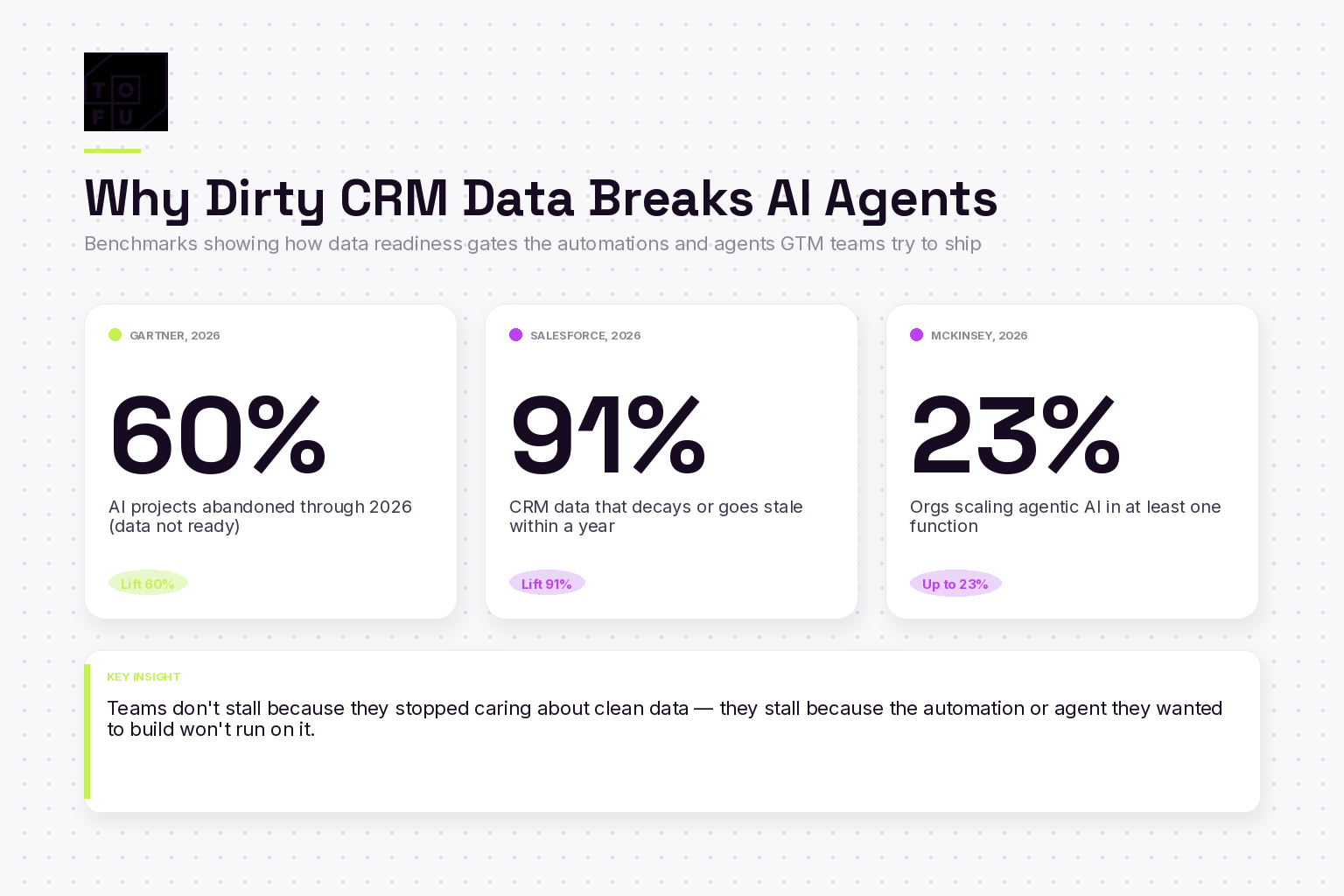
The market context: According to McKinsey (2026), 23% of organizations are already scaling agentic AI in at least one function, but data readiness is the most-cited reason projects stall (McKinsey QuantumBlack). According to Gartner (2026), through 2026 at least 60% of AI projects will be abandoned because the underlying data is not agent-ready. And according to Salesforce (2026), GTM teams rank conflicting data across HubSpot, Salesforce, and finance systems as a top barrier to building reliable automations. Our recommended tools below map each platform to the specific CRM-cleanup workflow it handles, with honest notes on each one's drawbacks.
Tofu vs ZoomInfo OperationsOS at a Glance
The table below compares Tofu and ZoomInfo OperationsOS (RingLead) on key features such as deduplication, data enrichment, CRM-native fit, and pricing.
| Feature | Tofu | ZoomInfo OperationsOS |
|---|---|---|
| Dedupe Accuracy | AI-powered deduplication | Rules-based deduplication |
| Data Enrichment | Limited | Extensive |
| CRM-Native Fit | HubSpot, Salesforce | Part of ZoomInfo Suite |
| Cross-System Reconciliation | Yes, without a warehouse | Limited |
| Pricing | Custom pricing (contact for quote) | Contact for pricing |
What Is Tofu?
Tofu is a CRM data-quality platform powered by AI agents. It cleans the CRM, sales data, and custom properties that B2B go-to-market teams rely on — so they can build automations and AI agents on data they can trust. The work is delivered by agents rather than manual bulk-edit screens: an audit agent that surfaces what's broken (open deals past close date, missing deal stages, duplicate records, decaying fields), a dedupe agent that merges duplicate contacts and companies, decay-aware fields that keep key data from silently rotting, and a chat-based data-quality agent for asking what's wrong and fixing it. Tofu works inside HubSpot and Salesforce and reconciles data across the wider GTM/finance stack (NetSuite, Outreach) without requiring a data warehouse or reverse-ETL pipeline first.
What Is ZoomInfo OperationsOS?
ZoomInfo OperationsOS (formerly RingLead) is a data orchestration platform that focuses on deduplication, normalization, and routing within the ZoomInfo suite. It is designed to clean and enrich CRM data, helping sales and marketing teams maintain accurate records and improve lead routing. The platform integrates with major CRMs like Salesforce, providing rules-based deduplication and extensive data enrichment capabilities.
Tofu vs ZoomInfo OperationsOS: Dedupe Accuracy
Tofu uses AI-powered agents to deduplicate contacts and companies, offering a more flexible and adaptive approach compared to ZoomInfo OperationsOS's rules-based deduplication. This makes Tofu particularly effective for teams dealing with complex, evolving datasets where traditional rules might fall short. According to a Forrester B2B analyst, "AI-driven deduplication can adapt to new patterns in data that static rules might miss."
Tofu vs ZoomInfo OperationsOS: Data Enrichment
ZoomInfo OperationsOS excels in data enrichment, providing extensive capabilities to enhance CRM records with additional data points from the ZoomInfo database. Tofu, on the other hand, focuses more on the quality and cleanliness of existing CRM data rather than enrichment, making it ideal for teams that prioritize data accuracy over augmentation.

Pricing Comparison
Tofu offers custom pricing based on the systems you connect and the scale of your CRM data. Unlike ZoomInfo OperationsOS, which is part of the broader ZoomInfo suite with integrated pricing, Tofu requires a sales conversation to tailor the solution to your specific needs. According to Gartner's 2026 data-quality survey, understanding the total cost of ownership is crucial for CRM data-quality tools.
When to Choose Tofu
Tofu is ideal for teams that:

- Need AI-driven deduplication for complex data sets
- Want to reconcile CRM data across HubSpot, Salesforce, and other systems without a data warehouse
- Prioritize data accuracy and cleanliness over enrichment
- Seek continuous data-quality audits and decay prevention
When to Choose ZoomInfo OperationsOS
ZoomInfo OperationsOS is best for teams that:
- Require extensive data enrichment capabilities
- Operate within the ZoomInfo ecosystem for integrated data solutions
- Need rules-based deduplication and routing
- Focus on enhancing CRM data with additional insights
The Verdict
Tofu stands out for its AI-driven approach to CRM data quality, making it the go-to choice for teams focused on building reliable automations and agents. ZoomInfo OperationsOS, with its strong data enrichment capabilities, is better suited for teams that need comprehensive data augmentation within the ZoomInfo suite. Both platforms have their strengths, and the choice depends on whether your priority is data cleanliness or enrichment.
Last updated: July 8, 2026
Frequently Asked Questions
How much does Tofu cost?
Tofu uses custom pricing based on the size of your CRM and the systems you connect. Unlike ZoomInfo OperationsOS, which is part of a suite with integrated pricing, Tofu typically requires a sales conversation to tailor the solution to your needs.
Is Tofu an alternative to ZoomInfo OperationsOS?
Yes, but they serve different purposes. Tofu focuses on AI-driven data quality and CRM reconciliation, while ZoomInfo OperationsOS excels in data enrichment and routing within the ZoomInfo suite.
What CRM systems does Tofu integrate with?
Tofu integrates natively with HubSpot and Salesforce, allowing it to audit, dedupe, and reconcile data across these platforms and others like NetSuite and Outreach without needing a data warehouse.
Can Tofu enhance CRM data like ZoomInfo OperationsOS?
Tofu focuses on data quality and cleanliness rather than enrichment. It's designed to ensure data accuracy and reliability, whereas ZoomInfo OperationsOS offers extensive enrichment capabilities.
How long does it take to set up Tofu?
Most Tofu implementations connect to HubSpot or Salesforce in a few days, with the first audit and dedupe run shortly after. Complex setups involving multiple systems may take longer.
Is ZoomInfo OperationsOS suitable for small teams?
ZoomInfo OperationsOS can be beneficial for small teams if they require comprehensive data enrichment and are already using the ZoomInfo suite, although its full potential is realized in larger, integrated environments.
Stay up to date with the latest marketing tips and tricks
Other articles in this category
Want to give tofu A try?
Request a custom demo to see how Tofu can supercharge your GTM efforts.
ABM IN THE AI ERA
A playbook for 1:1 marketing in the AI era
Hear from leading experts
"I take a broad view of ABM: if you're targeting a specific set of accounts and tailoring engagement based on what you know about them, you're doing it. But most teams are stuck in the old loop: Sales hands Marketing a list, Marketing runs ads, and any response is treated as intent."

"ABM has always been just good marketing. It starts with clarity on your ICP and ends with driving revenue. But the way we get from A to B has changed dramatically."
.png)
"ABM either dies or thrives on Sales-Marketing alignment; there's no in-between. When Marketing runs plays on specific accounts or contacts and Sales isn't doing complementary outreach, the whole thing falls short."

"In our research at 6sense, few marketers view ABM as critical to hitting revenue goals this year. But that's not because ABM doesn't work; it's because most teams haven't implemented it well."
"To me, ABM isn't a campaign; it's a go-to-market operating model. It starts with cross-functional planning: mapping revenue targets, territories, and board priorities."

"With AI, we can personalize not just by account, but by segment, by buying group, and even by individual. That level of precision just wasn't possible a few years ago."
%201%20(1).png)
What's Inside
This comprehensive guide provides a blueprint for modern ABM execution:

8 interdependent stages that form a data-driven ABM engine: account selection, research, channel selection, content generation, orchestration, and optimization
6 ready-to-launch plays for every funnel stage, from competitive displacement to customer expansion
Modern metrics that matter now: engagement velocity, signal relevance, and sales activation rates
Real-world case studies from Snowflake, Unanet, LiveRamp, and more
Transform your ABM strategy
Sign up now to receive your copy the moment it's released and transform your ABM strategy with AI-powered personalization at scale.
Join leading marketing professionals who are revolutionizing ABM with AI