
Tofu vs Writer: AI Content Platform Comparison for B2B in 2026
Last updated: April 30, 2026
Disclosure: Tofu is our product. We've written this comparison to help buyers make an informed decision. We've aimed to represent Writer's capabilities accurately based on their public documentation and published pricing.
Tofu and Writer are both AI content platforms for B2B teams, but they solve different problems. Writer is best for brand governance and ensuring consistent, compliant content across your organization. Tofu, an agentic demand generation platform, is best for generating personalized campaign assets — emails, landing pages, ads, and microsites — tailored to each target account. Writer makes sure everything your team produces sounds right and stays on brand. Tofu generates the personalized campaign assets themselves, at scale, from a single brief. Understanding the difference matters because the right choice depends on whether your bottleneck is content governance or content production.
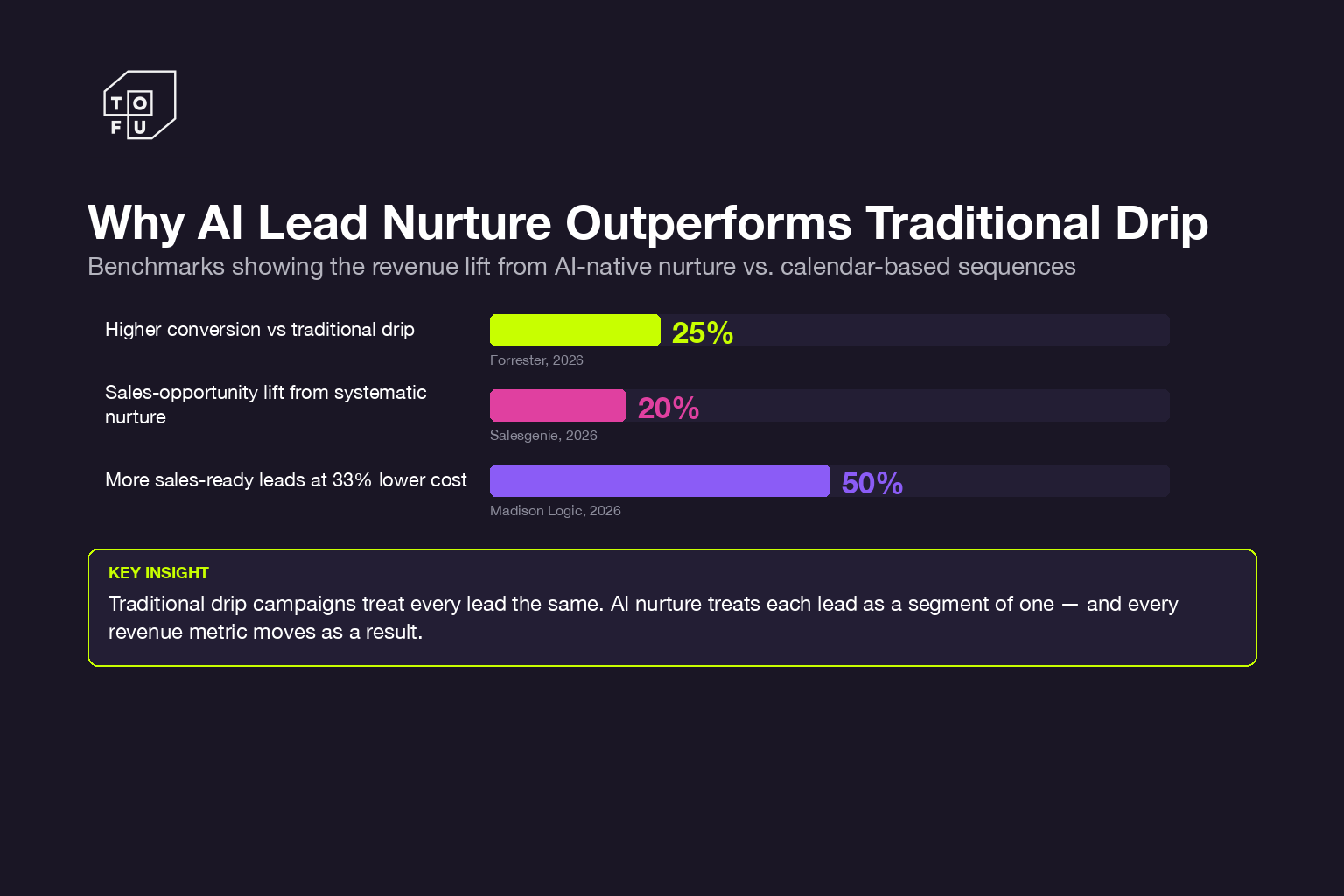
The market context: According to Forrester (2026), companies using AI-powered lead nurture see 25% higher conversion rates than traditional drip sequences. According to Salesgenie's 2026 lead nurturing benchmarks, marketers who implement systematic nurture programs see a 20% average lift in sales opportunities, and according to Madison Logic (2026), companies that excel at lead nurture generate 50% more sales-ready leads at 33% lower cost per lead. Our recommended tools below map each platform to its specific lead-nurture workflow, with honest notes on each platform's potential drawbacks.
Head-to-Head Comparison: Tofu vs Writer
Before diving into the details, here's a side-by-side overview of how Tofu and Writer compare across the capabilities that matter most to B2B marketing teams.
| Capability | Tofu | Writer |
|---|---|---|
| Core Strength | AI-powered campaign asset generation with 1:1 account-level personalization | Brand governance, style consistency, and compliant content generation at scale |
| Content Generation | Full campaign asset creation. Generates landing pages, emails, ads, microsites, one-pagers, and sales collateral — all personalized per target account from a single brief | General-purpose content creation. Blog posts, social copy, marketing copy, internal comms, and documentation — with brand voice enforcement baked in |
| Brand Governance | Trained on your brand guidelines and messaging frameworks to maintain voice consistency across generated assets | Industry-leading. Real-time style guide enforcement, terminology tracking, compliance flagging, and AI guardrails that prevent off-brand content at the model level |
| Personalization | True 1:1 account-level. Each target account receives materially different content based on their industry, pain points, tech stack, and buying stage | Segment-level personalization through templates and brand-consistent outputs; not designed for account-by-account content variation |
| Campaign Execution | End-to-end. Generates coordinated multi-channel campaign assets (email, web, ads, sales enablement) from a single brief and pushes them into your execution stack | Content creation and editing assistance; campaign execution depends on separate marketing automation tools |
| Compliance / Security | Enterprise security; does not publish specific compliance certifications | Enterprise-grade. SOC 2 Type II, HIPAA, PCI, GDPR compliant; does not use customer data to train models; custom data retention policies |
| Integrations | HubSpot, Salesforce, Outreach, Salesloft — focused on CRM and sales engagement for content delivery | Salesforce, HubSpot, Adobe Experience Manager, Snowflake, Databricks, Chrome extension, and MCP gateway for governed access across systems |
| Pricing | Custom pricing (contact for quote) | Team plan from ~$18/user/month; Enterprise plan custom pricing; transparent per-seat model for smaller teams |
| Best For | B2B marketing teams that need to generate personalized campaign assets at scale for ABM and demand gen | Organizations that need enterprise-wide brand governance, content compliance, and AI-assisted writing across teams |
What Tofu Does Best
Tofu is an agentic demand generation platform built to solve the content production bottleneck that slows down most marketing teams. The core problem is familiar: you have a list of target accounts, a campaign strategy, and a set of channels to execute across — but creating personalized content for each account, across each channel, takes more time and headcount than your team has. Tofu automates that content creation process by generating full campaign assets from a single brief, personalized to each target account.
Where Writer focuses on making sure content is on-brand and compliant, Tofu focuses on producing the campaign assets themselves. These are different problems. A team using Writer still needs to create each landing page, email, and ad — Writer helps ensure those assets are consistent and brand-compliant. A team using Tofu gets those assets generated automatically, personalized per account, and ready to deploy.
Key Features
Campaign Asset Generation from a Single Brief. Tofu's core capability is turning a single campaign brief into a complete suite of personalized assets. You provide the campaign objective, target accounts, and messaging direction — and Tofu generates landing pages, email sequences, ad copy, microsites, one-pagers, and sales collateral, all tailored to each account. This is not template fill-in-the-blank personalization. The AI produces genuinely differentiated content for each account based on their specific context.
True 1:1 Account-Level Personalization. Tofu ingests data about each target account — industry vertical, company size, technology stack, pain points, competitive landscape — and produces content that speaks directly to that account's situation. A cybersecurity company and a logistics company in the same campaign receive materially different landing pages, emails, and one-pagers. The content reflects their specific challenges, not just their company name swapped into a generic template.
Multi-Channel Content Creation. Unlike tools that address a single content type, Tofu generates coordinated assets across email, web, display ads, social, and sales enablement materials from the same brief. A single campaign execution produces on-brand, personalized content for every touchpoint — reducing the manual effort of adapting and reformatting content across channels.
Content Repurposing. Tofu can take an anchor asset — a webinar recording, whitepaper, or case study — and automatically derive derivative content: blog summaries, email drip sequences, social posts, and ad variations. This maximizes the return on every piece of content your team produces.
Brand Voice Consistency. Tofu's AI is trained on your brand guidelines, messaging frameworks, and existing content library. Generated assets match your voice and tone, which reduces the editing required before deployment. While this is not the same depth of governance that Writer provides, it ensures outputs are recognizably on-brand without manual rework.
Integrations
Tofu integrates with HubSpot, Salesforce, Outreach, and Salesloft — enabling generated content and campaign data to flow directly into your CRM, marketing automation, and sales engagement tools. Assets can be pushed into your execution stack for deployment without manual handoffs.
Pricing
Tofu uses custom pricing based on your team's needs and scale. Contact the Tofu team for a quote.
Limitations
Tofu is purpose-built for campaign asset generation and personalization. It does not provide the deep brand governance, compliance enforcement, or organization-wide style monitoring that Writer offers. If your primary challenge is ensuring that hundreds of employees across departments produce content that adheres to strict brand and regulatory guidelines, Tofu is not designed for that use case. Tofu also does not publish specific compliance certifications like SOC 2 or HIPAA, which may be a factor for teams in heavily regulated industries. Its integration ecosystem is focused on CRM and sales engagement tools rather than the broader enterprise data connectors Writer provides.
What Writer Does Best
Writer is an enterprise AI content platform built around brand governance, content compliance, and consistent content generation at scale. Where Tofu focuses on producing personalized campaign assets, Writer focuses on ensuring that everything your organization produces — across every team, every tool, and every channel — sounds right, stays on brand, and meets compliance requirements. Writer has built a strong reputation in enterprise B2B, with customers including Vanguard, Intuit, L'Oreal, Accenture, Spotify, and Qualcomm.
Writer's approach is fundamentally about governance and guardrails. It operates on proprietary Palmyra LLMs trained specifically for enterprise use, with a focus on compliance, brand voice enforcement, and data security. The platform is designed to be the AI layer that sits across your organization, ensuring quality and consistency regardless of who is creating the content or which tool they are using.
Key Features
Brand Governance and Style Enforcement. Writer's standout capability is real-time brand governance. The platform ingests your style guides, approved terminology, messaging frameworks, and brand guidelines — then enforces them at the model level. As writers work, Writer flags violations in real time: incorrect terminology, off-brand tone, non-compliant claims, or inconsistent messaging. This is not just spell-check or grammar correction. Writer's AI guardrails prevent off-brand content from being generated in the first place, and the system can block certain topics, enforce terminology preferences, and flag content that does not meet compliance requirements.
Knowledge Graph. Writer's Knowledge Graph is a retrieval-augmented generation (RAG) system that connects their AI models to your internal data sources. You upload company-specific information — product details, policies, technical specifications, approved messaging — and the AI references this knowledge base when generating content. This ensures factual accuracy around your company's specifics, not just stylistic consistency. The Knowledge Graph tracks approved terminology across the organization and flags violations as they happen.
General-Purpose Content Generation. Writer generates a wide range of content types: blog posts, social media copy, marketing copy, internal communications, documentation, and more. The generation is always filtered through your brand governance rules, so outputs are on-brand by default. Writer also offers CoWrite for collaborative AI writing and prebuilt AI agents for common content workflows.
AI Agents and Automation. Writer provides over 100 prebuilt AI agents along with the ability to create custom agents through AI Studio. Marketing teams can build "Playbooks" and "Routines" that automate repetitive content tasks while maintaining brand compliance. This is useful for teams that produce high volumes of similar content — product descriptions, support documentation, internal communications — where consistency matters more than account-level personalization.
Enterprise Security and Compliance. Writer's security posture is one of its clearest differentiators. The platform is SOC 2 Type II, HIPAA, PCI, and GDPR compliant. Writer does not use customer data to train its models and supports custom data retention policies. For organizations in regulated industries — financial services, healthcare, legal — these certifications and data handling practices are often requirements, not nice-to-haves.
Chrome Extension and Cross-Platform Enforcement. Writer's Chrome extension enables brand governance and AI assistance wherever your team works on the web — not just inside the Writer platform. This means writers using Google Docs, email clients, CMS platforms, or other web-based tools still get real-time style and compliance enforcement.
Integrations
Writer integrates with Salesforce, HubSpot, Adobe Experience Manager (AEM), Snowflake, and Databricks through its MCP gateway and specialized connectors. The platform also provides APIs for custom integrations, a Chrome extension for web-wide enforcement, and connectors to enterprise data and identity systems. Writer's integration strategy is broader than Tofu's, reflecting its position as an organization-wide AI layer rather than a campaign-specific tool.
Pricing
Writer offers a Team plan starting at approximately $18 per user per month (billed annually), which includes AI-powered writing assistance, basic brand controls, and collaboration features. The Enterprise plan uses custom pricing and adds advanced governance, custom model training, multi-domain support, SAML-based SSO, and higher content generation limits. For mid-market deployments (100-500 users), annual contracts typically fall in the $75K-$250K range. Large enterprise deals with extensive seats, high API usage, or custom model training can exceed $500K annually. Writer's per-seat pricing model provides more pricing transparency than most enterprise AI platforms, especially at the Team tier.
Limitations
Writer is not a campaign asset generation platform. It helps you write better, more consistent content — but it does not generate complete campaign suites (personalized landing pages, email sequences, ad variations, microsites, and one-pagers) from a single brief the way Tofu does. Writer's content generation is general-purpose: you prompt it for a blog post or social copy, and it produces on-brand output. But it does not take a campaign brief and automatically produce a coordinated set of multi-channel assets personalized to individual target accounts.
Writer also does not offer true 1:1 account-level personalization. It can help you create content for audience segments and ensure brand consistency, but it is not designed to produce materially different versions of the same campaign asset for hundreds of individual accounts. If your primary need is scaling personalized content for ABM or demand gen campaigns, Writer's architecture is not built for that workflow.
At scale, Writer's per-seat pricing can add up quickly. An organization with 200+ seats on the Enterprise plan is looking at a significant annual investment — which is justified if brand governance is the priority, but worth considering against platform-level pricing models that do not charge per seat.
When to Choose Writer
Writer is the right choice when your primary challenge is brand governance, content compliance, and consistency across a large organization. Choose Writer if:
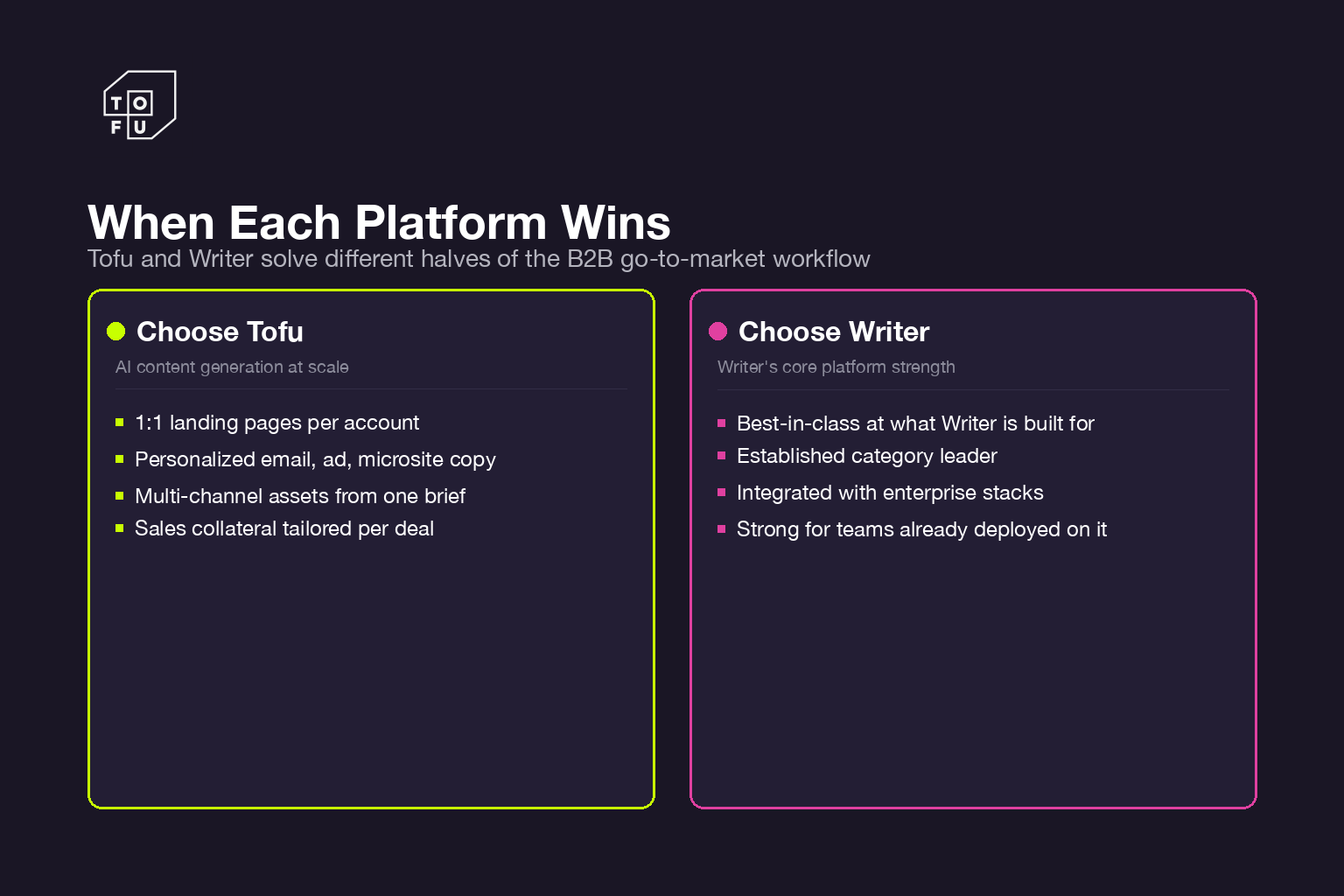
- Brand consistency is your top priority. If your biggest pain point is that content produced across teams, agencies, and tools sounds inconsistent or goes off-brand, Writer's real-time governance and style enforcement solve that problem directly.
- You operate in a regulated industry. Writer's SOC 2 Type II, HIPAA, PCI, and GDPR compliance — combined with its commitment to not using customer data for model training — makes it a strong fit for financial services, healthcare, legal, and other regulated verticals where data security and compliance are non-negotiable.
- You need AI assistance across the entire organization — not just marketing. Writer's Chrome extension and broad integration ecosystem mean that product teams, support teams, sales teams, and executives all benefit from AI-powered writing with brand guardrails.
- You produce high volumes of general content — blog posts, documentation, social media, internal communications — and need to ensure consistency and quality at scale without manually reviewing every piece.
- Your team needs transparent per-seat pricing. Writer's Team plan starting at ~$18/user/month is accessible for smaller teams that want to try AI-assisted writing with brand controls before committing to an enterprise contract.
- You need a Knowledge Graph that connects AI generation to your internal data sources, ensuring factual accuracy about your products, policies, and technical specifications.
When to Choose Tofu
Tofu is the right choice when your primary challenge is producing personalized campaign assets at scale for B2B marketing. Choose Tofu if:
- Your bottleneck is campaign content production. If your team is spending weeks manually creating landing pages, emails, ads, and sales collateral for different accounts or segments, Tofu automates that process from a single brief.
- You need true 1:1 account-level personalization. Tofu generates materially different content for each target account — not just segment-level variations with a company name swapped in, but genuinely differentiated messaging based on each account's industry, challenges, and context.
- You run ABM or demand gen campaigns and need personalized assets across email, web, ads, and sales enablement channels — all coordinated from a single campaign brief.
- You want to do more with a lean marketing team. Tofu enables small teams to produce the volume and variety of personalized content that would normally require a much larger staff or an agency.
- You need content repurposing. Tofu takes anchor assets like webinars, whitepapers, and case studies and automatically derives email sequences, social posts, ad variations, and blog summaries.
- You need campaign assets deployed into your existing stack. Tofu integrates with HubSpot, Salesforce, Outreach, and Salesloft to push generated assets directly into your CRM and sales engagement tools.
Can You Use Tofu and Writer Together?
Yes — and for many B2B marketing organizations, this is the strongest approach. Tofu and Writer address different layers of the content challenge, and using both creates a more complete content operation than either platform provides alone.
The logic is straightforward: Writer serves as the brand governance layer, and Tofu serves as the campaign asset generation layer. Writer ensures that your brand voice, terminology, compliance requirements, and style guidelines are codified and enforced across the organization. Tofu takes those brand standards and generates the personalized campaign assets — landing pages, emails, ads, microsites, and sales collateral — that actually drive pipeline.
Here is how the two platforms complement each other in practice:
Writer establishes and enforces the brand foundation. Your marketing team uses Writer to codify brand guidelines, approved terminology, messaging frameworks, and compliance rules. Writer's Knowledge Graph stores your product details, company policies, and technical specifications. The Chrome extension ensures that anyone creating content across the organization — whether in Google Docs, a CMS, or an email client — adheres to these standards. Writer becomes the source of truth for how your brand communicates.
Tofu generates the personalized campaign assets at scale. When your marketing team launches an ABM campaign targeting 300 accounts across five industries, Tofu generates the full suite of personalized assets from a single brief — landing pages, email sequences, ad copy, one-pagers, and microsites tailored to each account. These assets are generated with brand voice consistency built in, and they can be reviewed against Writer's governance rules before deployment.
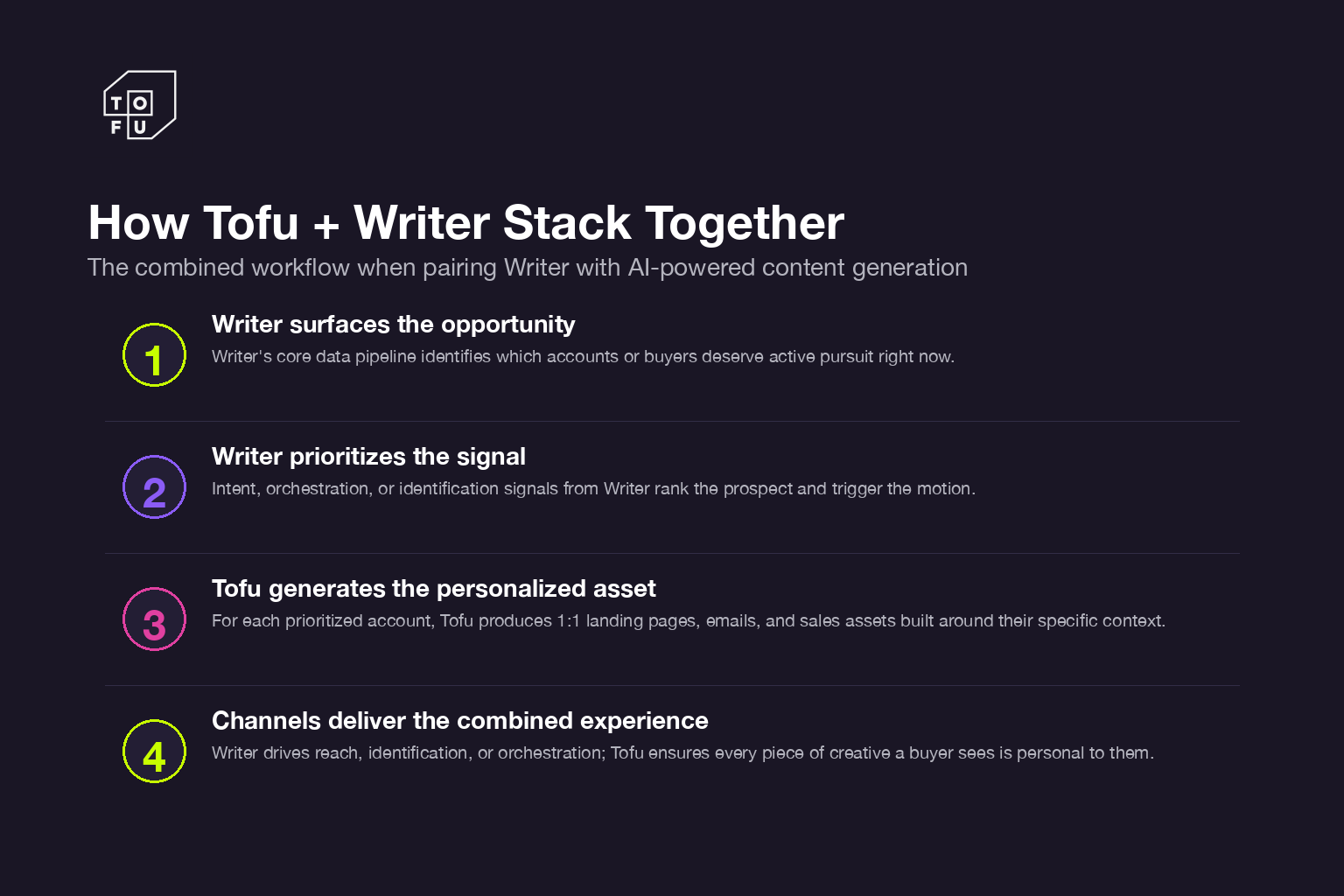
The combined workflow looks like this:
- Writer codifies your brand voice, style guidelines, approved terminology, and compliance requirements into its governance engine and Knowledge Graph.
- Your team creates a campaign brief in Tofu with target accounts, messaging direction, and campaign objectives.
- Tofu generates personalized landing pages, email sequences, ad copy, one-pagers, and microsites for each target account.
- Generated assets are reviewed with Writer's governance tools to verify brand compliance, terminology accuracy, and regulatory adherence.
- Approved assets are pushed into HubSpot, Salesforce, Outreach, or Salesloft for campaign execution.
- Writer continues to govern all other content production across the organization — blog posts, documentation, internal comms, support materials — ensuring everything stays on-brand.
This combination is particularly valuable for enterprise B2B teams that operate in regulated industries. Writer provides the compliance certifications (SOC 2, HIPAA, PCI, GDPR) and governance guardrails that regulated organizations require. Tofu provides the campaign asset generation and account-level personalization that marketing teams need to drive pipeline. Together, they deliver personalized, compliant content at scale — which is what most enterprise marketing teams are ultimately trying to achieve.
The economic case also makes sense for the right teams. Writer's per-seat pricing scales with your organization's overall content needs. Tofu's pricing scales with your campaign volume and personalization requirements. Each tool delivers ROI in its own domain: Writer reduces the cost of brand inconsistency, compliance risk, and manual content review; Tofu reduces the cost and time of producing personalized campaign assets. Teams that need both governance and personalization — which describes most enterprise B2B marketing organizations — get more value from the combination than from stretching either platform beyond its core use case.
The Bottom Line
Tofu and Writer are both strong AI content platforms for B2B, but they serve fundamentally different functions. Writer is the right choice when your primary need is brand governance — ensuring consistent, compliant content across your entire organization with enterprise-grade security. Writer's real-time style enforcement, Knowledge Graph, compliance certifications, and transparent per-seat pricing make it a leader in the brand governance category.
Tofu is the right choice when your primary need is generating personalized campaign assets at scale. If your team has strong brand guidelines but is bottlenecked on producing the personalized landing pages, emails, ads, and sales collateral that ABM and demand gen campaigns require, Tofu removes that bottleneck with AI-powered content generation and true 1:1 account-level personalization.
For many B2B marketing teams, the most honest answer is that both platforms address real and different needs. Writer ensures everything your organization produces sounds right and stays compliant. Tofu generates the personalized campaign assets that drive pipeline. The two platforms are complementary, not competitive — and using both creates a more complete content operation than either one delivers alone.
The right choice depends on where your biggest gap is today. If you are struggling with "how do we keep all our content on-brand and compliant?" — start with Writer. If you are struggling with "how do we produce personalized content for every target account without scaling our team?" — start with Tofu.
Frequently Asked Questions
What's the difference between Tofu and Writer?
Tofu is an agentic demand generation platform that generates personalized campaign assets — landing pages, emails, ads, microsites, one-pagers, and sales collateral — from a single campaign brief, with true 1:1 account-level personalization. Writer is an enterprise AI content platform focused on brand governance, style consistency, and content compliance across your entire organization. Tofu generates the campaign assets; Writer ensures all content stays on-brand and compliant. They solve different problems: Tofu addresses the content production bottleneck, while Writer addresses the brand consistency and compliance challenge.
Which is better for B2B content: Tofu or Writer?
It depends on the type of B2B content you need. Tofu is better for generating personalized campaign assets at scale — landing pages, email sequences, ad copy, and sales enablement materials tailored to individual target accounts. Writer is better for general content creation with brand governance — blog posts, social copy, documentation, and internal communications where brand consistency and compliance are the priority. For B2B teams running ABM or demand gen campaigns, Tofu is typically the better fit. For B2B teams focused on organization-wide content quality and compliance, Writer is the stronger choice.
Is Writer better than Tofu for enterprise?
Writer has stronger enterprise credentials in brand governance, compliance, and security. It is SOC 2 Type II, HIPAA, PCI, and GDPR compliant, does not use customer data to train models, and is used by major enterprises including Vanguard, Intuit, and Accenture. For enterprise teams where brand governance and regulatory compliance are the primary requirements, Writer is the stronger choice. However, Tofu is the better enterprise choice when the primary requirement is generating personalized campaign assets at scale. Many enterprise teams benefit from using both — Writer for the governance layer and Tofu for the campaign generation layer.
Can I use Tofu and Writer together?
Yes, and this is a strong approach for B2B marketing organizations that need both brand governance and personalized campaign execution. Writer serves as the brand governance layer — codifying your style guidelines, terminology, and compliance rules and enforcing them across the organization. Tofu serves as the campaign asset generation layer — producing personalized landing pages, emails, ads, and sales collateral for each target account. Generated assets from Tofu can be reviewed against Writer's governance rules before deployment, creating a workflow that is both personalized and compliant.
Which AI content platform is best for brand governance?
Writer is one of the strongest AI content platforms for brand governance. Its real-time style enforcement, Knowledge Graph for approved terminology and company data, AI guardrails that prevent off-brand content at the model level, and Chrome extension for cross-platform enforcement make it a leader in this category. Writer's compliance certifications (SOC 2 Type II, HIPAA, PCI, GDPR) add an additional layer of governance for regulated industries. Tofu maintains brand voice consistency in generated assets but does not offer the same depth of organization-wide governance, real-time style monitoring, or compliance enforcement that Writer provides.
Which AI platform generates personalized marketing campaigns?
Tofu is specifically designed for personalized marketing campaign generation. It takes a single campaign brief and generates a complete suite of personalized assets — landing pages, email sequences, ad copy, microsites, one-pagers, and sales collateral — tailored to each individual target account. Tofu provides true 1:1 account-level personalization based on industry, company size, tech stack, pain points, and buying stage. Writer generates content with brand governance but is not designed for account-by-account campaign asset generation or 1:1 personalization at the individual account level.
How do Tofu and Writer compare on pricing?
Writer offers more transparent pricing at the entry level: its Team plan starts at approximately $18 per user per month (billed annually), making it accessible for smaller teams. Writer's Enterprise plan uses custom pricing, with mid-market deployments typically ranging from $75K to $250K annually and large enterprise contracts potentially exceeding $500K. Tofu uses custom pricing based on your team's campaign volume and personalization needs — contact Tofu for a quote. Writer's per-seat model is more predictable for teams scaling across an organization, while Tofu's pricing is tied to campaign output rather than user count. The right pricing model depends on whether you are scaling AI assistance across many users (Writer) or scaling personalized campaign production (Tofu).
Ready to See Tofu in Action?
If generating personalized campaign assets at scale is your team's biggest challenge, Tofu can help. Schedule a demo to see how Tofu generates personalized landing pages, emails, ads, and sales collateral from a single campaign brief — and how it integrates with your existing marketing stack.
Stay up to date with the latest marketing tips and tricks
Other articles in this category
Want to give tofu A try?
Request a custom demo to see how Tofu can supercharge your GTM efforts.
ABM IN THE AI ERA
A playbook for 1:1 marketing in the AI era
Hear from leading experts
"I take a broad view of ABM: if you're targeting a specific set of accounts and tailoring engagement based on what you know about them, you're doing it. But most teams are stuck in the old loop: Sales hands Marketing a list, Marketing runs ads, and any response is treated as intent."

"ABM has always been just good marketing. It starts with clarity on your ICP and ends with driving revenue. But the way we get from A to B has changed dramatically."
.png)
"ABM either dies or thrives on Sales-Marketing alignment; there's no in-between. When Marketing runs plays on specific accounts or contacts and Sales isn't doing complementary outreach, the whole thing falls short."

"In our research at 6sense, few marketers view ABM as critical to hitting revenue goals this year. But that's not because ABM doesn't work; it's because most teams haven't implemented it well."
"To me, ABM isn't a campaign; it's a go-to-market operating model. It starts with cross-functional planning: mapping revenue targets, territories, and board priorities."

"With AI, we can personalize not just by account, but by segment, by buying group, and even by individual. That level of precision just wasn't possible a few years ago."
%201%20(1).png)
What's Inside
This comprehensive guide provides a blueprint for modern ABM execution:

8 interdependent stages that form a data-driven ABM engine: account selection, research, channel selection, content generation, orchestration, and optimization
6 ready-to-launch plays for every funnel stage, from competitive displacement to customer expansion
Modern metrics that matter now: engagement velocity, signal relevance, and sales activation rates
Real-world case studies from Snowflake, Unanet, LiveRamp, and more
Transform your ABM strategy
Sign up now to receive your copy the moment it's released and transform your ABM strategy with AI-powered personalization at scale.
Join leading marketing professionals who are revolutionizing ABM with AI