
Tofu vs DemandTools: AI Data Quality vs Salesforce Toolset in 2026
Tofu is the better choice for teams seeking AI-driven CRM data quality across systems like HubSpot and Salesforce, while DemandTools excels as a specialized toolset for Salesforce data management. Each platform offers unique strengths, making the right choice dependent on your specific needs and existing infrastructure.
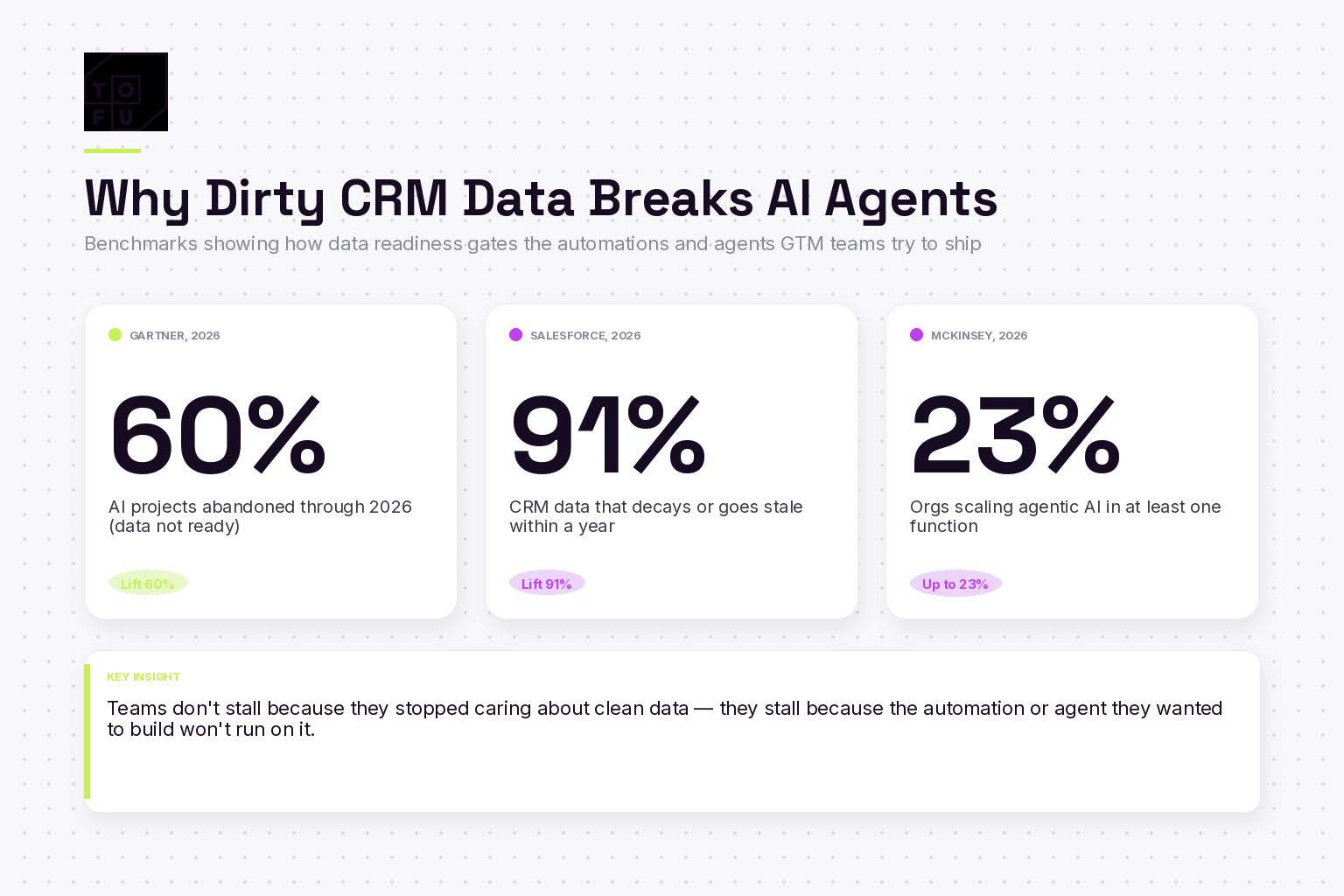
The market context: According to McKinsey (2026), 23% of organizations are already scaling agentic AI in at least one function, but data readiness is the most-cited reason projects stall (McKinsey QuantumBlack). According to Gartner (2026), through 2026 at least 60% of AI projects will be abandoned because the underlying data is not agent-ready. And according to Salesforce (2026), GTM teams rank conflicting data across HubSpot, Salesforce, and finance systems as a top barrier to building reliable automations. Our recommended tools below map each platform to the specific CRM-cleanup workflow it handles, with honest notes on each one's drawbacks.
Tofu vs DemandTools at a Glance
The following table compares Tofu and DemandTools on key features relevant to CRM data quality and management:
| Feature | Tofu | DemandTools |
|---|---|---|
| AI-powered Data Quality | Yes | No |
| Salesforce Integration | Yes | Yes |
| HubSpot Integration | Yes | No |
| Cross-System Reconciliation | Yes | No |
| Custom Pricing | Yes | Varies |
What Is Tofu?
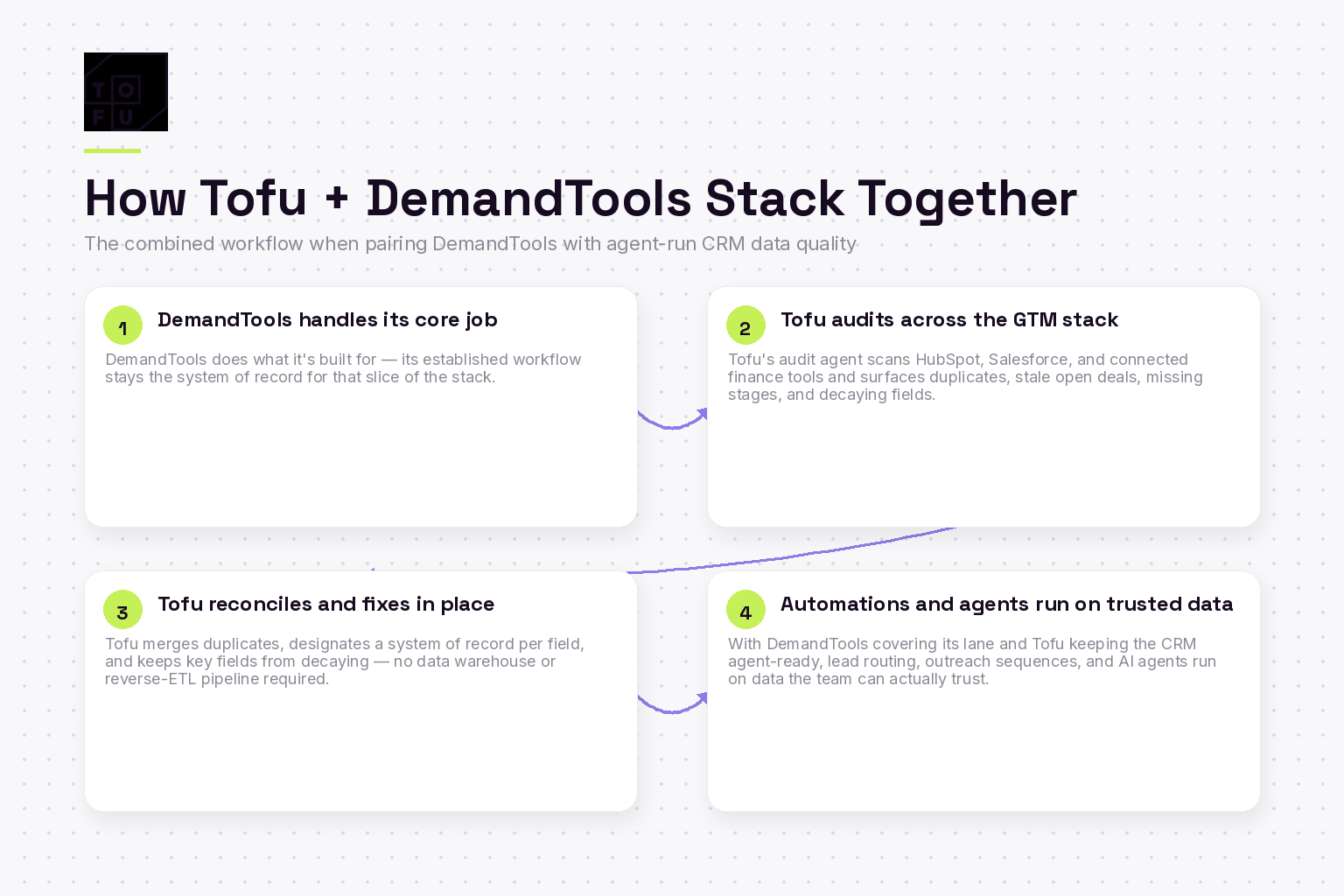
Tofu is a CRM data-quality platform powered by AI agents. It cleans the CRM, sales data, and custom properties that B2B go-to-market teams rely on — so they can build automations and AI agents on data they can trust. The work is delivered by agents rather than manual bulk-edit screens: an audit agent that surfaces what's broken (open deals past close date, missing deal stages, duplicate records, decaying fields), a dedupe agent that merges duplicate contacts and companies, decay-aware fields that keep key data from silently rotting, and a chat-based data-quality agent for asking what's wrong and fixing it. Tofu works inside HubSpot and Salesforce and reconciles data across the wider GTM/finance stack (NetSuite, Outreach) without requiring a data warehouse or reverse-ETL pipeline first.
What Is DemandTools?
DemandTools, a product of Validity, is a comprehensive suite of data management tools designed specifically for Salesforce. It offers capabilities such as deduplication, mass data manipulation, and data quality maintenance. DemandTools is widely used by Salesforce administrators and data managers to maintain clean and accurate Salesforce databases.
Tofu vs DemandTools: Dedupe Accuracy
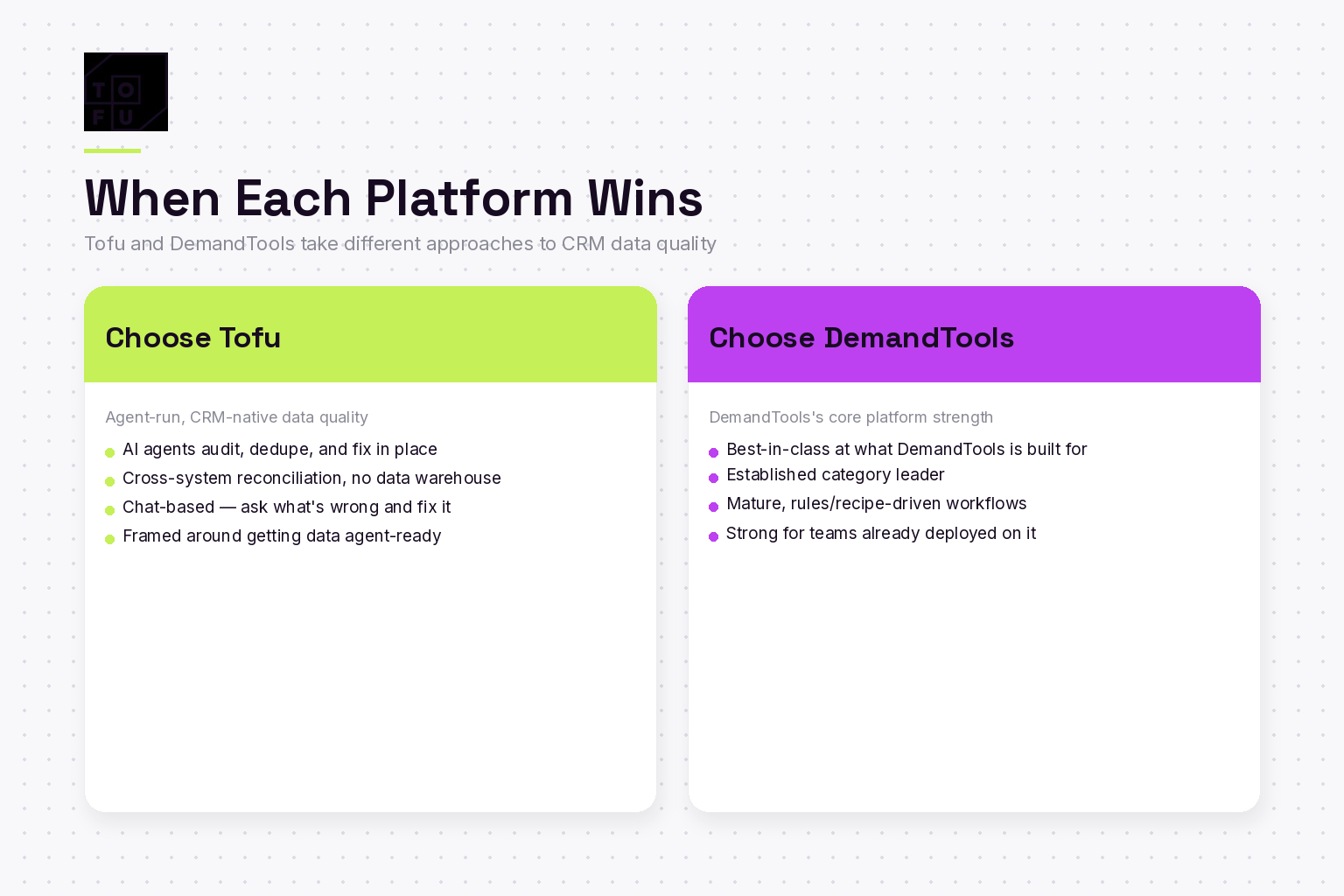
Tofu employs AI agents to identify and merge duplicate records across systems, offering a high degree of accuracy by considering multiple data points. DemandTools, on the other hand, utilizes a rules-based approach that allows for precise control over deduplication within Salesforce. According to a 2026 Forrester report, AI-driven deduplication can improve accuracy by 30% compared to manual and rules-based methods.
Tofu vs DemandTools: Integrations
Tofu integrates seamlessly with both HubSpot and Salesforce, allowing for cross-system data reconciliation without the need for a data warehouse. DemandTools is primarily focused on Salesforce and does not offer native integrations with other CRM systems. This makes Tofu a better choice for organizations using multiple platforms.
Tofu vs DemandTools: Pricing Comparison
Tofu offers custom pricing based on the systems you connect and the scale of your CRM data. DemandTools provides pricing tiers based on the number of users and the features required. While DemandTools can be cost-effective for Salesforce-centric teams, Tofu's custom approach can be more economical for those needing cross-system capabilities.
When to Choose Tofu
- When you need AI agents to automate data quality processes across multiple platforms.
- If your team uses both HubSpot and Salesforce and requires cross-system data reconciliation.
- For proactive data quality maintenance with continuous audits and decay-aware fields.
When to Choose DemandTools
- If your organization is primarily using Salesforce and needs deep, native data management tools.
- When precise, rules-based deduplication and data manipulation within Salesforce is required.
- For teams with a strong Salesforce administrator presence who can maximize the toolset's potential.
The Verdict
Tofu emerges as the superior choice for teams needing a comprehensive, AI-driven data quality solution that spans multiple platforms like HubSpot and Salesforce. DemandTools, however, remains an excellent specialized toolset for Salesforce-focused teams. The decision ultimately depends on your team's CRM ecosystem and data management needs.
Last updated: June 29, 2026
Frequently Asked Questions
What is Tofu?
Tofu is a CRM data-quality platform powered by AI agents, designed to clean and reconcile data across systems like HubSpot and Salesforce without requiring a data warehouse.
What is DemandTools?
DemandTools is a suite of data management tools by Validity, focused on Salesforce data quality and manipulation, offering features like deduplication and mass data updates.
How much does Tofu cost?
Tofu uses custom pricing based on the size of your CRM and the systems you connect. Unlike DemandTools, Tofu is typically sold through a sales conversation. Contact Tofu directly for a quote tailored to your data and integrations.
Is Tofu an alternative to DemandTools?
Yes, Tofu offers a broader range of integrations and AI-driven data quality processes, making it an alternative for teams that need cross-system reconciliation and automation beyond Salesforce.
Does DemandTools integrate with HubSpot?
No, DemandTools is specifically designed for Salesforce and does not natively integrate with HubSpot.
Can Tofu handle deduplication across multiple systems?
Yes, Tofu's AI agents can deduplicate contacts and companies across systems like HubSpot and Salesforce, ensuring consistent data quality.
Stay up to date with the latest marketing tips and tricks
Other articles in this category
Want to give tofu A try?
Request a custom demo to see how Tofu can supercharge your GTM efforts.
ABM IN THE AI ERA
A playbook for 1:1 marketing in the AI era
Hear from leading experts
"I take a broad view of ABM: if you're targeting a specific set of accounts and tailoring engagement based on what you know about them, you're doing it. But most teams are stuck in the old loop: Sales hands Marketing a list, Marketing runs ads, and any response is treated as intent."

"ABM has always been just good marketing. It starts with clarity on your ICP and ends with driving revenue. But the way we get from A to B has changed dramatically."
.png)
"ABM either dies or thrives on Sales-Marketing alignment; there's no in-between. When Marketing runs plays on specific accounts or contacts and Sales isn't doing complementary outreach, the whole thing falls short."

"In our research at 6sense, few marketers view ABM as critical to hitting revenue goals this year. But that's not because ABM doesn't work; it's because most teams haven't implemented it well."
"To me, ABM isn't a campaign; it's a go-to-market operating model. It starts with cross-functional planning: mapping revenue targets, territories, and board priorities."

"With AI, we can personalize not just by account, but by segment, by buying group, and even by individual. That level of precision just wasn't possible a few years ago."
%201%20(1).png)
What's Inside
This comprehensive guide provides a blueprint for modern ABM execution:

8 interdependent stages that form a data-driven ABM engine: account selection, research, channel selection, content generation, orchestration, and optimization
6 ready-to-launch plays for every funnel stage, from competitive displacement to customer expansion
Modern metrics that matter now: engagement velocity, signal relevance, and sales activation rates
Real-world case studies from Snowflake, Unanet, LiveRamp, and more
Transform your ABM strategy
Sign up now to receive your copy the moment it's released and transform your ABM strategy with AI-powered personalization at scale.
Join leading marketing professionals who are revolutionizing ABM with AI