
Tofu vs Demandbase in 2026: Which Is Right for You?

Last updated: April 16, 2026
Disclosure: Tofu is our product. We've written this comparison to help buyers make an informed decision. We've aimed to represent Demandbase's capabilities accurately based on their public documentation.
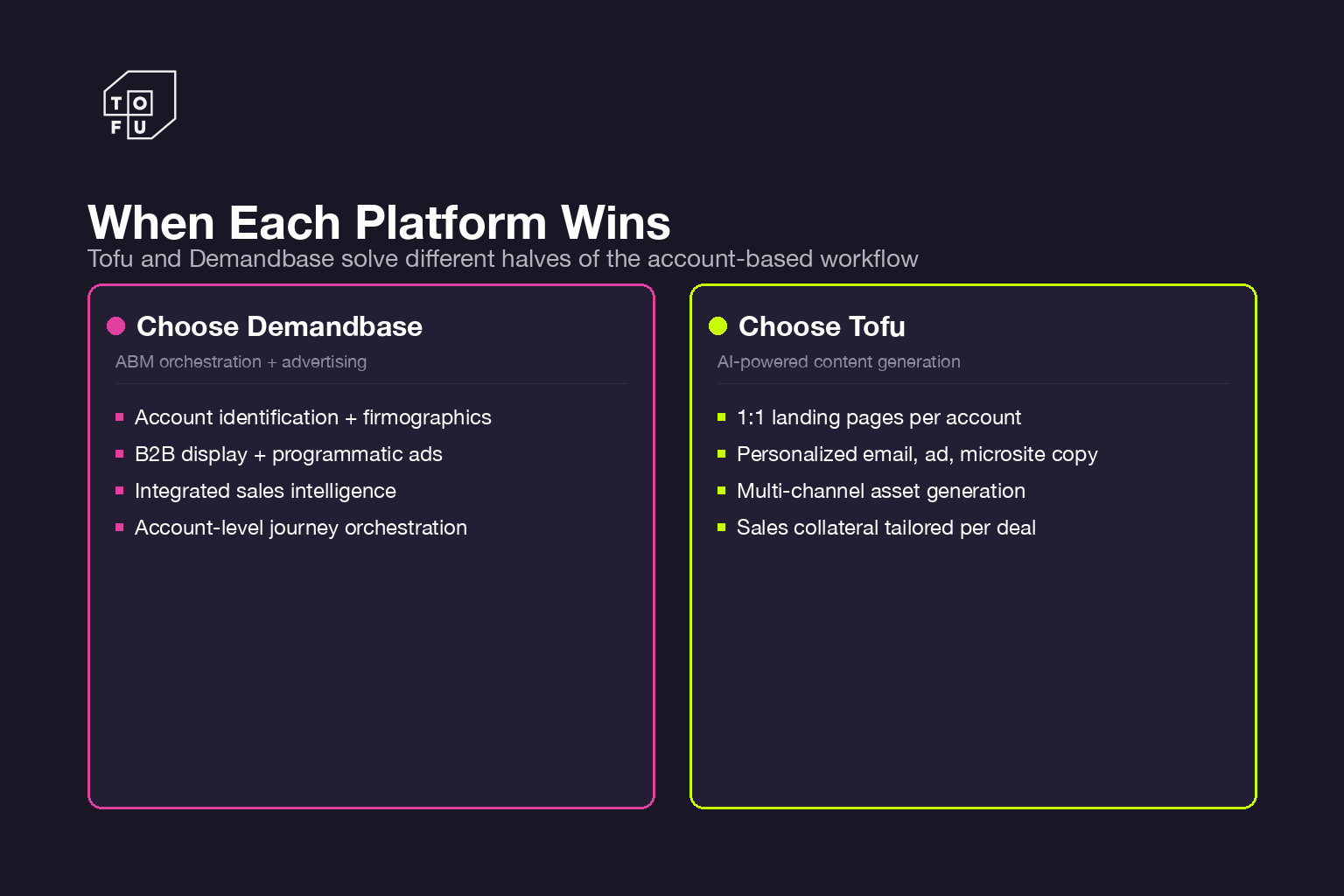
Tofu and Demandbase are both account-based marketing platforms, but they solve different parts of the ABM problem. Tofu, an AI-native B2B marketing platform, is best for generating personalized content at scale — turning a single campaign brief into tailored landing pages, emails, ads, and sales collateral for every target account. Demandbase is best for account identification, intent data, B2B advertising, and orchestration — helping you figure out which accounts to target and when they're in-market. Many teams find the two platforms are actually complementary rather than competitive.
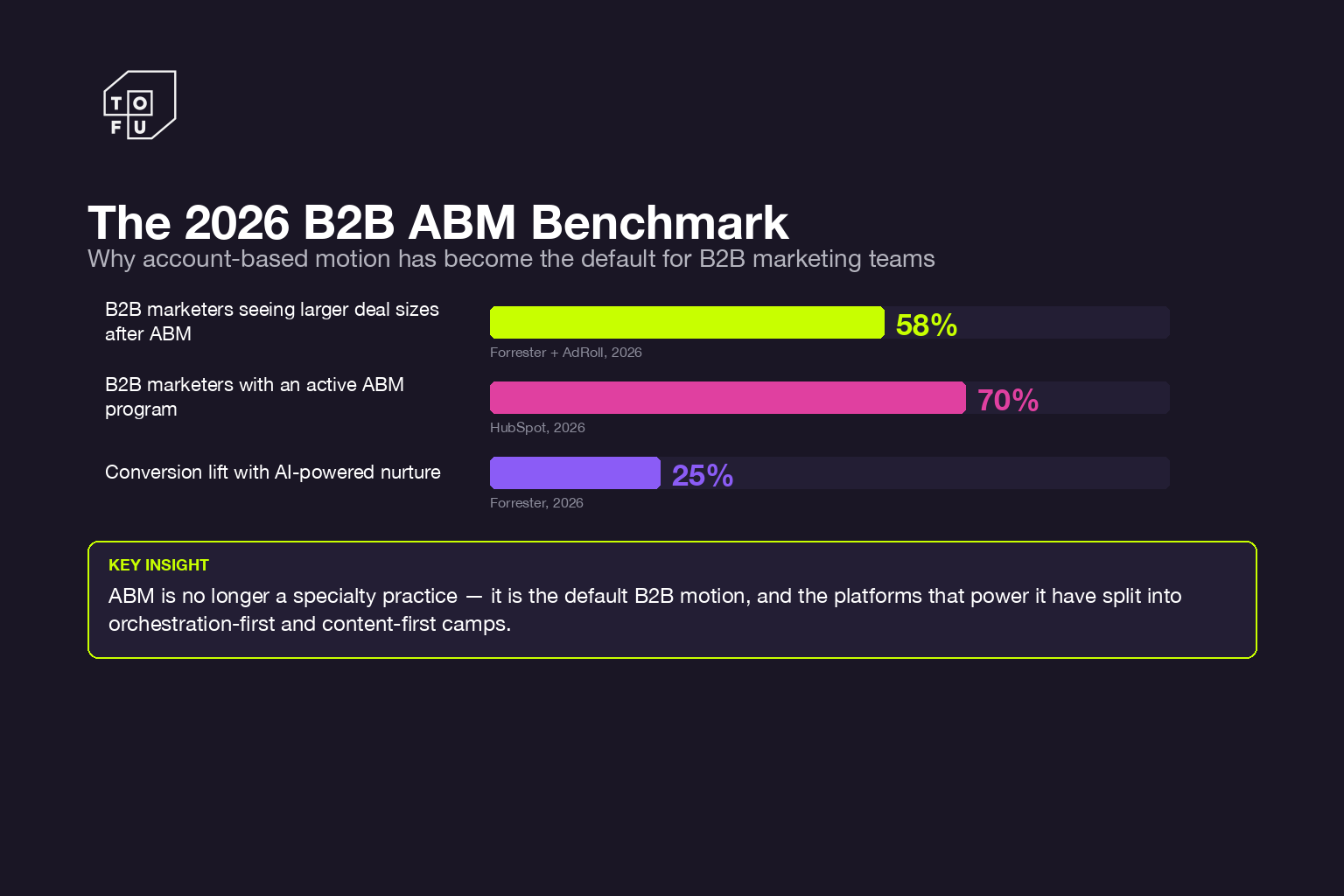
ABM is now the default B2B growth motion: according to HubSpot (2026), 70% of B2B marketers have an active ABM program in place (HubSpot State of Marketing). According to Forrester and AdRoll (2026), 58% of B2B marketers see larger deal sizes after adopting ABM (Forrester x AdRoll 2026 ABM Report), and according to Gartner (2026), 72% of ABM teams use ABM specifically to align content strategy with target accounts (Gartner ABM Trends). Against that backdrop, the Tofu vs Demandbase question is really about which side of ABM — content or account intelligence — is your biggest gap.
Head-to-Head Comparison: Tofu vs Demandbase
Before diving into the details, here's a side-by-side overview of how Tofu and Demandbase compare across the capabilities that matter most to ABM teams. Our evaluation methodology. We assessed both platforms on nine dimensions that consistently drive ABM buyer decisions: core strength, AI capabilities, content generation, intent data, account targeting, native advertising, integrations, pricing transparency, and ideal-team fit — the evaluation criteria most ABM buyers prioritize. Assessment is based on each vendor's public documentation, product pages, and customer-facing materials as of April 2026.
| Capability | Tofu | Demandbase |
|---|---|---|
| Core Strength | AI-powered content generation and 1:1 personalization across channels | Account identification, intent data, and B2B advertising |
| AI Capabilities | Generative AI that creates full campaign assets (pages, emails, ads, one-pagers) from a single brief | Predictive AI for account scoring, intent signal processing, and journey-stage modeling (Pipeline Predict, JourneyIQ, Agentbase) |
| Content Generation | Full content creation engine. Generates landing pages, emails, ad copy, microsites, one-pagers, and sales collateral — all personalized per account | Limited. Website personalization overlays and dynamic content swaps; does not generate net-new marketing content or full campaign assets |
| Intent Data | Integrates with third-party intent providers; does not generate proprietary intent signals | Market-leading. Proprietary intent data combining first-party web signals with third-party keyword-level intent across the open web |
| Account Targeting | Uses CRM data and imported account lists to personalize content; relies on external tools for account identification | Deep account intelligence. Firmographics, technographics, intent signals, predictive scoring, and dynamic audience segmentation |
| Ad Platform | Generates ad creative and copy; relies on native ad platforms (LinkedIn, Google) for delivery | Native B2B DSP. Account-targeted display advertising across the open web with journey-stage optimization (JourneyIQ) |
| Integrations | HubSpot, Salesforce, Outreach, Salesloft; focused on content delivery and sales enablement | Salesforce, HubSpot, Marketo, Pardot, Eloqua, LinkedIn, Outreach, Salesloft, Microsoft Dynamics; broad ecosystem |
| Pricing | Custom pricing (contact for quote) | Custom enterprise pricing; median ~$65K/year with modules ranging from $30K–$60K+ each |
| Best For | Teams that need to produce personalized content at scale across email, web, ads, and sales — without scaling headcount | Enterprise teams that need deep account intelligence, intent-driven targeting, and native B2B advertising |
What Tofu Does Best
Tofu is an AI-native B2B marketing platform built to solve one of the hardest problems in account-based marketing: creating personalized content at scale without scaling your team. Teams like Wunderkind, LaunchDarkly, and Highspot use Tofu to run 1:1 ABM campaigns across email, landing pages, ads, and sales collateral without standing up dedicated design or content teams for every account. Where most ABM platforms focus on identifying which accounts to target and when, Tofu focuses on what you actually say to those accounts — and how you say it across every channel.
The gap Tofu addresses is real. Most B2B marketing teams can identify their target accounts — through CRM data, intent providers, or manual research. The bottleneck is producing enough personalized content to actually engage those accounts individually. A marketing team might have 500 target accounts but only enough bandwidth to create personalized content for 20 of them. Tofu closes that gap by automating the content creation process while maintaining quality and brand consistency.
Key Features
AI-Powered Content Generation from a Single Brief. Tofu's core capability is transforming a single campaign brief into a complete suite of personalized assets. Feed it your campaign objective, target accounts, and messaging — and it generates landing pages, email sequences, ad copy, microsites, one-pagers, and sales collateral, all tailored to each account's industry, persona, and buying stage. This is not template-based personalization where you swap a company name into a generic page. Tofu's AI produces genuinely differentiated content for each account.
True 1:1 Account-Level Personalization. Tofu can ingest data about each target account — industry vertical, company size, tech stack, pain points, competitive landscape — and produce content that speaks directly to that account's specific context. A fintech company and a healthcare company in the same campaign receive materially different landing pages, not just different logos.
Multi-Channel Content Creation. Unlike point solutions that address only one channel, Tofu generates content across email, web, display ads, social, and sales enablement materials. This means a single campaign execution produces coordinated, on-brand assets for every touchpoint — reducing the manual effort of adapting content across channels.
Content Repurposing. Tofu can take an anchor asset — a webinar recording, whitepaper, or case study — and automatically derive derivative content: blog summaries, email drip sequences, social posts, and ad variations. This maximizes the ROI of every piece of content your team creates.
Brand Voice Fidelity. Tofu's AI is trained on your brand guidelines, messaging frameworks, and existing content. The output matches your voice and tone, which means less time editing AI-generated drafts and more time executing campaigns.
Integrations
Tofu integrates with HubSpot, Salesforce, Outreach, and Salesloft — enabling content and campaign data to flow between your CRM, marketing automation, and sales engagement tools. Generated assets can be pushed directly into your execution stack.
Pricing
Tofu uses custom pricing based on your team's needs and scale. Contact the Tofu team for a quote.
Limitations
Tofu does not generate its own intent data or account identification signals. If your primary challenge is figuring out which accounts to target or when they're in-market, you'll need a separate intent data provider or account intelligence platform. Tofu is also a newer platform compared to Demandbase, which means its integration ecosystem, while growing, is not yet as broad. Teams that need native B2B advertising capabilities will need to pair Tofu with an ad platform or DSP.
What Demandbase Does Best
Demandbase is one of the largest and most established ABM platforms in the market. Built through a series of strategic acquisitions — Engagio (ABM orchestration), InsideView (sales intelligence), and DemandMatrix (technographic data) — Demandbase One consolidates account identification, intent data, advertising, and orchestration into a single enterprise platform. Its strength is in the "who" and "when" of ABM: identifying which accounts are in-market and enabling you to reach them through targeted advertising and orchestrated workflows.
Key Features
Market-Leading Intent Data. Demandbase's intent data engine is widely regarded as one of the best in the market. It combines first-party signals (who's visiting your website and what they're engaging with) with proprietary third-party intent data that tracks keyword-level research activity across the open web. This gives ABM teams a reliable signal for when target accounts are actively researching solutions in your category.
Account Intelligence and Predictive Scoring. Pipeline Predict uses AI to score accounts based on their likelihood to convert, incorporating firmographic data, technographic data, engagement history, and intent signals. Dynamic Audiences automatically segments accounts based on real-time engagement levels, removing the manual work of list management.
Native B2B Advertising (DSP). Demandbase is one of the few ABM platforms with its own demand-side platform for display advertising. This lets you serve targeted ads to specific accounts across the open web — not just on LinkedIn — with journey-stage optimization through JourneyIQ, which adapts ad delivery in real time based on where an account is in the buying process.
Orchestration and Workflow Automation. Demandbase's orchestration engine enables persona-based automation with drag-and-drop workflow templates. You can trigger actions across marketing channels based on Demandbase signals — for example, automatically moving an account into an ad campaign when intent spikes, or alerting sales when a target account visits your pricing page.
Agentbase (AI Agents). In 2025-2026, Demandbase launched Agentbase, a set of AI agents designed to perform concrete go-to-market tasks. They also introduced Model Context Protocol (MCP) integration, allowing teams to access Demandbase intelligence within LLMs like ChatGPT and Claude.
Integrations
Demandbase has one of the broadest integration ecosystems in the ABM category. It connects natively with Salesforce, HubSpot, Microsoft Dynamics, Marketo, Pardot, Eloqua, LinkedIn, Outreach, Salesloft, and many more. Its marketplace supports data integrations, workflow integrations, and orchestration integrations — enabling bi-directional data sync between Demandbase and your entire go-to-market stack.
Pricing
Demandbase uses custom enterprise pricing. Based on publicly available data, contracts typically start at $18K/year, with a median of approximately $65K/year based on reported purchases. The base platform runs $45K-$65K/year, with add-on modules for advertising ($60K+), visitor deanonymization ($60K+), and personalization ($30K-$60K) each carrying separate price tags. Onboarding fees of approximately $29K are common. Per-seat fees range from $1,200-$3,000/year. Annual contracts are standard, with many enterprise agreements requiring multi-year commitments.
Limitations
Demandbase's most frequently cited limitation is complexity. Reviewers consistently report a steep learning curve — the platform is feature-rich but can feel overwhelming for non-power users, and extracting full value typically requires dedicated marketing operations support. Implementation takes months, not weeks, and the time-to-value can be longer than expected.
Demandbase identifies companies visiting your website, not individual people. You'll know "someone from Acme Corp visited your pricing page" but not who specifically. There can also be lag in data syncs and alerts, which impacts real-time workflow automation.
On the content side, Demandbase does not generate net-new marketing content. It can personalize existing website content through overlays and dynamic swaps, but it cannot produce landing pages, emails, ad copy, or sales collateral from scratch. Teams using Demandbase still need a separate content creation process — whether that's an in-house team, an agency, or a tool like Tofu.
The advertising DSP, while differentiated, requires more manual setup through Demandbase's team rather than offering full self-serve execution. And the total cost of ownership — once you add modules, seats, onboarding, and media spend — can reach well into six figures, making it impractical for teams without a substantial ABM budget.
When to Choose Tofu
Tofu is the right choice when your primary bottleneck is content creation and personalization — not account identification. Choose Tofu if:
- You already know your target accounts (from your CRM, a Demandbase or 6sense instance, or manual research) and need to produce personalized content for them at scale.
- Your team is spending too much time creating content. If your marketers are manually adapting the same email, landing page, or one-pager for different industries, personas, or accounts, Tofu automates that work.
- You need multi-channel personalization from a single brief. Tofu generates coordinated assets across email, web, ads, and sales enablement — not just one channel.
- You want true 1:1 account-level content — not just segment-level personalization where you swap in an industry name, but genuinely differentiated messaging for each account.
- You're looking to do more with a lean team. Tofu enables small marketing teams to produce the volume and variety of personalized content that would normally require a much larger staff.
- You already have an intent data provider and need a platform to act on those signals with personalized content.
When to Choose Demandbase
Demandbase is the right choice when your primary challenge is account identification, targeting, and advertising — the "who" and "when" of ABM. Choose Demandbase if:
- You need proprietary intent data to identify which accounts are actively researching your category. Demandbase's intent engine is one of the strongest in the market.
- Account-targeted display advertising is a priority. Demandbase's native B2B DSP is genuinely differentiated — very few platforms let you serve targeted display ads to specific accounts across the open web.
- You need deep account intelligence — firmographics, technographics, predictive scoring, and dynamic audience segmentation — to build and prioritize your target account lists.
- You have a large, enterprise ABM team with dedicated marketing operations resources that can manage the platform's complexity and extract full value from its feature set.
- You need a broad integration ecosystem that connects to every part of your go-to-market stack, including multiple CRMs, marketing automation platforms, and ad networks.
- Your budget supports $65K+ per year for a comprehensive account intelligence and advertising platform, plus additional module costs.
Can You Use Tofu and Demandbase Together?
Yes — and this is where it gets interesting. Tofu and Demandbase are not just comparable platforms; they are genuinely complementary. They address different halves of the ABM execution challenge, and using them together creates a more complete ABM engine than either one provides alone.

One of the most common failure modes in ABM is the gap between account intelligence and content execution. Teams invest heavily in platforms that tell them which accounts are in-market, what topics they're researching, and what stage of the buying journey they're in — and then they send those accounts the same generic landing page and boilerplate email that everyone else receives. The intelligence is wasted because the content doesn't match the signal. This is the exact gap that a Tofu + Demandbase combination addresses.
Here's how the two platforms fit together in practice:
Demandbase identifies and prioritizes the accounts. Its intent data engine surfaces which accounts are actively researching your category. Pipeline Predict scores those accounts by their likelihood to convert. Dynamic Audiences segments them by buying stage, industry, and engagement level. The result: a prioritized, signal-rich account list that tells your team exactly where to focus.
Tofu creates the personalized content to engage those accounts. Once you know which accounts to target and what they care about (from Demandbase's intent and firmographic data), Tofu takes that intelligence and generates the actual campaign assets — personalized landing pages, email sequences, ad copy, one-pagers, and sales collateral for each account. Instead of your team manually creating content for every high-intent account Demandbase surfaces, Tofu automates the personalized content production.
The workflow looks like this:
- Demandbase identifies 200 accounts showing high intent for your category this quarter.
- Your team exports or syncs that account list (with intent topics, industry, and firmographic data) into Tofu via your CRM.
- Tofu generates a personalized landing page, email sequence, and sales one-pager for each of those 200 accounts — tailored to their specific industry, pain points, and the topics they're researching.
- Your team deploys the emails via HubSpot or Outreach, publishes the landing pages, and equips sales with account-specific collateral via Salesloft or Salesforce.
- Demandbase continues to run targeted display ads to those same accounts, reinforcing the campaign across the web.
This combined approach solves one of the most common ABM execution gaps: teams invest in intent data and account intelligence but then send the same generic content to every account they surface. Demandbase tells you who to target. Tofu ensures you have something genuinely personalized to say to them.
For enterprise teams running large-scale ABM programs, this combination is particularly powerful. Demandbase handles the data and advertising layer, while Tofu handles the content and personalization layer — each platform doing what it does best.
The economic argument also holds up. Demandbase's strength in intent data and advertising means you're spending your ad budget more efficiently by targeting the right accounts at the right time. Tofu's strength in content generation means you're converting more of that targeted traffic by giving each account a personalized experience when they arrive. Neither platform fully captures the ABM value chain on its own, but together they cover the full loop from account identification through personalized engagement.
The Bottom Line
Tofu and Demandbase are both strong ABM platforms, but they serve different functions. Demandbase is a market leader in account intelligence, intent data, and B2B advertising. If your primary need is knowing which accounts to target and reaching them through display ads, Demandbase is a proven choice with a deep feature set and broad integrations.
Tofu is the better choice when your challenge is creating the personalized content those accounts actually receive. If your team has good account intelligence but is bottlenecked on producing personalized emails, landing pages, ads, and sales materials for each target account, Tofu removes that bottleneck with AI-powered content generation that works across channels.
For many B2B marketing teams, the honest answer is that both platforms address real needs — and using them together produces better results than either one alone. Demandbase provides the intelligence and advertising reach; Tofu provides the personalized content that converts that reach into pipeline.
The right choice depends on where your biggest gap is today. If you're struggling with "who should we target?" — start with Demandbase. If you're struggling with "what do we say to them?" — start with Tofu.
Frequently Asked Questions
Is Tofu better than Demandbase for ABM?
Tofu and Demandbase excel at different parts of ABM. Tofu is better for generating personalized content at scale — it creates tailored landing pages, emails, ads, and sales collateral for each target account from a single campaign brief. Demandbase is better for account identification, intent data, and B2B advertising. The best choice depends on whether your team's primary gap is in content creation or account intelligence.
What's the difference between Tofu and Demandbase?
Tofu is an AI-native content generation platform that produces personalized marketing assets (landing pages, emails, ads, one-pagers) across multiple channels from a single brief. Demandbase is an account intelligence and advertising platform that identifies in-market accounts using intent data, scores them with predictive AI, and reaches them through a native B2B DSP. Tofu focuses on the "what do we say" side of ABM; Demandbase focuses on the "who do we target and when" side.
Can I use Tofu and Demandbase together?
Yes, and many teams find the two platforms are genuinely complementary. Demandbase identifies which accounts are in-market and provides intent data and firmographic intelligence. Tofu then uses that intelligence to generate personalized content for each of those accounts — landing pages, emails, ads, and sales collateral. The combination closes the common ABM gap where teams have great account data but send generic content to every account.
Which ABM platform is best for enterprise teams?
For enterprise ABM, Demandbase is a strong choice if you need deep account intelligence, intent data, and a native advertising platform — it's been purpose-built for large organizations with dedicated ABM operations. Tofu is the better enterprise choice if your priority is scaling personalized content production without scaling headcount. Enterprise teams with large budgets often benefit from using both: Demandbase for the data and targeting layer, Tofu for the content and personalization layer.
How much does Demandbase cost compared to Tofu?
Both platforms use custom pricing. Demandbase contracts have a reported median of approximately $65K/year, with individual modules (advertising, deanonymization, personalization) costing $30K-$60K+ each, plus onboarding fees and per-seat costs. The total cost of ownership can reach well into six figures. Tofu's pricing is also custom and based on your team's needs — contact Tofu directly for a quote. Both platforms require conversations with their sales teams to get accurate pricing.
Does Demandbase generate marketing content?
Demandbase offers website personalization features that can dynamically swap content on your existing web pages for different account segments. However, it does not generate net-new marketing content like landing pages, email sequences, ad copy, or sales collateral from scratch. Teams using Demandbase typically need a separate content creation process — whether that's an in-house team, an agency, or a content generation platform like Tofu.
Does Tofu provide intent data like Demandbase?
No. Tofu does not generate proprietary intent data or provide account identification signals. It integrates with CRMs and can work with data from intent providers like Demandbase, 6sense, or Bombora, but it relies on external sources for account intelligence. Tofu's focus is on what you do with that intelligence — generating personalized content at scale once you know which accounts to target.
Ready to See Tofu in Action?
If personalized content at scale is your team's biggest ABM challenge, Tofu can help. Schedule a demo to see how Tofu generates personalized landing pages, emails, ads, and sales collateral from a single campaign brief — and how it integrates with your existing ABM stack, including platforms like Demandbase.
Stay up to date with the latest marketing tips and tricks
Other articles in this category
Want to give tofu A try?
Request a custom demo to see how Tofu can supercharge your GTM efforts.
ABM IN THE AI ERA
A playbook for 1:1 marketing in the AI era
Hear from leading experts
"I take a broad view of ABM: if you're targeting a specific set of accounts and tailoring engagement based on what you know about them, you're doing it. But most teams are stuck in the old loop: Sales hands Marketing a list, Marketing runs ads, and any response is treated as intent."

"ABM has always been just good marketing. It starts with clarity on your ICP and ends with driving revenue. But the way we get from A to B has changed dramatically."
.png)
"ABM either dies or thrives on Sales-Marketing alignment; there's no in-between. When Marketing runs plays on specific accounts or contacts and Sales isn't doing complementary outreach, the whole thing falls short."

"In our research at 6sense, few marketers view ABM as critical to hitting revenue goals this year. But that's not because ABM doesn't work; it's because most teams haven't implemented it well."
"To me, ABM isn't a campaign; it's a go-to-market operating model. It starts with cross-functional planning: mapping revenue targets, territories, and board priorities."

"With AI, we can personalize not just by account, but by segment, by buying group, and even by individual. That level of precision just wasn't possible a few years ago."
%201%20(1).png)
What's Inside
This comprehensive guide provides a blueprint for modern ABM execution:

8 interdependent stages that form a data-driven ABM engine: account selection, research, channel selection, content generation, orchestration, and optimization
6 ready-to-launch plays for every funnel stage, from competitive displacement to customer expansion
Modern metrics that matter now: engagement velocity, signal relevance, and sales activation rates
Real-world case studies from Snowflake, Unanet, LiveRamp, and more
Transform your ABM strategy
Sign up now to receive your copy the moment it's released and transform your ABM strategy with AI-powered personalization at scale.
Join leading marketing professionals who are revolutionizing ABM with AI