
Tofu vs 6sense in 2026: Which ABM Platform Is Right for You?
Last updated: April 20, 2026
Disclosure: Tofu is our product. We've written this comparison to help ABM teams understand how these platforms differ. We've aimed to represent 6sense's capabilities accurately based on their public documentation.
The market context: According to HubSpot (2026), 70% of B2B marketers have an active ABM program in place (HubSpot State of Marketing). According to Forrester and AdRoll (2026), 58% of B2B marketers see larger deal sizes after adopting ABM (Forrester x AdRoll 2026 ABM Report), and according to Gartner (2026), 72% of ABM teams use it specifically to align content strategy with target accounts. The Tofu vs 6sense question isn't "which is better" — they solve different halves of ABM. Our evaluation methodology assesses each platform on the nine evaluation criteria ABM buyers prioritize: core strength, intent data, content generation, account targeting, native advertising, integrations, pricing transparency, team fit, and stack role.
Tofu vs 6sense: ABM Intent Data vs AI Content Generation
Tofu and 6sense both serve account-based marketing teams, but they solve fundamentally different problems. 6sense is best for identifying in-market accounts through intent data and predictive analytics. Tofu, an AI-native B2B marketing platform, is best for generating personalized campaign content — emails, landing pages, ads, and microsites — for each target account. Where 6sense answers "who should I target and when should I engage them?", Tofu answers "what personalized content do I send them?" Understanding this distinction is critical for ABM leaders building their tech stack, because the most effective programs use both intelligence and content execution working together.
This is not a traditional head-to-head comparison where one platform "wins." 6sense and Tofu occupy different layers of the ABM stack, and the teams getting the best results from account-based marketing are increasingly using platforms like these in tandem — 6sense to surface the right accounts at the right time, and Tofu to generate the personalized content that actually converts them.
Below, we'll break down what each platform does, where each excels, when to choose one over the other, and how the most advanced ABM teams are using them together.
Head-to-Head Comparison: Tofu vs 6sense
| Category | Tofu | 6sense |
|---|---|---|
| Core Function | AI content generation and personalization for ABM campaigns | Intent data, account identification, and predictive analytics |
| AI Capability | Generates full campaign content (landing pages, emails, ads, one-pagers, microsites) from a single brief | Predictive scoring, buying stage identification, AI email agents, account intelligence |
| Intent Data | Not a primary function; relies on CRM and partner data for account context | Core strength — processes billions of intent signals daily across web, social, and third-party sources |
| Content Generation | Core strength — generates personalized landing pages, emails, ads, microsites, one-pagers, and sales collateral at scale | Limited — AI email personalization for outbound; does not generate landing pages, ads, or multi-format content |
| Personalization | True 1:1 account-level content personalization across all formats and channels | Account-level targeting and segmentation; dynamic ad creative; AI-personalized email introductions |
| Advertising | Generates ad copy and creative for campaigns; relies on ad platforms for delivery | Built-in B2B DSP with display, retargeting, contextual, and LinkedIn ad campaigns |
| Key Integrations | HubSpot, Salesforce, Outreach, Salesloft | Salesforce, HubSpot, Marketo, Eloqua, Microsoft Dynamics, LinkedIn, Bombora |
| Pricing | Custom pricing (contact for quote) | Custom enterprise pricing (typically $60K–$200K+/year) |
| Best For | Marketing teams that need to produce personalized campaign content at scale across channels | Revenue teams that need to identify in-market accounts, prioritize pipeline, and time outreach |
What 6sense Does Best
6sense is an ABM and revenue intelligence platform that has built one of the most comprehensive intent data engines in B2B. Its core value proposition is straightforward: it tells you which accounts are actively researching solutions like yours, what topics they're investigating, how far along they are in the buying process, and when your sales team should engage. For revenue teams that struggle with knowing where to focus, 6sense is transformative.

Key Strengths
Intent Data and Account Identification. 6sense's Signalverse processes billions of intent signals daily from across the web, matching anonymous buying activity to specific accounts. This is its flagship capability. When a cluster of people at a target company start researching topics related to your product category, 6sense surfaces that activity — even before those accounts visit your website or fill out a form. For ABM teams, this is the difference between guessing which accounts to pursue and knowing which ones are already in-market.
Predictive Analytics and Buying Stage Models. 6sense doesn't just tell you an account is showing intent — it predicts where that account is in the buying journey. Its AI models score accounts across stages (Awareness, Consideration, Decision, Purchase) and predict conversion likelihood. This allows marketing and sales teams to align their outreach to the buyer's actual stage rather than blasting the same message to every account on their list. The predictive scoring goes well beyond basic firmographic fit, incorporating behavioral signals, engagement patterns, and historical conversion data.
Built-In B2B Advertising. 6sense includes its own demand-side platform (DSP) for running display, retargeting, contextual, and LinkedIn advertising campaigns directly within the platform. You can build audience segments based on intent signals and predictive scores, then serve targeted ads to those accounts across the web. The platform supports banner, video, native, HTML5, and dynamic creative formats, with account-level reporting that shows exactly how your ads are influencing target accounts. This is a significant differentiator — the intelligence and the ad execution live in the same system.
AI Email Agents. In recent releases, 6sense has added AI-powered email capabilities that generate personalized outbound emails using CRM data and intent signals. These AI agents can craft 1:1 email introductions at scale, handling what 6sense describes as 80% of the email creation process while sellers add the remaining personal touches. This is a meaningful step into content generation, though it's focused specifically on outbound sales email rather than broader marketing content.
Enterprise-Grade Infrastructure. 6sense is built for large-scale deployments. The platform handles total addressable markets of 100,000+ accounts, supports complex user permissions across large organizations, and maintains enterprise-level uptime. It has been recognized as a Leader in The Forrester Wave for Revenue Marketing Platforms (Q1 2026), which speaks to its maturity and market position.
6sense Integrations
6sense integrates with Salesforce, HubSpot, Marketo, Eloqua, Microsoft Dynamics, Salesforce Marketing Cloud, LinkedIn, Bombora, and a wide ecosystem of sales and marketing tools. Its CRM integrations push predictive scores, intent signals, and account intelligence directly into sales workflows so reps can act on insights without leaving their primary tools.
6sense Pricing
6sense uses custom enterprise pricing and does not publicly list rates. Based on publicly available data, mid-market contracts typically run $60,000 to $130,000 per year, while enterprise deployments with the full suite, advertising, and AI email can range from $130,000 to $300,000+ per year. Implementation costs ($5,000–$50,000) and the need for dedicated administration should also be factored into total cost of ownership. The median annual contract value reported across platforms is approximately $55,000, though this reflects smaller deployments.
Honest Limitations of 6sense
6sense's limitations are essentially the inverse of its strengths. It excels at telling you who to target and when, but it does not generate the full range of marketing content you need to engage those accounts. Its AI email feature handles outbound sales messaging, but it does not produce landing pages, microsites, ad creative, one-pagers, case studies, or the multi-format campaign assets that ABM programs require. Teams using 6sense still need a separate solution (or significant manual effort) to create the personalized content that brings their ABM campaigns to life. Additionally, the platform's complexity and cost mean it requires real investment in administration and training — many teams find they need dedicated RevOps resources to fully leverage the platform.
What Tofu Does Best
Tofu is an AI-native B2B marketing platform built to solve the content bottleneck in account-based marketing. The platform generates personalized landing pages, emails, ads, microsites, one-pagers, and sales collateral from a single campaign brief. Where 6sense provides the intelligence layer, Tofu provides the content execution layer — producing the actual assets that marketing and sales teams deliver to target accounts.
Key Strengths
AI-Powered Content Generation at Scale. Tofu's core capability is generating complete, brand-aligned marketing content from a single brief. Provide a campaign brief with your target accounts, messaging, and goals, and Tofu produces personalized versions of landing pages, email sequences, ad copy, microsites, one-pagers, and sales enablement materials. This isn't template-based mail merge — it's true content generation that adapts messaging, value propositions, proof points, and calls-to-action for each account's industry, company size, pain points, and persona. A single marketer can produce hundreds of account-specific assets in the time it would previously take to create one.
True 1:1 Account-Level Personalization. Tofu enables genuine 1:1 personalization at the account level — not just inserting a company name into a template, but generating content that speaks to each account's specific context. A landing page for a healthcare company will emphasize different pain points, use different proof points, and reference different regulatory considerations than one for a financial services company. This level of personalization has historically required either an agency (expensive and slow) or a large in-house team (hard to scale). Tofu makes it operationally feasible for lean teams.
Multi-Channel Campaign Output. Unlike tools that only personalize one channel, Tofu generates content across the full campaign spectrum: email, web, display ads, social, direct mail, sales outreach, and event collateral. From one campaign brief, you get a cohesive set of assets that tell a consistent story across every touchpoint. This multi-channel capability means your ABM campaigns maintain message consistency regardless of where the account encounters your brand.
Content Repurposing and Adaptation. Tofu can take existing content — a whitepaper, webinar, case study, or product brief — and repurpose it into multiple formats tailored for different audiences. Turn a single piece of long-form content into account-specific email sequences, vertical-specific landing pages, persona-targeted ad copy, and sales one-pagers. This multiplies the value of every piece of content your team creates.
Platform Consolidation. By handling content generation across formats and channels, Tofu often replaces three or more separate tools in the marketing stack — a dedicated web personalization tool, an AI copywriting assistant, a landing page builder, and sometimes part of a design workflow. This reduces both cost and operational complexity.
Tofu Integrations
Tofu integrates with HubSpot, Salesforce, Outreach, and Salesloft. These integrations allow generated content to flow directly into the tools that sales and marketing teams use for execution — CRM for account data, sales engagement platforms for outbound delivery, and marketing automation for campaign orchestration.
Tofu Pricing
Tofu uses custom pricing based on your team's needs. Contact Tofu directly for a quote.
Honest Limitations of Tofu
Tofu does not provide intent data or account identification. It does not tell you which accounts are in-market, predict buying stage, or surface anonymous research activity. If your primary challenge is figuring out which accounts to target, Tofu doesn't solve that — you need an intent data platform like 6sense, Bombora, or Demandbase for that layer. Tofu also does not include a built-in advertising DSP; it generates the content and creative for ad campaigns, but you'll use your existing ad platforms (or a tool like 6sense) to serve the ads. Tofu is a content engine, not an intelligence engine, and it works best when paired with strong account intelligence upstream.
When to Choose 6sense
6sense is the right choice when your primary challenge is account identification and prioritization. Choose 6sense if:
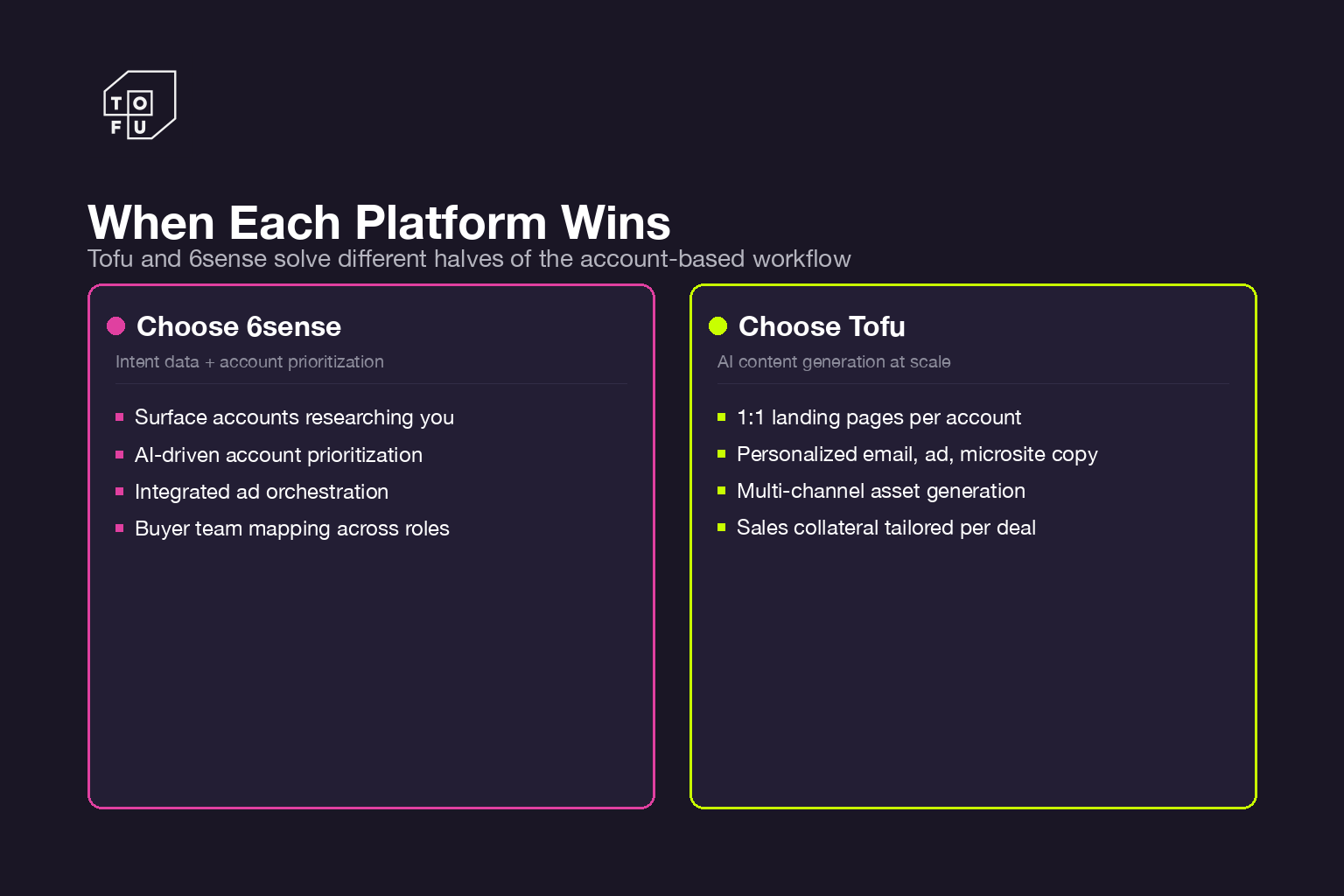
- You don't know which accounts to target. If your TAM is large and you need help identifying which accounts are actually in-market right now, 6sense's intent data and predictive models are purpose-built for this.
- Your sales team wastes time on accounts that aren't ready. 6sense's buying stage predictions help reps focus on accounts that are actively evaluating, not just accounts that match your ICP on paper.
- You need to run targeted display advertising at the account level. 6sense's built-in DSP lets you build audiences based on intent signals and serve ads directly, with account-level reporting on ad influence.
- You want to understand what topics target accounts are researching. 6sense's keyword-level intent data shows you exactly what themes and topics are trending at specific accounts, which can inform your messaging strategy.
- You need a mature, enterprise-grade ABM intelligence platform. 6sense has years of market presence, a Forrester Leader designation, and proven scale with large enterprises. If organizational credibility and vendor maturity are important to your procurement process, 6sense has a strong track record.
6sense is not the right choice if your primary challenge is creating the personalized content that your campaigns need. 6sense can tell you that a target account is researching "cloud security solutions" — but it won't produce a cloud-security-specific landing page, email sequence, and one-pager for that account. That's where Tofu comes in.
When to Choose Tofu
Tofu is the right choice when your primary challenge is content creation and personalization at scale. Choose Tofu if:
- You know which accounts to target but struggle to produce personalized content for them. Most ABM teams have their account list. The bottleneck is generating enough personalized content to run 1:1 campaigns at scale. Tofu eliminates that bottleneck.
- Your marketing team is lean and needs to produce more with less. Tofu's AI generates complete campaign assets from a single brief, enabling small teams to execute ABM programs that would normally require a much larger team or agency support.
- You need personalization beyond email. If your ABM strategy requires personalized landing pages, microsites, one-pagers, ad copy, and sales collateral — not just personalized email — Tofu generates all of these from one workflow.
- You want consistent messaging across channels. Because Tofu generates all campaign assets from the same brief, your emails, landing pages, ads, and sales materials tell a unified story for each account. No more fragmented messaging across touchpoints.
- You already have account intelligence and need to activate it. If you're already using 6sense, Demandbase, Bombora, or another intent platform, Tofu is the natural next step — it turns that intelligence into personalized content that sales and marketing can actually use.
Tofu is not the right choice if your primary challenge is figuring out which accounts to prioritize. If you don't have a clear account list or intent data strategy, you'll want to solve that problem first (possibly with 6sense) before investing in personalized content generation.
Using Tofu and 6sense Together: The Complete ABM Stack
Here's the insight most ABM teams eventually arrive at: the best results come not from choosing between intelligence and content, but from connecting them. 6sense and Tofu solve different halves of the same problem, and when used together, they create a closed-loop ABM system that's significantly more effective than either platform alone.
The Ideal Workflow
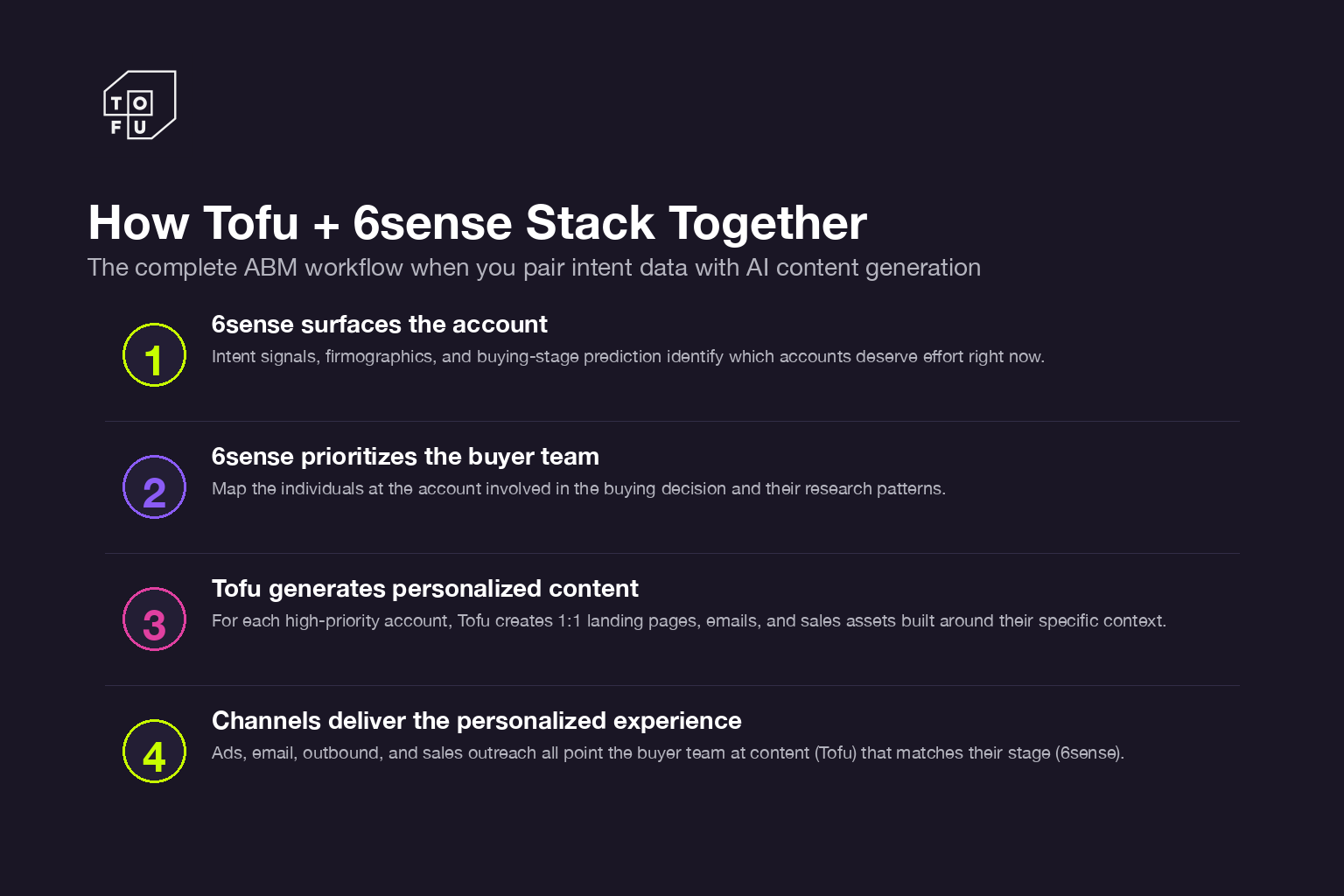
The combined stack works like this:
Step 1: 6sense identifies and prioritizes accounts. 6sense's intent engine surfaces accounts that are actively researching topics related to your solution. Its predictive models score those accounts by buying stage and conversion likelihood. Your marketing team now knows which accounts to focus on and what those accounts care about.
Step 2: Tofu generates personalized content for those accounts. Armed with the account list and intent context from 6sense, Tofu generates personalized campaign assets — landing pages, email sequences, ad copy, microsites, one-pagers, and sales collateral — tailored to each account's industry, stage, and the specific topics they're researching. Instead of generic ABM campaigns, you now have 1:1 content that speaks directly to what each account cares about right now.
Step 3: Sales engagement platforms deliver the content. The personalized content flows into Outreach, Salesloft, or your marketing automation platform for execution. Sales reps send account-specific emails with links to personalized landing pages. Marketing runs display campaigns through 6sense's DSP with messaging aligned to the same themes. Every touchpoint reinforces the same personalized narrative.
Step 4: Engagement data feeds back into the cycle. 6sense tracks how accounts respond to advertising and web engagement. Tofu's performance data shows which content themes and personalization approaches convert best. Together, this feedback loop continuously improves both targeting and content over time.
Why This Combination Wins
The reason this stack outperforms using either tool alone is simple: intelligence without execution is wasted, and execution without intelligence is inefficient.
Teams that have 6sense but lack a content generation platform often fall into a frustrating pattern: they know exactly which accounts are in-market and what those accounts care about, but they can't produce personalized content fast enough to act on those insights. By the time a marketer or agency manually creates account-specific landing pages and emails, the buying window may have passed. The intent data is valuable, but the content bottleneck prevents it from translating into pipeline.
Teams that have Tofu but lack an intent data platform can produce personalized content at incredible speed, but they may not be directing that content at the right accounts at the right time. They're personalizing efficiently, but not necessarily strategically.
When you combine 6sense's real-time account intelligence with Tofu's content generation speed, you get something neither can deliver alone: the ability to identify an in-market account, generate personalized content for that account, and deliver it across channels — all within the window when that account is actively buying. That's the promise of ABM, and this stack is how leading teams are actually delivering on it.
Example: The Full Stack in Action
Imagine your 6sense dashboard shows that Acme Corp (a Tier 1 target account in financial services) has moved from Awareness to Consideration stage, with intent signals around "compliance automation" and "regulatory reporting." Your marketing team feeds this context into Tofu, which generates a personalized landing page highlighting your compliance capabilities with financial services proof points, a three-email sequence for the SDR team referencing regulatory trends, a one-pager for the AE to share after the first meeting, and LinkedIn ad copy focused on compliance automation. The SDR sends the first email through Outreach. 6sense runs display ads reinforcing the same compliance theme. When the prospect clicks through to the personalized landing page, they see content that speaks directly to their current research. That's ABM working as intended — intelligence and content in lockstep.
Frequently Asked Questions
What's the difference between Tofu and 6sense?
Tofu and 6sense solve different problems in account-based marketing. 6sense is an ABM intelligence platform that identifies which accounts are in-market, predicts buying stage, and provides intent data so you know who to target and when. Tofu is an AI content generation platform that creates personalized landing pages, emails, ads, microsites, and sales collateral for your target accounts. 6sense answers "who should I engage?" while Tofu answers "what personalized content do I send them?" They occupy different layers of the ABM tech stack and are often used together rather than as alternatives to each other.
Can I use Tofu and 6sense together?
Yes, and this is often the most effective approach. 6sense identifies in-market accounts and provides intent context (what topics they're researching, what buying stage they're in). Tofu then uses that context to generate personalized campaign content — emails, landing pages, one-pagers, and ads — tailored to each account's specific interests and stage. The content flows into execution tools like Outreach, Salesloft, or your CRM for delivery. Together, they create a complete ABM workflow: 6sense provides the intelligence, Tofu provides the content, and your sales engagement platform provides the delivery.
Which is better for ABM: Tofu or 6sense?
Neither is universally "better" — they serve different ABM functions. If your biggest challenge is knowing which accounts to target and when to engage them, 6sense is the better investment. If your biggest challenge is producing personalized content at scale for accounts you've already identified, Tofu is the better investment. For a complete ABM program, you need both capabilities: account intelligence and content execution. Many teams start with whichever addresses their most pressing gap and add the other over time.
Does 6sense generate personalized content?
6sense has added some content generation capabilities, most notably its AI Email feature that generates personalized outbound email introductions using CRM data and intent signals. It also supports dynamic ad creative through its built-in DSP. However, 6sense does not generate landing pages, microsites, one-pagers, multi-format campaign assets, or sales collateral. Its content generation is focused on the outbound email use case. For teams that need personalized content across multiple formats and channels, a dedicated content platform like Tofu is needed alongside 6sense.
Does Tofu have intent data?
No. Tofu does not provide intent data, account identification, or predictive analytics. Tofu is a content generation and personalization platform, not an intelligence platform. It relies on your existing CRM data, account lists, and any intent data you bring from other sources (like 6sense, Bombora, or Demandbase) to inform the personalization of the content it generates. If you need intent data, you'll want to pair Tofu with a dedicated intent data provider.
What ABM platform is best for identifying target accounts?
For account identification specifically, 6sense is one of the strongest platforms available. It processes billions of intent signals to identify which accounts are actively researching topics related to your solution, even before those accounts visit your website. Other strong options for account identification include Demandbase (which also combines intent data with advertising) and Bombora (which focuses specifically on intent data as a data provider). The right choice depends on whether you want a full ABM platform with built-in advertising (6sense, Demandbase) or a pure intent data feed you can plug into other tools (Bombora).
How do I build a complete ABM tech stack?
A complete ABM tech stack needs four layers: intelligence, content, execution, and measurement. For the intelligence layer, you need a platform that identifies target accounts and provides intent data — 6sense, Demandbase, or Bombora are common choices. For the content layer, you need a platform that generates personalized campaign assets at scale — Tofu handles this across emails, landing pages, ads, microsites, and sales materials. For the execution layer, you need tools that deliver the content — Outreach or Salesloft for sales outreach, HubSpot or Marketo for marketing automation, and LinkedIn or a DSP for advertising. For measurement, your CRM (Salesforce, HubSpot) ties it all together with pipeline and revenue attribution. The most effective stacks integrate these layers so that intelligence informs content, content feeds execution, and execution data flows back into intelligence for continuous optimization.
The Bottom Line
The Tofu vs 6sense comparison isn't really a competition — it's a question of which ABM problem you need to solve first. 6sense is an excellent platform for account intelligence, intent data, and predictive analytics. It has earned its position as a market leader in ABM intelligence, and teams that use it to identify and prioritize accounts consistently report better sales efficiency and pipeline predictability.
Tofu solves the other half of the equation: once you know which accounts to target, Tofu generates the personalized content that makes those campaigns actually work. Personalized landing pages, tailored email sequences, account-specific ads, and custom sales materials — at a speed and scale that manual processes or generic AI tools simply cannot match.
If you're building an ABM program from scratch, consider which gap is more urgent. If you're spending money on campaigns but don't have confidence in your account targeting, start with 6sense. If you have a clear account list and strong intent data but can't produce personalized content fast enough, start with Tofu.
And if you're ready to run ABM the way it was always meant to work — with real-time intelligence driving personalized content across every channel — the 6sense + Tofu combination is one of the most powerful stacks available to B2B marketing teams today.
Ready to See Tofu in Action?
If your ABM program has the intelligence but needs the content engine, Tofu can help. Schedule a demo to see how Tofu generates personalized campaign content at scale — and how it fits alongside your existing ABM stack, including 6sense.
Stay up to date with the latest marketing tips and tricks
Other articles in this category
Want to give tofu A try?
Request a custom demo to see how Tofu can supercharge your GTM efforts.
ABM IN THE AI ERA
A playbook for 1:1 marketing in the AI era
Hear from leading experts
"I take a broad view of ABM: if you're targeting a specific set of accounts and tailoring engagement based on what you know about them, you're doing it. But most teams are stuck in the old loop: Sales hands Marketing a list, Marketing runs ads, and any response is treated as intent."

"ABM has always been just good marketing. It starts with clarity on your ICP and ends with driving revenue. But the way we get from A to B has changed dramatically."
.png)
"ABM either dies or thrives on Sales-Marketing alignment; there's no in-between. When Marketing runs plays on specific accounts or contacts and Sales isn't doing complementary outreach, the whole thing falls short."

"In our research at 6sense, few marketers view ABM as critical to hitting revenue goals this year. But that's not because ABM doesn't work; it's because most teams haven't implemented it well."
"To me, ABM isn't a campaign; it's a go-to-market operating model. It starts with cross-functional planning: mapping revenue targets, territories, and board priorities."

"With AI, we can personalize not just by account, but by segment, by buying group, and even by individual. That level of precision just wasn't possible a few years ago."
%201%20(1).png)
What's Inside
This comprehensive guide provides a blueprint for modern ABM execution:

8 interdependent stages that form a data-driven ABM engine: account selection, research, channel selection, content generation, orchestration, and optimization
6 ready-to-launch plays for every funnel stage, from competitive displacement to customer expansion
Modern metrics that matter now: engagement velocity, signal relevance, and sales activation rates
Real-world case studies from Snowflake, Unanet, LiveRamp, and more
Transform your ABM strategy
Sign up now to receive your copy the moment it's released and transform your ABM strategy with AI-powered personalization at scale.
Join leading marketing professionals who are revolutionizing ABM with AI