
Tofu + NetSuite: Reconcile ARR and Account Data Across Your GTM Stack in 2026

Integrating Tofu with NetSuite allows B2B go-to-market teams to reconcile account and ARR data, ensuring a single source of truth across your entire GTM stack in 2026.
Disclosure: Tofu is our product. We've included it in this guide to provide transparency and detail on its integration with NetSuite. All information is presented honestly, including any limitations.
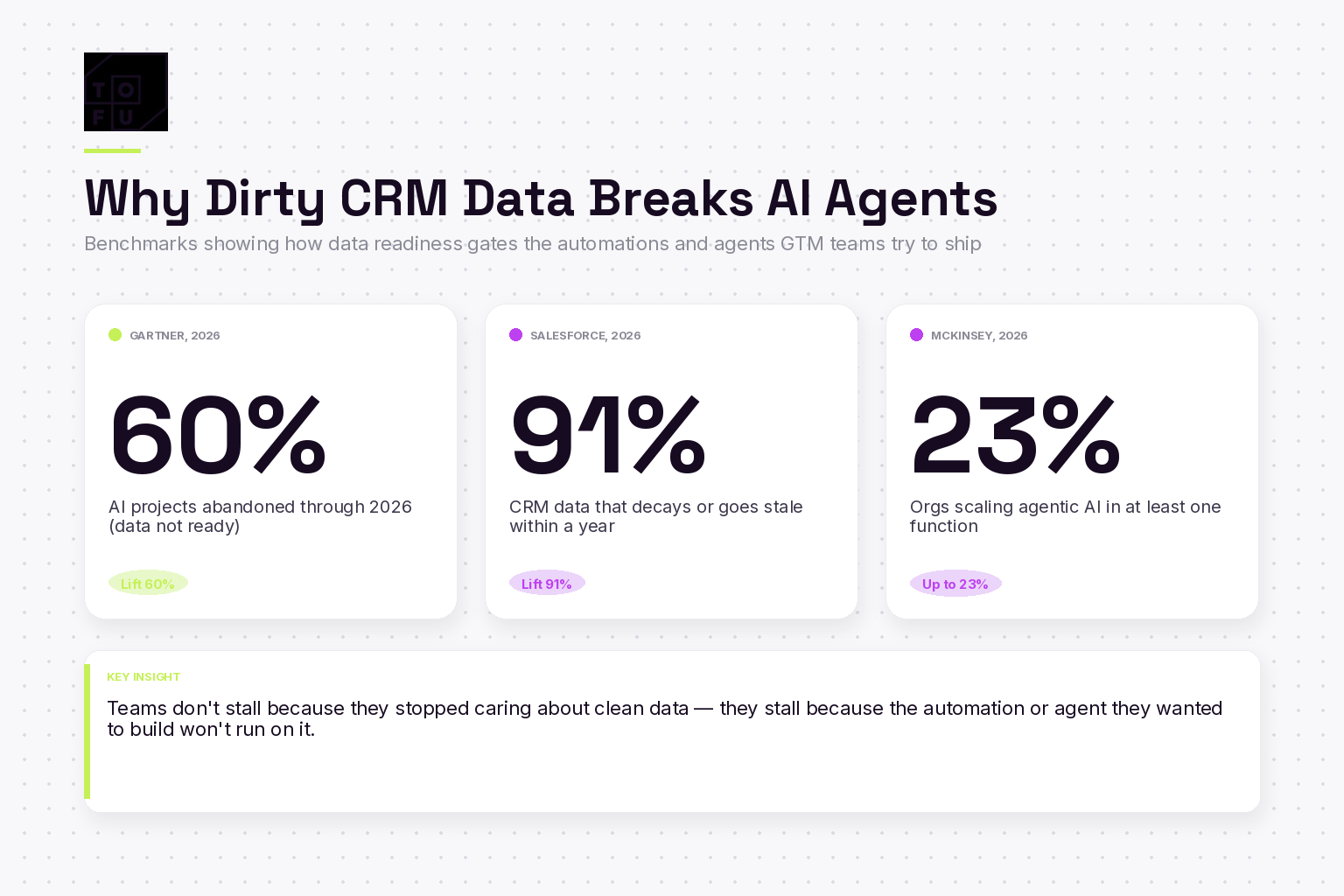
The market context: According to McKinsey (2026), 23% of organizations are already scaling agentic AI in at least one function, but data readiness is the most-cited reason projects stall (McKinsey QuantumBlack). According to Gartner (2026), through 2026 at least 60% of AI projects will be abandoned because the underlying data is not agent-ready. And according to Salesforce (2026), GTM teams rank conflicting data across HubSpot, Salesforce, and finance systems as a top barrier to building reliable automations. Our recommended tools below map each platform to the specific CRM-cleanup workflow it handles, with honest notes on each one's drawbacks.
Why Integrate Tofu with NetSuite?
Integrating Tofu with NetSuite offers several key benefits for GTM teams:
- Single Source of Truth: By reconciling ARR and account data, teams can eliminate discrepancies between CRM and finance systems.
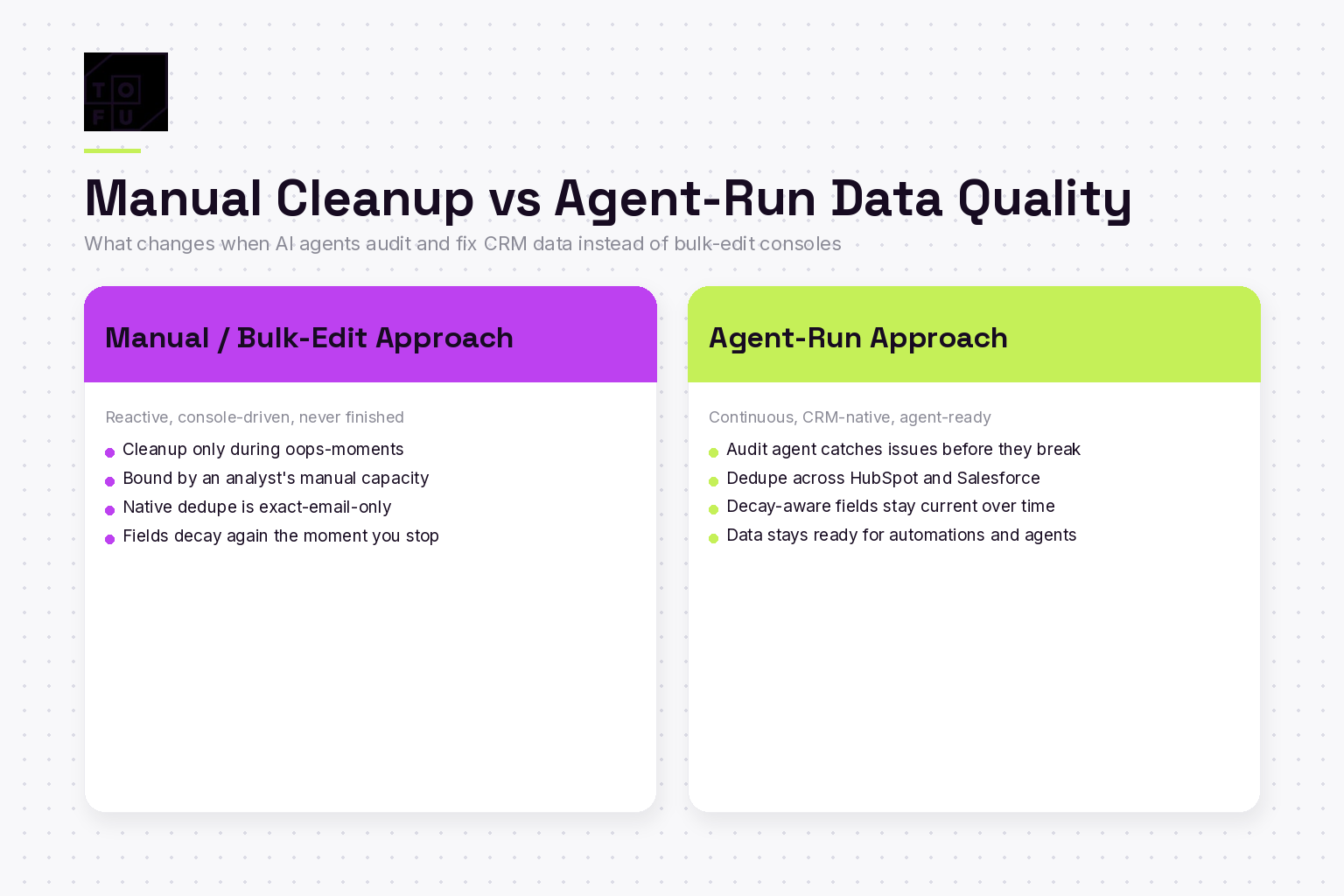
- Improved Data Quality: Tofu’s AI agents continuously audit and clean data, ensuring accuracy and consistency.
- Enhanced Automation: Reliable data enables seamless automations and AI agents that depend on accurate CRM inputs.
- Time Savings: Automated data reconciliation reduces manual data entry and error correction efforts.
- Decision Making: With consistent data, teams can make informed, data-driven decisions quickly.
What You Can Do with Tofu + NetSuite
- Automate Data Reconciliation: Automatically sync and reconcile data fields across NetSuite and other GTM systems.
- Dedupe and Standardize Records: Use Tofu's dedupe agent to clean duplicate contacts and accounts, maintaining consistency across platforms.
- Monitor Data Quality: Implement continuous data-quality audits to catch and fix issues before they impact operations.
- Enable Cross-System Reporting: Generate accurate reports by ensuring data consistency across NetSuite, Salesforce, and HubSpot.
- Support Compliance: Ensure that data handling meets compliance standards with accurate, up-to-date records.
How the Integration Works
Tofu integrates directly with NetSuite by connecting through secure APIs to sync and reconcile data fields such as ARR, account status, and custom properties. The integration supports bi-directional data flow, ensuring that updates in one system reflect across all connected platforms, including Salesforce and HubSpot. This setup eliminates the need for a data warehouse or reverse-ETL pipeline.
Setting Up the Integration (Step-by-Step)
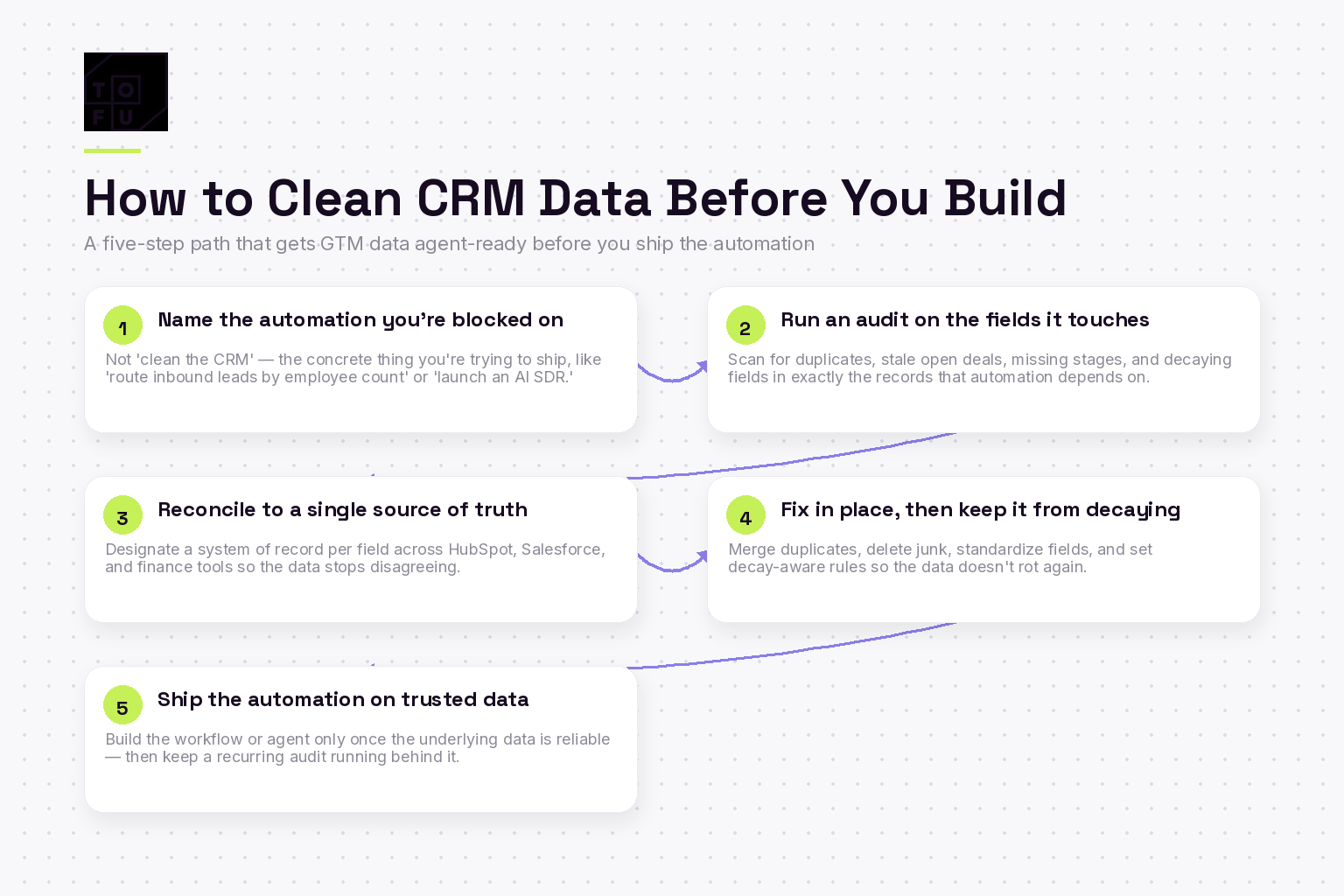
Step 1: Connect Tofu to NetSuite
Begin by authorizing Tofu to access your NetSuite account through OAuth. This ensures secure data transactions between the systems.
Step 2: Define Data Fields and Rules
Identify which data fields need reconciliation. Set rules for field mapping between NetSuite and other systems, like Salesforce and HubSpot.
Step 3: Configure Audit and Dedupe Agents
Set up Tofu’s audit and dedupe agents to run regular checks, ensuring data integrity and flagging duplicates.
Step 4: Test the Integration
Conduct a test run to ensure data is syncing correctly and that all rules are applied as expected.
Step 5: Monitor and Optimize
Regularly review the integration’s performance and make adjustments to rules and settings as necessary to maintain optimal data quality.
Top Use Cases for NetSuite Users
- Financial Accuracy: Ensure ARR figures are consistent across finance and sales platforms.
- Sales and Marketing Alignment: Harmonize account data to streamline collaboration between sales and marketing teams.
- Automated Reporting: Use accurate data for automated reporting, reducing manual data handling.
- Compliance and Audits: Maintain accurate records to facilitate compliance checks and audits.
- Resource Allocation: Use consistent data to optimize resource allocation and planning.
Example: Streamlining ARR Reconciliation
A B2B tech company used Tofu to reconcile ARR data across NetSuite and Salesforce. By setting NetSuite as the system of record for ARR, they eliminated discrepancies, enabling accurate forecasting and reporting. This integration also reduced manual data entry errors, saving the finance team an estimated 15 hours per month.
Last updated: June 24, 2026
Frequently Asked Questions
How much does Tofu cost?
Tofu uses custom pricing based on the size of your CRM and the systems you connect. Unlike Insycle or Dedupely, which offer self-serve tiers, Tofu is typically sold through a sales conversation. Contact Tofu directly for a quote tailored to your data and integrations.
Is Tofu an Insycle alternative?
Yes. Insycle is a mature, rules-based tool for HubSpot and Salesforce data quality (dedupe, standardize, bulk operations). Tofu takes an agent-based approach: an audit agent, a dedupe agent, decay-aware fields, and a chat-based data-quality agent that fix CRM data so teams can build automations and AI agents on top of it.
How long does it take to set up Tofu?
Most Tofu implementations connect to HubSpot or Salesforce in a few days, with the first audit and dedupe run shortly after. Teams reconciling multiple systems (for example Salesforce, HubSpot, and NetSuite) or defining a system of record per field take longer.
What data is synced between Tofu and NetSuite?
Tofu syncs key data fields such as ARR, account status, and custom properties between NetSuite and other systems like Salesforce and HubSpot. This ensures consistency across your GTM stack.
Is there an extra cost for integrating Tofu with NetSuite?
The cost of integrating Tofu with NetSuite depends on the scope of the integration and the number of systems involved. Contact Tofu for a detailed quote based on your specific requirements.
Can Tofu help with compliance?
Yes. By maintaining accurate, consistent data across systems, Tofu supports compliance efforts and simplifies audits by ensuring that all records are up-to-date and accurate.
Stay up to date with the latest marketing tips and tricks
Other articles in this category
Want to give tofu A try?
Request a custom demo to see how Tofu can supercharge your GTM efforts.
ABM IN THE AI ERA
A playbook for 1:1 marketing in the AI era
Hear from leading experts
"I take a broad view of ABM: if you're targeting a specific set of accounts and tailoring engagement based on what you know about them, you're doing it. But most teams are stuck in the old loop: Sales hands Marketing a list, Marketing runs ads, and any response is treated as intent."

"ABM has always been just good marketing. It starts with clarity on your ICP and ends with driving revenue. But the way we get from A to B has changed dramatically."
.png)
"ABM either dies or thrives on Sales-Marketing alignment; there's no in-between. When Marketing runs plays on specific accounts or contacts and Sales isn't doing complementary outreach, the whole thing falls short."

"In our research at 6sense, few marketers view ABM as critical to hitting revenue goals this year. But that's not because ABM doesn't work; it's because most teams haven't implemented it well."
"To me, ABM isn't a campaign; it's a go-to-market operating model. It starts with cross-functional planning: mapping revenue targets, territories, and board priorities."

"With AI, we can personalize not just by account, but by segment, by buying group, and even by individual. That level of precision just wasn't possible a few years ago."
%201%20(1).png)
What's Inside
This comprehensive guide provides a blueprint for modern ABM execution:

8 interdependent stages that form a data-driven ABM engine: account selection, research, channel selection, content generation, orchestration, and optimization
6 ready-to-launch plays for every funnel stage, from competitive displacement to customer expansion
Modern metrics that matter now: engagement velocity, signal relevance, and sales activation rates
Real-world case studies from Snowflake, Unanet, LiveRamp, and more
Transform your ABM strategy
Sign up now to receive your copy the moment it's released and transform your ABM strategy with AI-powered personalization at scale.
Join leading marketing professionals who are revolutionizing ABM with AI