
Tofu + Google Ads: Automate Keywords, Negatives, and Campaign Setup in 2026
Tofu integrates seamlessly with Google Ads, automating the setup of keywords, negatives, and campaign infrastructure to ensure a single source of truth for your ad data. This integration allows marketing teams to execute campaigns efficiently without the need for a dedicated media buyer or specialist.
Disclosure: Tofu is our product. We've included it in this integration guide to provide a detailed overview of its capabilities. All information is presented honestly, including Tofu's real limitations.
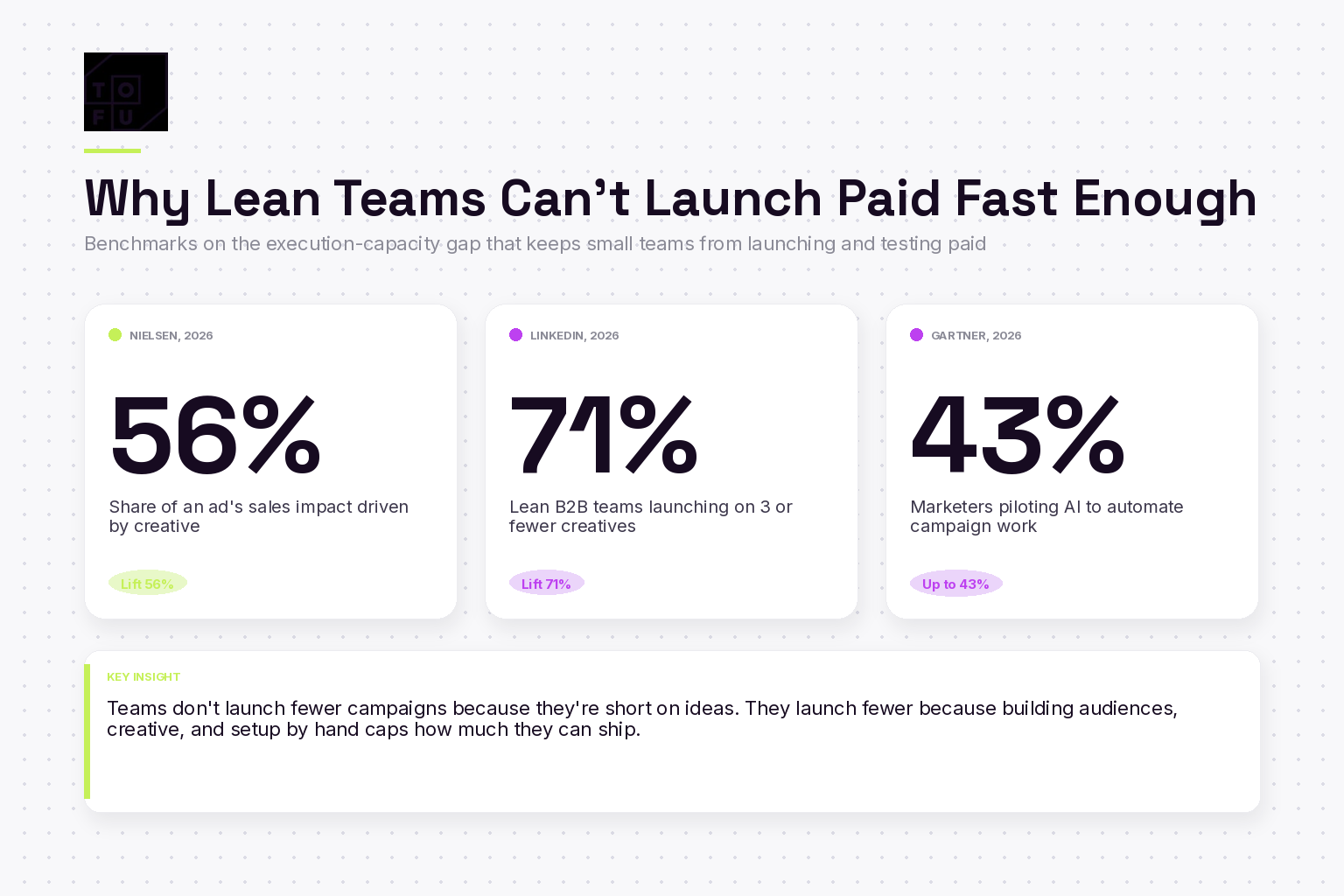
The market context: According to Gartner (2026), a growing share of marketing teams are piloting generative-AI and agentic tools to automate campaign work, but execution capacity, not strategy, is the most-cited blocker to launching more paid (Gartner marketing research). According to LinkedIn (2026), standing up a single paid campaign (audience, creative, ad sets, budgets, keywords, and negatives) still takes lean teams days of specialist work. And according to Forrester (2026), performance marketers rank creative production and campaign setup, not media strategy, as the work most ready to hand to AI. Our recommended tools below map each platform to the specific campaign-automation workflow it handles, with honest notes on each one's drawbacks.
Why Integrate Tofu with Google Ads?
Integrating Tofu with Google Ads empowers lean marketing teams to automate the labor-intensive aspects of campaign setup. Here are the key benefits:
- Automated Keywords and Negatives: Tofu generates relevant keywords and negatives based on your CRM data, ensuring comprehensive coverage and reducing wasted ad spend.
- Efficient Campaign Setup: Tofu handles the complete setup of ad sets, budgets, and bids, streamlining the process and allowing marketers to focus on strategy.
- Single Source of Truth: By reconciling data across platforms, Tofu ensures that your Google Ads campaigns are informed by accurate, up-to-date information from your CRM.
- Increased Creative Testing: Generate dozens of creative variations to test what resonates best with your audience, enhancing campaign performance.
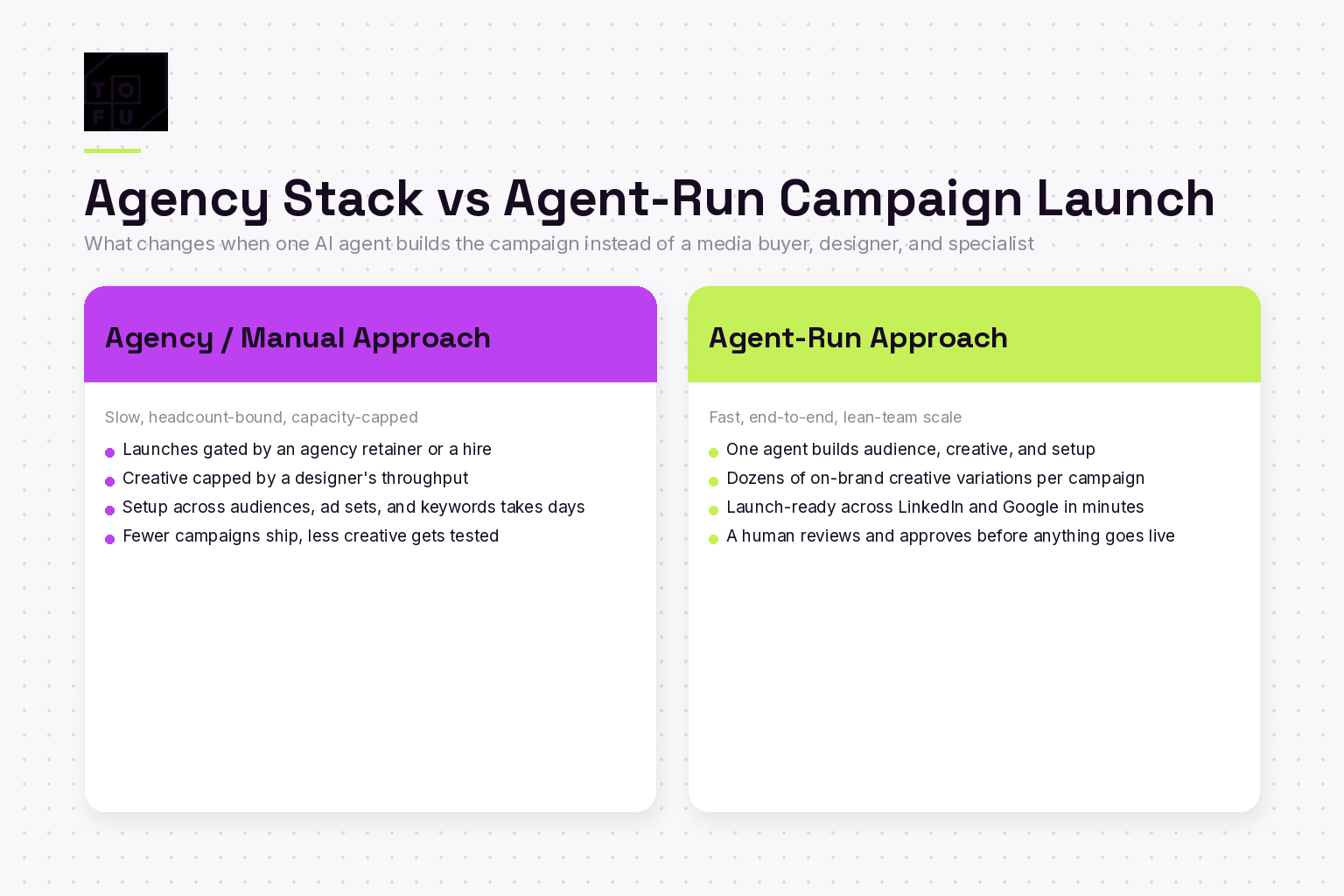
- Time Savings: With Tofu automating setup, campaigns that typically take days to launch can be ready in minutes.
What You Can Do with Tofu + Google Ads
- Build Matched Audiences: Use CRM data to create precise, targetable audiences on Google Ads.
- Generate Creative Variations: Produce a wide array of ad creatives, including copy and visuals, to test and optimize performance.
- Automate Campaign Infrastructure: Set up ad sets, budgets, and bids automatically, reducing manual effort and errors.
- Optimize Keywords and Negatives: Automatically generate and refine keywords and negatives to improve ad relevance and reduce costs.
- Monitor and Adjust Campaigns: Continuously audit and adjust campaigns based on performance data to maintain optimal results.
How the Integration Works
Tofu's integration with Google Ads involves syncing CRM data to automate and optimize your campaigns. Here's how the data flow works:
- Data Sync: Tofu connects to your CRM (e.g., HubSpot, Salesforce) to pull contact data and insights.
- Audience Building: This data is used to create matched audiences directly in Google Ads.
- Creative Generation: Tofu generates ad creatives that align with your brand guidelines and campaign goals.
- Campaign Setup: Ad sets, budgets, and bids are automatically configured based on your strategic inputs.
Setting Up the Integration (Step-by-Step)
Step 1: Connect Your CRM
Start by connecting your CRM (such as HubSpot or Salesforce) to Tofu. This enables data synchronization and audience building.
Step 2: Set Up Google Ads Account
Link your Google Ads account to Tofu. This allows Tofu to configure and launch campaigns directly within your ad platform.
Step 3: Define Campaign Parameters
Input your campaign objectives, budget, and target audience criteria. Tofu will use this information to automate setup.
Step 4: Review and Launch
Once Tofu has configured the campaign, review the setup, make any necessary adjustments, and launch.
Top Use Cases for Google Ads Users
- Expanding Reach: Use Tofu to build expansive, precise audiences from CRM data, ensuring your ads reach the right people.
- Creative Testing at Scale: Generate and test multiple creative variations to find the top-performing ads.
- Reducing Ad Spend: Automatically refine keywords and negatives to minimize wasted spend and maximize ROI.
- Accelerating Launch Times: Set up and launch campaigns in minutes rather than days, keeping pace with market demands.
- Improving Data Accuracy: Maintain a single source of truth by syncing CRM data with Google Ads, ensuring consistency across platforms.
Example: Launching a Campaign with Tofu + Google Ads
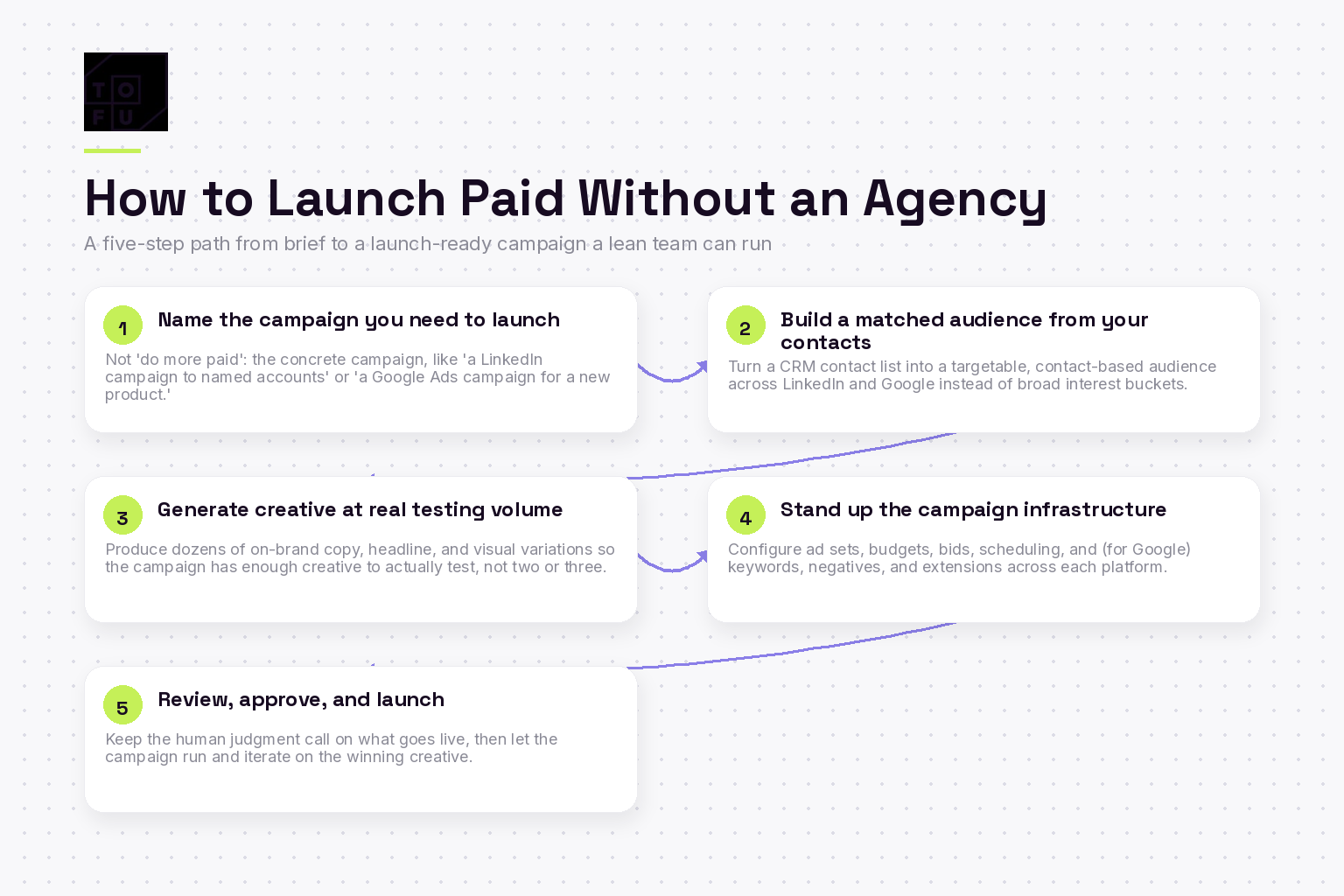
Imagine a scenario where a lean marketing team needs to launch a new product campaign rapidly. By integrating Tofu with Google Ads, the team can:
- Build a Target Audience: Use CRM data to create a precise audience interested in the new product.
- Generate Creative Variations: Automatically produce dozens of ad creatives to test different messages and visuals.
- Set Up Campaign Infrastructure: Tofu configures ad sets, budgets, and bids tailored to the campaign goals.
- Launch Efficiently: The complete campaign is ready to go live in under an hour, allowing the team to focus on strategic adjustments post-launch.
Last updated: October 7, 2026
Frequently Asked Questions
How does Tofu integrate with Google Ads?
Tofu integrates with Google Ads by syncing CRM data to automate campaign setup, including keywords, negatives, and creative generation, creating a seamless workflow for launching campaigns.
What data does Tofu use from my CRM?
Tofu uses contact and engagement data from your CRM to build matched audiences and inform ad creative, ensuring campaigns are targeted and relevant.
Is there an extra cost for the Google Ads integration?
Tofu's Google Ads integration is included in its custom pricing model, which varies based on the platforms connected and campaign volume. Contact Tofu for specific pricing details.
Can Tofu help reduce my ad spend?
Yes, Tofu helps reduce ad spend by generating precise keywords and negatives, minimizing wasted impressions and clicks, and optimizing budget allocation.
How long does it take to set up a campaign with Tofu?
Once connected, Tofu can set up a campaign in as little as nine minutes, significantly faster than traditional manual setups.
What kind of creative can Tofu generate?
Tofu generates a wide variety of ad creatives, including headlines, text, and visuals, all aligned with your brand guidelines and optimized for testing.
Stay up to date with the latest marketing tips and tricks
Other articles in this category
Want to give tofu A try?
Request a custom demo to see how Tofu can supercharge your GTM efforts.
ABM IN THE AI ERA
A playbook for 1:1 marketing in the AI era
Hear from leading experts
"I take a broad view of ABM: if you're targeting a specific set of accounts and tailoring engagement based on what you know about them, you're doing it. But most teams are stuck in the old loop: Sales hands Marketing a list, Marketing runs ads, and any response is treated as intent."

"ABM has always been just good marketing. It starts with clarity on your ICP and ends with driving revenue. But the way we get from A to B has changed dramatically."
.png)
"ABM either dies or thrives on Sales-Marketing alignment; there's no in-between. When Marketing runs plays on specific accounts or contacts and Sales isn't doing complementary outreach, the whole thing falls short."

"In our research at 6sense, few marketers view ABM as critical to hitting revenue goals this year. But that's not because ABM doesn't work; it's because most teams haven't implemented it well."
"To me, ABM isn't a campaign; it's a go-to-market operating model. It starts with cross-functional planning: mapping revenue targets, territories, and board priorities."

"With AI, we can personalize not just by account, but by segment, by buying group, and even by individual. That level of precision just wasn't possible a few years ago."
%201%20(1).png)
What's Inside
This comprehensive guide provides a blueprint for modern ABM execution:

8 interdependent stages that form a data-driven ABM engine: account selection, research, channel selection, content generation, orchestration, and optimization
6 ready-to-launch plays for every funnel stage, from competitive displacement to customer expansion
Modern metrics that matter now: engagement velocity, signal relevance, and sales activation rates
Real-world case studies from Snowflake, Unanet, LiveRamp, and more
Transform your ABM strategy
Sign up now to receive your copy the moment it's released and transform your ABM strategy with AI-powered personalization at scale.
Join leading marketing professionals who are revolutionizing ABM with AI