
Tofu for Enterprise ABM Teams in 2026

Last updated: May 20, 2026
Enterprise ABM teams face a paradox: the more accounts they target with personalized campaigns, the harder it becomes to maintain quality, brand consistency, and speed. The buying committees are larger — often eight to twelve stakeholders across procurement, IT, finance, and line-of-business leadership. The geographic footprint is wider — campaigns need to land in EMEA, APAC, and the Americas simultaneously. And the content demand is relentless — every account, every persona, every stage of the funnel needs its own asset. Tofu, an AI-native B2B marketing platform, was built to solve exactly this problem. From a single campaign brief, Tofu generates personalized landing pages, emails, ads, one-pagers, and sales collateral — all tailored to each target account's industry, pain points, competitive landscape, and buying committee structure. For enterprise ABM teams running programs across hundreds of strategic accounts, Tofu eliminates the content production bottleneck that has historically forced a choice between personalization depth and account coverage. This guide explains the specific challenges Tofu solves for enterprise organizations, how large teams use the platform day to day, what security and compliance features matter at the enterprise tier, and how Tofu compares to the incumbent ABM platforms.
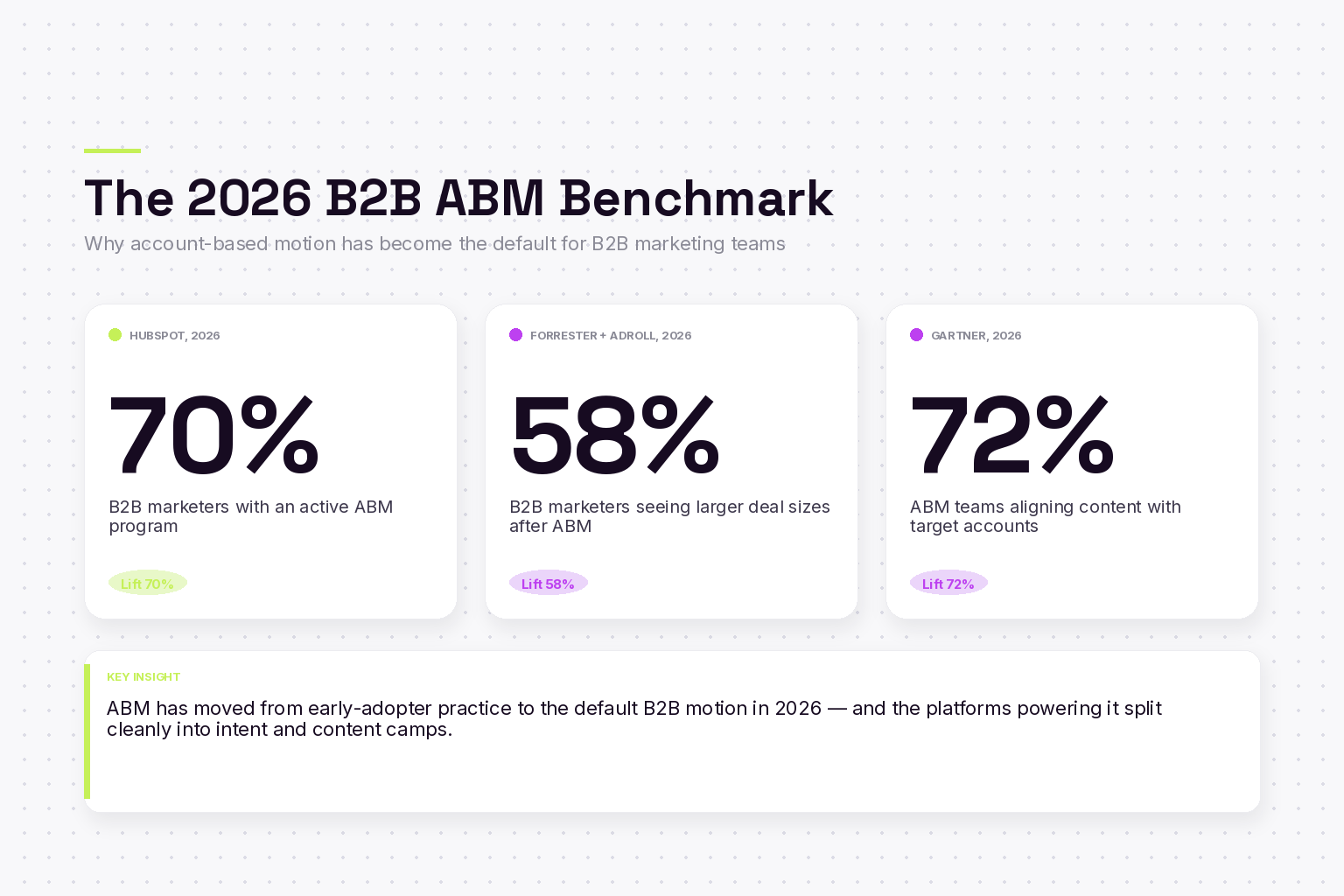
The market context: According to HubSpot (2026), 70% of B2B marketers have an active ABM program in place (HubSpot State of Marketing). According to Forrester and AdRoll (2026), 58% of B2B marketers see larger deal sizes after adopting ABM (Forrester x AdRoll 2026 ABM Report), and according to Gartner (2026), 72% of ABM teams use it specifically to align content strategy with target accounts. Our evaluation methodology assesses each platform on the evaluation criteria ABM buyers prioritize: core strength, intent data, content generation, account targeting, integrations, pricing, team fit, and stack role.
Enterprise ABM Challenges Tofu Solves
Enterprise ABM is fundamentally different from mid-market or SMB-focused account-based programs. The scale is larger, the stakeholders are more demanding, and the operational complexity compounds in ways that break traditional content workflows. Understanding these challenges is the first step to evaluating whether an AI-native platform like Tofu belongs in your stack.
The Content Bottleneck at Scale
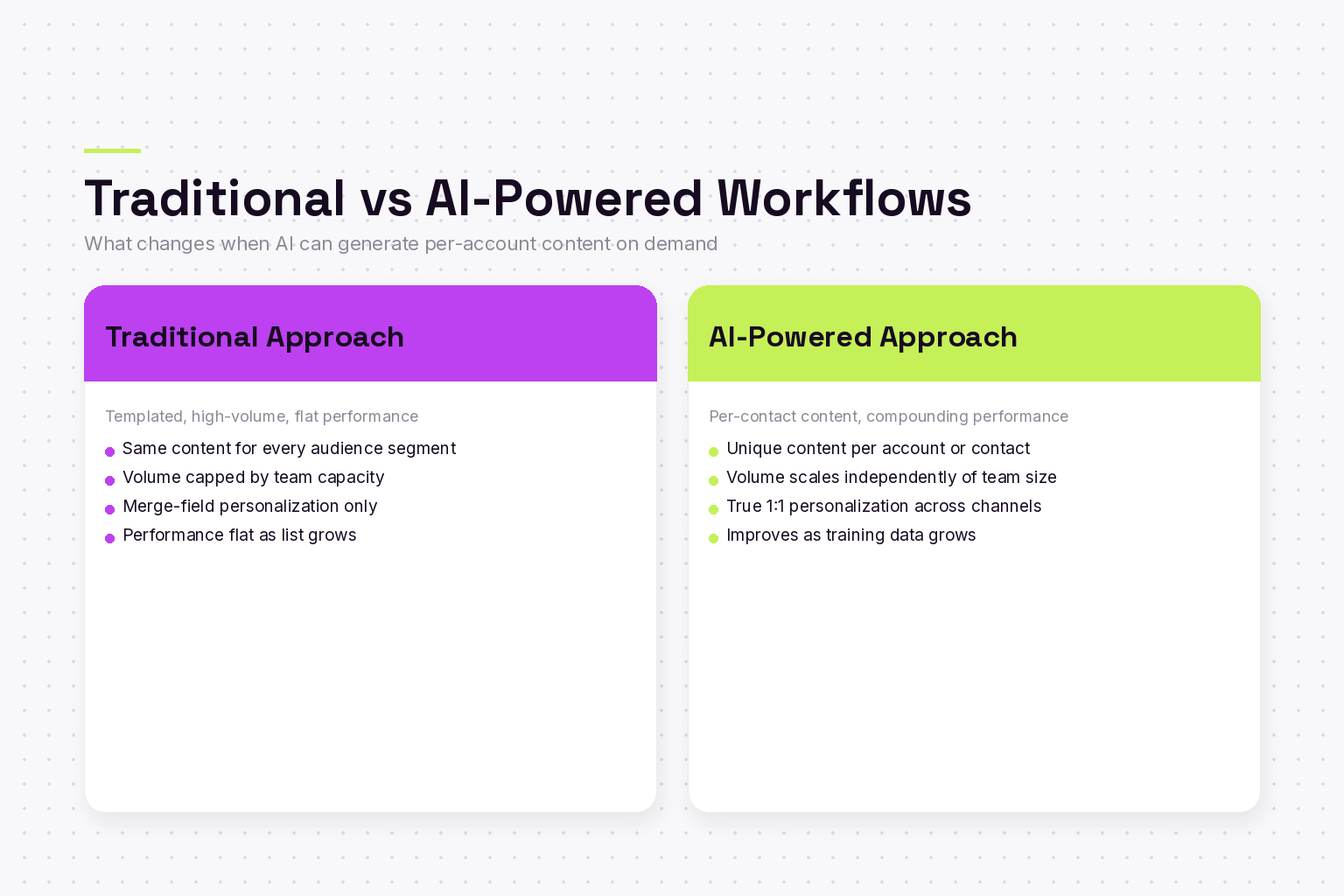
A well-executed 1:1 ABM campaign for a single enterprise account typically requires ten to thirty unique assets: personalized landing pages, account-specific one-pagers, persona-tailored email sequences, custom ad creative, sales leave-behinds, and executive briefing documents. Multiply that by fifty strategic accounts, and the content demand exceeds what even large marketing teams can produce. According to Forrester (formerly SiriusDecisions), enterprise marketing teams spend an average of 60 to 70 percent of their time on content production tasks rather than strategy and optimization. Tofu collapses this production cycle from weeks to hours. A single campaign brief — including target account list, value propositions, personas, and brand guidelines — generates a full suite of personalized assets for every account in the program. The content is not templated with mail-merge tokens; it is genuinely rewritten with account-specific language, references to the target company's industry dynamics, and messaging aligned to each persona's priorities.
Multi-Stakeholder Personalization
Enterprise deals involve buying committees, not individual buyers. The CFO cares about total cost of ownership and ROI timelines. The CTO evaluates technical architecture, integration complexity, and security posture. The VP of Marketing wants to understand workflow impact and time-to-value. The procurement team needs vendor risk assessments and compliance documentation. Generic ABM content — even when "personalized" at the account level — falls flat because it cannot speak to each stakeholder's distinct evaluation criteria. Tofu generates persona-specific content variations within each account. From a single brief, the platform produces a CFO-facing one-pager that leads with financial metrics, a CTO-facing technical overview that addresses integration and data handling, and a marketing-leader-facing case study that highlights operational efficiency gains. Each asset shares the same core value proposition but frames it through the lens that matters most to that specific decision-maker.
Brand Consistency Across Regions
Global enterprises run ABM programs across multiple regions, and every region has its own marketing team, its own agency relationships, and its own interpretation of brand guidelines. The result is brand fragmentation: the EMEA team produces assets that look different from what the North America team creates, messaging drifts between regions, and the overall brand experience feels inconsistent to target accounts that span multiple geographies. Tofu enforces brand consistency by design. Brand guidelines — including voice, tone, terminology, visual identity, and approved messaging frameworks — are embedded in the platform and applied uniformly across every asset generated. Regional teams can localize content without departing from the global brand standard, because the AI generates within the guardrails set at the organizational level. For enterprises with distributed marketing organizations, this is not a nice-to-have — it is a requirement for maintaining the brand equity that supports premium pricing and enterprise credibility.
Campaign Velocity
In competitive enterprise deals, speed matters. The vendor that gets relevant, personalized content in front of the buying committee first has a significant advantage in framing the evaluation criteria. Traditional content production workflows — briefing, drafting, review, revision, design, approval — take two to four weeks for a single campaign. By the time assets are ready, the buying window may have shifted or a competitor may have already established the narrative. Tofu compresses campaign production from weeks to hours. Enterprise teams report launching full multi-channel, multi-persona ABM campaigns in a single day — a timeline that was previously impossible regardless of team size or budget. This velocity advantage compounds over time: faster campaigns mean more learning cycles, more optimization, and more opportunities to engage accounts at the moments that matter.
How Enterprise Teams Use Tofu
Understanding what Tofu can do is useful, but understanding how enterprise teams actually use it day to day is more valuable. Below are the four most common workflows that large ABM organizations run through the platform.
Global Campaign Localization
A global enterprise software company launching an ABM campaign targeting financial services firms across three regions illustrates how Tofu handles localization at scale. The central marketing team creates a single campaign brief that defines the value proposition, target personas, and core messaging themes. Tofu then generates regionally adapted assets that account for local market conditions, regulatory environments, and cultural communication norms. The EMEA assets reference GDPR and PSD2 compliance. The APAC assets address data sovereignty requirements specific to markets like Singapore, Australia, and Japan. The North America assets lead with competitive displacement messaging relevant to the incumbent vendors most common in that market. All assets maintain the same brand voice and visual identity while feeling locally relevant. The alternative — having three regional teams independently produce their own content — would take three to four times as long and produce inconsistent results.
Vertical-Specific Content Production
Enterprise ABM teams frequently organize their target account lists by industry vertical — healthcare, financial services, manufacturing, technology, retail — because vertical-specific messaging dramatically outperforms horizontal content. A healthcare target does not want to see a generic "digital transformation" pitch; they want to see messaging that addresses HIPAA compliance, EHR integration, clinical workflow optimization, and patient outcome metrics. Tofu enables vertical-specific content production without requiring a dedicated content team for each industry. The platform ingests industry-specific context — regulatory frameworks, common technology stacks, industry terminology, competitive dynamics — and generates assets that read as though they were written by a subject-matter expert in that vertical. Enterprise teams using Tofu typically report being able to run personalized campaigns across five to eight verticals simultaneously, compared to the one or two verticals their team could support with manual content production.
Executive-Level Personalization
When the target account is a Fortune 500 company and the deal size exceeds seven figures, the buying committee includes C-suite executives who expect a level of personalization that goes far beyond inserting a company name into a template. They want to see that you understand their strategic priorities, their recent earnings calls, their competitive positioning, and the specific challenges they have publicly discussed. Tofu enables this depth of executive personalization at a scale that would be impossible manually. Account research — pulled from public filings, earnings transcripts, press releases, and industry reports — is synthesized into the content generation process. The result is executive-facing assets that reference the target company's recent strategic initiatives, use language consistent with how that company describes its own priorities, and position the seller's solution in the context of challenges the executive has publicly acknowledged. This level of personalization signals respect for the executive's time and demonstrates genuine understanding of their business — two prerequisites for earning a meeting at the C-suite level.
Sales Enablement at Scale
Enterprise sales teams are constantly requesting custom content from marketing: a one-pager tailored to a specific account, an updated deck that addresses a prospect's objection, a competitive battle card for an upcoming meeting. These requests create a backlog that frustrates sellers and slows deal progression. With Tofu, enterprise organizations shift from a request-and-wait model to a self-service model. Sales teams access Tofu to generate account-specific collateral on demand — personalized one-pagers, competitive positioning documents, ROI calculators, and executive summaries — without waiting for marketing to produce them. The content stays on-brand because Tofu generates within the organization's approved messaging framework. Marketing retains strategic control over positioning and brand standards while sales gets the speed they need to keep deals moving. Organizations using Tofu for sales enablement report a 40 to 60 percent reduction in marketing content requests from sales and measurably faster deal progression in accounts where personalized collateral is deployed.
Enterprise Security and Compliance
Enterprise procurement teams evaluate vendors against security, compliance, and data governance requirements that are non-negotiable. For AI-powered platforms, these requirements are even more stringent because of the nature of the data being processed — account intelligence, competitive positioning, and proprietary messaging strategies. Tofu is built for enterprise security requirements from the ground up.
| Requirement | Tofu Enterprise Capability |
|---|---|
| SOC 2 Type II | Tofu maintains SOC 2 Type II certification, providing independent verification of security controls across availability, confidentiality, and processing integrity. |
| Single Sign-On (SSO) | SAML 2.0 and OIDC-based SSO integration with enterprise identity providers including Okta, Azure AD, and OneLogin. Enforces organizational authentication policies. |
| Data Handling | Customer data is encrypted at rest and in transit. Account intelligence and generated content are isolated per customer. No customer data is used to train Tofu's models. |
| Role-Based Access Control | Granular RBAC with configurable roles for administrators, campaign managers, content creators, and read-only users. Audit logs track all user activity. |
| Data Residency | Enterprise plans support data residency requirements for organizations operating under GDPR, CCPA, and other regional data protection regulations. |
| Vendor Security Assessments | Tofu maintains a completed CAIQ (Consensus Assessments Initiative Questionnaire) and supports custom security questionnaires for enterprise procurement teams. |
For enterprise teams evaluating AI marketing platforms, the security conversation often centers on how the AI models handle proprietary data. Tofu's architecture ensures that customer data — including account lists, messaging strategies, competitive intelligence, and generated content — is never used to train or improve models for other customers. This is a critical distinction from consumer-grade AI tools where data may be used to improve general model performance. Enterprise customers retain full ownership of their generated content and the underlying data that informed it.
Integration with Enterprise Martech Stacks
No enterprise marketing tool operates in isolation. The value of any platform is determined not only by what it does independently but by how well it integrates with the existing technology stack. Enterprise ABM teams typically run a complex ecosystem of CRM, marketing automation, ABM platforms, intent data providers, and sales engagement tools. Tofu is designed to slot into this ecosystem as the content generation layer — the engine that produces personalized assets that are then distributed and measured through the platforms the organization already uses.
CRM Platforms
Salesforce is the dominant CRM in enterprise environments, and Tofu's Salesforce integration enables bi-directional data flow. Account and contact data from Salesforce informs content personalization — industry, company size, deal stage, and engagement history are all available as personalization inputs. Generated assets can be pushed back to Salesforce as activities or attachments linked to the relevant accounts and opportunities, giving sales reps immediate access to personalized collateral within their existing workflow. HubSpot integration follows the same pattern, pulling account data for personalization and pushing generated content into HubSpot's CMS and email tools for distribution and tracking.
ABM and Intent Data Platforms
Tofu integrates with leading ABM platforms including 6sense and Demandbase to leverage intent signals and account intelligence as content personalization inputs. When 6sense identifies that a target account is researching a specific topic or competitor, Tofu can generate content that directly addresses that intent signal — a competitive displacement landing page, a relevant case study, or an email sequence focused on the topic the account is actively researching. This closes the loop between intent detection and content delivery, a gap that has historically limited the effectiveness of intent data investments. With Demandbase, Tofu pulls account-level engagement data and technographic information to further refine content personalization, ensuring that generated assets reflect what the ABM platform knows about each target account's current buying journey.
Marketing Automation Platforms
Marketo is the most common marketing automation platform in enterprise B2B environments, and Tofu's integration enables automated content distribution at scale. Personalized email content generated by Tofu can be pushed directly into Marketo email programs, landing page content can be deployed through Marketo's landing page infrastructure, and engagement data flows back to inform future content optimization. For organizations using other marketing automation platforms — Pardot, Eloqua, or HubSpot Marketing Hub — Tofu provides comparable integrations that maintain the same bi-directional data flow between content generation and campaign execution.
Enterprise Pricing and Packaging
Enterprise pricing for AI marketing platforms is not published on pricing pages, and for good reason — the scope of enterprise deployments varies dramatically based on the number of users, target accounts, content volume, integration requirements, and support expectations. Here is honest guidance on what enterprise ABM teams should expect when evaluating Tofu.
Pricing model: Tofu's enterprise pricing is usage-based, typically structured around the number of target accounts, the volume of generated content, and the number of platform users. This aligns cost with value — teams pay more as they generate more personalized content across more accounts.
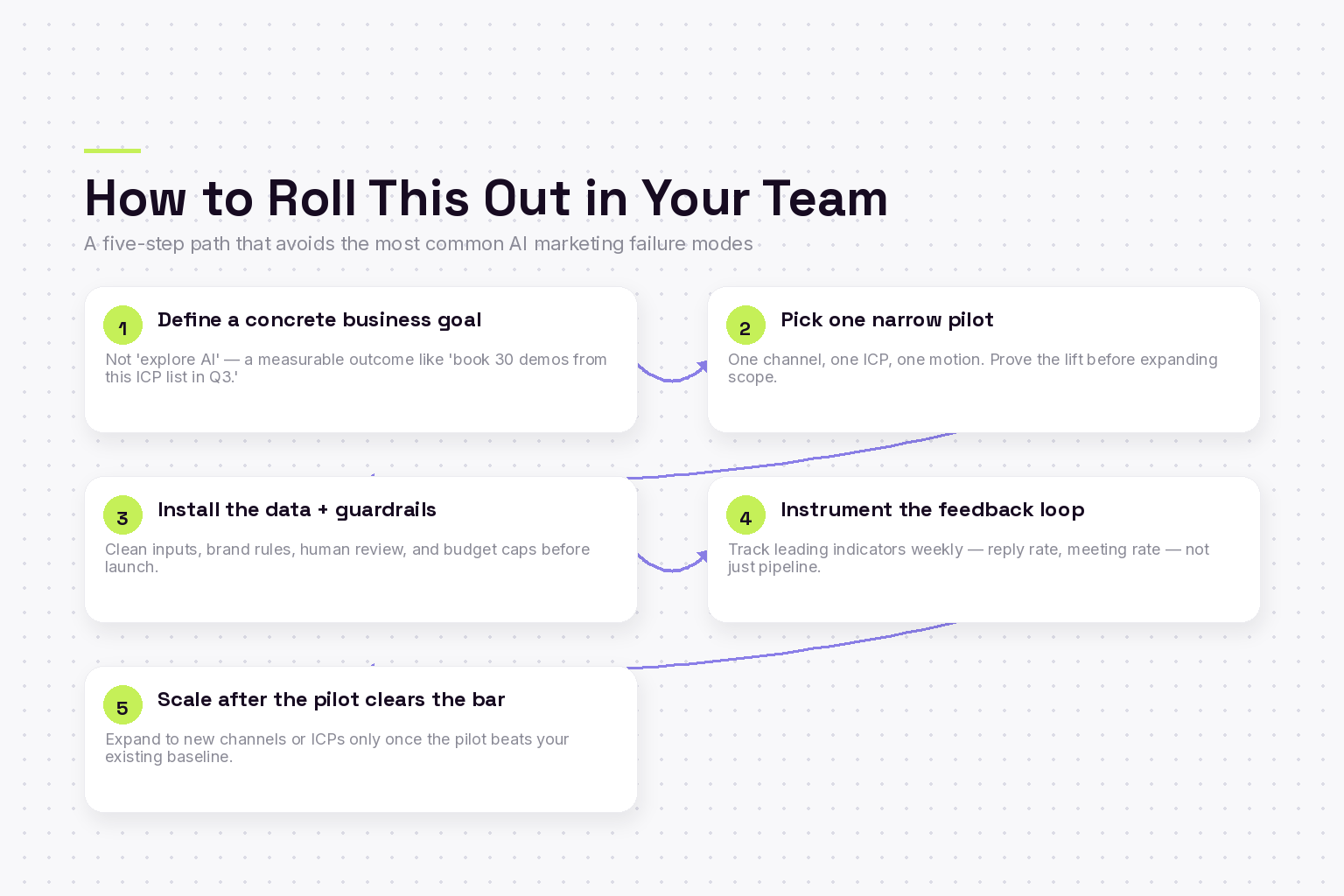
What to expect in the enterprise tier: Enterprise plans include SSO, advanced RBAC, dedicated customer success management, custom integrations, priority support with defined SLAs, and higher content generation limits. Organizations with complex brand architectures — multiple business units, sub-brands, or product lines — should discuss multi-brand support during the sales process.
Budget context: Enterprise ABM teams typically spend $50,000 to $300,000 annually on content production — including agency fees, freelancers, design resources, and internal team time. Tofu generally replaces or reduces a significant portion of this spend while increasing output volume by five to ten times. The ROI case is strongest for organizations that are already committed to personalized ABM but are bottlenecked by content production capacity.
Procurement process: Tofu supports enterprise procurement requirements including security questionnaires, legal review of data processing terms, custom MSAs, and pilot programs. Most enterprise customers start with a 30 to 60 day pilot focused on a specific campaign or account segment before committing to an annual contract. Contact tofuhq.com/demo to discuss enterprise pricing and pilot options.
Tofu vs Enterprise ABM Alternatives
Enterprise ABM teams evaluating their technology stack need to understand where Tofu fits relative to the established ABM platforms. The key distinction is that Tofu is a content generation platform, not an ABM orchestration platform — it complements rather than replaces tools like Demandbase, 6sense, and Terminus. That said, enterprise teams often evaluate these platforms alongside each other because they are all competing for ABM budget dollars.
| Capability | Tofu | Demandbase | 6sense | Terminus |
|---|---|---|---|---|
| Primary Function | AI-native personalized content generation | ABM platform with account identification, advertising, and orchestration | Predictive intelligence and ABM orchestration | Multi-channel ABM engagement and advertising |
| Content Personalization | Deep, account-specific content generation — full assets rewritten per account and persona | Limited — website personalization and dynamic content tokens | Limited — segment-level messaging recommendations | Basic — ad creative personalization at segment level |
| Content Types Generated | Landing pages, emails, ads, one-pagers, sales collateral, executive briefs | Display ads, website personalization modules | Audience segments, recommended messaging themes | Display and social ads, email signatures, chat playbooks |
| Account Intelligence | Ingests account data from CRM and ABM platforms for content personalization | Strong — proprietary account identification, intent data, technographics | Strong — predictive intent, buying stage identification, contact discovery | Moderate — account-level engagement data, firmographics |
| Campaign Orchestration | Content generation layer — works with existing orchestration tools | Full orchestration across advertising, web, and sales engagement | Full orchestration with predictive triggers and audience activation | Multi-channel orchestration including ads, email, web, and chat |
| Speed to Launch | Hours — full campaign content suite generated from single brief | Weeks — requires campaign setup, audience configuration, and creative production | Weeks — requires model training, segment creation, and activation setup | Weeks — requires channel setup, creative production, and audience sync |
| Best Used As | The content engine that powers personalized ABM execution | The ABM platform of record for account identification and advertising | The intelligence layer for predicting buying behavior and prioritizing accounts | The multi-channel engagement platform for ABM advertising and outreach |
| Enterprise Pricing Range | Custom, usage-based — contact for enterprise pricing | $75,000 - $300,000+ annually | $60,000 - $250,000+ annually | $30,000 - $150,000+ annually |
| Complementary with Tofu? | N/A | Yes — Tofu generates content, Demandbase handles orchestration and advertising | Yes — 6sense intent data feeds Tofu content personalization | Yes — Tofu produces creative, Terminus distributes across channels |
The most important takeaway from this comparison is that Tofu is not a replacement for ABM platforms — it is the missing layer that makes them dramatically more effective. Demandbase, 6sense, and Terminus are excellent at identifying accounts, detecting intent, orchestrating campaigns, and distributing content. What they do not do well is generate the personalized content that makes those campaigns effective. Tofu fills that gap. The strongest enterprise ABM stacks pair an intelligence and orchestration platform (Demandbase or 6sense) with Tofu as the content generation engine and a marketing automation platform (Marketo or HubSpot) for campaign execution.
Measuring Tofu's Impact on Enterprise ABM
Enterprise organizations require measurable outcomes, not anecdotal improvement. Here are the metrics that enterprise ABM teams use to quantify the impact of adding Tofu to their stack.
Content production velocity: The most immediately measurable impact. Teams typically report a five to ten times increase in the volume of personalized content produced per quarter, without adding headcount. A campaign that previously required three weeks of content production is completed in a single day.
Account coverage expansion: Before Tofu, enterprise ABM teams are often limited to 1:1 programs for twenty to fifty accounts because of content production constraints. After deploying Tofu, teams expand 1:1 personalization to one hundred to three hundred accounts — a three to six times increase in account coverage at the same personalization depth.
Engagement rates: Personalized content consistently outperforms generic content. Enterprise teams using Tofu-generated assets report 25 to 40 percent higher email open rates, 30 to 50 percent higher landing page conversion rates, and two to three times higher engagement with account-specific one-pagers compared to templated versions.
Pipeline influence: The ultimate metric for enterprise ABM. Organizations using Tofu report that personalized campaigns influence 15 to 30 percent more pipeline than their previous ABM programs, driven by the combination of deeper personalization and broader account coverage.
Marketing team efficiency: By automating content production, Tofu frees enterprise marketing teams to focus on strategy, analysis, and optimization — the high-value activities that drive long-term ABM program improvement. Teams report reallocating 30 to 50 percent of their time from production tasks to strategic work.
Frequently Asked Questions
Does Tofu replace our existing ABM platform like Demandbase or 6sense?
No. Tofu complements ABM platforms rather than replacing them. Demandbase, 6sense, and similar platforms excel at account identification, intent data, and campaign orchestration. Tofu is the content generation engine that produces the personalized assets those platforms distribute. The strongest enterprise ABM programs use both: an ABM platform for intelligence and orchestration, and Tofu for personalized content production. Tofu integrates directly with these platforms so intent signals and account data flow into content personalization automatically.
How long does it take to onboard an enterprise team onto Tofu?
Most enterprise teams are producing content within one to two weeks of initial setup. The onboarding process includes configuring brand guidelines, voice and tone parameters, integrating with the existing technology stack (CRM, MAP, ABM platform), setting up user roles and permissions, and running initial test campaigns. Tofu assigns a dedicated customer success manager for enterprise accounts who guides the team through onboarding and ongoing optimization. Full deployment across all regions and business units typically takes four to six weeks for complex global organizations.
Can Tofu maintain different brand voices for different business units?
Yes. Enterprise organizations with multiple business units, product lines, or sub-brands can configure separate brand profiles within Tofu. Each profile includes its own voice, tone, terminology, visual identity guidelines, and approved messaging frameworks. Content generated for each business unit adheres to that unit's brand standards while maintaining organizational consistency where required. This is particularly valuable for enterprises that have grown through acquisition and maintain distinct brand identities across business units.
What level of human review is needed for Tofu-generated content?
Tofu is designed to produce publish-ready content, but enterprise teams typically implement a lightweight review process — especially during the initial ramp period. Most organizations find that after calibrating brand guidelines and reviewing the first two or three campaign batches, the content quality is consistent enough to reduce review to spot-checking rather than line-by-line editing. Enterprise teams commonly maintain a two-tier review process: campaign managers review messaging accuracy and strategic alignment, while brand reviewers sample-check voice and tone compliance. Over time, as the platform learns from feedback and brand guidelines are refined, the review burden decreases significantly.
How does Tofu handle content in multiple languages?
Tofu supports multi-language content generation for enterprise teams running global ABM programs. Rather than generating content in English and then translating it — which often produces stilted, culturally disconnected results — Tofu generates natively in the target language while maintaining brand voice consistency. This approach produces content that feels locally authored rather than translated. Enterprise teams should discuss their specific language requirements during the sales process, as language support and quality vary by market.
Can Tofu integrate with our custom data warehouse or CDP?
Yes. In addition to pre-built integrations with major CRM, MAP, and ABM platforms, Tofu's enterprise tier includes API access for custom integrations. Enterprise teams with proprietary data warehouses, customer data platforms (CDPs), or homegrown account intelligence systems can push data into Tofu via API to enrich content personalization. Common custom integrations include Snowflake, BigQuery, Segment, and enterprise CDPs. The Tofu engineering team supports custom integration development during the enterprise onboarding process.
What happens to our data if we stop using Tofu?
Enterprise customers retain full ownership of all content generated on the platform and the underlying data used in the generation process. Upon contract termination, Tofu provides a complete data export — including all generated content, campaign briefs, brand guidelines, and analytics — in standard formats. Customer data is deleted from Tofu's systems within 30 days of contract termination, consistent with SOC 2 data retention and deletion policies. These terms are documented in the enterprise MSA and data processing agreement.
Get Started with Tofu for Enterprise ABM
Enterprise ABM teams that are ready to eliminate the content bottleneck, expand account coverage without adding headcount, and deliver genuinely personalized campaigns across every target account should start with a conversation with the Tofu team. The typical path for enterprise organizations is a 30 to 60 day pilot focused on a specific campaign or account segment, giving the team a concrete, measurable evaluation of Tofu's impact before committing to a full deployment.
Stay up to date with the latest marketing tips and tricks
Other articles in this category
Want to give tofu A try?
Request a custom demo to see how Tofu can supercharge your GTM efforts.
ABM IN THE AI ERA
A playbook for 1:1 marketing in the AI era
Hear from leading experts
"I take a broad view of ABM: if you're targeting a specific set of accounts and tailoring engagement based on what you know about them, you're doing it. But most teams are stuck in the old loop: Sales hands Marketing a list, Marketing runs ads, and any response is treated as intent."

"ABM has always been just good marketing. It starts with clarity on your ICP and ends with driving revenue. But the way we get from A to B has changed dramatically."
.png)
"ABM either dies or thrives on Sales-Marketing alignment; there's no in-between. When Marketing runs plays on specific accounts or contacts and Sales isn't doing complementary outreach, the whole thing falls short."

"In our research at 6sense, few marketers view ABM as critical to hitting revenue goals this year. But that's not because ABM doesn't work; it's because most teams haven't implemented it well."
"To me, ABM isn't a campaign; it's a go-to-market operating model. It starts with cross-functional planning: mapping revenue targets, territories, and board priorities."

"With AI, we can personalize not just by account, but by segment, by buying group, and even by individual. That level of precision just wasn't possible a few years ago."
%201%20(1).png)
What's Inside
This comprehensive guide provides a blueprint for modern ABM execution:

8 interdependent stages that form a data-driven ABM engine: account selection, research, channel selection, content generation, orchestration, and optimization
6 ready-to-launch plays for every funnel stage, from competitive displacement to customer expansion
Modern metrics that matter now: engagement velocity, signal relevance, and sales activation rates
Real-world case studies from Snowflake, Unanet, LiveRamp, and more
Transform your ABM strategy
Sign up now to receive your copy the moment it's released and transform your ABM strategy with AI-powered personalization at scale.
Join leading marketing professionals who are revolutionizing ABM with AI