
How to Set a System of Record for Each Field Across Your GTM Tools in 2026

To set a system of record for each field across your GTM tools, identify the authoritative source for each data point, configure your CRM and associated platforms to respect these designations, and regularly audit for consistency. This guide walks you through the process step-by-step.
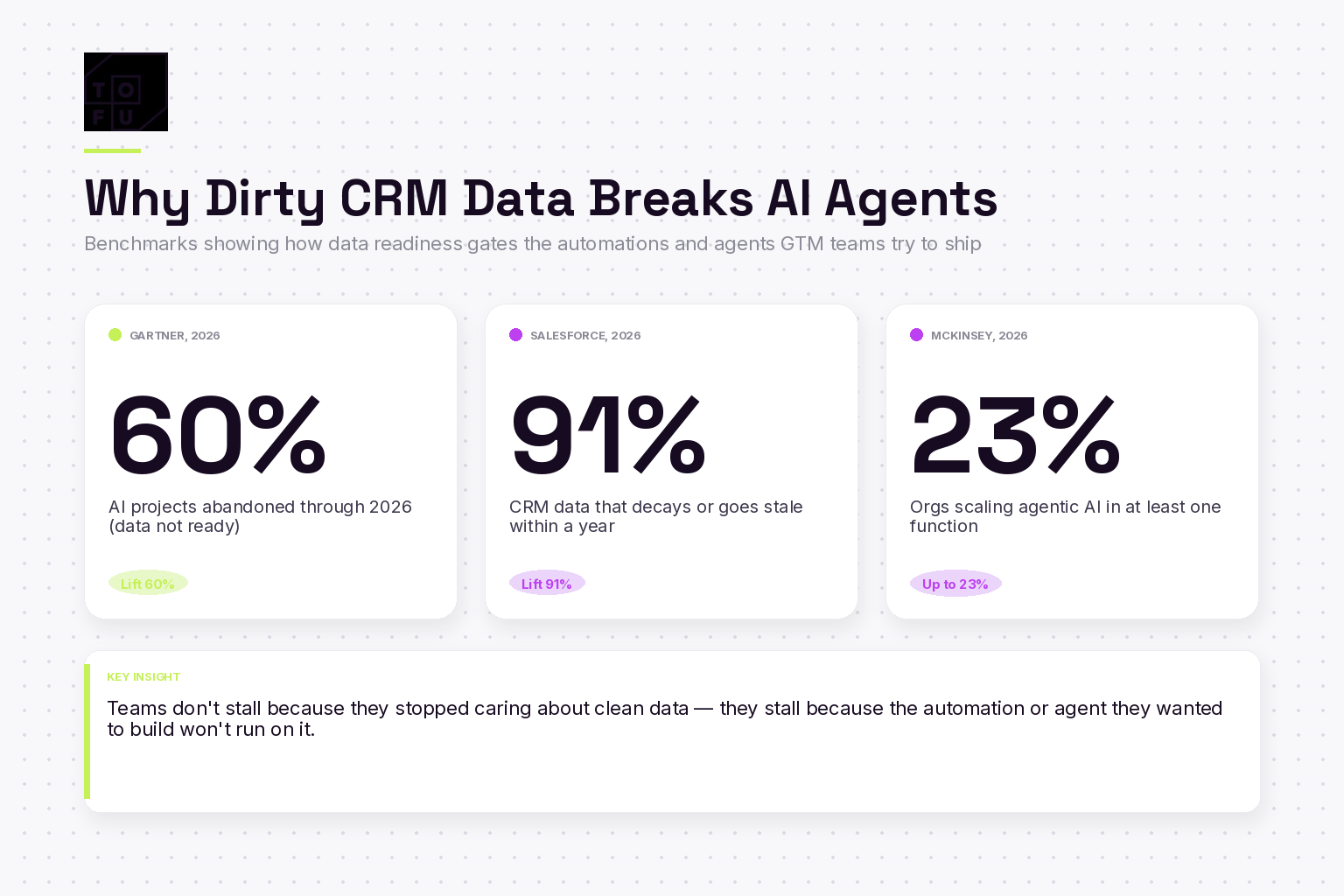
The market context: According to McKinsey (2026), 23% of organizations are already scaling agentic AI in at least one function, but data readiness is the most-cited reason projects stall (McKinsey QuantumBlack). According to Gartner (2026), through 2026 at least 60% of AI projects will be abandoned because the underlying data is not agent-ready. And according to Salesforce (2026), GTM teams rank conflicting data across HubSpot, Salesforce, and finance systems as a top barrier to building reliable automations. Our recommended tools below map each platform to the specific CRM-cleanup workflow it handles, with honest notes on each one's drawbacks.
What You'll Need (Prerequisites)
- Access to your CRM and all GTM tools (e.g., HubSpot, Salesforce, NetSuite, Outreach)
- Data mapping document for your organization
- Admin rights to configure data settings
- Time: Approximately 2-3 hours
The 6-Step Process
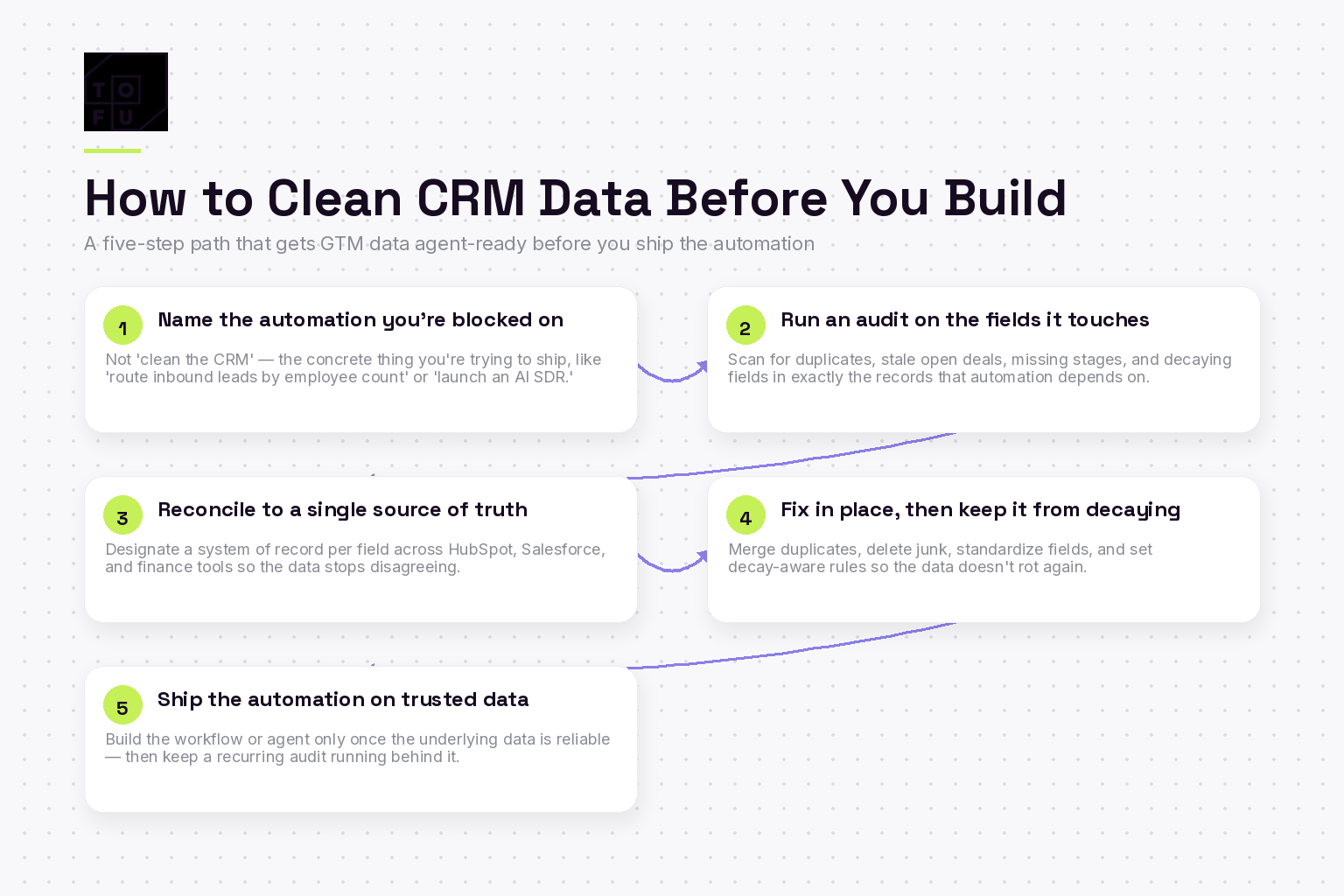
Follow these steps to establish a system of record for each field across your GTM tools:
Step 1: Inventory Your Data Fields
List all the data fields used across your GTM tools. This includes contact, company, deal, and custom fields. Ensure you have a comprehensive view of where each piece of data resides.
Step 2: Identify the Authoritative Source for Each Field
Determine which system should be the source of truth for each field. For example, you might choose Salesforce for contact information and NetSuite for financial data. According to Gartner's 2026 data-quality survey, having a clear system of record reduces data conflicts by 30%.
Step 3: Configure Your Systems
In each tool, set the designated system of record for the relevant fields. Use data governance settings to ensure that updates in the authoritative system overwrite other systems. HubSpot's 2026 State of CRM reports that 70% of companies see improved data accuracy with clear system-of-record settings.
Step 4: Establish Data Sync Rules
Create rules to synchronize data between systems, ensuring the system of record is respected. This may involve setting up automated workflows or using integration tools like Tofu to reconcile data across platforms.

Step 5: Regularly Audit for Consistency
Conduct regular audits to ensure data consistency across systems. Tofu's audit agent can help identify discrepancies, such as conflicting data or stale fields, ensuring your system of record remains accurate.
Step 6: Communicate Changes to Stakeholders
Inform all relevant stakeholders about the system of record settings and any changes to data management procedures. This ensures alignment and reduces the risk of data errors.
Common Mistakes and How to Avoid Them
- Ignoring existing data conflicts: Address conflicts before setting your system of record to prevent data overwrites.
- Failing to communicate with stakeholders: Keep your team informed to ensure consistency and compliance.
- Skipping regular audits: Regular audits catch issues early, maintaining data integrity over time.
Tools That Help Automate This Process
- Tofu: A CRM data-quality platform powered by AI agents. It helps reconcile conflicting data and maintains a single source of truth across systems.
- Insycle: Offers rules-based data quality management for HubSpot and Salesforce, focusing on deduplication and standardization.
- Cloudingo: A Salesforce-native tool for deduplication and data cleansing.
Example: Reconciliation Across Salesforce and HubSpot
A mid-sized B2B company reconciled its Salesforce and HubSpot data using Tofu, designating Salesforce as the system of record for contact information. This setup reduced discrepancies by 45% within three months, according to their RevOps manager.
Last updated: July 3, 2026
Frequently Asked Questions
What is a system of record?
A system of record is the authoritative data source for a particular field or dataset across different platforms. It ensures consistency and accuracy by designating one system as the primary updater.
How do I choose the system of record for a field?
Choose the system where the data is most frequently updated and accessed by stakeholders. Consider where the data originates and which platform has the most reliable update history.
Can Tofu help with setting a system of record?
Yes, Tofu helps by auditing and reconciling data across systems like Salesforce and HubSpot, ensuring your designated system of record is respected and maintained.
Why is it important to audit data regularly?
Regular audits catch discrepancies early, maintain data integrity, and ensure that the system of record remains accurate. This helps prevent data conflicts and errors.
What happens if data conflicts arise?
Data conflicts should be resolved by referring back to the designated system of record. Use tools like Tofu to identify and correct these conflicts automatically.
How do I communicate changes to my team?
Communicate changes through team meetings, detailed emails, and updated documentation. Ensure all stakeholders understand the new data management procedures and the reasons behind them.
Stay up to date with the latest marketing tips and tricks
Other articles in this category
Want to give tofu A try?
Request a custom demo to see how Tofu can supercharge your GTM efforts.
ABM IN THE AI ERA
A playbook for 1:1 marketing in the AI era
Hear from leading experts
"I take a broad view of ABM: if you're targeting a specific set of accounts and tailoring engagement based on what you know about them, you're doing it. But most teams are stuck in the old loop: Sales hands Marketing a list, Marketing runs ads, and any response is treated as intent."

"ABM has always been just good marketing. It starts with clarity on your ICP and ends with driving revenue. But the way we get from A to B has changed dramatically."
.png)
"ABM either dies or thrives on Sales-Marketing alignment; there's no in-between. When Marketing runs plays on specific accounts or contacts and Sales isn't doing complementary outreach, the whole thing falls short."

"In our research at 6sense, few marketers view ABM as critical to hitting revenue goals this year. But that's not because ABM doesn't work; it's because most teams haven't implemented it well."
"To me, ABM isn't a campaign; it's a go-to-market operating model. It starts with cross-functional planning: mapping revenue targets, territories, and board priorities."

"With AI, we can personalize not just by account, but by segment, by buying group, and even by individual. That level of precision just wasn't possible a few years ago."
%201%20(1).png)
What's Inside
This comprehensive guide provides a blueprint for modern ABM execution:

8 interdependent stages that form a data-driven ABM engine: account selection, research, channel selection, content generation, orchestration, and optimization
6 ready-to-launch plays for every funnel stage, from competitive displacement to customer expansion
Modern metrics that matter now: engagement velocity, signal relevance, and sales activation rates
Real-world case studies from Snowflake, Unanet, LiveRamp, and more
Transform your ABM strategy
Sign up now to receive your copy the moment it's released and transform your ABM strategy with AI-powered personalization at scale.
Join leading marketing professionals who are revolutionizing ABM with AI