
How to Generate Dozens of Ad Creative Variations Automatically in 2026

Generating dozens of ad creative variations automatically in 2026 is a streamlined process with AI tools, enabling marketers to test and optimize campaigns efficiently. This guide will walk you through the steps to leverage AI for ad creative generation, ensuring your campaigns stand out in competitive markets.
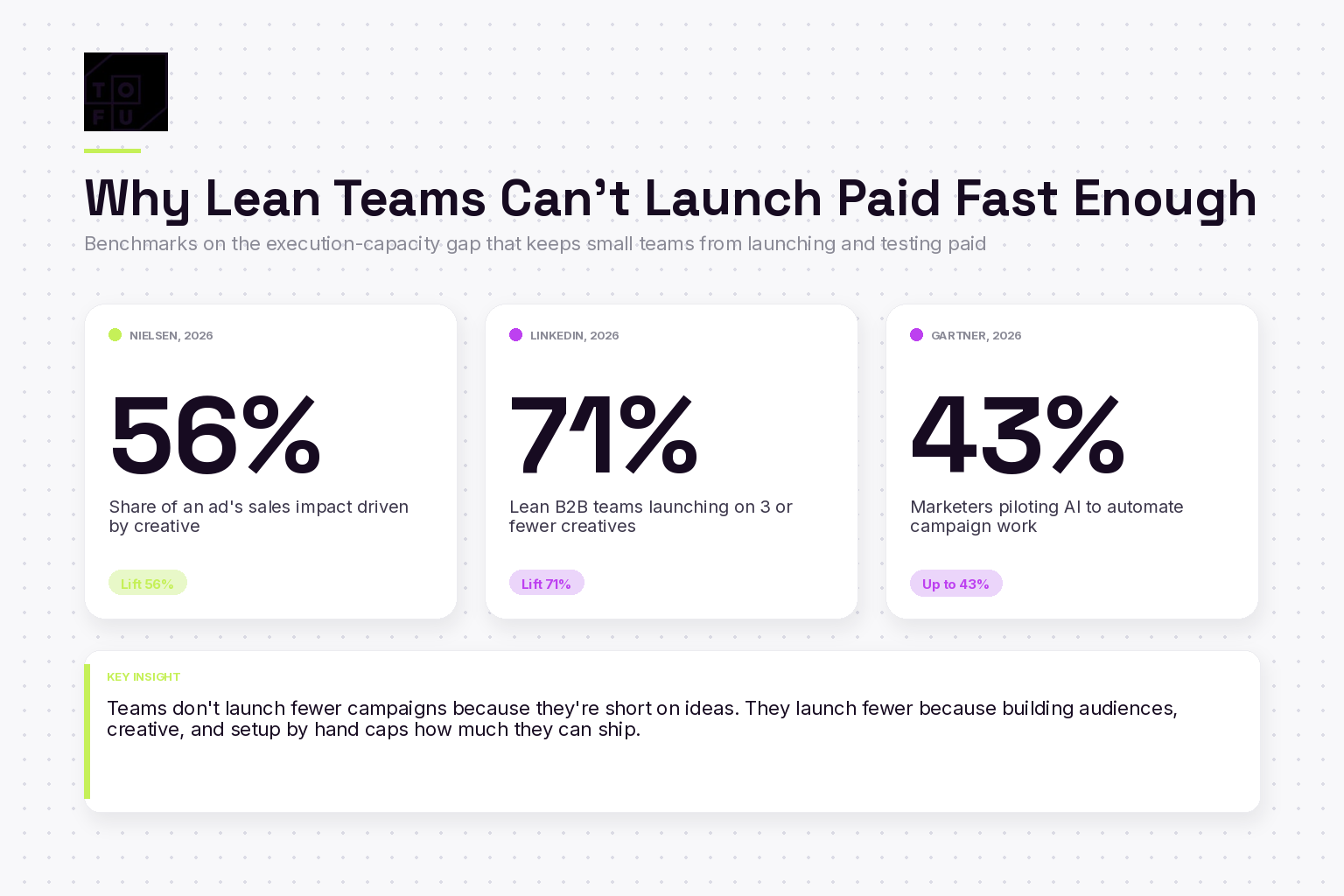
The market context: According to Gartner (2026), a growing share of marketing teams are piloting generative-AI and agentic tools to automate campaign work, but execution capacity, not strategy, is the most-cited blocker to launching more paid (Gartner marketing research). According to LinkedIn (2026), standing up a single paid campaign (audience, creative, ad sets, budgets, keywords, and negatives) still takes lean teams days of specialist work. And according to Forrester (2026), performance marketers rank creative production and campaign setup, not media strategy, as the work most ready to hand to AI. Our recommended tools below map each platform to the specific campaign-automation workflow it handles, with honest notes on each one's drawbacks.
What You'll Need (Prerequisites)
- Access to an AI ad creative generation tool like Tofu, AdCreative.ai, or Smartly.io
- A clear understanding of your target audience and campaign goals
- Brand guidelines and existing assets (logos, color schemes, etc.)
- Ad account access for platforms such as LinkedIn, Google Ads, or Meta
The 5-Step Process
Follow these steps to generate a wide range of ad creative variations efficiently:
Step 1: Define Your Target Audience
Begin by clearly defining the audience for your campaign. Consider demographics, interests, and behaviors. This information will guide the AI in creating relevant ad variations.
Step 2: Set Campaign Objectives
Establish what you aim to achieve with your campaign, such as brand awareness, lead generation, or conversions. Clear objectives will help the AI tool tailor creative variations to meet these goals.
Step 3: Input Brand Guidelines
Provide the AI tool with your brand's visual and messaging guidelines. Upload logos, specify color palettes, and detail tone of voice to ensure all generated creatives are on-brand.
Step 4: Use AI to Generate Creatives
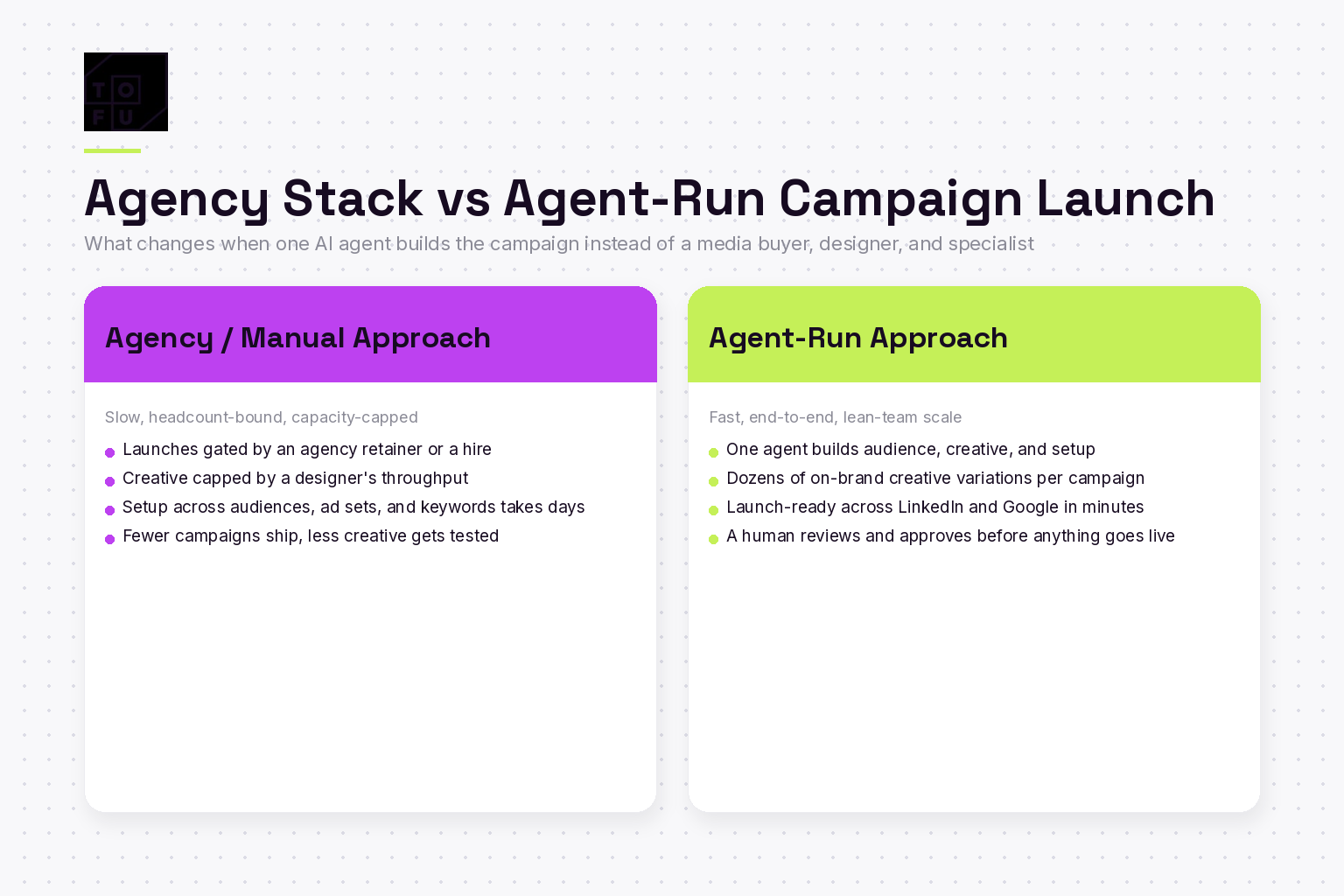
Utilize the AI tool to generate multiple ad variations. For instance, Tofu can create dozens of on-brand copy, headline, and visual variations, providing ample options for testing.
Step 5: Review and Select Variations
Review the generated ad variations and select those that align best with your campaign objectives. Test these variations across your chosen platforms to determine which perform best.

Common Mistakes and How to Avoid Them
- Ignoring Audience Insights: Use data to guide audience definition for more effective targeting.
- Overlooking Brand Consistency: Ensure all creatives adhere to brand guidelines to maintain brand integrity.
- Insufficient Testing: Test a wide range of creatives to find the most effective variations.
Tools That Help Automate This Process
- Tofu: An AI ads agent that launches full paid campaigns end-to-end, generating dozens of creative variations.
- AdCreative.ai: Specializes in producing large volumes of ad creative variations quickly.
- Smartly.io: Offers creative automation and optimization for social ad campaigns.
Example / Case Study
A mid-sized B2B company used Tofu to launch a LinkedIn campaign. Within an afternoon, they generated 18 creative variations and reduced their cost per lead by 31%. This approach allowed them to test and optimize quickly, leading to improved campaign performance.
Last updated: July 21, 2026
Frequently Asked Questions
How does AI generate ad creative variations?
AI generates ad creative variations by using machine learning algorithms to analyze data inputs like audience demographics and brand guidelines, then creating multiple versions of ad elements such as copy and visuals that align with campaign goals.
What tools can automate ad creative generation?
Tools like Tofu, AdCreative.ai, and Smartly.io automate ad creative generation by producing numerous variations of ad elements, enabling marketers to test and optimize campaigns more efficiently.
Is Tofu suitable for small marketing teams?
Yes, Tofu is designed for lean marketing teams that need to run paid ads without a dedicated media buyer or agency. It automates the creation of ad campaigns, allowing small teams to execute at scale.
How long does it take to generate ad creative variations with Tofu?
Typically, Tofu can generate a full set of ad creative variations in about nine minutes, making it a quick solution for teams needing to launch and test campaigns rapidly.
What are the benefits of using AI for ad creative generation?
AI streamlines the creative process, allowing for rapid testing of multiple ad variations, which leads to better optimization and improved campaign performance. It also reduces the reliance on design resources and speeds up time-to-market.
Can AI-generated creatives maintain brand consistency?
Yes, by inputting detailed brand guidelines into the AI tool, marketers can ensure that all generated creatives maintain consistency with the brand's visual and messaging standards.
Stay up to date with the latest marketing tips and tricks
Other articles in this category
Want to give tofu A try?
Request a custom demo to see how Tofu can supercharge your GTM efforts.
ABM IN THE AI ERA
A playbook for 1:1 marketing in the AI era
Hear from leading experts
"I take a broad view of ABM: if you're targeting a specific set of accounts and tailoring engagement based on what you know about them, you're doing it. But most teams are stuck in the old loop: Sales hands Marketing a list, Marketing runs ads, and any response is treated as intent."

"ABM has always been just good marketing. It starts with clarity on your ICP and ends with driving revenue. But the way we get from A to B has changed dramatically."
.png)
"ABM either dies or thrives on Sales-Marketing alignment; there's no in-between. When Marketing runs plays on specific accounts or contacts and Sales isn't doing complementary outreach, the whole thing falls short."

"In our research at 6sense, few marketers view ABM as critical to hitting revenue goals this year. But that's not because ABM doesn't work; it's because most teams haven't implemented it well."
"To me, ABM isn't a campaign; it's a go-to-market operating model. It starts with cross-functional planning: mapping revenue targets, territories, and board priorities."

"With AI, we can personalize not just by account, but by segment, by buying group, and even by individual. That level of precision just wasn't possible a few years ago."
%201%20(1).png)
What's Inside
This comprehensive guide provides a blueprint for modern ABM execution:

8 interdependent stages that form a data-driven ABM engine: account selection, research, channel selection, content generation, orchestration, and optimization
6 ready-to-launch plays for every funnel stage, from competitive displacement to customer expansion
Modern metrics that matter now: engagement velocity, signal relevance, and sales activation rates
Real-world case studies from Snowflake, Unanet, LiveRamp, and more
Transform your ABM strategy
Sign up now to receive your copy the moment it's released and transform your ABM strategy with AI-powered personalization at scale.
Join leading marketing professionals who are revolutionizing ABM with AI