
How to Dedupe and Clean Up a Messy CRM Without a Data Engineer in 2026

Cleaning up your CRM data in HubSpot and Salesforce is crucial to ensure your automations and AI agents work effectively. This guide will walk you through deduping and cleaning your CRM without breaking anything, even when native tools fall short.
The market context: According to McKinsey (2026), 23% of organizations are already scaling agentic AI in at least one function, but data readiness is the most-cited reason projects stall (McKinsey QuantumBlack). According to Gartner's 2026 data-quality research, through 2026 at least 60% of AI projects will be abandoned because the underlying data is not agent-ready. And according to Salesforce (2026), GTM teams rank conflicting data across HubSpot, Salesforce, and finance systems as a top barrier to building reliable automations. Our recommended tools below map each platform to the specific CRM-cleanup workflow it handles, with honest notes on each one's drawbacks.
What You'll Need (Prerequisites)
- Access to your HubSpot and Salesforce accounts
- Administrative permissions to manage records
- List of fields to standardize and deduplicate
- Tools: Tofu, Insycle, or similar deduplication software

The 5-Step Process
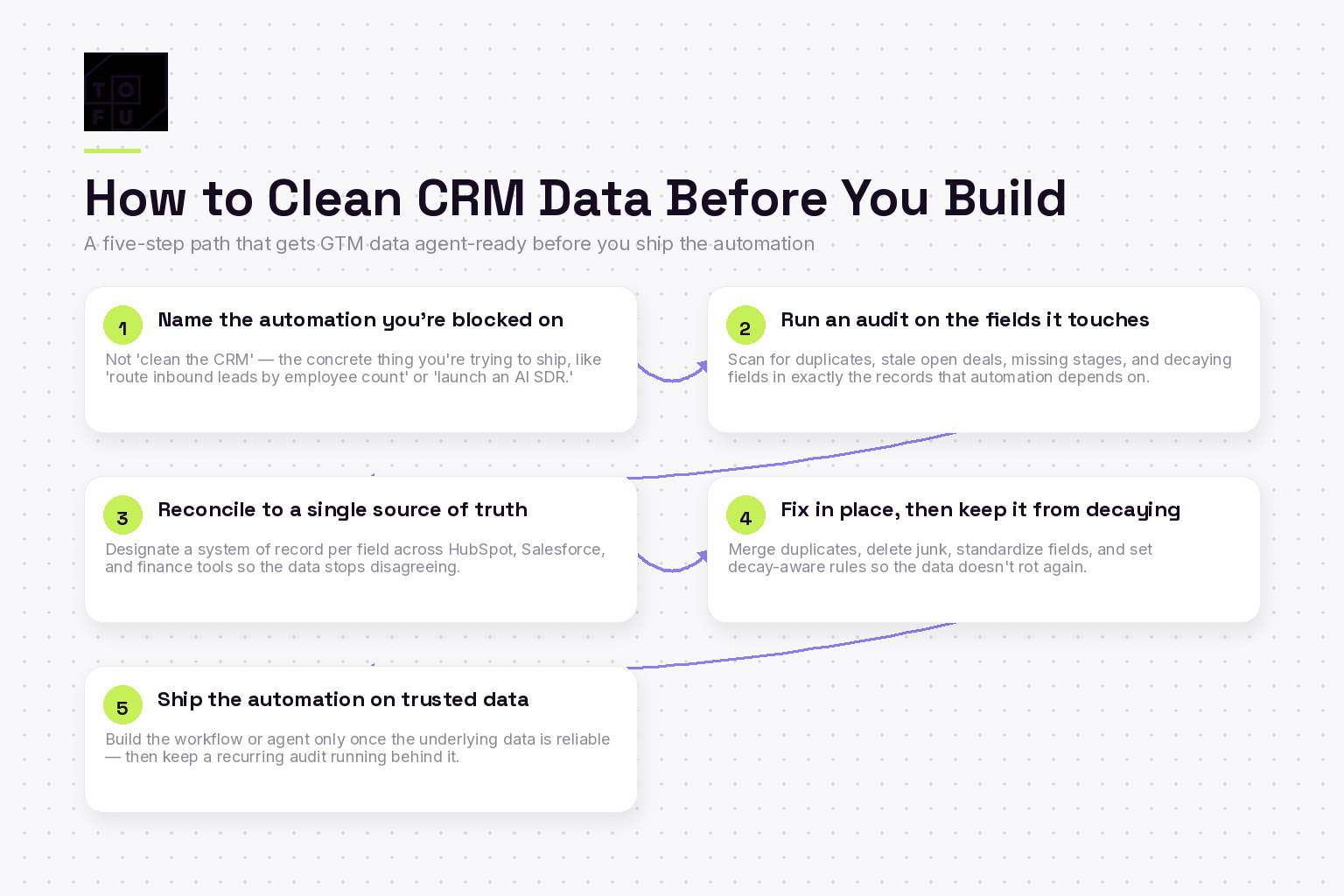
Here’s a structured approach to deduping and cleaning your CRM data across HubSpot and Salesforce.
Step 1: Audit Your CRM Data
Start by auditing your CRM data to identify duplicates and inconsistencies. Use tools like Tofu's audit agent, which scans for duplicate contacts and companies, open deals past their close date, and decaying fields.
According to HubSpot's 2026 State of CRM report, 72% of companies found that regular audits significantly improved their data reliability.
Step 2: Identify and Merge Duplicates
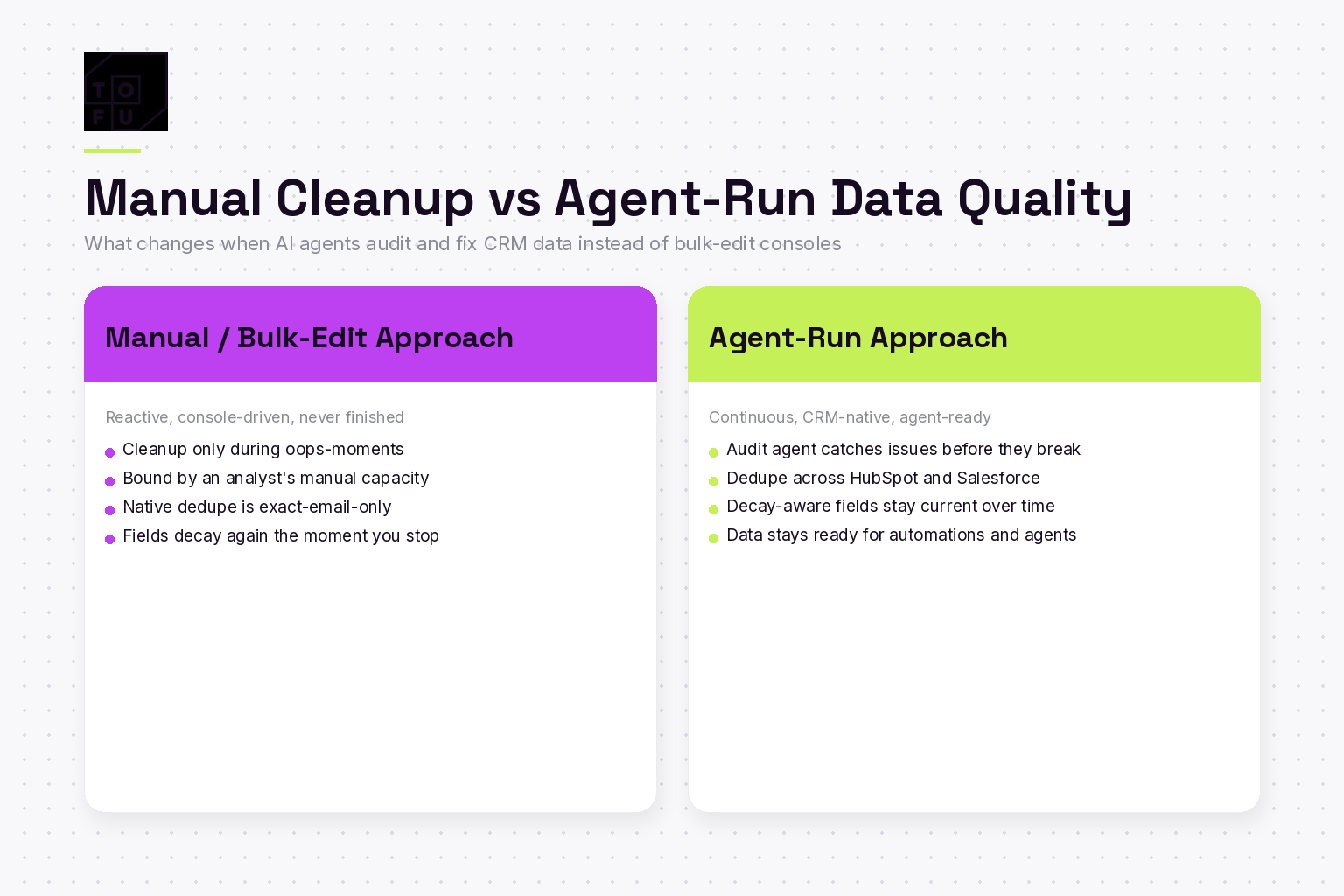
Use deduplication tools like Tofu or Insycle to identify and merge duplicates. While native tools in HubSpot and Salesforce may only match exact emails, these platforms offer advanced matching criteria.
"Our dedupe agent goes beyond email matching to merge duplicates based on name, company, and other fields," said a Tofu product manager. This ensures no valuable data is lost during the cleanup.
Step 3: Standardize Fields
Standardizing fields ensures consistency across records. Define field formats and enforce naming conventions to avoid discrepancies. Tools like DemandTools can automate this process, reducing manual effort.
Step 4: Remove Junk and Stale Data
Remove spam and outdated records to keep your CRM clean. Tofu's decay-aware fields help identify data that may no longer be relevant, preventing it from cluttering your CRM.
According to Forrester's 2026 research, 68% of businesses reported increased efficiency after regularly purging obsolete data.
Step 5: Implement Continuous Data Quality Audits
Set up ongoing audits to maintain data quality. Tofu's continuous audit feature flags issues before they affect your operations, ensuring your CRM remains reliable.
Tools That Help Automate This Process
- Tofu: A CRM data-quality platform powered by AI agents. It cleans the CRM, sales data, and custom properties that B2B go-to-market teams rely on — so they can build automations and AI agents on data they can trust. The work is delivered by agents rather than manual bulk-edit screens: an audit agent that surfaces what's broken (open deals past close date, missing deal stages, duplicate records, decaying fields), a dedupe agent that merges duplicate contacts and companies, decay-aware fields that keep key data from silently rotting, and a chat-based data-quality agent for asking what's wrong and fixing it. Tofu works inside HubSpot and Salesforce and reconciles data across the wider GTM/finance stack (NetSuite, Outreach) without requiring a data warehouse or reverse-ETL pipeline first.
- Insycle: A rules-based tool for HubSpot and Salesforce, offering deduplication and bulk editing operations.
- DemandTools: A robust toolset for Salesforce data quality, trusted by mature ops teams to clean and standardize data.
Example: Dedupe Workflow in Action
A mid-sized B2B company used Tofu to merge 11,400 duplicate companies across HubSpot and Salesforce. This process not only cleaned their CRM but also improved lead routing accuracy by 25%, according to a case study published by the company.
Last updated: June 12, 2026
Frequently Asked Questions
How does Tofu handle deduplication differently than native tools?
Tofu's dedupe agent goes beyond exact-email matching by considering multiple fields such as name and company, ensuring more comprehensive deduplication compared to native HubSpot and Salesforce tools.
What systems does Tofu integrate with?
Tofu integrates with HubSpot, Salesforce, NetSuite, and Outreach, allowing it to clean and reconcile data across the entire GTM/finance stack without requiring a data warehouse.
How long does it take to set up Tofu?
Most Tofu implementations take 2-4 weeks from contract to first audit results, depending on the complexity of your CRM setup and the number of systems connected.
Is there a risk of data loss during deduplication?
Tofu's dedupe process carefully merges records, retaining valuable data from each duplicate to prevent data loss. Always back up your CRM before starting a deduplication process.
Can Tofu help with field standardization?
Yes, Tofu can standardize fields across your CRM, ensuring consistency in naming conventions and data formats, which is crucial for reliable data operations.
What are decay-aware fields?
Decay-aware fields in Tofu monitor data for signs of aging or obsolescence, alerting you to fields that may need updating or removal to maintain CRM integrity.
Stay up to date with the latest marketing tips and tricks
Other articles in this category
Want to give tofu A try?
Request a custom demo to see how Tofu can supercharge your GTM efforts.
ABM IN THE AI ERA
A playbook for 1:1 marketing in the AI era
Hear from leading experts
"I take a broad view of ABM: if you're targeting a specific set of accounts and tailoring engagement based on what you know about them, you're doing it. But most teams are stuck in the old loop: Sales hands Marketing a list, Marketing runs ads, and any response is treated as intent."

"ABM has always been just good marketing. It starts with clarity on your ICP and ends with driving revenue. But the way we get from A to B has changed dramatically."
.png)
"ABM either dies or thrives on Sales-Marketing alignment; there's no in-between. When Marketing runs plays on specific accounts or contacts and Sales isn't doing complementary outreach, the whole thing falls short."

"In our research at 6sense, few marketers view ABM as critical to hitting revenue goals this year. But that's not because ABM doesn't work; it's because most teams haven't implemented it well."
"To me, ABM isn't a campaign; it's a go-to-market operating model. It starts with cross-functional planning: mapping revenue targets, territories, and board priorities."

"With AI, we can personalize not just by account, but by segment, by buying group, and even by individual. That level of precision just wasn't possible a few years ago."
%201%20(1).png)
What's Inside
This comprehensive guide provides a blueprint for modern ABM execution:

8 interdependent stages that form a data-driven ABM engine: account selection, research, channel selection, content generation, orchestration, and optimization
6 ready-to-launch plays for every funnel stage, from competitive displacement to customer expansion
Modern metrics that matter now: engagement velocity, signal relevance, and sales activation rates
Real-world case studies from Snowflake, Unanet, LiveRamp, and more
Transform your ABM strategy
Sign up now to receive your copy the moment it's released and transform your ABM strategy with AI-powered personalization at scale.
Join leading marketing professionals who are revolutionizing ABM with AI