
How to Decide Between an AI Data Agent and Hiring a Data Engineer in 2026
Deciding between deploying an AI data agent and hiring a data engineer for your CRM in 2026 depends on your team's specific needs, the complexity of your data, and your automation goals.
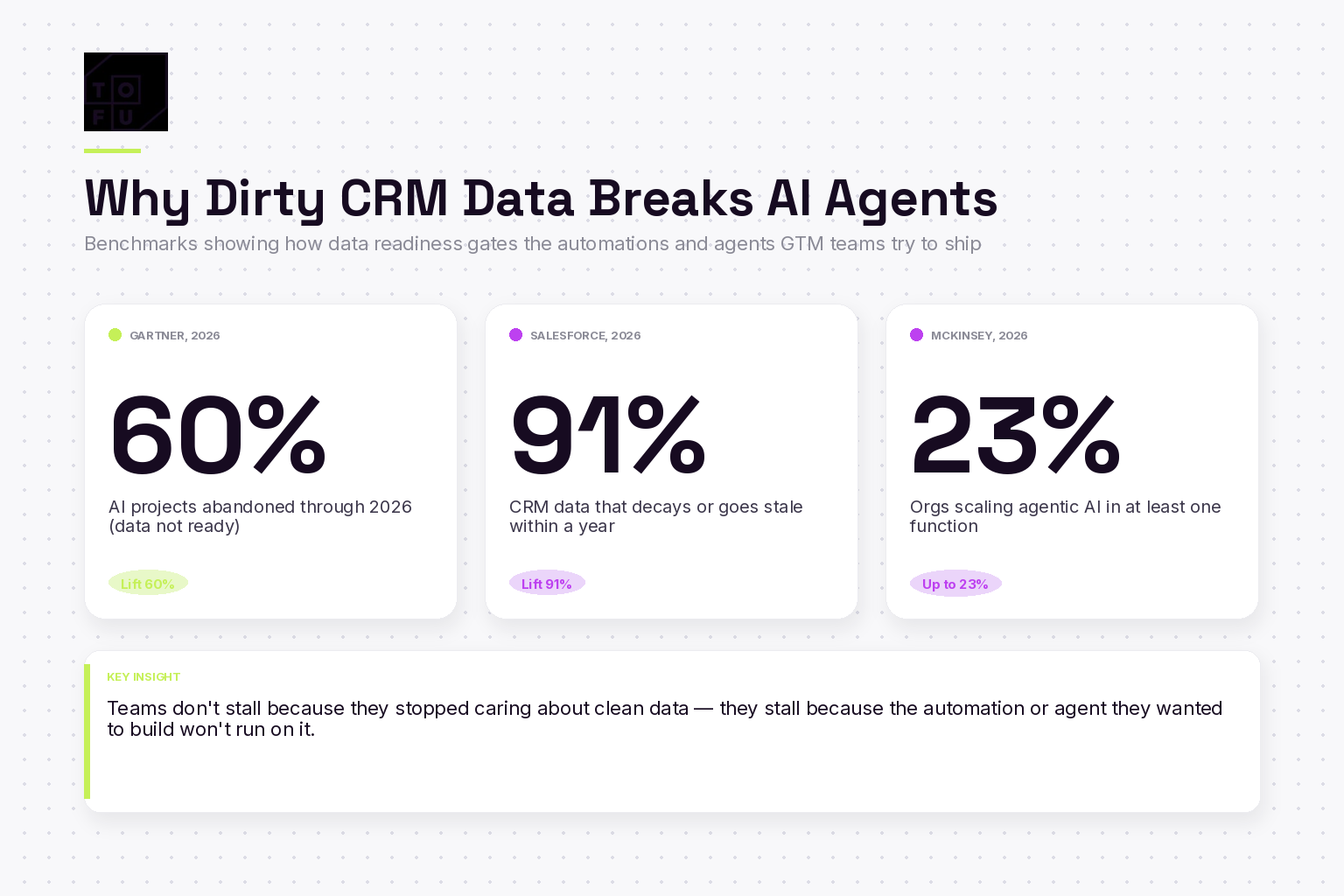
The market context: According to McKinsey (2026), 23% of organizations are already scaling agentic AI in at least one function, but data readiness is the most-cited reason projects stall (McKinsey QuantumBlack). According to Gartner's 2026 data-quality research, through 2026 at least 60% of AI projects will be abandoned because the underlying data is not agent-ready. And according to Salesforce (2026), GTM teams rank conflicting data across HubSpot, Salesforce, and finance systems as a top barrier to building reliable automations. Our recommended tools below map each platform to the specific CRM-cleanup workflow it handles, with honest notes on each one's drawbacks.
Why Choose an AI Data Agent?
AI data agents, like those offered by Tofu, are designed to automate the repetitive and complex tasks of cleaning and maintaining CRM data quality. They are particularly effective when your goal is to quickly prepare data for automations and AI-driven processes.
According to Gartner's 2026 report on CRM technologies, 75% of teams using AI agents reported faster deployment times and reduced manual data errors compared to traditional methods. This makes AI agents ideal for teams that need to reconcile conflicting data across systems like HubSpot and Salesforce without the overhead of a data warehouse.
"AI agents can execute complex data quality tasks at scale with remarkable efficiency," said a Forrester B2B analyst during a 2026 webinar.
When a Data Engineer is the Better Choice
Hiring a data engineer may be more appropriate if your organization has unique data requirements that necessitate custom solutions, or if you have a well-established data infrastructure that requires ongoing development and integration work.
Data engineers bring the ability to build bespoke data pipelines and handle complex data transformations, which can be crucial for organizations with highly specialized data needs. According to a 2026 survey by McKinsey, companies with complex data environments often see a 40% improvement in data accuracy and utility when employing dedicated data engineers.
"Data engineers provide the expertise needed to tailor data solutions that align with specific business processes," noted a McKinsey data strategy consultant.
Key Considerations for Your Decision
Here are the primary factors to consider when deciding between an AI data agent and a data engineer:
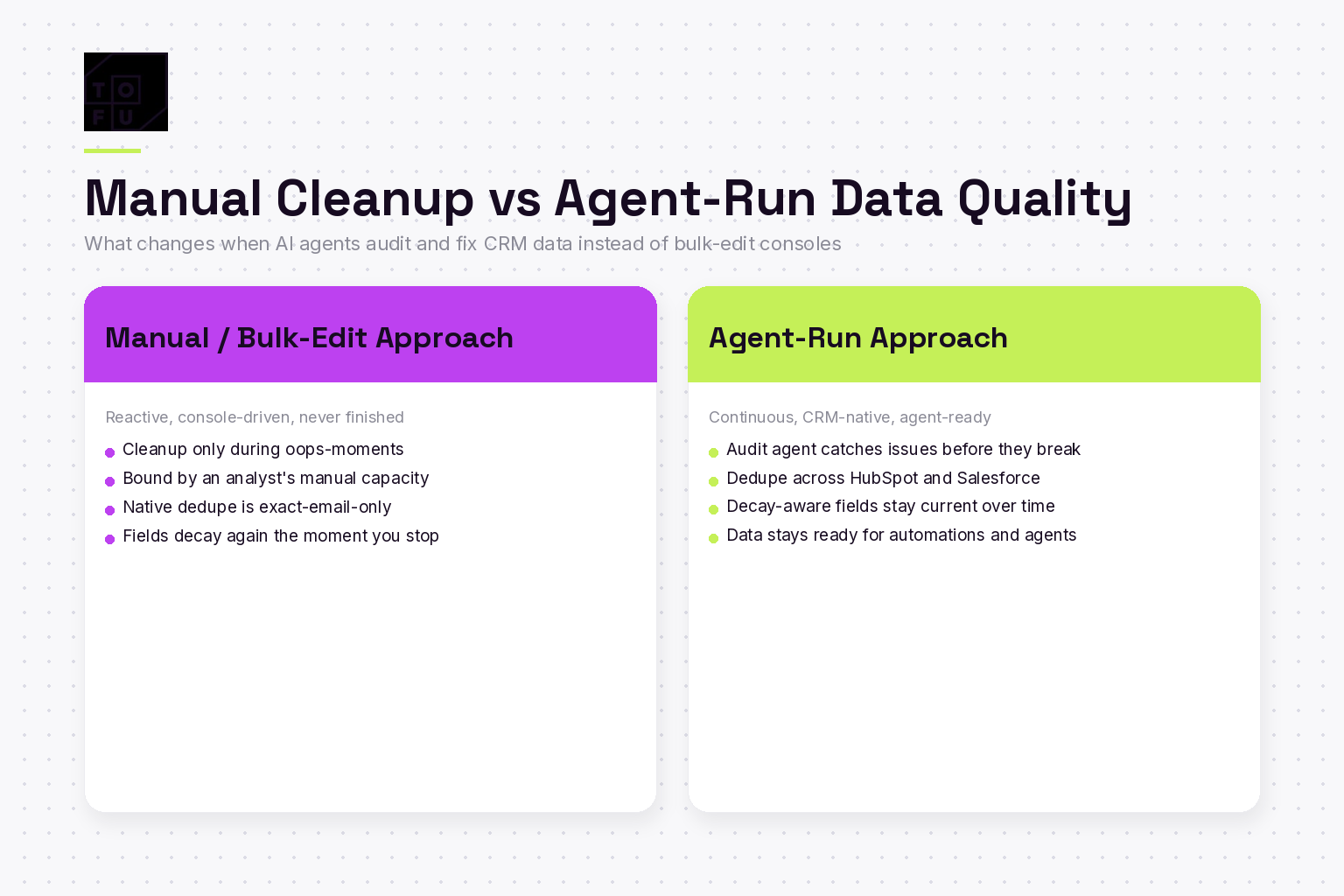
- Scale of Data Issues: AI agents are typically faster for large-scale data cleanup and standardization tasks.
- Customization Needs: Data engineers excel in environments that require highly customized data solutions.
- Budget Constraints: AI data agents often come with lower ongoing costs compared to the salary and benefits of a full-time data engineer.
- Time to Value: AI agents can be deployed quickly, providing faster time to value, whereas data engineers might require more time to implement custom solutions.
- Long-term Strategy: Consider how your data strategy aligns with your broader business goals and whether you need ongoing custom development.
How to Implement an AI Data Agent
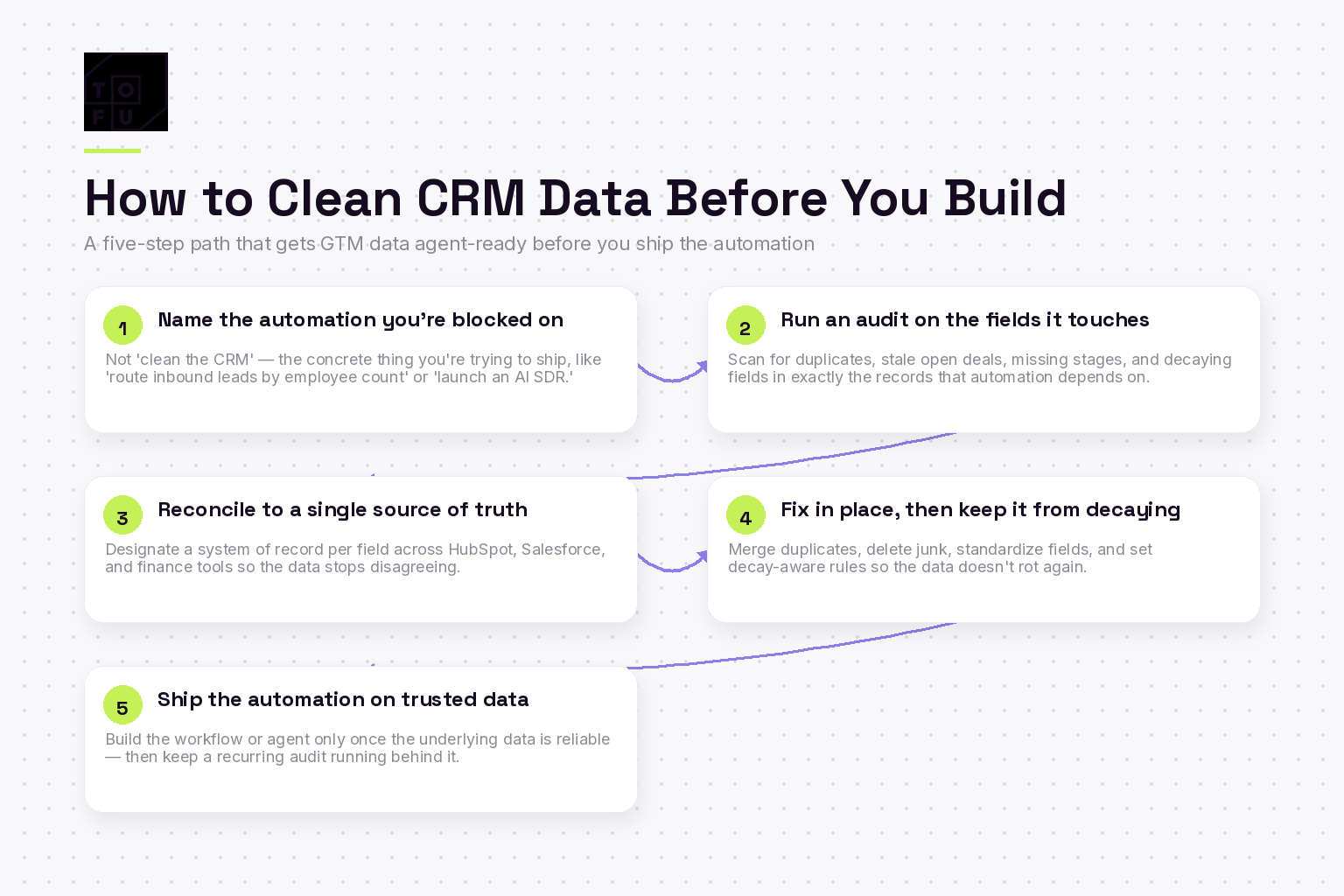
Implementing an AI data agent involves several key steps:
Step 1: Assess Your Data Needs
Evaluate your current data quality issues and determine the specific tasks an AI agent will need to perform. This might include deduplication, field standardization, or decay prevention.
Step 2: Choose the Right AI Data Agent
Select an AI data agent that integrates seamlessly with your existing CRM systems such as Salesforce or HubSpot. Ensure it can handle cross-system data reconciliation if needed.
Step 3: Set Up and Configure the Agent
Work with the vendor to configure the agent according to your data needs. This typically involves setting parameters for data audits, deduplication, and decay prevention.
Step 4: Monitor and Optimize
After deployment, continuously monitor the agent's performance and optimize settings to ensure it is effectively maintaining data quality across your CRM systems.
Last updated: July 13, 2026
Frequently Asked Questions
How much does an AI data agent cost?
AI data agents like Tofu typically offer custom pricing based on the size of your CRM and the complexity of your data needs. Contact the vendor directly for a tailored quote.
Can an AI data agent replace a data engineer?
While AI data agents can handle many routine data quality tasks, they may not replace the need for a data engineer in environments requiring custom data solutions or complex integrations.
What are the benefits of using an AI data agent?
AI data agents provide automated data cleaning, faster deployment, and reduced manual errors, making them ideal for teams looking to quickly prepare data for automations.
How long does it take to implement an AI data agent?
Implementation times vary but typically range from a few days to a few weeks, depending on the complexity of your data and the number of systems involved.
How do AI data agents integrate with existing CRMs?
AI data agents integrate with CRMs like Salesforce and HubSpot through native connectors, allowing them to perform tasks directly within these environments without additional infrastructure.
What skills are needed to manage an AI data agent?
Managing an AI data agent typically requires basic CRM admin skills. Most vendors provide support and training to help teams optimize agent performance.
Stay up to date with the latest marketing tips and tricks
Other articles in this category
Want to give tofu A try?
Request a custom demo to see how Tofu can supercharge your GTM efforts.
ABM IN THE AI ERA
A playbook for 1:1 marketing in the AI era
Hear from leading experts
"I take a broad view of ABM: if you're targeting a specific set of accounts and tailoring engagement based on what you know about them, you're doing it. But most teams are stuck in the old loop: Sales hands Marketing a list, Marketing runs ads, and any response is treated as intent."

"ABM has always been just good marketing. It starts with clarity on your ICP and ends with driving revenue. But the way we get from A to B has changed dramatically."
.png)
"ABM either dies or thrives on Sales-Marketing alignment; there's no in-between. When Marketing runs plays on specific accounts or contacts and Sales isn't doing complementary outreach, the whole thing falls short."

"In our research at 6sense, few marketers view ABM as critical to hitting revenue goals this year. But that's not because ABM doesn't work; it's because most teams haven't implemented it well."
"To me, ABM isn't a campaign; it's a go-to-market operating model. It starts with cross-functional planning: mapping revenue targets, territories, and board priorities."

"With AI, we can personalize not just by account, but by segment, by buying group, and even by individual. That level of precision just wasn't possible a few years ago."
%201%20(1).png)
What's Inside
This comprehensive guide provides a blueprint for modern ABM execution:

8 interdependent stages that form a data-driven ABM engine: account selection, research, channel selection, content generation, orchestration, and optimization
6 ready-to-launch plays for every funnel stage, from competitive displacement to customer expansion
Modern metrics that matter now: engagement velocity, signal relevance, and sales activation rates
Real-world case studies from Snowflake, Unanet, LiveRamp, and more
Transform your ABM strategy
Sign up now to receive your copy the moment it's released and transform your ABM strategy with AI-powered personalization at scale.
Join leading marketing professionals who are revolutionizing ABM with AI