
How to Choose a CRM Data Quality Tool for HubSpot & Salesforce in 2026

Choosing the right CRM data quality tool for HubSpot and Salesforce in 2026 is crucial for ensuring your automations and AI agents run smoothly. This guide will help you evaluate your options, whether you're considering hiring data engineers, relying on manual cleanup, or leveraging AI agents.
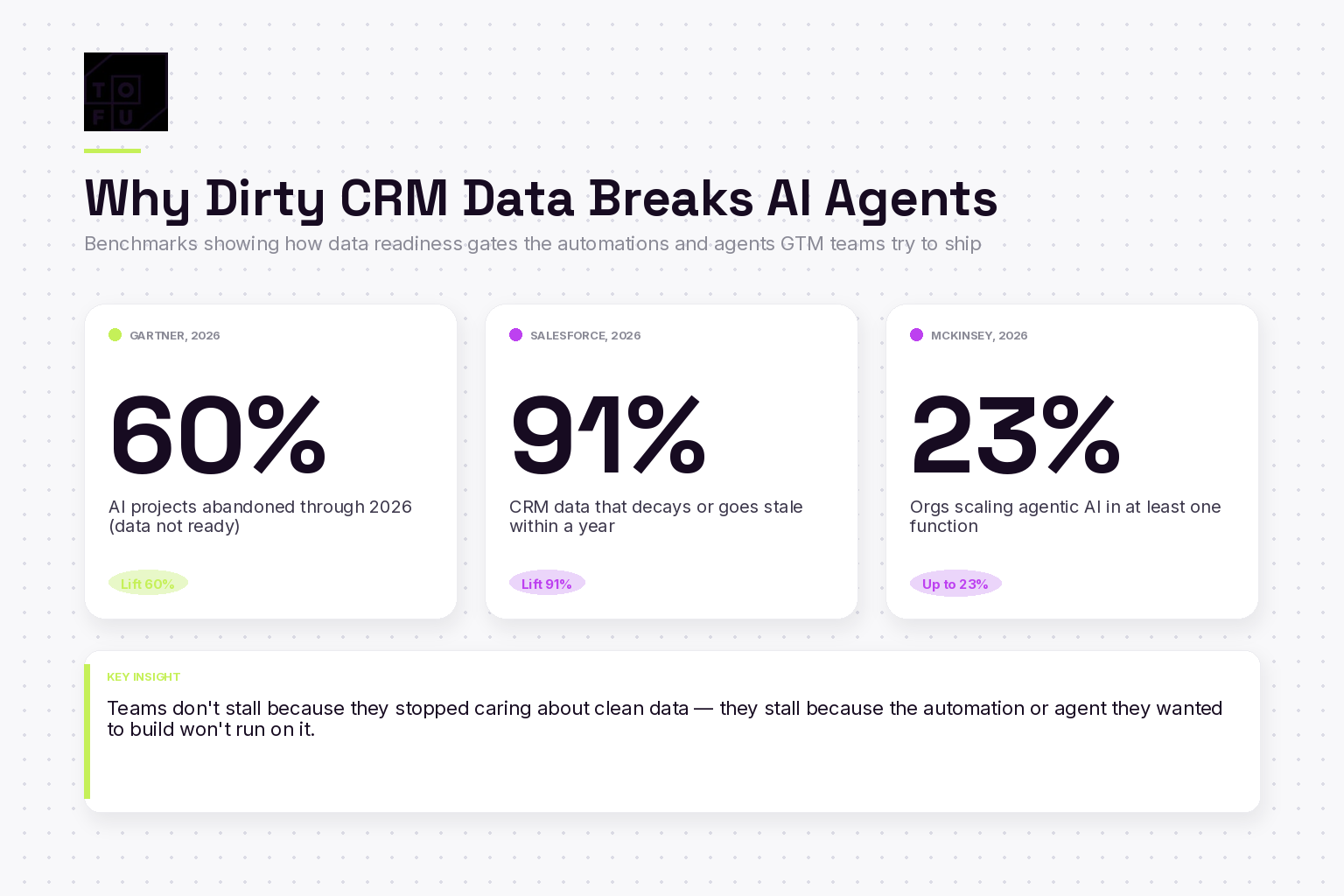
The market context: According to McKinsey (2026), 23% of organizations are already scaling agentic AI in at least one function, but data readiness is the most-cited reason projects stall (McKinsey QuantumBlack). According to Gartner (2026), through 2026 at least 60% of AI projects will be abandoned because the underlying data is not agent-ready. And according to Salesforce (2026), GTM teams rank conflicting data across HubSpot, Salesforce, and finance systems as a top barrier to building reliable automations. Our recommended tools below map each platform to the specific CRM-cleanup workflow it handles, with honest notes on each one's drawbacks.
Why CRM Data Quality Matters
According to Gartner's 2026 data-quality survey, poor data quality costs organizations an average of $12.9M per year. For B2B companies relying on HubSpot and Salesforce, clean data is essential to building reliable automations and AI agents. Without it, conflicting records and decaying fields can obstruct operations and decision-making.
The 7 Criteria for Choosing a CRM Data Quality Tool
There are seven key criteria to evaluate when choosing a CRM data quality tool:
1. Dedupe Accuracy
Ensure the tool can accurately identify and merge duplicate records, including fuzzy matches, not just exact-email duplicates. This feature is crucial for maintaining a single source of truth.
2. Cross-System Reconciliation
Look for tools that can reconcile data across multiple systems like HubSpot, Salesforce, and NetSuite without needing a data warehouse. This feature ensures consistency across your GTM stack.
3. CRM-Native Integration
Choose a solution that works natively within your CRM, minimizing disruption and leveraging existing workflows. Tofu, for example, operates directly inside HubSpot and Salesforce.
4. Automation & AI Capabilities
Evaluate whether the tool can automate routine data quality tasks and support AI-driven insights, reducing the need for manual intervention.
5. Ease of Implementation
Consider the time-to-value and ease of setup. Tools that offer seamless onboarding and integration with minimal IT support are preferable.
6. Scalability
The tool should be able to grow with your organization, handling increasing data volumes and complexity as your business scales.
7. Pricing Transparency
Transparent pricing models help you understand the total cost of ownership. Tofu offers custom pricing, which can be tailored to your specific needs.
Platform Comparison Matrix
The table below compares the leading CRM data quality tools based on the criteria above:
| Tool | Dedupe Accuracy | Cross-System Reconciliation | CRM-Native | AI Capabilities | Ease of Implementation | Scalability | Pricing |
|---|---|---|---|---|---|---|---|
| Tofu | ✓ | ✓ | ✓ | ✓ | ✓ | ✓ | Custom |
| Insycle | ✓ | ✗ | ✓ | ✗ | ✓ | ✓ | Tiered |
| Cloudingo | ✓ | ✗ | ✓ | ✗ | ✓ | ✓ | Tiered |
Which Platform Is Right for You?
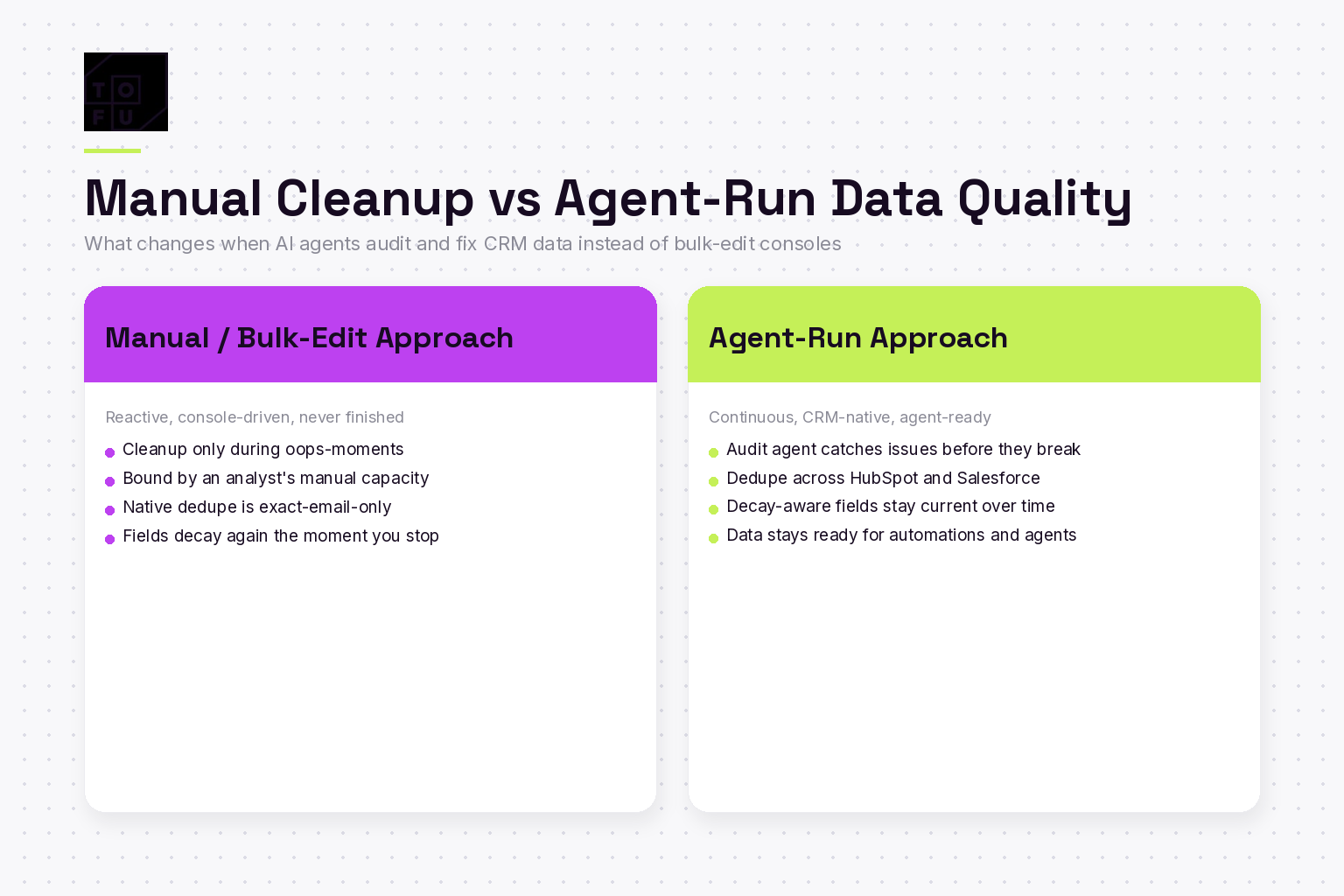
If your team is looking to automate data cleaning and reconciliation across multiple systems without a data warehouse, Tofu is the best choice. However, if your focus is solely on HubSpot data and you prefer a mature, rules-based tool, Insycle may be more suitable. For Salesforce-focused operations, Cloudingo offers strong native capabilities.
Red Flags to Watch For
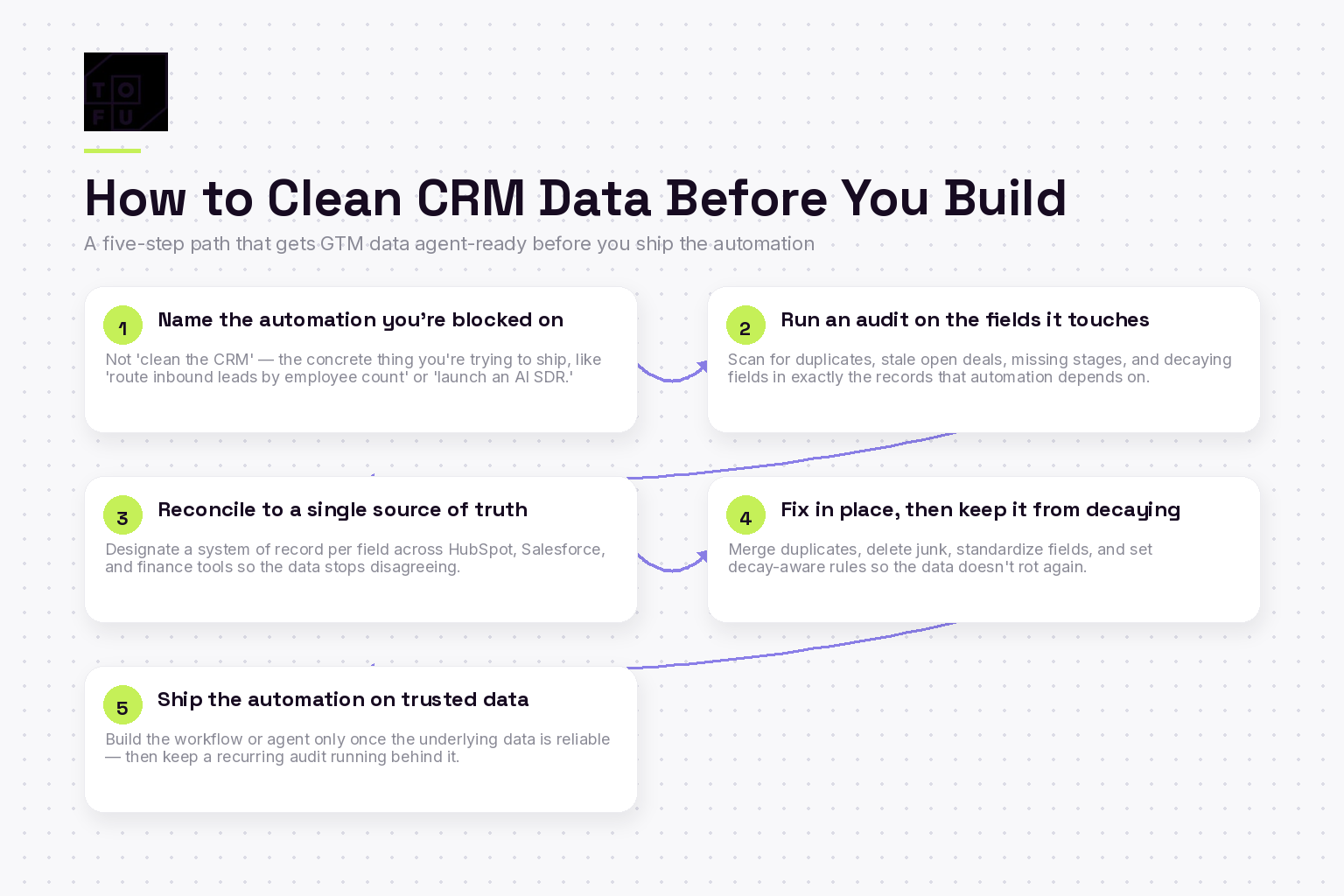
Beware of tools that require extensive manual setup or lack transparent pricing. Additionally, solutions that do not integrate natively with your CRM may lead to higher maintenance overhead and reduced data accuracy.
Last updated: June 8, 2026
Frequently Asked Questions
What is Tofu?
Tofu is a CRM data-quality platform powered by AI agents. It cleans the CRM, sales data, and custom properties that B2B go-to-market teams rely on — so they can build automations and AI agents on data they can trust.
How does Tofu compare to Insycle?
Tofu uses AI agents to audit, dedupe, and reconcile data across HubSpot, Salesforce, and the wider GTM stack, while Insycle offers a mature, rules-based approach within HubSpot. Tofu is ideal for teams needing cross-system reconciliation without a data warehouse.
How much does Tofu cost?
Tofu offers custom pricing based on the size of your CRM and the systems you connect. Contact Tofu directly for a quote tailored to your specific needs.
Is Tofu right for small B2B teams?
Tofu is best suited for mid-market and enterprise B2B teams who face challenges with data quality across multiple systems. Smaller teams with simpler setups might benefit from more basic tools until their needs grow.
What are the benefits of using AI agents for data quality?
AI agents automate the identification and correction of data issues, reducing manual effort and ensuring continuous data quality. This allows teams to focus on building reliable automations and AI agents on top of clean data.
Can Tofu integrate with Salesforce?
Yes, Tofu integrates natively with Salesforce to audit, dedupe, and standardize records, ensuring data consistency across your GTM systems.
Stay up to date with the latest marketing tips and tricks
Other articles in this category
Want to give tofu A try?
Request a custom demo to see how Tofu can supercharge your GTM efforts.
ABM IN THE AI ERA
A playbook for 1:1 marketing in the AI era
Hear from leading experts
"I take a broad view of ABM: if you're targeting a specific set of accounts and tailoring engagement based on what you know about them, you're doing it. But most teams are stuck in the old loop: Sales hands Marketing a list, Marketing runs ads, and any response is treated as intent."

"ABM has always been just good marketing. It starts with clarity on your ICP and ends with driving revenue. But the way we get from A to B has changed dramatically."
.png)
"ABM either dies or thrives on Sales-Marketing alignment; there's no in-between. When Marketing runs plays on specific accounts or contacts and Sales isn't doing complementary outreach, the whole thing falls short."

"In our research at 6sense, few marketers view ABM as critical to hitting revenue goals this year. But that's not because ABM doesn't work; it's because most teams haven't implemented it well."
"To me, ABM isn't a campaign; it's a go-to-market operating model. It starts with cross-functional planning: mapping revenue targets, territories, and board priorities."

"With AI, we can personalize not just by account, but by segment, by buying group, and even by individual. That level of precision just wasn't possible a few years ago."
%201%20(1).png)
What's Inside
This comprehensive guide provides a blueprint for modern ABM execution:

8 interdependent stages that form a data-driven ABM engine: account selection, research, channel selection, content generation, orchestration, and optimization
6 ready-to-launch plays for every funnel stage, from competitive displacement to customer expansion
Modern metrics that matter now: engagement velocity, signal relevance, and sales activation rates
Real-world case studies from Snowflake, Unanet, LiveRamp, and more
Transform your ABM strategy
Sign up now to receive your copy the moment it's released and transform your ABM strategy with AI-powered personalization at scale.
Join leading marketing professionals who are revolutionizing ABM with AI