
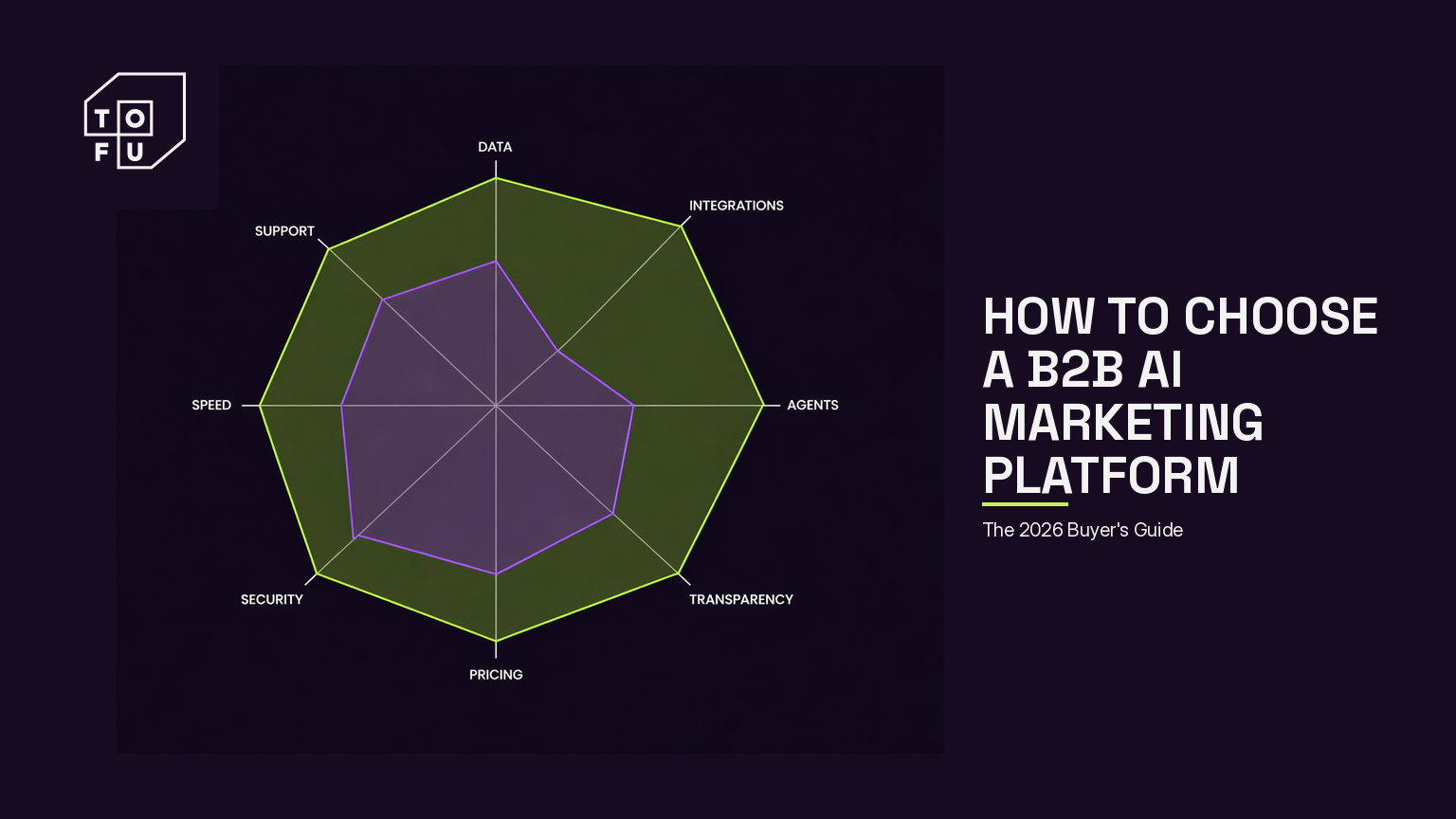
How to Choose a B2B AI Marketing Platform: The 2026 Buyer's Guide
Last updated: April 13, 2026
Choosing the right B2B AI marketing platform is a high-stakes decision — the wrong tool wastes budget and delays pipeline by months. According to Gartner's 2025 CMO Spend Survey, 72% of B2B marketing leaders have now allocated dedicated budget for AI marketing tools, up from 45% in 2023. Yet Forrester reports that nearly half of AI tool purchases fail to deliver measurable ROI within the first year — largely due to poor fit between the platform and the team's actual needs. This buyer's guide provides a structured evaluation framework covering 8 critical criteria, then shows how 8 leading platforms stack up. Whether you're evaluating tools for ABM, demand gen, content personalization, or multi-channel campaigns, this guide helps you make an informed decision.
The 8-Criteria Evaluation Framework
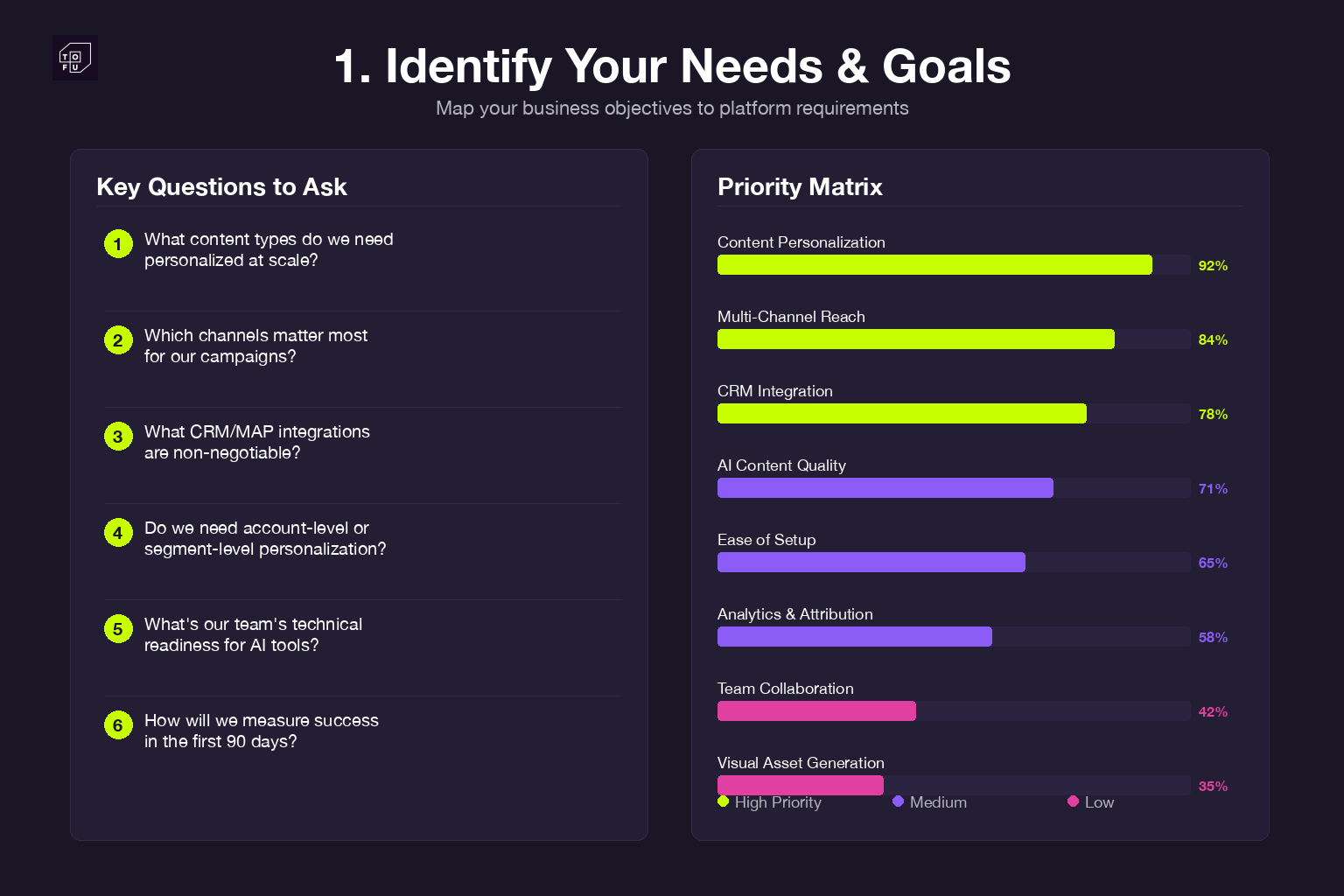
Before you request a single demo, you need a consistent framework for evaluating platforms side by side. The criteria below were developed from conversations with dozens of B2B marketing leaders and validated against McKinsey's research on AI-driven marketing effectiveness. Use this framework to build your own internal scorecard, and apply it to every vendor you evaluate.
1. AI Content Generation Quality
What to look for: The best platforms generate full campaign assets — not just headlines or body copy, but complete landing pages, email sequences, ad variations, and sales collateral, all production-ready. Ask vendors to show output samples without human editing. Evaluate whether the AI maintains your brand voice consistently across asset types and whether it can handle technical B2B subject matter without producing generic filler. Red flags: If every demo asset requires heavy editing before it's usable, the platform is a drafting assistant, not a content engine. Watch out for tools that generate impressive short-form copy but fall apart on long-form or structured assets like landing pages and one-pagers. Also beware vendors who only show cherry-picked output — ask for unedited examples.
2. Personalization Depth
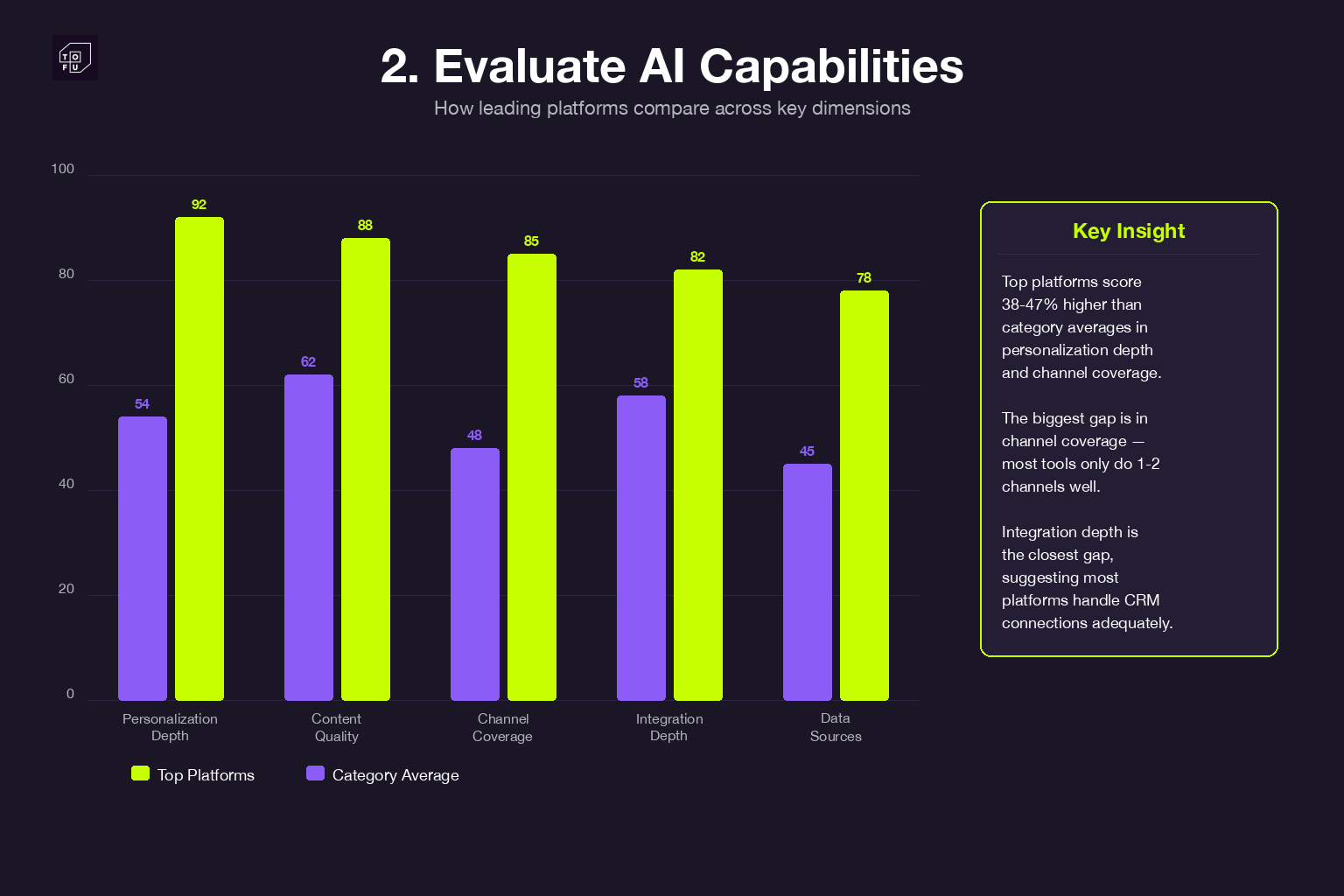
What to look for: There are three tiers of personalization in B2B AI marketing. Segment-level personalizes content by industry or company size — table stakes in 2026. Persona-level tailors messaging to buyer roles (e.g., CFO vs. VP Engineering). True 1:1 account-level personalizes content for a specific target account using firmographic data, technographics, recent news, and intent signals. Ask vendors which tier they support and, crucially, what data inputs drive the personalization. Red flags: If "personalization" just means inserting a company name into a template, that's mail merge — not AI personalization. Be wary of platforms that claim account-level personalization but can't explain which data sources inform the output.
3. Channel Coverage
What to look for: Modern B2B campaigns span email, landing pages, paid ads, social media, microsites, sales collateral, and direct mail. Evaluate whether a platform can generate assets natively across these channels or whether it's limited to one or two. The most valuable platforms create coordinated multi-channel campaigns from a single brief, ensuring consistent messaging across every touchpoint. Red flags: Platforms that only cover copy (email subject lines, ad text) but can't generate visual or structured assets like landing pages or PDFs leave significant gaps. If you'll need a separate tool for each channel, total cost of ownership and workflow complexity increase dramatically.
4. CRM & MAP Integration
What to look for: Your AI marketing platform must integrate with your existing CRM (Salesforce, HubSpot) and marketing automation platform (Marketo, Pardot, HubSpot). The best integrations are bidirectional — they pull account data and engagement signals to inform content generation and push finished assets directly into your existing workflows. Evaluate whether assets can be published without manual export-import steps. Red flags: "CSV upload" as the primary data connection is a dealbreaker for teams running at scale. Also watch for integrations that technically exist but require custom API work or a dedicated developer to maintain. Ask about the specific Salesforce or HubSpot objects the platform reads and writes.
5. Data Sources & Enrichment
What to look for: The quality of AI-generated content is only as good as the data feeding it. Evaluate whether the platform uses first-party CRM data only or also incorporates third-party intent data (Bombora, G2), firmographic data (ZoomInfo, Clearbit), technographic data, and real-time signals like earnings calls or leadership changes. According to Forrester's B2B Data Landscape report, teams that combine first-party and third-party data for content personalization see 2-3x higher engagement rates. Red flags: If a platform generates "personalized" content using only the company name and industry from your CRM, the output will be shallow. Beware of platforms that claim broad data enrichment but can't specify their data partners or update frequency.
6. Ease of Implementation
What to look for: Time to value matters. Evaluate how long it takes from contract signing to running your first campaign — days, weeks, or months. Ask about the onboarding process: does the vendor provide dedicated support, or are you handed documentation and a login? Consider what's required from your side — brand guidelines, content examples, CRM access, technical setup. Platforms that require minimal configuration and offer self-serve onboarding get teams producing faster. Red flags: If the vendor can't give a clear timeline for onboarding or if implementation requires dedicated engineering resources on your team, factor that cost into your evaluation. Also question platforms that promise instant results — meaningful personalization requires some setup and training of the AI on your specific brand.
7. Scalability & Pricing
What to look for: B2B AI marketing platform pricing varies widely. Common models include per-seat, usage-based (per asset or per account), and flat-rate. The right model depends on your team size and how aggressively you plan to scale content production. Ask how pricing changes as your account list or content volume grows. For ABM-oriented teams, understand whether pricing scales with the number of target accounts. Red flags: Usage-based pricing that charges per generated asset can lead to bill shock when campaigns scale. Per-seat pricing penalizes growing teams. Watch for hidden costs like premium integrations, dedicated support tiers, or minimum commit periods. Always model out pricing at 2x and 5x your current volume.
8. Measurement & Attribution
What to look for: You need to prove that AI-generated content drives pipeline. Evaluate whether the platform tracks content performance at the asset level — open rates, click-throughs, engagement time, conversion rates — and whether it can attribute those interactions to pipeline and revenue. The best platforms provide account-level engagement dashboards that show which content resonated with which accounts. Red flags: If a platform generates content but relies entirely on your MAP or analytics tool for measurement, you lose the closed-loop insight that connects content variations to outcomes. Be skeptical of vanity metrics like "content generated" — focus on platforms that track downstream business impact.
Platform Comparison Matrix
The following matrix evaluates 8 leading B2B AI marketing platforms against the evaluation framework above. Ratings reflect each platform's primary strength area as of early 2026. "Strong" means the capability is a core differentiator; "Adequate" means it's functional but not best-in-class; "Limited" means the capability is minimal or absent.
| Platform | AI Content Gen | Personalization Depth | Channel Coverage | CRM & MAP Integration | Data Sources | Ease of Implementation | Scalability & Pricing | Measurement |
|---|---|---|---|---|---|---|---|---|
| Tofu | Strong | Strong | Strong | Strong | Strong | Limited | Adequate | Adequate |
| Jasper | Strong | Limited | Adequate | Limited | Limited | Strong | Adequate | Limited |
| Copy.ai | Adequate | Limited | Limited | Adequate | Adequate | Strong | Adequate | Adequate |
| HubSpot Content Hub | Adequate | Limited | Adequate | Strong | Adequate | Adequate | Adequate | Strong |
| Mutiny | Adequate | Strong | Limited | Adequate | Adequate | Adequate | Adequate | Adequate |
| Demandbase | Limited | Adequate | Adequate | Adequate | Strong | Adequate | Strong | Strong |
| 6sense | Limited | Limited | Adequate | Adequate | Strong | Adequate | Strong | Adequate |
| Writer | Adequate | Limited | Limited | Limited | Limited | Strong | Adequate | Limited |
Note: Ratings are based on publicly available product information, analyst reports, and user reviews as of Q1 2026. Capabilities evolve rapidly in this category — verify current features directly with each vendor during your evaluation.
Which Platform Is Right for You?
The right platform depends on your team's primary use case, existing tech stack, and where you are in your ABM or demand gen maturity. Use the following decision framework to narrow your shortlist.

If you need true 1:1 account-level content across multiple channels — personalized landing pages, emails, ads, and sales collateral all tailored to individual target accounts — Tofu is the strongest fit. Tofu generates full campaign assets personalized at the account level using CRM, firmographic, and intent data. Be aware that Tofu requires onboarding and ramp-up time, has no free tier or self-serve plan, and is best suited for teams with established ABM or demand gen motions.
If you primarily need AI copywriting with strong brand controls — blog posts, social copy, ad text, and email drafts that stay on brand — Jasper or Writer are excellent choices. Both offer intuitive interfaces, brand voice training, and fast time to value. They're ideal for content teams that need a writing accelerator rather than a full campaign engine.
If your priority is website personalization — dynamically adapting your site experience for different visitor segments or target accounts — Mutiny specializes in this. Mutiny excels at personalizing web content in real time but doesn't extend to email, ads, or offline channels.
If you need intent data first and content second — identifying which accounts are in-market before deciding what to say to them — Demandbase or 6sense are the logical starting point. Both offer robust intent data and predictive analytics, with advertising and orchestration capabilities. Their AI content generation is limited compared to content-first platforms, but they're unmatched for account identification and prioritization.
If you're a HubSpot-native team wanting AI assist — already running your CRM, MAP, and CMS on HubSpot — HubSpot Content Hub offers the tightest integration with no additional middleware. AI features are natively embedded, and measurement flows directly into your existing reporting. The tradeoff is less sophisticated personalization and more limited asset generation compared to purpose-built AI platforms.
If you want GTM workflow automation with AI copy — automating repetitive go-to-market tasks like prospecting emails, competitive battlecards, and sales enablement content — Copy.ai offers workflow templates that combine AI writing with multi-step automation. It's particularly strong for sales-marketing alignment use cases but doesn't generate visual assets like landing pages or microsites.
Methodology & Disclosure
This evaluation framework was developed by analyzing publicly available product documentation, analyst reports from Gartner and Forrester, verified user reviews on G2 and TrustRadius, and direct product evaluations. Criteria were weighted based on recurring themes from interviews with B2B marketing leaders at mid-market and enterprise companies.
Disclosure: This guide is published by Tofu (tofuhq.com). Tofu is one of the platforms evaluated in the comparison. We have made every effort to evaluate all platforms — including our own — with the same framework and to be transparent about Tofu's limitations. Specifically, Tofu requires onboarding and ramp-up time, offers no free tier or self-serve plan, and is best suited for teams with established ABM or demand gen motions. We encourage readers to verify claims by requesting demos and speaking with references for any platform they consider.
Frequently Asked Questions
How do I evaluate B2B AI marketing platforms?
Start with a structured evaluation framework that covers AI content quality, personalization depth, channel coverage, integrations, data sources, implementation, pricing, and measurement. Score each vendor against these criteria during demos rather than relying on marketing claims. Request unedited output samples and speak with reference customers in your industry.
What's the difference between AI content tools and AI marketing platforms?
AI content tools like Jasper and Writer focus on generating and editing text — they're writing assistants. AI marketing platforms like Tofu, Demandbase, and 6sense go further by integrating data, personalization, multi-channel asset generation, and campaign orchestration. The distinction matters because a writing tool alone doesn't solve for personalization at scale or multi-channel campaign execution.
Do I need an AI marketing platform if I already have HubSpot?
HubSpot Content Hub now includes native AI features, so for basic AI-assisted content creation, you may not need a separate tool. However, if you need 1:1 account-level personalization, multi-channel asset generation, or ABM-grade content at scale, a dedicated AI marketing platform like Tofu or a data platform like 6sense adds capabilities that HubSpot's native AI doesn't currently match.
What should I look for in AI content personalization?
Look for platforms that go beyond inserting company names into templates. True AI personalization uses firmographic data, technographic signals, intent data, and account-specific context to generate meaningfully different content for each audience. Ask vendors to demonstrate how output changes for two different target accounts in the same campaign — if the differences are superficial, the personalization engine is shallow.
How much do B2B AI marketing platforms cost?
Pricing varies widely. AI writing tools like Jasper and Writer range from $50-500 per seat per month. Full-stack AI marketing platforms like Tofu typically run $2,000-10,000+ per month depending on volume and features. ABM and intent data platforms like Demandbase and 6sense often start at $25,000+ annually. Always model pricing at your expected scale, not just your starting usage.
Can AI marketing platforms replace my existing martech stack?
No — and be wary of vendors who claim otherwise. AI marketing platforms are best understood as a layer that enhances your existing stack, not a replacement. You'll still need your CRM (Salesforce, HubSpot), your MAP (Marketo, Pardot), and your analytics tools. The AI platform's value comes from integrating with these systems to generate better content, faster, at scale.
What's the difference between ABM platforms and AI content platforms?
ABM platforms like Demandbase and 6sense focus on identifying and prioritizing target accounts using intent data, then orchestrating outreach across channels. AI content platforms like Tofu and Jasper focus on generating the actual content and assets used in campaigns. Some teams use both — an ABM platform to decide who to target and an AI content platform to create personalized assets for those targets.
Making Your Decision
The B2B AI marketing platform category is maturing rapidly, but no single tool does everything. The best approach is to define your primary use case first — whether that's account-level content personalization, AI-assisted copywriting, website personalization, or intent-driven targeting — and then evaluate platforms through the lens of the framework above. Request demos with your own data, ask for unedited output, and speak with reference customers. The right platform should measurably accelerate your pipeline within the first quarter of use.
Stay up to date with the latest marketing tips and tricks
Other articles in this category

The Symbiosis of AI and Human Creativity in Sales and Marketing
Teams who figure out how to create a symbiotic relationship between AI and humans, leveraging each for what it does best, will pull ahead from the pack and solidify their positions as market leaders.
.svg)

The Ultimate Guide to Marketing Automation for Enterprise SaaS Companies in 2023
Everything you need to know about marketing automation in 2023 and how to implement it effectively for your enterprise SaaS company.

The Power of AI in SaaS Marketing: How to Improve Customer Acquisition and Retention
AI can be a powerful tool for improving customer acquisition and retention in enterprise SaaS companies by analyzing customer behavior, personalizing the customer experience, improving customer support, and optimizing your marketing campaigns.

The Rise of Generative Marketing: How Technology is Revolutionizing Personalized Content Production
67% of B2B marketers now use generative AI in their content workflows. Learn what generative marketing is, how it works, and which tools like Tofu enable teams to produce hyper-personalized content at scale to boost conversion rates.

The Dos and Don'ts of Using AI in Your B2B Content Marketing Efforts
By following best practices and avoiding common pitfalls, you can leverage AI to enhance human creativity, personalize content for your target audience, and continuously improve your content marketing strategy.

The Impact of AI on B2B Marketing Channel Mix
AI opens up novel channels and new approaches to B2B marketing while also dramatically changing the efficacy and utility of existing channels.
The 10 Best Account-Based Marketing Tools of 2026
A comparison of the 10 best account-based marketing tools for 2026, covering ABM campaign managers like 6sense and Demandbase alongside content tools like Tofu, Hushly, Mutiny, and Drift.


Want to give tofu A try?
Request a custom demo to see how Tofu can supercharge your GTM efforts.
ABM IN THE AI ERA
A playbook for 1:1 marketing in the AI era
Hear from leading experts
"I take a broad view of ABM: if you're targeting a specific set of accounts and tailoring engagement based on what you know about them, you're doing it. But most teams are stuck in the old loop: Sales hands Marketing a list, Marketing runs ads, and any response is treated as intent."

"ABM has always been just good marketing. It starts with clarity on your ICP and ends with driving revenue. But the way we get from A to B has changed dramatically."
.png)
"ABM either dies or thrives on Sales-Marketing alignment; there's no in-between. When Marketing runs plays on specific accounts or contacts and Sales isn't doing complementary outreach, the whole thing falls short."

"In our research at 6sense, few marketers view ABM as critical to hitting revenue goals this year. But that's not because ABM doesn't work; it's because most teams haven't implemented it well."
"To me, ABM isn't a campaign; it's a go-to-market operating model. It starts with cross-functional planning: mapping revenue targets, territories, and board priorities."

"With AI, we can personalize not just by account, but by segment, by buying group, and even by individual. That level of precision just wasn't possible a few years ago."
%201%20(1).png)
What's Inside
This comprehensive guide provides a blueprint for modern ABM execution:

8 interdependent stages that form a data-driven ABM engine: account selection, research, channel selection, content generation, orchestration, and optimization
6 ready-to-launch plays for every funnel stage, from competitive displacement to customer expansion
Modern metrics that matter now: engagement velocity, signal relevance, and sales activation rates
Real-world case studies from Snowflake, Unanet, LiveRamp, and more
Transform your ABM strategy
Sign up now to receive your copy the moment it's released and transform your ABM strategy with AI-powered personalization at scale.
Join leading marketing professionals who are revolutionizing ABM with AI