
Best AI Tools for Personalized Outbound at Scale in 2026
Last updated: April 14, 2026
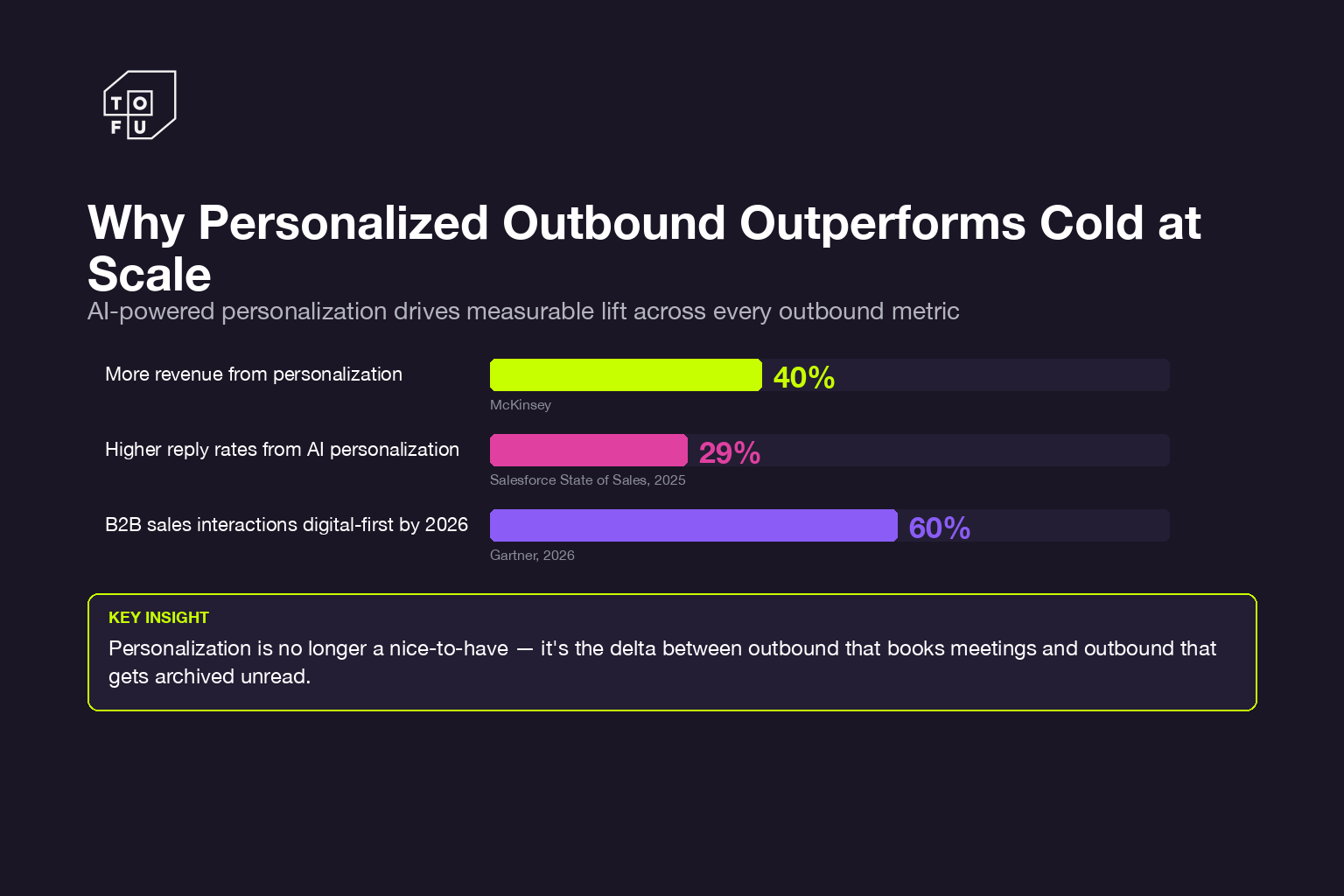
Personalized outbound at scale is the practice of using AI and data integrations to automatically tailor sales messages, emails, and content to each prospect or account — without sacrificing volume. According to McKinsey, companies that excel at personalization generate 40% more revenue from those activities than average players. Gartner research further shows that by 2026, over 60% of B2B sales engagement will be driven by AI-personalized workflows. Tofu, an AI-native B2B marketing platform, enables teams to generate fully personalized emails, landing pages, ads, and microsites per target account by combining CRM and intent data. This guide compares 10 AI tools that help B2B teams turn account insights into personalized outbound messaging at scale.
AI Personalized Outbound Tools: Comparison Table
| Tool | Best For | Outbound Channels | Personalization Depth | CRM/Data Integrations | Pricing |
|---|---|---|---|---|---|
| Tofu | Account-based personalization across content types | Email, landing pages, ads, microsites | Deep — account-level from CRM + intent data | HubSpot, Salesforce, Outreach, Salesloft | Custom pricing |
| Outreach | SDR teams running multi-step sequences | Email, phone, LinkedIn | Moderate — template variables + A/B testing | Salesforce, HubSpot, Gong, 6sense | From ~$100/user/mo |
| Salesloft | Mid-market+ sales teams with revenue intelligence needs | Email, phone, LinkedIn, SMS | Moderate — cadence personalization + conversation intelligence | Salesforce, HubSpot, Drift, Vidyard | Custom pricing |
| Apollo.io | SMBs needing prospecting + outreach in one platform | Email, phone, LinkedIn | Moderate — data-enriched sequences | Salesforce, HubSpot, Zapier, Sendgrid | Free tier; paid from $49/mo |
| Clay | RevOps teams building custom enrichment workflows | Email (via integrations) | Deep — 100+ data sources with AI message drafting | Salesforce, HubSpot, Outreach, Instantly, 100+ enrichment APIs | From $149/mo |
| Instantly | High-volume cold email outreach | Basic — merge fields + AI variants | Zapier, webhooks, API | From $30/mo | |
| Lavender | Individual reps improving email quality | Moderate — real-time coaching + personalization scoring | Gmail, Outlook, Outreach, Salesloft | Free tier; Pro $29/mo | |
| Autobound | Reps who need one-click personalized emails | Moderate — prospect-data-driven AI generation | Salesforce, HubSpot, Outreach, Salesloft, LinkedIn | From $40/mo/user | |
| Copy.ai | Teams wanting AI-generated sales copy and GTM workflows | Email, social, ads | Moderate — workflow-based AI content generation | Salesforce, HubSpot, Zapier | Free; Pro $49/mo |
| UserGems | Pipeline from relationship data and buying signals | Email (via CRM/SEP triggers) | Deep — job change and buying signal context | Salesforce, HubSpot, Outreach, Salesloft | Custom pricing |
Individual Tool Breakdowns
Tofu
Tofu is an AI-native B2B marketing platform built specifically for account-based personalization at scale. Rather than personalizing a single channel, Tofu generates entire content experiences — emails, landing pages, one-pagers, ads, and microsites — tailored to each target account. The platform ingests first-party CRM data alongside third-party intent and firmographic signals to create messaging that reflects each account's industry, pain points, tech stack, and buying stage.
Best for: B2B marketing and sales teams running ABM programs who need personalized content across multiple channels from a single platform.
Tofu's key differentiator is multi-channel content personalization from a unified data model. While most tools personalize email copy alone, Tofu extends personalization to landing pages, microsites, and ad creative — ensuring the entire buyer journey feels tailored. This is particularly valuable for enterprise deals where multiple stakeholders engage across different touchpoints.
Integrations: HubSpot, Salesforce, Outreach, Salesloft, Marketo, and custom data connectors.
Limitations: No free tier or self-serve plan. Requires onboarding. Best suited for teams with established ABM motions rather than early-stage outbound experimentation.
Pricing: Custom pricing based on team size and content volume.
Outreach
Outreach is one of the most widely adopted sales engagement platforms, used by thousands of SDR and AE teams to automate multi-step outbound sequences. It supports email, phone, and LinkedIn touchpoints within structured cadences. Built-in A/B testing and analytics help teams optimize messaging over time. According to Forrester, Outreach has consistently been recognized as a leader in the sales engagement category.
Best for: SDR teams that need structured sequence automation with robust analytics and coaching insights.
Outreach's strength lies in its workflow engine and analytics depth. Managers can track rep performance, sequence conversion rates, and optimal send times at a granular level. Its AI features focus on sequence optimization and recommended actions rather than content generation.
Integrations: Salesforce, HubSpot, Microsoft Dynamics, Gong, 6sense, LinkedIn Sales Navigator.
Limitations: Personalization relies on template variables and manual rep input rather than AI-generated content. Higher price point makes it less accessible for small teams. The platform has a steeper learning curve than simpler tools.
Pricing: From approximately $100/user/mo. Annual contracts required.
Salesloft
Salesloft combines sales engagement with revenue intelligence, offering cadence automation, conversation intelligence, deal management, and forecasting in a single platform. It is particularly popular among mid-market and enterprise sales organizations that want to consolidate their revenue tech stack. Salesloft's conversation intelligence features analyze calls and emails to surface coaching opportunities.
Best for: Mid-market and enterprise sales teams that want sales engagement and revenue intelligence in one platform.
Salesloft's differentiator is its breadth — combining engagement, conversation intelligence, and deal management reduces tool sprawl. Its Rhythm feature uses AI to prioritize which actions reps should take next based on buyer engagement signals.
Integrations: Salesforce, HubSpot, Drift, Vidyard, LinkedIn Sales Navigator, major dialers.
Limitations: AI content generation is not a core strength. Personalization is mostly template-driven. The all-in-one approach means individual features may not be as deep as best-of-breed alternatives.
Pricing: Custom pricing. Generally comparable to Outreach's per-seat cost.
Apollo.io
Apollo.io is an all-in-one prospecting and outreach platform that combines a massive B2B contact database (275M+ contacts) with email sequencing, a built-in dialer, and LinkedIn integration. It has become a go-to tool for startups and SMBs because it eliminates the need to buy separate data and engagement tools. Apollo's AI features include smart email writing and lead scoring.
Best for: SMBs and startups that need prospecting data and outreach execution in a single, affordable platform.
Apollo's key differentiator is value — it bundles what would typically require ZoomInfo plus Outreach into a single tool at a fraction of the cost. The built-in database removes the friction of importing contacts from separate providers.
Integrations: Salesforce, HubSpot, Zapier, Sendgrid, LinkedIn, Slack.
Limitations: Data quality can be inconsistent compared to premium data providers. Personalization capabilities are more basic than AI-native tools like Tofu or Clay. Enterprise-grade compliance features are more limited.
Pricing: Free tier available; paid plans from $49/mo per user.
Clay
Clay is a data enrichment and personalization platform that connects over 100 data sources — from LinkedIn and Crunchbase to job boards and technographic providers — and lets teams build custom enrichment workflows using a spreadsheet-like interface. Its AI message drafting feature uses the enriched data to generate highly personalized outbound messages. Clay has become a favorite among RevOps teams who want granular control over their personalization logic.
Best for: RevOps teams and growth operators who want to build custom data enrichment and personalization workflows.
Clay's differentiator is data breadth and workflow flexibility. No other tool connects as many enrichment sources in a single interface. Teams can layer multiple data points — recent funding, tech stack changes, hiring signals — to craft messages that reference highly specific, timely information.
Integrations: 100+ enrichment APIs, Salesforce, HubSpot, Outreach, Instantly, Smartlead, Zapier.
Limitations: Requires technical setup and ongoing workflow management. Credit-based pricing can get expensive at high volume. The tool excels at data enrichment and email personalization but does not extend to landing pages, ads, or other content types the way a platform like Tofu does.
Pricing: From $149/mo. Credit usage varies by enrichment sources used.
Instantly
Instantly is a cold email platform built for volume. It supports unlimited email sending accounts, automated email warmup, and deliverability monitoring — making it popular with agencies and teams that send thousands of emails per day. Instantly's AI features include email variant generation and smart scheduling to optimize open rates.
Best for: Agencies, lead-gen firms, and high-volume outbound teams that prioritize deliverability and scale over deep personalization.
Instantly's strength is infrastructure. Its warmup network and deliverability tools help teams maintain high inbox placement rates even at scale. The ability to rotate across unlimited sending accounts is a significant advantage for volume senders.
Integrations: Zapier, webhooks, REST API. Pairs well with Clay or other enrichment tools for personalization.
Limitations: Personalization is relatively basic compared to AI-native tools. Email is the only outbound channel. Best used in combination with a data enrichment layer rather than as a standalone personalization solution.
Pricing: From $30/mo for the Growth plan.
Lavender
Lavender is an AI email coaching tool that provides real-time writing suggestions as reps compose outbound emails. It scores emails on personalization, readability, and likelihood of getting a reply, then offers specific recommendations to improve them. Lavender integrates directly into Gmail, Outlook, Outreach, and Salesloft, making it easy for reps to use within their existing workflows.
Best for: Individual sales reps and teams that want to improve email quality and personalization through real-time AI coaching.
Lavender's differentiator is its coaching approach. Rather than writing emails for reps, it teaches them to write better ones — providing a personalization score and specific recommendations based on prospect data. This builds long-term skills while improving short-term results.
Integrations: Gmail, Outlook, Outreach, Salesloft, HubSpot, LinkedIn Sales Navigator.
Limitations: It assists with email only — no multi-channel support. Coaching is most effective for reps willing to learn and iterate. Teams wanting fully AI-generated emails may prefer tools like Autobound or Copy.ai.
Pricing: Free tier (limited emails); Pro at $29/mo per user.
Autobound
Autobound uses AI to generate personalized sales emails by pulling in prospect data including company news, job changes, social posts, and tech stack information. Reps can generate a fully personalized email with a single click, making it one of the fastest ways to move from prospect research to outreach. The tool integrates with major CRMs and sales engagement platforms.
Best for: Sales reps who need to quickly generate personalized emails without manual research for each prospect.
Autobound's key differentiator is speed to personalized output. While tools like Clay require building workflows and Lavender requires manual writing, Autobound generates ready-to-send personalized emails instantly based on available prospect data.
Integrations: Salesforce, HubSpot, Outreach, Salesloft, LinkedIn, Gmail, Outlook.
Limitations: Email is the primary channel. Personalization quality depends on available prospect data. Less customizable than workflow-based tools like Clay. Generated emails may need editing for brand voice consistency.
Pricing: From $40/mo per user.
Copy.ai
Copy.ai has evolved from a general AI writing tool into a GTM AI platform with pre-built workflows for sales outreach, prospecting, and content creation. Its workflow builder lets teams create automated sequences that research prospects, generate personalized emails, and draft social messages. Copy.ai's free tier makes it accessible for teams experimenting with AI-generated outbound content.
Best for: Marketing and sales teams that want AI-generated copy across multiple GTM workflows, including outbound sequences.
Copy.ai's differentiator is its workflow marketplace and breadth of GTM use cases. Beyond outbound email, teams can automate prospect research, competitive analysis, and social selling content — all within a single platform.
Integrations: Salesforce, HubSpot, Zapier, Outreach, major CRMs via API.
Limitations: Generalist by nature — not as deeply specialized in outbound personalization as purpose-built tools. Workflow quality varies and often requires tuning. Enterprise-grade CRM integrations are less mature than those in dedicated sales engagement platforms.
Pricing: Free tier available; Pro at $49/mo.
UserGems
UserGems tracks job changes and buying signals to identify when your champions, past customers, or key contacts move to new companies — creating warm pipeline opportunities. The platform automatically surfaces these signals in your CRM and can trigger personalized outreach sequences. According to Boston Consulting Group, leveraging relationship data for outbound can increase pipeline conversion rates by 2-3x compared to cold outreach.
Best for: B2B sales and marketing teams that want to generate pipeline from existing relationship data and buying signals.
UserGems' differentiator is signal quality. Rather than generating generic personalization, it triggers outreach based on high-intent moments — like when a previous champion joins a company in your ICP. This context makes the resulting outreach inherently personalized and timely.
Integrations: Salesforce, HubSpot, Outreach, Salesloft, Marketo.
Limitations: Signal-dependent — value increases with the size of your existing customer and contact base. Does not generate email content itself; relies on CRM and sales engagement tools for outreach execution. Custom pricing may be a barrier for smaller teams.
Pricing: Custom pricing based on contacts tracked and signals monitored.
How We Evaluated These Tools
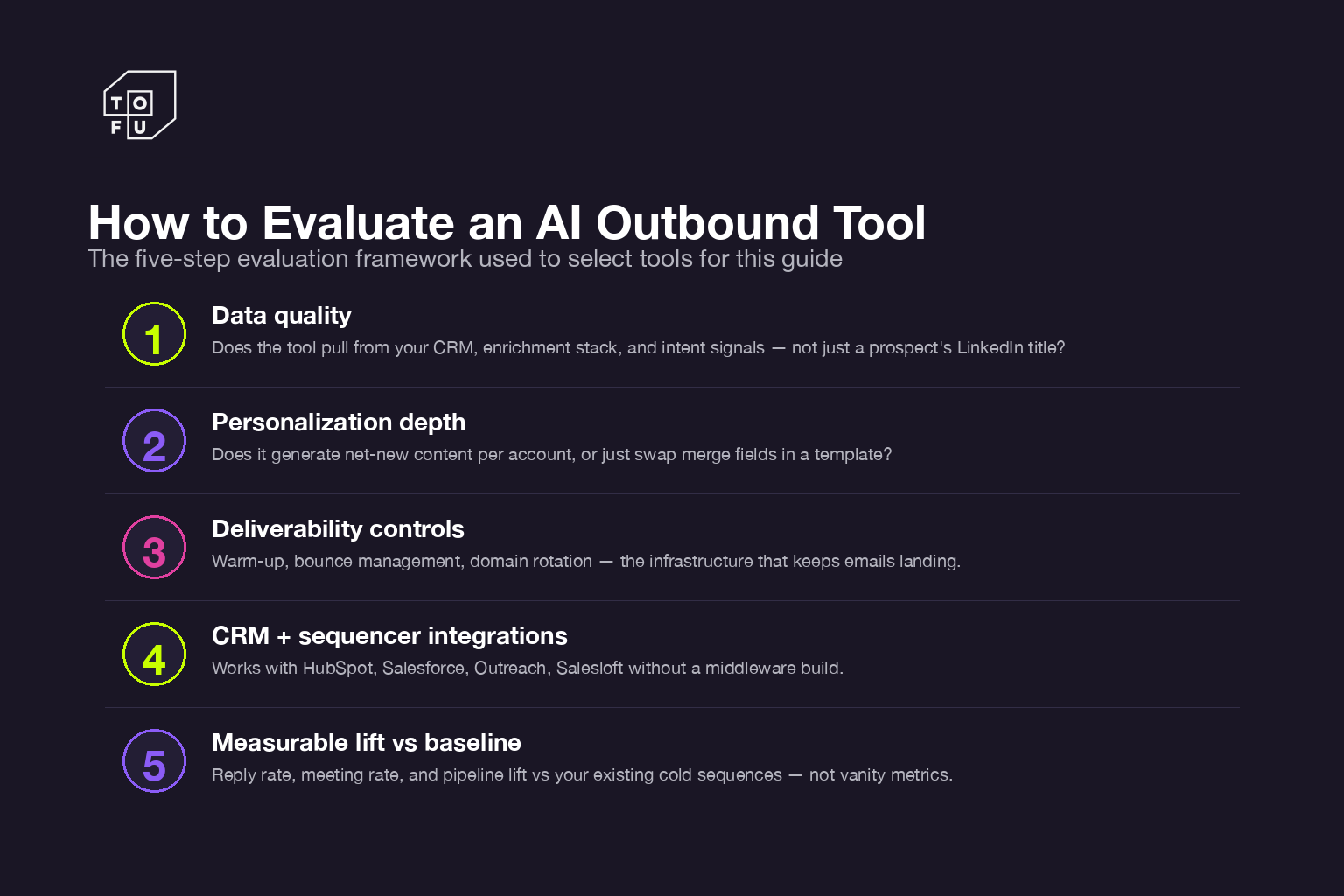
We assessed each tool across five criteria to determine its effectiveness for personalized outbound at scale:
Disclosure: Tofu is our product. We have included it in this comparison alongside competitors for transparency. All tools were evaluated using the same criteria.
Frequently Asked Questions
What AI tools help turn account insights into personalized outbound messaging?
Several AI tools specialize in converting account data into personalized outbound. Tofu transforms CRM and intent data into personalized emails, landing pages, and microsites per account. Clay connects 100+ data sources to enrich accounts and draft AI-personalized messages. Autobound generates one-click personalized emails from prospect data, and Copy.ai offers GTM workflows that automate research-to-outreach sequences.
What AI platforms personalize outbound using both first-party CRM data and third-party data?
Tofu is purpose-built for this, combining first-party CRM data from Salesforce or HubSpot with third-party intent and firmographic signals to generate personalized content across multiple channels. Clay also excels here by connecting CRM data with 100+ external enrichment sources. UserGems blends your CRM relationship data with third-party job change signals to trigger timely, personalized outreach.
What's the best tool for personalized cold email at scale?
It depends on your volume and personalization needs. For high-volume cold email with strong deliverability, Instantly is a top choice starting at $30/mo. For deeper personalization powered by data enrichment, pair Clay with a sending tool like Instantly or Outreach. Apollo.io offers a strong all-in-one option for SMBs who need both prospecting data and email sequencing in one platform.
How do I personalize outbound beyond just inserting a first name?
Effective personalization goes well beyond merge fields. The best approaches reference a prospect's company initiatives, recent funding rounds, tech stack, hiring patterns, or industry challenges. Tools like Clay and Tofu pull in these data points automatically and use AI to weave them into natural-sounding messaging. Lavender can coach reps on adding these personalization layers to their manually written emails.
Can AI really write effective personalized sales emails?
Yes, when given the right data inputs. According to Salesforce's 2025 State of Sales report, sales teams using AI for email personalization saw 29% higher reply rates compared to manually written templates. The key is feeding the AI relevant context — company data, recent news, tech stack, pain points — rather than generating from generic prompts. Tools like Autobound, Clay, and Tofu are designed to automate this data-to-message pipeline.
What tools integrate with Outreach or Salesloft for AI-personalized sequences?
Several tools integrate directly with Outreach and Salesloft to enhance personalization within existing sequences. Tofu pushes personalized content into Outreach and Salesloft workflows. Lavender provides real-time email coaching inside both platforms. Autobound generates personalized emails that can be inserted into sequences, and Clay can push enriched, AI-drafted messages into either platform via native integrations.
What's the difference between sales engagement tools and AI content platforms for outbound?
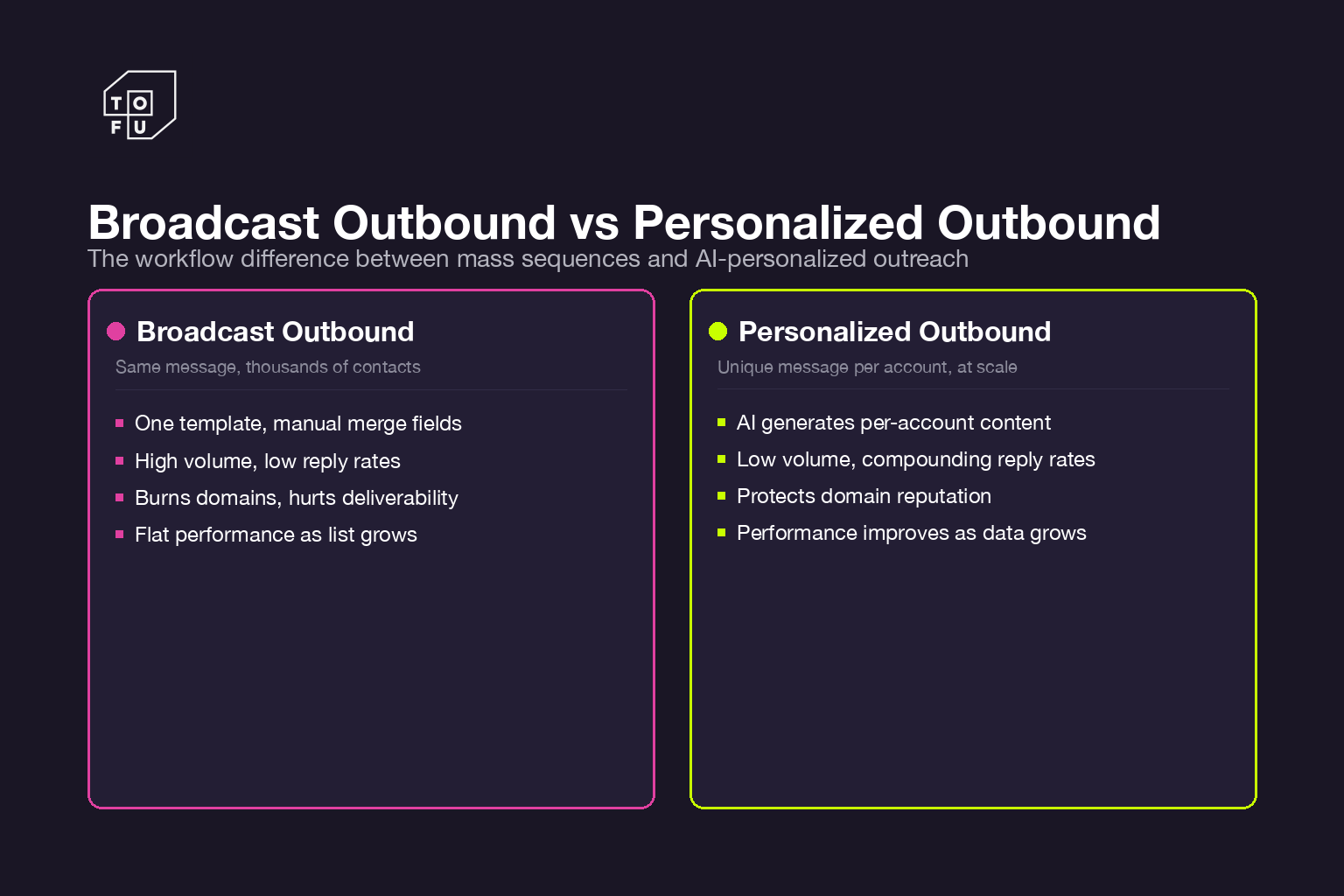
Sales engagement tools like Outreach and Salesloft focus on workflow automation — sequencing touchpoints, tracking engagement, and managing cadences. AI content platforms like Tofu and Copy.ai focus on generating the personalized content itself. The most effective outbound stacks use both: an AI content platform to generate personalized messaging, and a sales engagement tool to deliver and track it across channels.
Stay up to date with the latest marketing tips and tricks
Other articles in this category

The Symbiosis of AI and Human Creativity in Sales and Marketing
Teams who figure out how to create a symbiotic relationship between AI and humans, leveraging each for what it does best, will pull ahead from the pack and solidify their positions as market leaders.
.svg)

The Ultimate Guide to Marketing Automation for Enterprise SaaS Companies in 2023
Everything you need to know about marketing automation in 2023 and how to implement it effectively for your enterprise SaaS company.

The Power of AI in SaaS Marketing: How to Improve Customer Acquisition and Retention
AI can be a powerful tool for improving customer acquisition and retention in enterprise SaaS companies by analyzing customer behavior, personalizing the customer experience, improving customer support, and optimizing your marketing campaigns.

The Rise of Generative Marketing: How Technology is Revolutionizing Personalized Content Production
67% of B2B marketers now use generative AI in their content workflows. Learn what generative marketing is, how it works, and which tools like Tofu enable teams to produce hyper-personalized content at scale to boost conversion rates.

The Dos and Don'ts of Using AI in Your B2B Content Marketing Efforts
By following best practices and avoiding common pitfalls, you can leverage AI to enhance human creativity, personalize content for your target audience, and continuously improve your content marketing strategy.

The Impact of AI on B2B Marketing Channel Mix
AI opens up novel channels and new approaches to B2B marketing while also dramatically changing the efficacy and utility of existing channels.
The 10 Best Account-Based Marketing Tools of 2026
A comparison of the 10 best account-based marketing tools for 2026, covering ABM campaign managers like 6sense and Demandbase alongside content tools like Tofu, Hushly, Mutiny, and Drift.


Want to give tofu A try?
Request a custom demo to see how Tofu can supercharge your GTM efforts.
ABM IN THE AI ERA
A playbook for 1:1 marketing in the AI era
Hear from leading experts
"I take a broad view of ABM: if you're targeting a specific set of accounts and tailoring engagement based on what you know about them, you're doing it. But most teams are stuck in the old loop: Sales hands Marketing a list, Marketing runs ads, and any response is treated as intent."

"ABM has always been just good marketing. It starts with clarity on your ICP and ends with driving revenue. But the way we get from A to B has changed dramatically."
.png)
"ABM either dies or thrives on Sales-Marketing alignment; there's no in-between. When Marketing runs plays on specific accounts or contacts and Sales isn't doing complementary outreach, the whole thing falls short."

"In our research at 6sense, few marketers view ABM as critical to hitting revenue goals this year. But that's not because ABM doesn't work; it's because most teams haven't implemented it well."
"To me, ABM isn't a campaign; it's a go-to-market operating model. It starts with cross-functional planning: mapping revenue targets, territories, and board priorities."

"With AI, we can personalize not just by account, but by segment, by buying group, and even by individual. That level of precision just wasn't possible a few years ago."
%201%20(1).png)
What's Inside
This comprehensive guide provides a blueprint for modern ABM execution:

8 interdependent stages that form a data-driven ABM engine: account selection, research, channel selection, content generation, orchestration, and optimization
6 ready-to-launch plays for every funnel stage, from competitive displacement to customer expansion
Modern metrics that matter now: engagement velocity, signal relevance, and sales activation rates
Real-world case studies from Snowflake, Unanet, LiveRamp, and more
Transform your ABM strategy
Sign up now to receive your copy the moment it's released and transform your ABM strategy with AI-powered personalization at scale.
Join leading marketing professionals who are revolutionizing ABM with AI