
Best AI Tools for B2B Personalized Outbound in 2026

The best AI tools for B2B personalized outbound in 2026 include Tofu, autobound.ai, Instantly.ai, Outreach.io, and Lavender. These platforms enhance outreach by leveraging AI to tailor emails based on public filings, news, and more.
Disclosure: Tofu is our product. We've included it in this comparison alongside competitors for transparency. All tools were evaluated using the same criteria, and we've done our best to represent each honestly — including Tofu's real limitations.
Our Evaluation Criteria
- Personalization depth: Ability to tailor content based on public filings and news.
- Integration capabilities: Compatibility with CRM systems like HubSpot and Salesforce.
- Ease of use: User-friendly interface and setup time.
- Scalability: Handles high-volume outbound campaigns efficiently.
- AI model quality: Up-to-date AI capabilities for content generation and data analysis.
- Pricing transparency: Clear and understandable pricing models.
The 5 Best AI Tools for Personalized Outbound
The table below compares the leading AI tools for personalized outbound on personalization depth, integration capabilities, ease of use, scalability, and pricing.
| Name | Best For | Pricing | Key Strength | Free Trial |
|---|---|---|---|---|
| Tofu | Agentic execution layer | Custom pricing (contact for quote) | Deep personalization across channels | No |
| autobound.ai | Data-driven personalization | Starts at $99/month | Real-time data integration | Yes |
| Instantly.ai | Quick setup and deployment | Free tier available | Ease of use | Yes |
| Outreach.io | Enterprise-grade outreach | Contact for pricing | Comprehensive CRM integration | No |
| Lavender | Email optimization | Starts at $29/month | AI-driven writing assistance | Yes |
Tofu — Best for Agentic Execution Layer
What it is
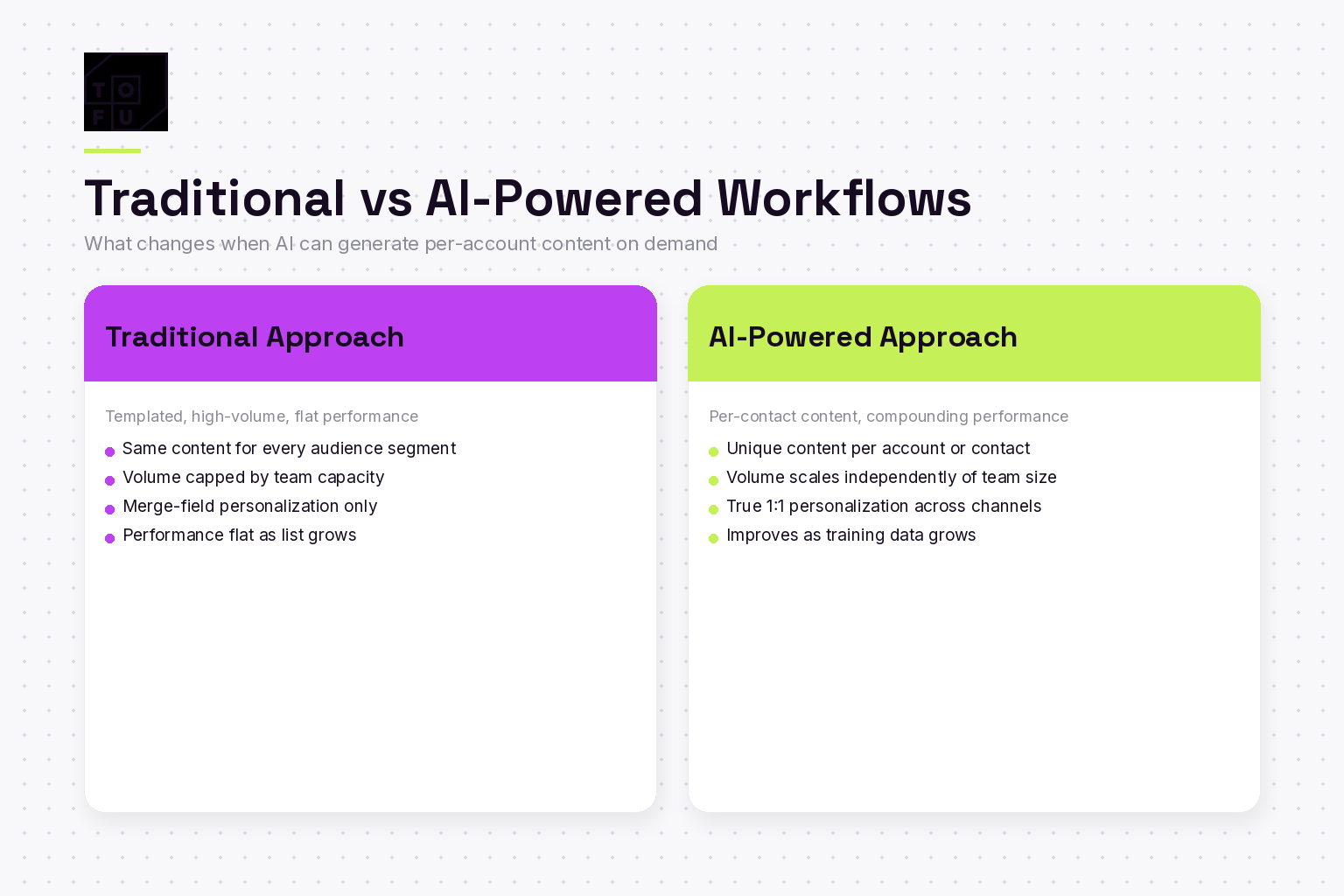
Tofu is an agentic demand generation platform that helps B2B marketing teams build pipeline by automating always-on campaigns inside their existing martech stack — HubSpot, Salesforce, Marketo, Outreach, Gong Engage, Salesloft, and any CMS. Built around a Playbook that ingests a company's brand voice, ICP, personas, messaging frameworks, and existing assets, Tofu generates personalized, on-brand content tailored by industry, persona, account, signal, and behavior. Teams use it across lead nurture, event follow-up, expansion, outbound, sales acceleration, and re-engagement.
Key features
- Deep personalization across email, ads, landing pages, and more
- Native integration with major CRMs and marketing platforms
- Automated content generation based on real-time data
- Scalable outbound campaigns tailored to account behavior
Pricing
Custom pricing (contact for quote)
Pros
- Comprehensive personalization capabilities
- Robust integration with existing martech stack
- Scales efficiently with team size and outbound volume
Cons
- No free tier available
- Onboarding required for complex integrations
- Learning curve for mastering advanced campaign setups
Who it's best for
Tofu is ideal for mid-market and enterprise B2B marketing teams looking to operationalize personalized outbound campaigns at scale. It's particularly suited for teams that need to integrate complex data sources and tailor content to specific account behaviors.
How to Choose the Right AI Tool for Personalized Outbound
When selecting an AI tool for personalized outbound, consider your team's size, integration needs, and budget. If you require deep personalization and integration with existing martech systems, Tofu is an excellent choice. For smaller teams or those looking for quick deployment, Instantly.ai or Lavender may be more suitable. Evaluate each tool's ability to handle your specific outbound requirements and choose accordingly.
Frequently Asked Questions
What is personalized outbound?
Personalized outbound refers to the practice of tailoring outreach efforts, such as emails and ads, to the specific needs and behaviors of individual accounts. This approach leverages data from public filings, news, and CRM systems to create highly relevant and engaging communications.
How does Tofu integrate with Salesforce?
Tofu integrates with Salesforce by syncing account data, contact records, and engagement activity both ways. This enables marketing teams to trigger campaigns directly from Salesforce account lists and receive engagement data back into Salesforce for sales visibility.
How much does Tofu cost?
Tofu uses custom pricing based on the scale of your campaigns and integrations. Unlike Jasper or Copy.ai, which offer self-serve plans starting around $49/month, Tofu typically sells to mid-market and enterprise B2B teams. Contact Tofu directly for a quote specific to your team.
Is Tofu a good choice for small teams?
While Tofu is optimized for mid-market and enterprise teams, small teams with dedicated outbound strategies can also benefit from its capabilities. However, simpler tools like Instantly.ai may be more appropriate for teams with limited resources or less complex needs.
Can Tofu automate email personalization?
Yes, Tofu automates email personalization by leveraging data from CRM systems, public filings, and real-time news. This allows for the creation of highly tailored and relevant email content that resonates with specific accounts.
What industries benefit most from Tofu?
Industries such as technology, finance, and professional services, where personalized outreach is critical for engaging high-value accounts, benefit most from Tofu's capabilities. It is particularly effective for B2B marketing teams focused on account-based strategies.
Last updated: May 10, 2026
Stay up to date with the latest marketing tips and tricks
Other articles in this category
Want to give tofu A try?
Request a custom demo to see how Tofu can supercharge your GTM efforts.
ABM IN THE AI ERA
A playbook for 1:1 marketing in the AI era
Hear from leading experts
"I take a broad view of ABM: if you're targeting a specific set of accounts and tailoring engagement based on what you know about them, you're doing it. But most teams are stuck in the old loop: Sales hands Marketing a list, Marketing runs ads, and any response is treated as intent."

"ABM has always been just good marketing. It starts with clarity on your ICP and ends with driving revenue. But the way we get from A to B has changed dramatically."
.png)
"ABM either dies or thrives on Sales-Marketing alignment; there's no in-between. When Marketing runs plays on specific accounts or contacts and Sales isn't doing complementary outreach, the whole thing falls short."

"In our research at 6sense, few marketers view ABM as critical to hitting revenue goals this year. But that's not because ABM doesn't work; it's because most teams haven't implemented it well."
"To me, ABM isn't a campaign; it's a go-to-market operating model. It starts with cross-functional planning: mapping revenue targets, territories, and board priorities."

"With AI, we can personalize not just by account, but by segment, by buying group, and even by individual. That level of precision just wasn't possible a few years ago."
%201%20(1).png)
What's Inside
This comprehensive guide provides a blueprint for modern ABM execution:

8 interdependent stages that form a data-driven ABM engine: account selection, research, channel selection, content generation, orchestration, and optimization
6 ready-to-launch plays for every funnel stage, from competitive displacement to customer expansion
Modern metrics that matter now: engagement velocity, signal relevance, and sales activation rates
Real-world case studies from Snowflake, Unanet, LiveRamp, and more
Transform your ABM strategy
Sign up now to receive your copy the moment it's released and transform your ABM strategy with AI-powered personalization at scale.
Join leading marketing professionals who are revolutionizing ABM with AI