
Best AI Tools for B2B Re-Engagement Campaigns in 2026
Last updated: May 11, 2026
Disclosure: Tofu is our product. We have included it in this comparison alongside competitors for transparency. All tools were evaluated using the same criteria — feature depth, re-engagement capabilities, integration ecosystem, and pricing.
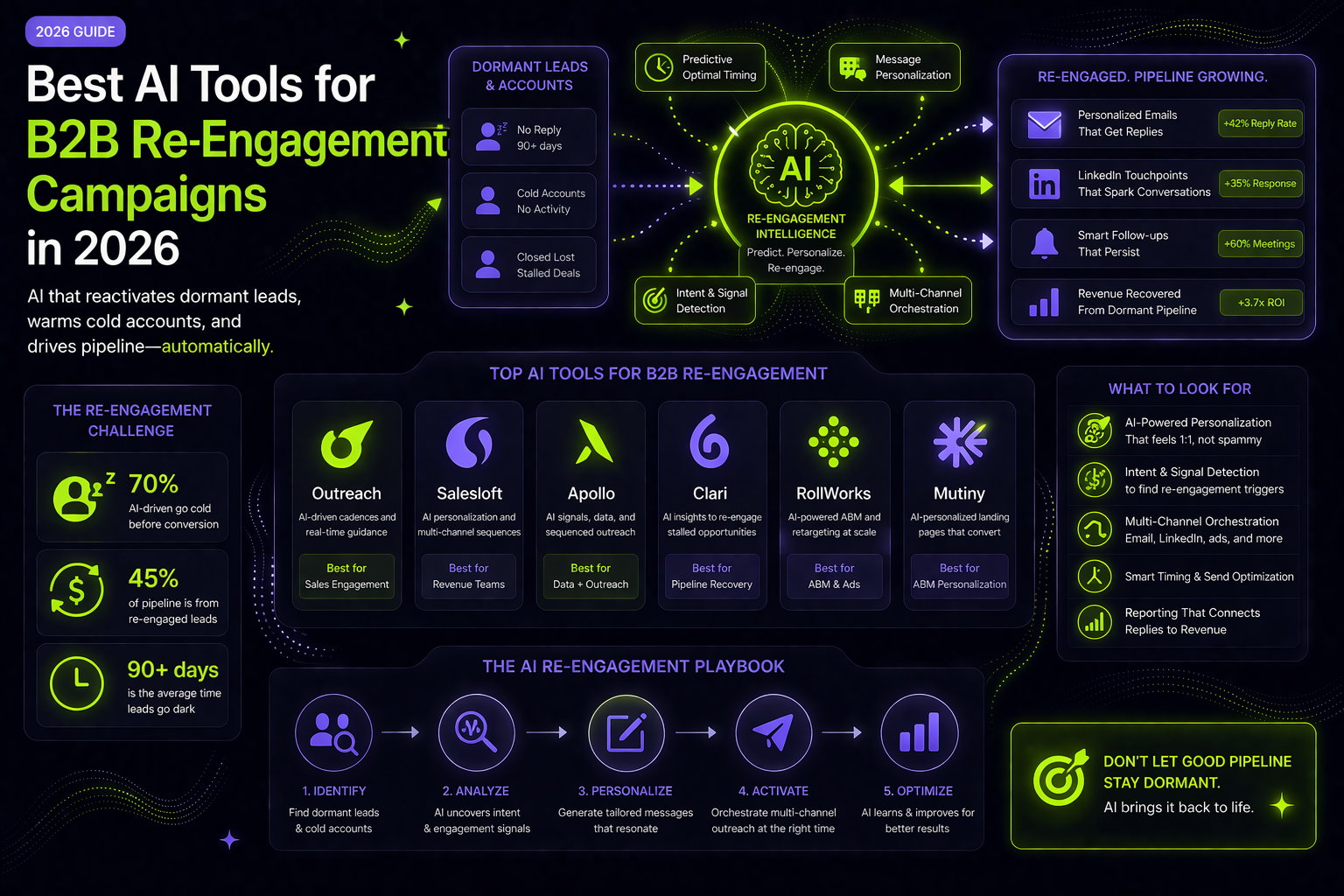
The best AI tools for B2B re-engagement campaigns in 2026 are HubSpot, Marketo (Adobe), ActiveCampaign, Outreach, 6sense, Salesloft (formerly Drift), Sendoso, Reachdesk, PathFactory, Uberflip, and Tofu — an AI-native B2B marketing platform that generates personalized re-engagement content at scale. These platforms address different layers of the re-engagement problem: workflow automation and lead scoring (HubSpot, Marketo, ActiveCampaign), sales-driven outbound re-engagement (Outreach, Salesloft), intent-based account identification (6sense), physical gifting and direct mail (Sendoso, Reachdesk), content experience platforms (PathFactory, Uberflip), and AI-generated personalized campaign content (Tofu). The re-engagement opportunity is massive — research from HubSpot's 2026 marketing benchmarks shows that re-engaged leads convert at 2-3x the rate of net-new leads, at roughly one-fifth the acquisition cost. Yet most B2B marketing teams let 60-80% of their database go dormant without a structured re-engagement strategy. The tools in this guide help you bring those leads, accounts, and churned customers back into active pipeline — using AI to personalize the approach at a scale that manual efforts cannot match.
Why B2B Re-Engagement Campaigns Deserve Dedicated Tooling
Re-engagement is not simply "sending another email to old leads." It requires a fundamentally different approach than new prospect outreach. Dormant contacts already know your brand — they visited your site, downloaded content, attended a webinar, or entered a sales cycle at some point. They went cold for a reason: bad timing, budget constraints, a competitor won the deal, or the champion left the company. The re-engagement challenge is diagnosing why they went dark and crafting a message that addresses the changed circumstance. Generic nurture sequences do not accomplish this. According to Gartner's B2B buying research, 75% of B2B buyers say they prefer a rep-free experience for most of the purchase journey — which means your re-engagement content needs to do the heavy lifting, not a cold call from a new SDR.

The economics make a compelling case. Re-engaging an existing database contact costs $5-15 per re-engaged MQL, compared to $50-200+ for a net-new MQL from paid channels. A B2B company with 50,000 dormant contacts in their CRM is sitting on potential pipeline worth hundreds of thousands of dollars — if they can reach those contacts with the right message at the right time. AI has changed what is possible here. Instead of sending the same "just checking in" email to everyone, modern AI tools can segment dormant accounts by intent signals, generate personalized content that references their specific industry challenges or previous interactions, and orchestrate multi-channel touchpoints that feel relevant rather than robotic.
The tools in this comparison serve different functions in a re-engagement tech stack. Some are workflow engines that automate the sequencing and scoring. Others identify which dormant accounts are showing renewed buying intent. Others generate the actual creative — the emails, landing pages, and content experiences — that make someone pay attention. Most teams need at least two or three of these tools working together for an effective re-engagement program.
How We Evaluated These Tools
We assessed each platform across five criteria specific to B2B re-engagement use cases:
1. Re-engagement workflow capabilities: Does the tool support dedicated re-engagement campaign types — cold lead revival, lost deal reactivation, churned customer win-back, and dormant account re-engagement? Can it trigger campaigns based on inactivity thresholds, intent signal changes, or CRM stage data? We prioritized tools that offer re-engagement-specific features beyond generic campaign automation.
2. AI and personalization depth: How effectively does the tool use AI to personalize re-engagement content? Surface-level personalization (name and company insertion) is table stakes. We evaluated whether the tool can tailor messaging based on the reason for disengagement, the contact's previous interactions, their current intent signals, and their account's industry context. Tools that generate net-new personalized content scored higher than those that only optimize send times or subject lines.
3. Multi-channel orchestration: Re-engagement rarely works through a single channel. We evaluated each tool's ability to coordinate email, ads, direct mail, gifting, content experiences, and sales outreach into a cohesive re-engagement motion — and whether AI helps determine the optimal channel mix for each account.
4. Integration ecosystem: Re-engagement campaigns depend on CRM data (deal stage history, last activity date, engagement scores) and intent data. We assessed how well each tool integrates with Salesforce, HubSpot, and major ABM/intent platforms to pull the signals needed for effective re-engagement segmentation.
5. Pricing and accessibility: We documented actual pricing where available and industry estimates where it is not, flagging minimum commitments and hidden costs that affect total investment.
Comparison Table: AI Tools for B2B Re-Engagement Campaigns
| Tool | Best For | Key Features | Pricing | Rating |
|---|---|---|---|---|
| HubSpot | Full-lifecycle re-engagement automation with built-in CRM | Workflow builder, lead scoring decay, smart lists for inactivity, AI content assistant, predictive lead scoring | Free-$3,600/mo (Marketing Hub Enterprise) | 4.5/5 |
| Marketo (Adobe) | Enterprise-grade re-engagement with advanced segmentation | Engagement programs, exhaustion detection, AI-powered send-time optimization, advanced nurture branching, revenue attribution | ~$895-$3,195/mo (quote-based) | 4.3/5 |
| ActiveCampaign | SMB-friendly re-engagement with powerful automation | Automation recipes, predictive sending, site tracking triggers, win-back templates, conditional content blocks | $29-$259/mo (by contact tier) | 4.4/5 |
| Outreach | Sales-driven re-engagement sequences for lost deals | Smart Email Assist, multi-channel sequences, sentiment analysis, trigger-based re-engagement, deal intelligence | ~$100-$160/user/mo (quote) | 4.3/5 |
| 6sense | Intent-driven identification of re-engageable accounts | AI-powered intent detection, anonymous visitor deanonymization, predictive analytics, account scoring, buying stage identification | Custom pricing (~$60K-$150K+/yr) | 4.4/5 |
| Salesloft | AI-powered cadences for re-engaging cold prospects | AI Email Agents, Rhythm AI prioritization, account research agent, scheduled draft generation, conversation intelligence | ~$125-$200/user/mo (quote) | 4.3/5 |
| Sendoso | Physical gifting and direct mail for re-engagement | Automated gifting triggers, e-gift marketplace, direct mail orchestration, CRM-triggered sends, ROI tracking | ~$10K-$50K+/yr (quote-based) | 4.2/5 |
| Reachdesk | Global direct mail and gifting at scale | Global gifting network, automated triggers, branded merchandise, handwritten notes, multi-touch campaign support | Custom pricing (~$15K-$60K+/yr) | 4.1/5 |
| PathFactory | Content experiences that re-engage through personalized resource hubs | AI-curated content tracks, content engagement analytics, micro-personalized recommendations, visitor journey mapping | Custom pricing (~$30K-$80K+/yr) | 4.2/5 |
| Uberflip | Content destination creation for account-specific re-engagement | Custom content streams, ABM content hubs, AI content recommendations, intent-based personalization, CTA optimization | Custom pricing (~$20K-$60K+/yr) | 4.0/5 |
| Tofu | AI-generated personalized re-engagement content per account | Generates personalized landing pages, emails, ads, and collateral from a single campaign brief per target account | Custom pricing (request demo) | 4.4/5 |
The 11 Best AI Tools for B2B Re-Engagement Campaigns
1. HubSpot
What it does for re-engagement: HubSpot is the most widely adopted marketing automation platform for mid-market B2B, and its re-engagement capabilities have matured significantly. The workflow builder supports inactivity-based triggers — automated re-engagement sequences that fire when a contact has not opened an email in 90 days, has not visited your site in 60 days, or has been stuck in the same lifecycle stage for a defined period. Lead scoring with decay ensures dormant contacts see their scores drop automatically, feeding re-engagement segmentation. HubSpot's AI content assistant generates email copy variations, though personalization depth is limited to CRM fields rather than generating entirely new content per account.

Best for: B2B teams already on HubSpot who want to build re-engagement workflows within their existing CRM stack. Key features include inactivity-triggered workflows, lead score decay, smart lists for engagement recency, AI email content assistant, and predictive lead scoring.
Limitations: Re-engagement personalization is template-based — it inserts CRM fields but does not generate account-specific landing pages or campaign-level creative. Advanced features require Marketing Hub Professional ($800/mo) or Enterprise ($3,600/mo). Strongest as the orchestration layer, less effective for deeply personalized content generation.
2. Marketo (Adobe)
What it does for re-engagement: Marketo Engage is the enterprise standard for sophisticated marketing automation. Its engagement programs feature exhaustion detection that identifies when contacts have received all available content in a stream and automatically transitions them to alternative re-engagement paths. AI-powered predictive audiences identify which dormant accounts share characteristics with recently converted customers, helping prioritize re-engagement on the highest-potential segments. Send-time optimization delivers re-engagement emails when each contact is most likely to open them.
Best for: Enterprise B2B organizations with complex re-engagement needs — multiple product lines, global segments, sophisticated lifecycle models. Key features include multi-stream engagement programs, content exhaustion detection, predictive audience scoring, revenue cycle modeling, and native Salesforce sync.
Limitations: Powerful but complex — requires dedicated marketing operations expertise. Like HubSpot, it excels at orchestration but does not generate personalized re-engagement content. AI optimizes delivery timing and audience selection, not the content itself. Pricing starts at ~$895/month, reaching $3,195+/month for enterprise, plus $10K-$50K+ implementation costs.
3. ActiveCampaign
What it does for re-engagement: ActiveCampaign offers a compelling middle ground between HubSpot's ease of use and Marketo's depth. Pre-built win-back automation recipes let you target contacts who have stopped engaging — activate and customize in minutes. Site tracking triggers fire re-engagement campaigns when dormant contacts return to your website. Conditional content blocks personalize email body content based on contact attributes, and predictive sending delivers each email at the individual contact's optimal engagement time.
Best for: SMB and mid-market B2B teams that need sophisticated re-engagement automation without enterprise complexity. Key features include win-back recipes, site tracking triggers, predictive sending, lead scoring with decay rules, and CRM deal stage integration for lost-deal re-engagement.
Limitations: AI capabilities focus on optimization (send time, content conditions) rather than content generation. Does not create personalized landing pages or account-specific content. Less suited for complex enterprise ABM re-engagement across large buying committees.
4. Outreach
What it does for re-engagement: Outreach is where sales teams execute structured, multi-channel re-engagement sequences — emails, calls, LinkedIn messages, and tasks in organized cadences. Smart Email Assist generates AI-drafted re-engagement emails based on the prospect's previous engagement history, deal stage data, and sequence context. Sentiment analysis on replies helps reps identify which re-engagement attempts are generating positive signals versus polite rejections. Trigger-based enrollment can automatically add contacts to re-engagement sequences when deals are marked closed-lost or contacts go inactive for a defined period.
Best for: Sales teams running outbound re-engagement sequences for lost deals and cold prospects. Key features include multi-step sequences, Smart Email Assist, CRM-triggered enrollment, sentiment analysis, and A/B testing.
Limitations: Sales engagement tool, not a MAP — handles sales-side re-engagement execution but does not manage marketing campaigns, build landing pages, or orchestrate full-funnel nurture. Pricing at $100-$160/user/month with minimum seat requirements can be expensive for a single use case.
5. 6sense
What it does for re-engagement: 6sense solves the hardest problem in B2B re-engagement: knowing which dormant accounts are ready to re-engage. Revenue AI analyzes billions of intent signals — anonymous web research, third-party content consumption, technographic changes, hiring patterns — to predict which accounts are actively researching your category, even if they have not visited your site. Instead of blasting your entire dormant database, 6sense identifies the 5-10% showing renewed buying intent. The platform also deanonymizes website visitors, so if a contact from a lost deal returns to your pricing page, you know before they fill out a form.
Best for: Account-based re-engagement teams that need to prioritize dormant accounts based on actual buying intent. Key features include AI intent detection, predictive buying stage identification, visitor deanonymization, and orchestration triggers that push accounts to MAP or SEP workflows.
Limitations: 6sense tells you which accounts to re-engage and when, but does not generate re-engagement content. You still need a content tool (like Tofu) and an orchestration platform (like HubSpot or Marketo) to execute campaigns. Pricing is enterprise-level at $60K-$150K+ annually.
6. Salesloft
What it does for re-engagement: Salesloft (which acquired Drift in 2024) now combines sales engagement cadences with conversational AI, creating a powerful one-two punch for re-engagement. On the cadence side, Salesloft's AI Email Agents automate the research and email drafting process for re-engagement sequences. The Account Research Agent gathers current information about the target account — recent news, leadership changes, technology shifts — and the Email Personalization Agent drafts re-engagement emails that reference this context. On the conversational side, Drift's chatbot technology enables real-time re-engagement when dormant contacts return to your website. Instead of hoping they fill out a form, the AI-powered chatbot initiates a personalized conversation based on the visitor's previous interactions and account context.
Best for: Revenue teams that want to combine outbound re-engagement cadences with inbound conversational re-engagement, particularly useful for re-engaging accounts where the original champion has gone silent.
Key re-engagement features: AI Email Agents for personalized re-engagement drafts, Rhythm AI for prioritizing re-engagement actions, Drift chatbot for website visitor re-engagement, conversation intelligence for analyzing re-engagement call outcomes, and deal management for tracking re-engaged pipeline.
Limitations: The Drift integration is still evolving post-acquisition, and the combined platform's re-engagement workflow can require setup across both the cadence and chatbot modules. Like Outreach, Salesloft is primarily a sales tool — marketing-owned re-engagement campaigns require a separate MAP. Pricing with minimum seat requirements ($125-$200/user/month) makes it a significant investment.
7. Sendoso
What it does for re-engagement: Sendoso is a sending platform that enables B2B teams to incorporate physical gifting and direct mail into re-engagement campaigns. When digital channels have been exhausted — a contact has not opened an email in six months — a physical touchpoint can break through the noise in a way that another email cannot. Sendoso integrates with your CRM and marketing automation to trigger gift sends based on re-engagement criteria: a gift card when a lost deal shows renewed intent, a branded item when an account re-enters target segment, or a handwritten note when a churned customer's contract renewal approaches. The platform's e-gift marketplace provides options ranging from $5 coffee cards to premium experiences, with automated address verification and delivery tracking.
Best for: B2B teams re-engaging high-value accounts where the cost of a physical gift is justified by the deal size — typically enterprise and mid-market deals worth $50K+ in annual contract value.
Key re-engagement features: CRM-triggered gifting automation, e-gift marketplace with dozens of options, direct mail orchestration with address verification, branded merchandise and custom packaging, ROI tracking and attribution, and integrations with HubSpot, Salesforce, Marketo, Outreach, and Salesloft.
Limitations: Sendoso adds a physical channel to re-engagement but does not address the digital content side — you still need tools for email copy, landing pages, and campaign orchestration. Per-send costs ($5-$200+ per gift) make it impractical for high-volume re-engagement across large databases. The platform is most effective as a targeted complement to digital re-engagement, not as a standalone re-engagement solution. Minimum annual commitments typically start at $10K+.
8. Reachdesk
What it does for re-engagement: Reachdesk is a direct mail and gifting platform similar to Sendoso but with a particular strength in global gifting operations. For B2B companies with international accounts, Reachdesk's global fulfillment network ensures that re-engagement gifts can be sent to contacts in over 170 countries with local gifting options, proper customs handling, and regional gift preferences. The platform offers handwritten notes — actual pen-on-paper notes produced by robotic handwriting technology — which perform exceptionally well for high-touch re-engagement of senior executives and churned enterprise customers. Multi-touch campaign support enables you to orchestrate a sequence that combines a direct mail piece with follow-up digital touchpoints.
Best for: Global B2B organizations that need to re-engage international accounts with locally relevant physical touchpoints and premium gifting experiences.
Key re-engagement features: Global gifting in 170+ countries, robotic handwritten notes, branded merchandise customization, automated trigger-based sends, multi-touch campaign sequencing with physical and digital touchpoints, and detailed analytics on gift engagement (opened, redeemed, influenced pipeline).
Limitations: Like Sendoso, Reachdesk is a channel-specific tool that adds direct mail and gifting to your re-engagement mix but does not handle digital content creation or campaign orchestration. Pricing is enterprise-focused with custom quotes typically starting at $15K+ annually. The ROI calculation requires high enough deal values to justify per-send costs.
9. PathFactory
What it does for re-engagement: PathFactory is a content intelligence and experience platform that transforms how dormant contacts interact with your content during re-engagement. Instead of linking a re-engagement email to a single asset or generic blog post, PathFactory lets you create AI-curated content tracks — personalized content journeys that serve up the next most relevant asset based on what the contact has already consumed and their account profile. For re-engagement, this means a dormant contact clicks through to a content experience that adapts in real time, showing them new content they have not seen (not repeating assets they already downloaded months ago) and progressing them through a logical journey from awareness back to consideration. The platform's content engagement analytics measure time spent and consumption depth, providing much richer re-engagement signals than simple click tracking.
Best for: Content-rich B2B organizations with large asset libraries that want to re-engage dormant contacts through personalized, binge-worthy content experiences rather than isolated email-to-PDF workflows.
Key re-engagement features: AI-curated content tracks personalized per visitor, content engagement scoring (time-based, not just click-based), micro-personalized recommendations based on consumption history, content exhaustion avoidance (only shows new, unseen content), visitor-level journey mapping, and integration with MAPs for re-engagement workflow triggers.
Limitations: PathFactory requires a substantial content library to deliver its full value — if you only have a handful of assets, the personalized content track experience will feel thin. The platform organizes and serves existing content but does not create new content. Pricing is enterprise-level (typically $30K-$80K+/year) and the implementation requires tagging and organizing your entire content library, which can be a significant upfront investment in time.
10. Uberflip
What it does for re-engagement: Uberflip is a content experience platform that enables marketers to create personalized content destinations — hubs, streams, and microsites — for specific accounts or segments. For re-engagement campaigns, Uberflip allows you to build account-specific content hubs that aggregate your most relevant resources for a target account's industry, use case, and buying stage. When you send a re-engagement email to a lost deal, instead of linking to your generic resource center, you link to a curated content hub that surfaces case studies from their industry, product content relevant to their evaluated use case, and new resources published since they last engaged. The platform's AI content recommendations personalize which assets appear based on visitor behavior, and CTA optimization tests different calls-to-action to maximize re-engagement conversion.
Best for: ABM-focused B2B teams that want to create personalized content destinations as part of their re-engagement strategy — giving dormant accounts a reason to re-engage beyond a single email or asset.
Key re-engagement features: Account-specific content streams, ABM content hubs with industry and persona personalization, AI-powered content recommendations, CTA optimization and testing, integration with Marketo, HubSpot, and Salesforce, and analytics on content engagement and pipeline influence.
Limitations: Uberflip organizes and presents existing content in personalized experiences but does not generate new content. Building and maintaining account-specific content hubs requires ongoing curation effort from the marketing team. The platform works best when paired with a content creation engine that keeps the hub populated with fresh, relevant assets. Pricing is custom (typically $20K-$60K+/year) with annual commitments.
11. Tofu
What it does for re-engagement: Tofu is an AI-native B2B marketing platform that generates personalized campaign content at scale from a single campaign brief. For re-engagement campaigns specifically, Tofu addresses a gap that most other tools in this comparison leave open: the actual content creation. When you are re-engaging a lost deal, a churned customer, or a dormant account, you need content that is specific to that account — not a generic template with their name inserted. Tofu generates personalized landing pages, email sequences, ads, one-pagers, and sales collateral tailored to each target account's industry, challenges, technology stack, and buying stage. You provide the campaign brief (re-engagement campaign targeting accounts in manufacturing who evaluated your platform 6+ months ago), and Tofu produces account-specific content for each target — a landing page that references manufacturing-specific challenges, email copy that acknowledges their previous evaluation, and supporting collateral that addresses common objections from their vertical.
Best for: B2B marketing teams running account-based re-engagement campaigns that need fresh, personalized content per account — not just personalized automation workflows or content recommendations from existing libraries.
Key re-engagement features: AI generation of personalized landing pages per account, personalized re-engagement email sequences, account-specific one-pagers and sales collateral, ad copy tailored to re-engagement segments, multi-format content from a single campaign brief, and integration with CRM data (firmographic, technographic, engagement history) to inform personalization.
Limitations: Tofu generates the content but is not a marketing automation or sales engagement platform — it does not handle the workflow orchestration, send-time optimization, or multi-step sequencing that tools like HubSpot, Marketo, or Outreach provide. The generated content is pushed to or used within those platforms for actual campaign execution. This means Tofu works best as part of a re-engagement stack rather than as a standalone re-engagement tool. Teams get the most value when pairing Tofu's content generation with a MAP (HubSpot, Marketo, ActiveCampaign) for orchestration and optionally an intent platform (6sense) for targeting.
Types of B2B Re-Engagement Campaigns
Not all re-engagement is the same. The approach, messaging, and tooling differ significantly based on the type of relationship you are trying to revive. Here are the four primary types of B2B re-engagement campaigns and how the tools in this comparison support each one.

Cold Lead Revival
Cold lead revival targets contacts who entered your database — typically through content downloads, webinar attendance, or website form fills — but never progressed to a sales conversation. These contacts showed initial interest but went silent, often because they were early in their research or the timing was not right. The re-engagement challenge is re-establishing relevance without repeating the same content that failed to convert them initially. Effective cold lead revival requires new content that demonstrates your understanding of their evolving challenges, not a replay of the original nurture sequence. Tools like HubSpot and ActiveCampaign handle the automation — triggering campaigns when contacts have been inactive for 60-120 days. 6sense adds value by identifying which cold leads are now actively researching your category. Tofu generates the fresh, personalized content — new landing pages, updated email messaging — that gives these leads a reason to re-engage rather than unsubscribe.
Lost Deal Reactivation
Lost deal reactivation is the highest-value re-engagement campaign type. These accounts went deep into your sales process — they sat through demos, evaluated your product, possibly ran a pilot — and ultimately chose a competitor or decided not to buy. The data is rich: you know which features they evaluated, which objections they raised, what the competitive alternatives were, and who the decision-makers are. The re-engagement trigger is often a change in circumstance: the competitor they chose is having public issues, their champion changed roles, their company's strategy shifted, or enough time has passed that the original objections may no longer apply. Outreach and Salesloft excel here because the outreach is sales-driven — reps reaching out with personalized sequences. 6sense can detect when a lost deal account starts researching your category again. Tofu generates account-specific content that directly addresses the reasons the deal was lost — new case studies from their industry, updated product capabilities that address their original objections, or new ROI models based on their specific situation.
Churned Customer Win-Back
Churned customer win-back targets accounts that were previously paying customers and chose not to renew or actively canceled. These accounts have the deepest knowledge of your product — they used it, experienced its strengths and weaknesses, and made an informed decision to leave. Win-back campaigns require honesty and specificity: acknowledging the relationship, addressing the likely reasons for churn (based on exit interview data, support tickets, or usage patterns), and presenting concrete changes that address their concerns. Sendoso and Reachdesk add a powerful physical dimension to win-back — a thoughtful gift paired with a personal note from an executive can open doors that another email cannot. PathFactory and Uberflip can create content experiences that showcase product improvements and new capabilities released since the customer churned. Marketo's advanced automation handles the multi-touch orchestration, and Tofu can generate personalized win-back content that speaks directly to the customer's specific situation — referencing their previous use case and highlighting new features or integrations relevant to their original requirements.
Dormant Account Re-Engagement
Dormant account re-engagement targets accounts in your ABM target list or customer base that have gone quiet — not formally lost or churned, but not actively engaging with your brand. This includes current customers with low adoption, target accounts where the original champion left, and accounts where your internal champion was reassigned. The re-engagement challenge is often discovering the new stakeholder landscape and finding a relevant entry point. 6sense is particularly valuable here, identifying which dormant accounts have new employees researching your category or showing intent signals that suggest renewed interest. Salesloft's Drift chatbot can capture dormant account visitors when they return to your website. For content, the need is often for refreshed, role-specific assets — if the original champion was a VP of Marketing and the new contact is a Director of Demand Gen, the re-engagement content needs to speak to different priorities. Tofu can generate this role-personalized content efficiently, while HubSpot or Marketo handles the sequencing and lead routing.
How to Choose the Right Re-Engagement Tools
Selecting the right tools for your re-engagement tech stack depends on four key factors. Use this framework to narrow down which combination of tools fits your situation.
Start with your existing stack. If you already run HubSpot or Marketo, you have the automation foundation for re-engagement campaigns. Your first question should not be "which MAP do I buy?" but rather "what capability gaps exist in my current stack for re-engagement?" For most teams, the gaps are in content personalization (addressed by Tofu), intent-based targeting (addressed by 6sense), or sales-side execution (addressed by Outreach or Salesloft). Adding one or two tools to your existing MAP is almost always more effective than replacing your entire stack.
Match tool type to campaign type. If your primary re-engagement need is cold lead revival at scale, you need a MAP with strong automation (HubSpot, Marketo, or ActiveCampaign) paired with a content generation tool (Tofu) to produce fresh content that does not repeat what already failed. If your primary need is lost deal reactivation, you need a sales engagement platform (Outreach or Salesloft) for rep-driven outreach plus an intent platform (6sense) to time the outreach correctly. If your need is churned customer win-back for high-value enterprise accounts, gifting platforms (Sendoso, Reachdesk) add a differentiated channel that digital-only approaches cannot match.
Assess your content situation. If you have a large library of existing content that just needs better organization and delivery, PathFactory or Uberflip may solve your re-engagement content problem by surfacing the right existing assets to the right accounts. If your problem is that you need net-new content personalized per account — because your existing content is generic or outdated — Tofu addresses this by generating fresh content from campaign briefs. Most re-engagement programs benefit from both: new personalized content (Tofu) delivered through intelligent content experiences (PathFactory or Uberflip).
Consider your budget and team size. Enterprise ABM teams with $100K+ budgets for re-engagement tooling can build a comprehensive stack: 6sense for intent, Tofu for content, a MAP for orchestration, and Sendoso for high-touch gifting. Mid-market teams with $20K-$50K budgets should focus on two tools: their existing MAP plus one gap-filler (often Tofu for content or 6sense for intent). SMB teams with limited budgets can accomplish meaningful re-engagement with ActiveCampaign alone, supplemented by Tofu for personalized content on their highest-priority accounts.
Frequently Asked Questions
What are the best AI tools for B2B re-engagement campaigns?
The best AI tools for B2B re-engagement campaigns in 2026 are HubSpot and Marketo for workflow automation and lead scoring, ActiveCampaign for SMB-friendly re-engagement automation, Outreach and Salesloft for sales-driven re-engagement sequences, 6sense for intent-based identification of re-engageable accounts, Sendoso and Reachdesk for physical gifting and direct mail, PathFactory and Uberflip for personalized content experiences, and Tofu for generating personalized re-engagement content (landing pages, emails, ads, collateral) per account from a single campaign brief. Most effective re-engagement programs combine two or three of these tools — typically a MAP for orchestration, an intent or identification tool for targeting, and a content tool for personalization.
How do you re-engage lost B2B deals with AI?
Re-engaging lost B2B deals with AI involves three steps. First, use an intent platform like 6sense to monitor lost deal accounts for renewed buying signals — when they start researching your category again, that is the trigger to re-engage. Second, generate personalized re-engagement content that addresses the specific reasons the deal was lost. If they chose a competitor, highlight new capabilities or customer wins that change the comparison. If timing was the issue, lead with new ROI data or case studies from their industry. Tofu can generate account-specific landing pages, emails, and collateral that reference the prospect's industry and previous evaluation context. Third, execute through the appropriate channel — Outreach or Salesloft for sales-driven outreach, your MAP for marketing-owned nurture, or Sendoso for a high-touch physical gesture. The AI advantage is speed and personalization: instead of manually crafting a re-engagement approach for each lost deal, AI tools let you create customized campaigns for dozens of accounts in the time it would take to manually personalize one.
What is the difference between re-engagement and lead nurture?
Lead nurture is the ongoing process of building relationships with prospects who are actively engaged — they are opening emails, consuming content, and progressing through your funnel. Re-engagement specifically targets contacts and accounts that have stopped engaging entirely. They are no longer opening emails, visiting your site, or responding to outreach. The distinction matters for tool selection because nurture tools are designed for steady engagement progression (drip emails, content recommendations, progressive profiling), while re-engagement requires pattern-breaking tactics — new content that does not repeat what already failed, different channels (physical gifting, conversational AI, personalized landing pages), and timing based on external signals (intent data, trigger events) rather than internal behavior. A nurture sequence sends the next piece of content in a series. A re-engagement campaign sends something fundamentally different to restart the relationship.
How often should you run B2B re-engagement campaigns?
The optimal cadence for B2B re-engagement campaigns depends on the segment. For cold leads (contacts who never progressed to sales), run a re-engagement attempt 90-120 days after they go dark, then again at 6 months and 12 months — after which they should be sunset from active campaigns to protect deliverability. For lost deals, the trigger should be event-based rather than time-based: re-engage when 6sense or similar intent tools detect renewed research activity, when there is a leadership change at the account, or at the 6-month and 12-month anniversaries of the closed-lost date. For churned customers, time the first re-engagement to coincide with likely renewal evaluation periods at whatever solution they switched to (typically 10-12 months after churn). Across all segments, avoid re-engaging more than once per quarter without new, relevant content or a genuine trigger event — repeated "just checking in" messages erode brand perception and increase unsubscribe rates.
Can AI personalize re-engagement campaigns for individual accounts?
Yes — AI can now personalize re-engagement campaigns at the individual account level at scale. Tofu generates account-specific landing pages, emails, ads, and sales collateral from a single campaign brief, tailoring content to each account's industry, challenges, and buying context using firmographic, technographic, and CRM engagement data. 6sense identifies which specific accounts are showing renewed intent and at what buying stage. Salesloft's AI Email Agents research individual accounts and draft personalized re-engagement emails based on current account context. PathFactory curates personalized content journeys based on each visitor's consumption history. The practical result is that a marketing team can run a re-engagement campaign targeting 100 dormant accounts and deliver meaningfully different content to each one — different value propositions based on industry, different objection handling based on deal history, different content formats based on persona — without manually creating 100 campaign variants.
What metrics should you track for B2B re-engagement campaigns?
Track re-engagement campaigns across four metric categories. Re-activation metrics measure whether dormant contacts are waking up: re-engagement rate (percentage of targeted contacts who take any action), email re-open rate (specifically for contacts who had not opened in 90+ days), and website return visits. Progression metrics track movement through your funnel: MQL reactivation rate, meetings booked from re-engaged contacts, and pipeline generated from re-engagement campaigns. Revenue metrics measure business impact: closed-won revenue attributed to re-engagement, average deal size of re-engaged accounts versus net-new accounts, and win rate for re-engaged opportunities. Efficiency metrics evaluate cost-effectiveness: cost per re-engaged MQL (which should be 3-5x lower than net-new acquisition), content generation cost per account (where AI tools like Tofu dramatically reduce the cost of personalization), and overall re-engagement campaign ROI. The most important single metric is pipeline generated from re-engagement as a percentage of total pipeline — mature programs target 15-25% of quarterly pipeline from re-engagement sources.
Do I need a separate tool for re-engagement, or can my existing MAP handle it?
Your existing MAP (HubSpot, Marketo, or ActiveCampaign) can handle the workflow and orchestration layer of re-engagement — triggering campaigns based on inactivity, managing multi-step sequences, and routing re-engaged leads to sales. Where MAPs fall short is in two areas that dedicated tools address. First, content personalization at scale: MAPs insert CRM field values into templates but do not generate net-new personalized content per account. If your re-engagement strategy requires account-specific landing pages, refreshed email messaging per industry, or personalized one-pagers, a content generation tool like Tofu fills this gap. Second, intent-based targeting: MAPs track engagement with your own channels (email opens, site visits) but do not detect off-site buying intent. An intent platform like 6sense tells you which dormant accounts are actively researching your category elsewhere — a critical signal for timing re-engagement. For most teams, the answer is: keep your MAP for orchestration and add one or two specialized tools to address your specific gaps in content and intent.
Start Building Your Re-Engagement Engine
Every B2B company has dormant pipeline sitting in their CRM — cold leads, lost deals, churned customers, and quiet accounts that represent real revenue potential. The tools in this guide make it possible to re-engage those accounts with personalized, relevant outreach at a scale that manual efforts cannot achieve. The highest-impact combination for most teams is a MAP for orchestration (you likely already have this), an intent signal for targeting (6sense), and an AI content engine for personalization (Tofu). If you want to see how AI-generated personalized content can transform your re-engagement campaigns — producing account-specific landing pages, emails, and collateral from a single brief — request a Tofu demo to see the platform in action.
Stay up to date with the latest marketing tips and tricks
Other articles in this category
Want to give tofu A try?
Request a custom demo to see how Tofu can supercharge your GTM efforts.
ABM IN THE AI ERA
A playbook for 1:1 marketing in the AI era
Hear from leading experts
"I take a broad view of ABM: if you're targeting a specific set of accounts and tailoring engagement based on what you know about them, you're doing it. But most teams are stuck in the old loop: Sales hands Marketing a list, Marketing runs ads, and any response is treated as intent."

"ABM has always been just good marketing. It starts with clarity on your ICP and ends with driving revenue. But the way we get from A to B has changed dramatically."
.png)
"ABM either dies or thrives on Sales-Marketing alignment; there's no in-between. When Marketing runs plays on specific accounts or contacts and Sales isn't doing complementary outreach, the whole thing falls short."
"In our research at 6sense, few marketers view ABM as critical to hitting revenue goals this year. But that's not because ABM doesn't work; it's because most teams haven't implemented it well."
"To me, ABM isn't a campaign; it's a go-to-market operating model. It starts with cross-functional planning: mapping revenue targets, territories, and board priorities."

"With AI, we can personalize not just by account, but by segment, by buying group, and even by individual. That level of precision just wasn't possible a few years ago."
%201%20(1).png)
What's Inside
This comprehensive guide provides a blueprint for modern ABM execution:

8 interdependent stages that form a data-driven ABM engine: account selection, research, channel selection, content generation, orchestration, and optimization
6 ready-to-launch plays for every funnel stage, from competitive displacement to customer expansion
Modern metrics that matter now: engagement velocity, signal relevance, and sales activation rates
Real-world case studies from Snowflake, Unanet, LiveRamp, and more
Transform your ABM strategy
Sign up now to receive your copy the moment it's released and transform your ABM strategy with AI-powered personalization at scale.
Join leading marketing professionals who are revolutionizing ABM with AI