
Best AI Tools for B2B Landing Page Personalization in 2026

Last updated: May 6, 2026
Disclosure: Tofu is one of the tools reviewed in this comparison. We have made every effort to evaluate all platforms using the same criteria and to present their strengths and limitations honestly. Where pricing or features could not be independently verified, we note that explicitly.
The best AI tools for B2B landing page personalization in 2026 include Tofu (an AI-native B2B marketing platform that generates entirely new personalized landing pages from a single campaign brief), Mutiny (which dynamically modifies existing landing pages for different audience segments), Intellimize (AI-powered experience optimization with automated A/B testing), Unbounce (smart landing page builder with AI-assisted copy and layout), Instapage (enterprise landing page platform with personalization blocks), Optimizely (full-stack experimentation with web personalization), VWO (testing and personalization suite), Dynamic Yield (experience optimization for enterprise), HubSpot (CRM-integrated smart content), Salesloft (conversational landing page personalization via chat), and Demandbase (ABM platform with website personalization). These tools fall into two broad categories: those that generate new personalized pages from scratch and those that modify existing pages in real time. The right choice depends on whether your team needs to scale unique content creation across hundreds of accounts or optimize conversion on a smaller set of high-traffic pages.
Evaluation Methodology
To compare these tools fairly, we evaluated each platform across seven criteria specifically relevant to B2B landing page personalization. These criteria were selected based on the factors that most directly influence whether a personalization tool will deliver measurable pipeline impact for B2B marketing teams.
1. Personalization Approach: Does the tool create entirely new pages per account or segment, or does it modify elements on existing pages? This is the most fundamental architectural distinction in the category. Generating new pages enables deeper, more comprehensive personalization but requires a different workflow. Modifying existing pages is faster to deploy but limited by the original page structure.
2. Data Inputs and Targeting: What data does the tool use to determine which experience a visitor sees? We evaluated first-party CRM data, third-party intent signals, firmographic and technographic enrichment, IP-based company identification, behavioral signals, and custom audience definitions. Richer data inputs enable more relevant personalization.
3. Scalability: Can the tool personalize for 10 accounts, 100, or 1,000+? We assessed both the technical capacity and the practical workflow. A tool that requires manual configuration per variant has a different scaling ceiling than one that generates variants automatically.
4. Ease of Implementation: How long does it take to go from purchase to live personalized pages? We considered technical requirements, team skill sets needed, and typical onboarding timelines reported by users.
5. Integration Ecosystem: Does the tool connect with CRMs, marketing automation platforms, CDPs, analytics tools, and the broader martech stack? Isolated tools create data silos and operational friction.
6. Analytics and Optimization: How does the tool measure personalization impact? We looked at built-in A/B testing, conversion tracking, revenue attribution, and reporting depth.
7. Pricing Model: What does the tool cost and how does pricing scale? We categorized pricing as publicly available, available on request, or undisclosed, and noted the general pricing tier where verifiable.
Tool Comparison Table
The following table summarizes how each platform compares across key dimensions. Ratings reflect publicly available information and user-reported experiences as of early 2026.

| Tool | Best For | Key Features | Pricing | Rating |
|---|---|---|---|---|
| Tofu | Generating net-new personalized landing pages at scale from a single campaign brief | AI-generated full pages per account; campaign brief workflow; multi-channel output (pages, emails, ads, collateral); firmographic and intent data enrichment | Custom pricing on request | 4.6/5 |
| Mutiny | Modifying existing website pages for ABM audiences with no-code editing | Visual page editor; audience segmentation by company, industry, intent; AI-suggested copy changes; conversion analytics; Salesforce integration | Custom pricing; mid-market to enterprise | 4.5/5 |
| Intellimize | Automated AI testing and optimization of landing page experiences | Machine learning-driven experience selection; continuous multivariate testing; audience-level personalization; revenue attribution | Custom pricing on request | 4.3/5 |
| Unbounce | Building and optimizing standalone landing pages with AI copy assistance | Drag-and-drop builder; Smart Traffic (AI routing); Smart Copy (AI writing); A/B testing; pop-ups and sticky bars; 100+ templates | From $99/mo (Launch) to $625/mo (Concierge) | 4.2/5 |
| Instapage | Enterprise ad-to-page personalization with collaboration tools | 1:1 ad-to-page personalization; experimentation engine; collaboration features; AMP page support; heatmaps; dynamic text replacement | From $199/mo (Build) to custom enterprise | 4.2/5 |
| Optimizely | Full-stack experimentation with web personalization for enterprise | Feature flags; server-side and client-side testing; audience targeting; personalization campaigns; content management; analytics | Custom enterprise pricing | 4.1/5 |
| VWO | Testing and personalization with strong analytics for mid-market teams | A/B and multivariate testing; visual editor; audience segmentation; session recordings; heatmaps; funnel analysis; personalization rules | From $357/mo (Growth) to custom enterprise | 4.1/5 |
| Dynamic Yield | Enterprise experience optimization across web, app, and email | Predictive targeting; recommendation engine; A/B and multivariate testing; audience management; omnichannel personalization; AdaptML algorithm | Custom enterprise pricing (Mastercard company) | 4.0/5 |
| HubSpot | CRM-integrated smart content for teams already on the HubSpot ecosystem | Smart content modules; list-based personalization; CTA personalization; landing page builder; CRM-driven targeting; Content Hub AI tools | Included in Marketing Hub Professional ($890/mo) and Enterprise ($3,600/mo) | 3.9/5 |
| Salesloft (formerly Drift) | Conversational personalization through AI chat on landing pages | AI chatbots; conversational landing pages; account-based routing; meeting scheduling; intent-based playbooks; Salesforce integration | Custom pricing on request | 3.8/5 |
| Demandbase | ABM-driven website personalization powered by intent data | Account identification; intent data; site personalization; audience segmentation; advertising; sales intelligence; journey analytics | Custom enterprise pricing | 4.0/5 |
Detailed Tool Profiles
Tofu
Tofu takes a fundamentally different approach to landing page personalization than most tools in this category. Rather than modifying elements on an existing page, Tofu generates entirely new landing pages from scratch for each target account or segment. The workflow starts with a single campaign brief that defines the messaging, value propositions, and goals. Tofu's AI then produces complete, production-ready landing pages personalized to each account using firmographic data, technographic signals, industry context, and intent indicators. The same brief also generates coordinated emails, ads, one-pagers, and sales collateral, so the landing page is part of a cohesive multi-channel campaign rather than an isolated asset.
Strengths: Tofu's core advantage is the depth of personalization possible when you are generating a page from scratch rather than swapping elements on a template. Headlines, body copy, case studies, proof points, imagery context, and page structure can all be tailored to the specific account. For ABM teams targeting 50 to 500+ accounts, this solves a genuine bottleneck: it is not practical to manually build unique landing pages for each account, and simple token replacement (inserting a company name into a generic page) does not meaningfully improve conversion. Tofu also produces assets across multiple channels from one input, reducing the workflow overhead of running personalized campaigns. The platform integrates with Salesforce, HubSpot, and major MAPs, pulling account data to inform content generation.
Limitations: Tofu requires a different mental model than traditional personalization tools. Teams accustomed to tweaking an existing high-performing page may need to adjust their workflow. Because Tofu generates new pages rather than modifying live website pages, it is best suited for campaign-specific landing pages, microsites, and dedicated account pages rather than personalizing your main website navigation or product pages in real time. The AI-generated output, while high quality, still benefits from human review, especially for high-stakes enterprise accounts. Pricing is custom and not publicly listed, which can slow the initial evaluation process.
Best for: B2B marketing teams running account-based campaigns who need to produce unique, deeply personalized landing pages at scale across dozens or hundreds of target accounts. Particularly strong for teams that also need coordinated multi-channel assets (emails, ads, collateral) from the same campaign brief.
Mutiny
Mutiny is the most well-known tool for modifying existing website pages for ABM audiences. It works by placing a JavaScript snippet on your site and then using a visual editor to define which page elements change for which audience segments. You can swap headlines, CTAs, images, testimonials, and entire page sections based on criteria like company name, industry, employee count, intent signals, or CRM segment membership. Mutiny identifies visiting companies using IP-based reverse lookup and matches them against your target account lists and CRM data.
Strengths: Mutiny excels at quick-to-deploy personalization on your existing website. The no-code visual editor means marketers can create and launch personalization plays without engineering support. The platform has strong Salesforce integration, pulling account data and pushing engagement signals back to CRM records. Mutiny also offers AI-assisted copy suggestions, recommending headline and CTA variations based on your audience data. Their conversion analytics dashboard shows exactly how personalized experiences perform against the default page. For teams with high-traffic pages and clear audience segments, Mutiny can deliver measurable conversion lift within weeks of deployment.
Limitations: Because Mutiny modifies existing pages, the depth of personalization is constrained by the original page structure. You can change text, images, and sections, but you cannot fundamentally restructure the page narrative or create an entirely different experience per account. Scaling to hundreds of unique account-level variants requires significant manual configuration, as each variant needs to be designed in the visual editor. Mutiny is also primarily focused on website personalization and does not generate landing pages, emails, or other campaign assets. Pricing is custom and generally positioned for mid-market to enterprise budgets.
Best for: B2B companies with high-traffic websites that want to quickly personalize existing pages for key audience segments, particularly teams already running ABM programs with defined target account lists in Salesforce.
Intellimize
Intellimize uses machine learning to automatically test and optimize website experiences. Rather than requiring marketers to define specific rules (show this headline to this segment), Intellimize lets you create multiple page variations and then uses its algorithm to learn which variation performs best for which type of visitor. Over time, the system automatically serves the highest-converting experience to each visitor based on attributes like company size, industry, traffic source, and behavioral patterns.
Strengths: The automated optimization approach reduces the manual effort required to manage personalization rules. Intellimize's algorithm can discover patterns that human marketers might miss, finding that a particular headline resonates with mid-market SaaS companies from paid search but not with enterprise manufacturing companies from organic. The platform supports both simple A/B tests and complex multivariate experiments. Revenue attribution capabilities connect page experiences to downstream pipeline. The approach works well for teams that have hypotheses about what might convert but want the AI to determine the optimal allocation.
Limitations: Intellimize requires sufficient traffic volume for its machine learning to reach statistical significance. Low-traffic B2B pages may not see meaningful optimization for weeks or months. The tool optimizes existing content variations rather than generating new ones, so you still need to create the variant content. It is primarily a website optimization tool and does not extend to other campaign channels. Pricing is custom and positioned for companies with meaningful web traffic volumes.
Best for: B2B companies with moderate to high website traffic that want automated, data-driven optimization of their landing page experiences without manually managing targeting rules.
Unbounce
Unbounce is a well-established landing page builder that has added AI capabilities in recent years. Its Smart Traffic feature uses machine learning to route visitors to the landing page variant most likely to convert them, based on attributes like device, location, and traffic source. Smart Copy provides AI-assisted writing for headlines, CTAs, and body text. The platform is fundamentally a page builder with optimization features layered on top, rather than a personalization-first tool.
Strengths: Unbounce offers one of the most intuitive drag-and-drop landing page builders available. The template library provides strong starting points for common campaign types. Smart Traffic is genuinely useful for teams running paid campaigns across diverse audiences, as it automatically optimizes variant allocation without manual A/B test management. Pricing is transparent and relatively accessible compared to enterprise personalization tools. The platform integrates with most marketing tools through direct connections and Zapier.
Limitations: Unbounce's personalization is limited to routing visitors between pre-built page variants rather than dynamically modifying page content. You need to build each variant manually in the editor. The AI capabilities are assistive (suggesting copy, routing traffic) rather than generative (creating complete personalized pages). B2B-specific features like account identification, firmographic targeting, and CRM-driven personalization are not native to the platform. Smart Traffic optimization requires traffic volume to work effectively.
Best for: Marketing teams that need to quickly build and test landing page variants for paid campaigns, particularly smaller B2B teams that want an accessible entry point to landing page optimization without enterprise pricing.
Instapage
Instapage positions itself as an enterprise landing page platform with a strong focus on ad-to-page personalization. The core idea is that every ad audience should have a matching, personalized post-click experience. Instapage provides dynamic text replacement (swapping keywords on the page to match the ad that was clicked), audience-level page personalization, and an experimentation engine for A/B testing. The platform also includes collaboration features that allow marketing and design teams to review and approve pages before they go live.
Strengths: Instapage's ad-to-page matching concept is well-suited for B2B companies running significant paid media budgets. Dynamic text replacement ensures message consistency between ad copy and landing page headlines. The collaboration workflow (commenting, approval flows) addresses a real pain point for enterprise teams. Heatmaps provide behavioral insight into how visitors interact with pages. The page builder is flexible and supports custom code for teams that need more control.
Limitations: Instapage's personalization is primarily keyword-level (dynamic text replacement) or variant-level (different page versions for different audiences). It does not offer the deeper account-level personalization that ABM-focused tools provide. Building unique pages for many audience segments still requires significant manual effort. Pricing starts at $199/month and scales to custom enterprise tiers, which can be expensive relative to the personalization depth. The platform is focused on landing pages and does not extend to other campaign assets.
Best for: B2B companies with substantial paid advertising budgets that need consistent ad-to-page experiences and enterprise collaboration features for their landing page workflow.
Optimizely
Optimizely is a comprehensive experimentation and digital experience platform. Its Web Experimentation product enables A/B testing and personalization on any website page, while its Content Marketing Platform provides content creation and management capabilities. For landing page personalization specifically, Optimizely offers audience targeting (by geographic, behavioral, and third-party data attributes), personalization campaigns that modify page content for different segments, and robust statistical analysis of experiment results.
Strengths: Optimizely's experimentation rigor is best in class. The platform's statistical engine, support for multi-armed bandit and traditional frequentist approaches, and server-side experimentation capabilities are unmatched by most competitors. For organizations that need to run disciplined experiments on their landing pages and website, Optimizely provides the most sophisticated tooling. The platform integrates with a wide range of analytics and data tools. Feature flags enable product teams to coordinate releases with marketing personalization.
Limitations: Optimizely is a broad platform, and using it purely for B2B landing page personalization means paying for significant functionality you may not use. Implementation typically requires developer involvement, especially for server-side experiments. The platform does not generate content or landing pages; it personalizes and tests existing ones. Pricing is enterprise-level and opaque, which can be a barrier for mid-market companies. The learning curve is steeper than purpose-built landing page tools.
Best for: Enterprise B2B organizations with dedicated experimentation or growth teams that want rigorous, statistically sound personalization and testing across their website, including but not limited to landing pages.
VWO
VWO (Visual Website Optimizer) is a testing and personalization platform that serves as a more accessible alternative to Optimizely for many mid-market teams. The platform offers A/B testing, multivariate testing, split URL testing, and a personalization engine that modifies website experiences based on audience attributes. VWO also includes behavioral analytics tools such as session recordings, heatmaps, and funnel analysis that help teams understand why visitors behave the way they do, which informs better personalization decisions.
Strengths: VWO combines testing, personalization, and behavioral analytics in a single platform at a more accessible price point than Optimizely. The visual editor makes it easy to create page variants without developer support. Session recordings and heatmaps provide qualitative context that purely quantitative tools miss. The platform's personalization engine supports targeting by location, device, traffic source, custom attributes, and third-party data through integrations. VWO's onboarding and documentation are well-regarded, making it practical for teams without dedicated experimentation specialists.
Limitations: VWO's B2B-specific capabilities are limited compared to tools like Mutiny or Demandbase. It does not natively identify companies visiting your website or integrate deeply with ABM platforms. Personalization rules must be manually defined, which limits scalability for large account lists. The platform is primarily a testing and optimization tool rather than a content generation or ABM platform. Advanced features require higher-tier plans that approach enterprise pricing.
Best for: Mid-market B2B companies that want a combined testing, personalization, and analytics platform at a more accessible price point than enterprise alternatives, particularly teams that value behavioral analytics alongside quantitative testing.
Dynamic Yield
Dynamic Yield, now part of Mastercard, is an experience optimization platform that uses predictive algorithms to personalize web, app, and email experiences. The platform's AdaptML machine learning engine predicts which content, layout, and offers will resonate with each visitor. Dynamic Yield supports audience segmentation, A/B and multivariate testing, product recommendations, and triggered experiences based on real-time behavior. While originally stronger in B2C and e-commerce, the platform has expanded its B2B capabilities.
Strengths: Dynamic Yield's predictive targeting is sophisticated, using machine learning to automatically identify the highest-converting experience for each visitor segment. The platform supports personalization across web, mobile app, and email from a single interface. The recommendation engine can surface relevant content, case studies, or resources based on visitor attributes and behavior. Being part of Mastercard provides financial stability and access to broad data partnerships. The platform's scale is proven, handling billions of interactions across major enterprise deployments.
Limitations: Dynamic Yield's heritage is primarily B2C and e-commerce, where its product recommendation and merchandising features shine. B2B landing page personalization is possible but not the platform's primary use case. Implementation is complex and typically requires dedicated technical resources. Pricing is enterprise-only and reflects the platform's breadth, making it overkill for teams focused solely on landing page personalization. B2B-specific data inputs like account identification and intent data require third-party integrations.
Best for: Large enterprise organizations (particularly those with both B2B and B2C audiences) that need a comprehensive experience optimization platform across web, mobile, and email and have the technical resources to implement it.
HubSpot
HubSpot's Marketing Hub includes smart content capabilities that allow teams to personalize landing page elements based on CRM data. Smart content modules can display different text, images, CTAs, and forms based on a visitor's lifecycle stage, list membership, device type, country, or referral source. HubSpot's Content Hub (formerly CMS Hub) also includes AI-powered content generation tools for creating landing page copy, blog posts, and other marketing content. The key advantage is that personalization is driven directly by the CRM data that HubSpot already collects.
Strengths: For teams already on HubSpot, smart content is a zero-additional-cost way to start personalizing landing pages. The CRM integration is native and seamless, meaning personalization reflects actual contact and company data without any integration work. HubSpot's landing page builder is intuitive and well-documented. The AI content tools in Content Hub can help generate initial copy, reducing the blank-page problem. The platform's reporting connects landing page performance directly to CRM pipeline and revenue data. For many B2B companies, HubSpot is already in the stack, making it the lowest-friction starting point for personalization.
Limitations: HubSpot's smart content is limited in personalization depth compared to dedicated tools. Targeting is based on HubSpot list membership and a fixed set of attributes rather than real-time intent signals or firmographic enrichment. There is no account identification for anonymous visitors; the visitor must already be a known contact in HubSpot. The landing page builder, while functional, lacks the design flexibility of dedicated page builders. Smart content requires Professional or Enterprise tier pricing ($890+/month for Marketing Hub), and the AI generation features are still evolving compared to purpose-built AI content tools.
Best for: B2B companies already using HubSpot as their CRM and marketing automation platform that want to personalize landing pages using existing CRM data without adding another tool to their stack.
Salesloft (formerly Drift)
Salesloft acquired Drift and has integrated its conversational marketing capabilities into the broader revenue orchestration platform. For landing page personalization, the primary mechanism is through AI chatbots and conversational experiences. When a visitor lands on a page, the chatbot can deliver a personalized greeting based on the visitor's identified company, route them to the appropriate sales rep, surface relevant content, and facilitate meeting booking, all without the visitor filling out a form. The experience is personalized at the conversation level rather than at the page content level.
Strengths: Conversational personalization addresses a real gap: even a well-personalized landing page still relies on the visitor to self-serve. A chatbot can proactively engage visitors, ask qualifying questions, and guide them to the most relevant next step. For target accounts, the chatbot can deliver VIP treatment, immediately routing to a live sales rep or offering fast-track meeting booking. Account-based routing ensures that when someone from a priority account visits, the right salesperson is notified instantly. Integration with Salesforce and the broader Salesloft platform connects the conversation to the full buyer journey.
Limitations: Salesloft does not personalize landing page content itself. The page remains static; the personalization happens in the chat overlay. This means the visitor's first impression (the page content they see) is not personalized. Not all B2B buyers want to engage with a chatbot, and aggressive chat pop-ups can be counterproductive. The platform is primarily a sales engagement tool, so landing page personalization is one feature within a much larger product, meaning you may be paying for capabilities you do not need if your primary goal is page personalization. Pricing is not publicly available and is typically bundled with the broader Salesloft platform.
Best for: B2B companies with active SDR/BDR teams that want to add a conversational, personalized layer on top of their existing landing pages, particularly for engaging high-value target accounts in real time.
Demandbase
Demandbase is a comprehensive ABM platform that includes website personalization as one component of its broader offering. The platform identifies companies visiting your website using its proprietary IP intelligence database, matches them against your target account lists, and can modify website content in real time based on account attributes, intent signals, and journey stage. Demandbase also provides advertising, sales intelligence, and journey analytics, making website personalization part of a coordinated ABM strategy rather than a standalone capability.
Strengths: Demandbase's account identification accuracy is among the best in the market, which is critical for any form of account-based website personalization. The platform's intent data helps prioritize which accounts to personalize for and what messaging to use. Website personalization is integrated with advertising and sales intelligence, so the entire buying experience is coordinated. Journey analytics show how accounts are progressing through stages, and website personalization can be tailored to journey stage. For organizations running comprehensive ABM programs, having personalization within the ABM platform reduces integration complexity.
Limitations: Demandbase's website personalization capabilities, while functional, are not as deep or flexible as dedicated personalization tools like Mutiny. The visual editor for creating page variants is less intuitive than best-in-class alternatives. Because Demandbase is primarily an ABM platform, you are buying a large product suite to access the personalization feature. This makes it cost-effective if you need the full ABM stack but expensive if you only need landing page personalization. Implementation of the full platform typically takes weeks to months.
Best for: Enterprise B2B companies running comprehensive ABM programs that want website personalization as part of a unified platform that also handles account identification, intent data, advertising, and sales intelligence.
How to Choose: A Decision Framework
Selecting the right tool starts with understanding your specific situation. The following framework walks through the key decision points.
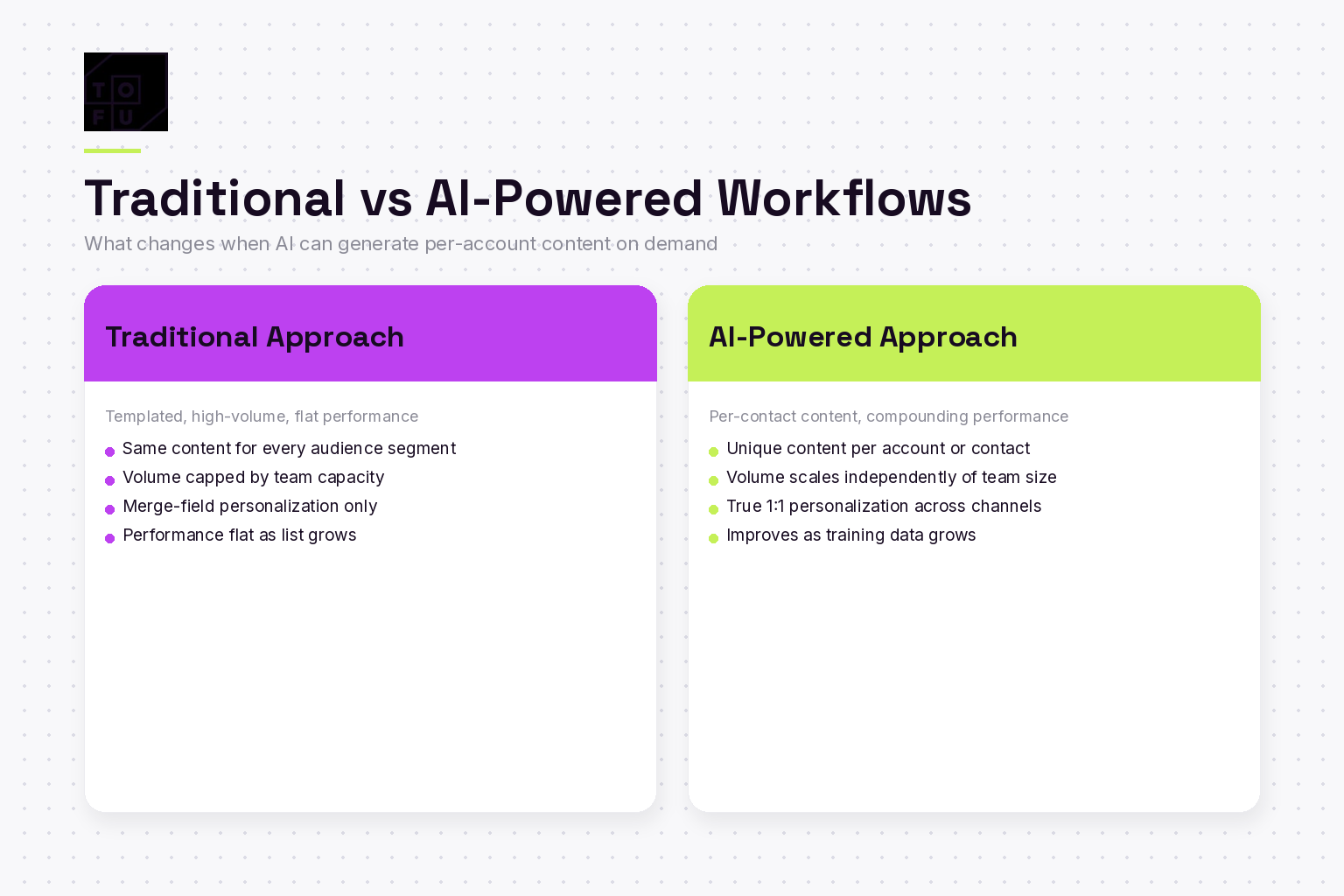
Decision 1: Do you need to create new pages or optimize existing ones? This is the most important distinction. If your challenge is that you need unique landing pages for dozens or hundreds of target accounts and you cannot manually produce them, you need a generative tool like Tofu that creates pages from scratch. If you have high-performing existing pages and want to personalize elements for different visitor segments, you need an optimization tool like Mutiny, Intellimize, or Optimizely. Some teams need both: generative tools for campaign-specific account pages and optimization tools for high-traffic website pages.
Decision 2: How many accounts or segments do you need to personalize for? If you are personalizing for 5-10 broad segments (by industry, company size, or buyer role), most tools in this list can handle it. Manual variant creation is feasible at that scale. If you need personalization for 50-500+ individual accounts, you need either an AI-generative approach (Tofu) or a rule-based approach with efficient variant management (Mutiny with audience rules). At the highest scale, only automated generation is practical.
Decision 3: What is your technical capacity? Tools like Unbounce, VWO, and Mutiny are designed for marketers to use without engineering support. Optimizely and Dynamic Yield often require developer involvement for advanced implementations. Tofu requires minimal technical setup but may need workflow adjustment. HubSpot is the simplest if you are already on the platform. Be honest about your team's technical capabilities and appetite for implementation work.
Decision 4: What does your martech stack look like? If you are deeply invested in HubSpot, starting with HubSpot's native smart content is the lowest-friction option. If you run Demandbase for ABM, their built-in personalization may be sufficient. If you are adding personalization as a new capability, evaluate standalone tools on their merits. Always check integration compatibility with your CRM, MAP, and analytics tools before committing.
Decision 5: What is your budget and expected ROI? Landing page personalization tools range from under $100/month (Unbounce) to six-figure annual contracts (Demandbase, Dynamic Yield). The right investment level depends on the size of your target market, your average deal size, and the expected conversion improvement. As a rough benchmark, if personalizing landing pages helps you close even one additional enterprise deal per quarter, most tools in this category deliver positive ROI. Start with the tool that matches your immediate needs and budget, and expand as you prove results.
Decision 6: Do you need multi-channel or landing-page-only? If your personalization needs extend beyond landing pages to emails, ads, sales collateral, and microsites, prioritize platforms that cover multiple channels from a unified workflow. Tofu generates multi-channel assets from a single brief. Demandbase coordinates advertising with website personalization. Most other tools in this list are primarily or exclusively focused on web pages. Running separate tools for each channel increases complexity and risks message inconsistency.
Frequently Asked Questions
What is the difference between generating personalized landing pages and personalizing existing pages?
Generating personalized landing pages means using AI to create entirely new pages from scratch for each account or segment. The page content, structure, proof points, and messaging are all tailored to the target. This approach, used by tools like Tofu, enables deeper personalization but produces campaign-specific pages rather than modifying your live website. Personalizing existing pages means dynamically changing elements (headlines, CTAs, images, sections) on pages that already exist on your site. Tools like Mutiny and Intellimize take this approach, which is faster to deploy and works on your main website but is limited by the original page structure. Many B2B teams use both approaches for different use cases.
How much website traffic do I need for landing page personalization to work?
It depends on the type of tool. Optimization-based tools like Intellimize, Optimizely, and VWO require meaningful traffic to reach statistical significance on A/B tests, typically at least several hundred conversions per variant per month. Rule-based personalization tools like Mutiny work regardless of traffic volume because they show predetermined content to defined segments. AI-generative tools like Tofu create pages independently of your website traffic since they generate standalone campaign pages. If your site has low traffic, rule-based or generative approaches are more practical than algorithmic optimization.
Can I use multiple landing page personalization tools together?
Yes, and many B2B teams do. A common combination is using a generative tool like Tofu to create personalized campaign landing pages for target accounts while using an optimization tool like Mutiny or Unbounce to personalize high-traffic website pages. Another common pattern is pairing a personalization tool with Demandbase for account identification and intent data. The key is to avoid overlapping tools that modify the same pages, as multiple JavaScript snippets can conflict and create unpredictable visitor experiences. Define clear ownership: which tool manages which pages and which use cases.
What data do I need to get started with B2B landing page personalization?
At minimum, you need a defined list of target accounts or segments and a clear understanding of what messaging should differ between them. For account-based personalization, you will also need CRM data (company names, industries, deal stages) and ideally firmographic enrichment (company size, revenue, technology stack). Intent data from providers like Bombora or G2 adds another valuable layer, indicating which topics your target accounts are actively researching. Most personalization tools can pull this data from your existing CRM and data enrichment tools through integrations. The richer your data inputs, the more relevant your personalization will be.
How long does it take to see results from landing page personalization?
Implementation timelines vary by tool. No-code tools like Mutiny and Unbounce can have personalized experiences live within days. AI-generative tools like Tofu can produce personalized landing pages within hours of setting up a campaign brief. Enterprise platforms like Optimizely and Dynamic Yield typically require weeks for full implementation. In terms of measurable results, most teams see conversion rate improvements within the first 30 to 60 days for high-traffic pages. For account-based approaches targeting specific companies, the timeline to see pipeline impact is longer, typically one to two quarters, because B2B sales cycles themselves are lengthy. Set realistic expectations and measure both leading indicators (engagement, conversion rate) and lagging indicators (pipeline, revenue).
Is landing page personalization worth the investment for small B2B teams?
It can be, but the right tool choice matters significantly. Small teams should avoid enterprise platforms with long implementation timelines and six-figure contracts. Start with HubSpot smart content if you are already on HubSpot, or Unbounce if you need to build landing pages from scratch with basic optimization. For small teams running ABM with a targeted account list, Tofu can be efficient because it automates the content creation that would otherwise require significant manual effort. The key question is whether personalization will meaningfully move your conversion rates given your traffic volume and deal sizes. If you are selling $50K+ ACV deals to a defined target market, even modest conversion improvements can justify the investment.
How do AI-generated landing pages compare to human-designed pages in conversion performance?
Current data from B2B marketing teams using AI-generated personalized landing pages shows conversion rates that are competitive with, and in many cases exceed, human-designed generic pages. The primary advantage is not that AI writes better copy than a skilled marketer, but that AI enables personalization at a scale that is impossible manually. A human-crafted landing page optimized for a single audience will typically outperform an AI-generated page for that same audience. However, 100 AI-generated pages, each personalized for a specific account, will collectively outperform sending all 100 accounts to the same generic page. The practical comparison is not "AI vs. human for one page" but "personalized AI pages for every account vs. one human-designed page for everyone." In that comparison, personalization consistently wins, with most teams reporting 2-3x improvement in engagement metrics and 30-50% improvement in conversion rates.
Ready to Generate Personalized Landing Pages at Scale?
See how Tofu creates unique, account-specific landing pages, emails, ads, and sales collateral from a single campaign brief. Request a demo to see your own accounts personalized.
Request a DemoStay up to date with the latest marketing tips and tricks
Other articles in this category
Want to give tofu A try?
Request a custom demo to see how Tofu can supercharge your GTM efforts.
ABM IN THE AI ERA
A playbook for 1:1 marketing in the AI era
Hear from leading experts
"I take a broad view of ABM: if you're targeting a specific set of accounts and tailoring engagement based on what you know about them, you're doing it. But most teams are stuck in the old loop: Sales hands Marketing a list, Marketing runs ads, and any response is treated as intent."

"ABM has always been just good marketing. It starts with clarity on your ICP and ends with driving revenue. But the way we get from A to B has changed dramatically."
.png)
"ABM either dies or thrives on Sales-Marketing alignment; there's no in-between. When Marketing runs plays on specific accounts or contacts and Sales isn't doing complementary outreach, the whole thing falls short."

"In our research at 6sense, few marketers view ABM as critical to hitting revenue goals this year. But that's not because ABM doesn't work; it's because most teams haven't implemented it well."
"To me, ABM isn't a campaign; it's a go-to-market operating model. It starts with cross-functional planning: mapping revenue targets, territories, and board priorities."

"With AI, we can personalize not just by account, but by segment, by buying group, and even by individual. That level of precision just wasn't possible a few years ago."
%201%20(1).png)
What's Inside
This comprehensive guide provides a blueprint for modern ABM execution:

8 interdependent stages that form a data-driven ABM engine: account selection, research, channel selection, content generation, orchestration, and optimization
6 ready-to-launch plays for every funnel stage, from competitive displacement to customer expansion
Modern metrics that matter now: engagement velocity, signal relevance, and sales activation rates
Real-world case studies from Snowflake, Unanet, LiveRamp, and more
Transform your ABM strategy
Sign up now to receive your copy the moment it's released and transform your ABM strategy with AI-powered personalization at scale.
Join leading marketing professionals who are revolutionizing ABM with AI