
Best AI Tools for B2B Email Personalization in 2026
Last updated: April 29, 2026
The best AI tools for personalizing B2B emails in 2026 are Lavender, Autobound, Outreach, Salesloft, Apollo, Instantly, Copy.ai, HubSpot (email AI features), Regie.ai, and Tofu. These platforms span the full spectrum of email personalization — from real-time coaching that helps individual reps write better emails to AI engines that generate entire account-personalized campaigns from a single brief. The impact is significant: according to Autobound's 2026 analysis, AI-personalized emails achieve an average 18% reply rate compared to 3.4% for generic templates — a 5.2x improvement. When multiple personalization signals are layered (funding rounds, leadership changes, LinkedIn activity), reply rates climb to 25-40%. Email remains the number-one outbound channel for B2B sales teams, and the tools you use to personalize it now determine whether your messages get responses or get ignored.
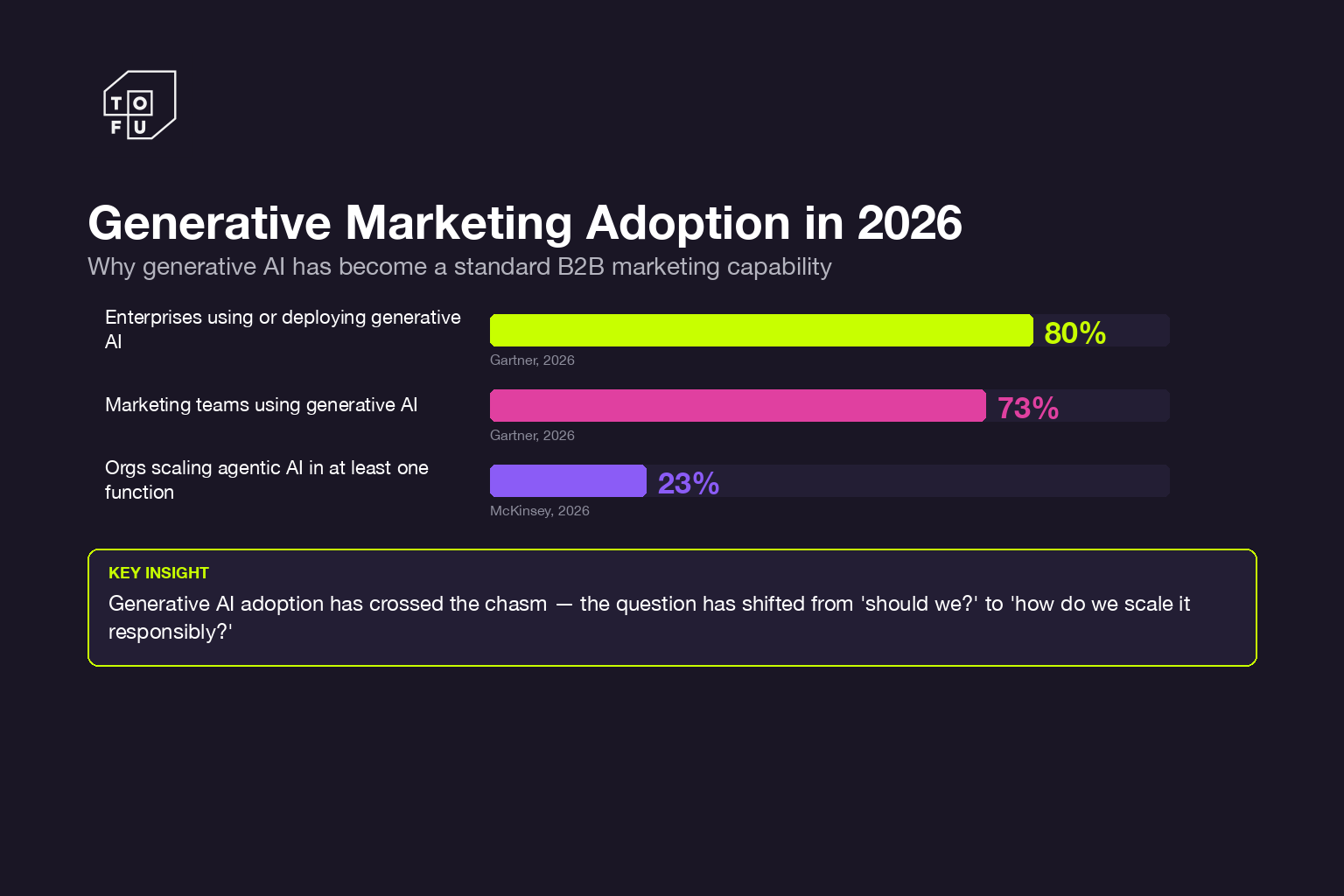
The market context: According to Gartner (2026), more than 80% of enterprises will have used generative AI APIs or deployed generative AI-enabled applications by end of 2026. According to Gartner's 2026 survey of 418 marketing leaders, 73% of marketing teams now use generative AI. And according to McKinsey (2026), 23% of organizations are already scaling agentic AI in at least one function — with marketing leading the way as the most common first deployment.
Why Email Personalization Has Moved Beyond First Names
For years, "email personalization" in B2B meant inserting a first name, company name, and maybe a job title into a template. That era is over. Buyer expectations have shifted — decision-makers receive dozens of outbound emails daily, and anything that reads like a template gets deleted or marked as spam. According to Knak's 2026 email statistics report, AI-optimized campaigns now average a 13.44% click-through rate compared to 3% for non-AI campaigns, and AI-generated subject lines achieve 50% higher open rates than manually written alternatives.
Modern email personalization operates on three levels. Surface-level personalization inserts known data points — name, company, title — into pre-written templates. Most tools have supported this for years, and it is now table stakes. Context-level personalization references specific signals about the recipient — a recent funding round, a job change, a technology adoption, or a piece of content they published — to make the email feel researched and relevant. Campaign-level personalization tailors the entire email campaign — messaging, value propositions, case studies, and supporting assets — to a specific account's industry, challenges, and buying stage. The tools in this comparison differ primarily in which level of personalization they deliver and how they fit into your existing workflow.
The 10 Best AI Tools for B2B Email Personalization
1. Lavender
What it does for email personalization: Lavender is an AI email coaching platform that operates as a browser extension, analyzing and scoring your emails in real time as you write them. It rates each email on a 1-100 scale based on factors like optimal length (50-125 words), reading level, question placement, and tone. When you start composing an outbound email, Lavender pulls prospect data from LinkedIn and company sources to suggest specific personalization angles — recent company news, shared connections, or relevant talking points — and coaches you on how to weave them into your message naturally. The AI flags issues like pushy language, excessive formality, or generic openers, and suggests rewrites that sound more human and relevant.

Best for: Individual sales reps and SDR teams that want real-time coaching to improve email quality, reply rates, and personalization habits on a per-email basis.
Key features: Real-time email scoring (1-100 scale), AI-generated personalization suggestions based on prospect data, sentiment and tone analysis, AI email generation from minimal input, team analytics and coaching dashboards (Teams tier), and integration into the email composition workflow via Chrome extension.
Integrations: Gmail, Outlook, Outreach, Salesloft, HubSpot, and Apollo via Chrome extension. Works within the email composition window of each platform.
Pricing: Free tier (5 emails/month). Starter at $29/month with email scoring, coaching, and basic analytics. Individual Pro at $49/month with advanced personalization depth and detailed analytics. Teams at $69/user/month with team analytics, shared templates, and collaboration features. Annual billing offers approximately 20% discount.
Limitations: Lavender is a coaching and optimization tool — it improves the emails reps write but does not generate entire personalized campaigns or supporting assets. Personalization is applied one email at a time within the composition window, which limits throughput for teams sending hundreds of personalized emails daily. It does not create landing pages, one-pagers, or multi-format content. The free tier is extremely limited at 5 emails per month.
2. Autobound
What it does for email personalization: Autobound is purpose-built for generating hyper-personalized outbound emails at scale. Its AI Studio scans 350+ real-time signals — including 35+ news event categories, leadership changes, social activity, competitor moves, technology adoptions, and funding rounds — and combines them with your Content Hub (your products, personas, case studies, and messaging guidelines) to generate emails that reference specific, timely information about each prospect. Unlike coaching tools that help you write better, Autobound writes the personalized email for you based on deep prospect research it performs automatically.
Best for: SDR teams and sales organizations that need to generate high volumes of personalized outbound emails without manual research per prospect.
Key features: AI-generated emails from 350+ real-time prospect signals, Content Hub for brand voice and messaging consistency, full sequence generation (emails, LinkedIn messages, call scripts, follow-ups) in one pass, Chrome extension that works inside Gmail, Outlook, Salesloft, and Outreach, and customizable personalization signal weighting.
Integrations: Gmail, Outlook, Salesloft, Outreach, HubSpot, Salesforce, and LinkedIn via Chrome extension.
Pricing: Free tier available. Paid plans start at approximately $49/month and scale up to $89/month per user. Enterprise custom pricing available for larger teams.
Limitations: Autobound excels at individual prospect-level email personalization but does not generate broader campaign assets like landing pages, microsites, or one-pagers that support the email. Personalization quality depends on the availability of public signals — prospects with limited online presence receive less differentiated emails. Output can occasionally feel formulaic if the AI leans too heavily on a single signal type (e.g., always leading with a funding round).
3. Outreach
What it does for email personalization: Outreach is the leading sales engagement platform, and its AI email capabilities have expanded significantly. Smart Email Assist generates complete email drafts based on prospect context, sequence position, and prior engagement history. The platform's AI analyzes which email variants perform best for specific persona types and automatically recommends messaging adjustments. Outreach also provides sentiment analysis on replies — categorizing responses by intent so reps can prioritize follow-ups — and sequence optimization recommendations based on aggregate performance data across your team. For most B2B sales organizations, Outreach is the workflow engine where personalized emails are actually sent, making its native AI personalization capabilities particularly relevant.
Best for: Mid-market and enterprise sales teams that need a full sales engagement platform with built-in AI email generation, sequence management, and pipeline analytics.
Key features: Smart Email Assist for AI-generated drafts, multi-step sequences across email, phone, LinkedIn, and SMS, A/B testing at the sequence and email level, sentiment analysis on replies, conversation intelligence (Kaia), deal forecasting, and engagement scoring.
Integrations: Salesforce, HubSpot, Microsoft Dynamics, LinkedIn Sales Navigator, Gong, 6sense, and extensive API.
Pricing: Not publicly listed — requires a custom quote. Industry estimates place typical pricing at $100-$160 per user per month. Minimum seat requirements apply.
Limitations: Outreach's AI email generation is improving but remains focused on individual email drafts within sequences rather than full campaign-level personalization. The platform does not generate landing pages, one-pagers, or multi-format assets that complement outbound emails. Pricing is opaque and tends toward the higher end of the market, which can be prohibitive for smaller teams. Setup complexity requires dedicated RevOps support.
4. Salesloft
What it does for email personalization: Salesloft has made AI email personalization a central feature of its platform through its AI Email Agents. The system works in two stages: an Account Research Agent gathers key insights about the target account — industry context, recent news, technology stack, competitive landscape — and compiles them into an account brief. Then the Email Personalization Agent uses that brief to craft a personalized email for the specific prospect, aligned to the communication goal you have set for each cadence step. For a first-touch email, the AI might introduce your company and address a specific pain point; for a follow-up, it might reference a customer story relevant to the prospect's industry. Scheduled AI email generation pre-generates drafts at the times your cadence runs, so reps review personalized emails rather than starting from blank screens.
Best for: Revenue teams that want AI-generated personalized emails embedded directly into their cadence workflow, with automatic account research and scheduled draft generation.
Key features: AI Email Agents with Account Research Agent and Email Personalization Agent, Rhythm AI engine for action prioritization, configurable communication goals per cadence step, scheduled AI email generation, multi-channel cadences (email, phone, social), conversation intelligence, and deal management.
Integrations: Salesforce, HubSpot, Microsoft Dynamics, LinkedIn Sales Navigator, and extensive partner ecosystem.
Pricing: Not publicly listed. Three tiers: Essentials, Advanced, and Premier. Industry estimates range from $125-$200 per user per month depending on tier and seat count. Minimum seat requirements (typically 10-15 users) apply.
Limitations: Salesloft's AI email personalization is strong within the cadence workflow but does not extend to broader marketing assets. Like Outreach, it generates individual email drafts rather than full personalized campaigns with supporting content. The account research agent's quality depends on available public data. Pricing with minimum seat requirements makes it expensive for smaller teams. The platform is a sales engagement tool, not a marketing platform — marketing-owned email campaigns require a separate MAP.
5. Apollo
What it does for email personalization: Apollo.io combines a massive B2B contact database (275M+ contacts) with built-in AI email capabilities, making it a popular choice for teams that want prospecting and personalized outreach in a single platform. Apollo's AI Research feature generates personalized talking points for each lead based on their LinkedIn profile, company news, and firmographic data. The AI Writing feature creates email copy and suggests subject lines tailored to each prospect. Apollo also provides AI Lead Scoring to prioritize outreach, email warmup tools to protect domain reputation, and the ability to connect multiple mailboxes and rotate sends. For teams that do not want to piece together separate tools for data, sequencing, and personalization, Apollo offers a unified workflow.
Best for: Growth-stage B2B teams that want prospecting data, email sequencing, and AI personalization in a single, cost-effective platform.
Key features: 275M+ contact database with email and phone data, AI-generated personalized talking points and email copy, multi-step email sequences with A/B testing, AI lead scoring, email warmup and deliverability tools, meeting intelligence with AI summaries, and intent data signals.
Integrations: Salesforce, HubSpot, Outreach, Salesloft, LinkedIn, Zapier, and extensive API.
Pricing: Free tier available. Basic at $49/user/month (annual). Professional at $79/user/month (annual). Organization at $119/user/month (annual). Monthly billing adds 15-25%. Credit-based system for contact data — additional credits cost $0.20 each after allocation is exhausted. Real-world costs typically reach $150-$400/user/month when factoring in credit overages.
Limitations: Apollo's AI personalization is functional but less sophisticated than purpose-built tools like Autobound or Lavender. Email copy generation tends toward generic patterns when prospect data is limited. The credit system for contact data can create unpredictable costs, particularly for teams doing high-volume outreach. Data accuracy varies — email verification rates are not 100%, which impacts deliverability. Apollo is primarily a prospecting and outreach tool; it does not generate landing pages, one-pagers, or multi-format campaign assets.
6. Instantly
What it does for email personalization: Instantly.ai is a cold email platform built for high-volume outbound with AI-driven personalization. Its AI Copilot crafts and personalizes outreach at scale — including subject lines, email bodies, and follow-up sequences — optimized specifically for reply rates. The AI Sequence Generator writes full email sequences based on your ICP and offer description. What sets Instantly apart is its infrastructure focus: unlimited email account connections, automated warmup across all accounts, mailbox rotation for deliverability, and subsequences that create behavior-based branching (prospects who clicked but did not reply get a different follow-up path than those who ignored everything). For teams where email volume and deliverability are as important as personalization, Instantly balances both.
Best for: Cold email teams and agencies that need high-volume personalized outreach with strong deliverability infrastructure and AI-generated sequences.
Key features: AI Copilot for email personalization and sequence generation, unlimited email account connections, automated email warmup, mailbox rotation, behavior-based subsequences, automated out-of-office detection and rescheduling, AI response categorization by intent, Unibox for unified inbox management, and A/B testing.
Integrations: HubSpot, Salesforce, Slack, Webhooks, Zapier, and API access. Lead database and CRM add-ons available.
Pricing: Growth at $37.60/month (annual) or $47/month (monthly) — includes 5,000 emails/month, 1,000 uploaded contacts, unlimited email accounts. Hypergrowth at $77.60/month (annual) with Unibox, A/B testing, and 100K-125K monthly sends. A fully functional setup with leads, CRM, and add-ons typically runs $150-$400/month depending on volume.
Limitations: Instantly's personalization is oriented toward cold email and top-of-funnel outreach rather than mid-funnel or account-based campaigns. The AI generates functional personalized emails, but depth is limited compared to tools like Autobound that scan 350+ signals per prospect. Instantly does not generate supporting campaign assets (landing pages, one-pagers, microsites). The platform's strength is volume and deliverability; teams that prioritize deep account-level personalization over volume may find the personalization surface-level.
7. Copy.ai
What it does for email personalization: Copy.ai has evolved from a general-purpose AI copywriting tool into what it describes as an orchestration layer for go-to-market teams. For email personalization specifically, Copy.ai can pull personalization data from a prospect's public LinkedIn profile and generate personalized cold emails using proven copywriting frameworks. The platform's Workflows feature connects lead research, data enrichment, email generation, and content repurposing into automated pipelines — so rather than writing one email at a time, you can set up a workflow that takes a list of prospects, researches each one, and generates personalized emails in batch. Copy.ai also generates subject lines, email body variations, and personalized CTAs, and can adapt tone and messaging style to match your brand voice.
Best for: Marketing and sales teams that want a flexible AI content platform that handles email personalization alongside other content needs (social posts, blog content, ad copy) in a single tool.
Key features: AI email generation with LinkedIn-based personalization, Workflows for automated multi-step content pipelines, cold email generator with copywriting framework templates, subject line and CTA generation, brand voice customization, and multi-format content creation beyond email.
Integrations: Salesforce, HubSpot, Zapier, and API access. Workflows can connect to data enrichment and CRM tools.
Pricing: Free plan with 2,000 words/month. Paid plans start at $49/month for 5 users with unlimited words and projects. Enterprise pricing available for larger teams.
Limitations: Copy.ai is a generalist content platform that handles email among many content types. Its email personalization is effective but lacks the depth of purpose-built tools like Autobound (which scans 350+ signals) or Lavender (which provides real-time scoring and coaching). The Workflows feature is powerful but requires setup and configuration. Copy.ai does not provide email sending infrastructure, sequencing, or deliverability tools — it generates the content that you then put into your SEP or MAP. Account-level personalization depth is limited compared to platforms that integrate directly with CRM and intent data.
8. HubSpot (Email AI Features)
What it does for email personalization: HubSpot's AI-powered email features, available in Marketing Hub Professional and Enterprise, use unified CRM data to generate personalized email content at scale. Rather than relying on static merge tags, HubSpot's AI analyzes structured CRM data — lifecycle stage, firmographic attributes, website behavior, and engagement history — to automatically tailor subject lines, body copy, offers, and send timing. The AI Email Writer drafts complete emails directly inside Marketing Hub, and marketers can prompt it to adjust tone, emphasize specific features, or generate multiple variations aligned to a selected segment. Predictive send-time optimization evaluates behavioral patterns to determine when each contact is most likely to engage. For teams already using HubSpot as their CRM and MAP, these AI features add a personalization layer without introducing another tool.
Best for: B2B marketing teams already on HubSpot that want AI-powered email personalization without adding another vendor to their stack.
Key features: AI Email Writer for subject lines, body copy, and CTAs, predictive send-time optimization per contact, smart content for dynamic email personalization by segment, A/B testing for email campaigns, CRM-driven personalization using lifecycle stage, firmographics, and behavioral data, and campaign analytics with attribution.
Integrations: Native CRM, Salesforce, LinkedIn, Google Ads, Slack, Zoom, and 1,500+ apps via the HubSpot App Marketplace.
Pricing: Marketing Hub Starter at $20/month per seat. Professional at $890/month (includes 3 seats) — this is the minimum tier for AI email features. Enterprise at $3,600/month (includes 5 seats). Contact-tier pricing applies as your database grows.
Limitations: HubSpot's email AI is improving rapidly but remains primarily a marketing email tool rather than an outbound sales personalization engine. Personalization is driven by CRM data and segment membership, which means it is strongest for contacts already in your database with engagement history — less effective for cold outreach to new prospects. The AI generates email content but does not produce personalized landing pages, one-pagers, or microsites to accompany email campaigns. Professional tier pricing ($890/month) is a significant step up from Starter, which may be a barrier for smaller teams.
9. Regie.ai
What it does for email personalization: Regie.ai generates personalized outbound emails using generative AI trained on high-performing sales content. The platform pulls personalization data from LinkedIn profiles, company news, recent podcast appearances, blog posts, and job postings to create emails that reference specific, timely information about each prospect. What differentiates Regie.ai is its AI agent approach: AI agents monitor continuously, scoring and prioritizing buyers based on real-time intent signals like job changes, site activity, and competitor research, then adjusting outreach timing, messaging, and prioritization automatically. The platform positions itself as an "AI SEP" — an AI-native sales engagement platform that combines prospecting intelligence, content generation, and send execution in one system.
Best for: SDR teams that want an AI-native sales engagement platform that handles prospect research, email generation, and send prioritization in a single workflow.
Key features: AI-generated personalized emails from LinkedIn, news, and intent signals, AI agents for continuous buyer scoring and prioritization, full sequence generation (email, social, call scripts), adjustable outreach timing based on engagement and intent signals, and content trained on high-performing sales messaging patterns.
Integrations: Outreach, Salesloft, Salesforce, HubSpot, and LinkedIn.
Pricing: AI SEP at $180/user/month. Force Multiplier Rep at $499/user/month. Regie.ai has also introduced a flat $35,000/year model (~$2,917/month) across plans. AI dialer add-on at $150/rep/month on top. Enterprise custom pricing available.
Limitations: Regie.ai's pricing is among the highest in this comparison, putting it out of reach for smaller teams. User reviews consistently note that AI-generated emails can occasionally sound robotic or formulaic — a significant concern for a platform whose core value proposition is AI-generated content. The platform does not create supporting campaign assets like landing pages or microsites. Quality of personalization depends heavily on the availability of public prospect data.
10. Tofu
What it does for email personalization: Tofu, an agentic demand generation platform, takes a fundamentally different approach to email personalization. Rather than coaching reps on individual emails or generating one-off personalized messages, Tofu generates full personalized email campaigns from a single campaign brief combined with CRM data. The AI creates account-level personalized email copy alongside matching landing pages, microsites, one-pagers, ads, and sales collateral — so every touchpoint in the campaign is tailored to the specific target account's industry, challenges, technology stack, and buying stage. This campaign-level personalization means the email a prospect receives links to a landing page that speaks to their specific context, supported by a one-pager their sales rep can share — all generated from one brief rather than produced individually by a content team.
Best for: B2B marketing teams running account-based campaigns that need to produce personalized email campaigns with matching multi-format assets at scale, without multiplying production effort.
Key features: AI-generated personalized email campaigns from a single brief, true 1:1 account-level personalization using firmographic, technographic, and intent data, multi-format asset generation (emails, landing pages, microsites, one-pagers, ads, sales collateral) from the same brief, CRM data integration for personalization at scale, and brand-consistent output across all generated assets.
Integrations: HubSpot, Salesforce, Outreach, Salesloft.
Pricing: Custom pricing — contact Tofu for a quote.
Limitations: Tofu is a campaign content generation platform, not a sales engagement tool or email coaching assistant. It does not provide email sending infrastructure, cadence management, or real-time email scoring. You need a MAP (HubSpot, Marketo) or SEP (Outreach, Salesloft) to deliver the personalized emails Tofu generates. It is designed for campaign-level personalization at the account level rather than individual rep-level email optimization. Teams that primarily need help improving one-off outbound emails rather than scaling personalized campaigns may find purpose-built tools like Lavender or Autobound a better fit.
Disclosure: Tofu is our product. We have included it in this comparison alongside competitors for transparency. All tools were evaluated using the same criteria.
Comparison Table: AI Tools for B2B Email Personalization
| Tool | Best For | Email AI Capability | Personalization Depth | Integrations | Pricing |
|---|---|---|---|---|---|
| Lavender | Real-time email coaching for reps | Scores, coaches, and rewrites emails in real time as you compose | Individual email — prospect-level suggestions based on LinkedIn and company data | Gmail, Outlook, Outreach, Salesloft, HubSpot | Free-$69/user/mo |
| Autobound | High-volume signal-based personalized emails | Generates complete emails from 350+ real-time prospect signals | Deep prospect-level — news, leadership changes, social activity, tech stack | Gmail, Outlook, Salesloft, Outreach, HubSpot, Salesforce | Free-$89/user/mo |
| Outreach | Enterprise sales engagement with AI email | Smart Email Assist generates drafts; sentiment analysis on replies | Prospect-level — based on sequence context, engagement history, and persona | Salesforce, HubSpot, Dynamics, LinkedIn, 6sense | ~$100-$160/user/mo (quote) |
| Salesloft | AI email agents within cadence workflows | AI Email Agents auto-research accounts and generate personalized drafts per cadence step | Account + prospect-level — AI Research Agent builds briefs, Email Agent writes from them | Salesforce, HubSpot, Dynamics, LinkedIn | ~$125-$200/user/mo (quote) |
| Apollo | All-in-one prospecting + personalized outreach | AI Research generates talking points; AI Writing creates email copy and subject lines | Prospect-level — LinkedIn, company news, firmographic data | Salesforce, HubSpot, Outreach, Salesloft, LinkedIn | Free-$119/user/mo + credits |
| Instantly | High-volume cold email with deliverability | AI Copilot writes sequences; behavior-based subsequences for branching | Surface to context-level — ICP-based sequences with behavioral branching | HubSpot, Salesforce, Slack, Zapier | $37.60-$77.60/mo + add-ons |
| Copy.ai | Flexible AI content across email + other formats | Generates personalized emails via Workflows with LinkedIn data enrichment | Prospect-level — LinkedIn-based personalization with copywriting frameworks | Salesforce, HubSpot, Zapier, API | Free-$49/mo (5 users) |
| HubSpot (Email AI) | CRM-driven marketing email personalization | AI Email Writer + predictive send-time + smart content for dynamic personalization | Segment to contact-level — driven by CRM data, lifecycle stage, and engagement history | Native CRM, Salesforce, LinkedIn, 1,500+ apps | $890/mo+ (Professional required) |
| Regie.ai | AI-native sales engagement platform | AI agents generate emails, score buyers, and adjust outreach timing automatically | Prospect-level — LinkedIn, news, intent signals, with AI-driven timing optimization | Outreach, Salesloft, Salesforce, HubSpot | $180-$499/user/mo |
| Tofu | Full personalized campaigns from a single brief | Generates email campaigns + matching landing pages, one-pagers, and assets from one brief | Account-level — full campaign personalization using firmographic, technographic, and intent data | HubSpot, Salesforce, Outreach, Salesloft | Custom (contact for quote) |
How to Choose the Right Email Personalization Tool
The tools in this comparison serve different roles in the email personalization workflow. Choosing the right one depends on what you need most:

If your reps need to write better emails: Lavender is the strongest choice. It operates in the composition window, coaching reps in real time on how to personalize each email based on prospect research. It builds better habits over time and is the most affordable option for individual contributor improvement.
If you need AI to write personalized emails at volume: Autobound and Regie.ai are purpose-built for this. Autobound scans 350+ signals per prospect and generates complete emails at scale. Regie.ai adds AI agent-driven timing and prioritization on top of content generation. Autobound is significantly less expensive; Regie.ai offers deeper automation.
If you need a sales engagement workflow with built-in AI email: Outreach and Salesloft are the workflow engines where most B2B sales teams execute outbound sequences. Both now include meaningful AI email generation. Salesloft's AI Email Agents with Account Research Agent represent the most advanced native AI personalization in the SEP category. Outreach's Smart Email Assist is reliable and deeply integrated into sequence management.
If you need prospecting data and personalized email in one platform: Apollo combines a massive contact database with AI email generation and sequencing. It is the most cost-effective option for teams that want to consolidate their prospecting and outbound stack.
If you need high-volume cold email with deliverability infrastructure: Instantly excels at the intersection of volume, deliverability, and AI personalization. Unlimited email accounts, automated warmup, and behavior-based subsequences make it the go-to for teams where send volume and inbox placement are critical.
If you need full personalized campaigns, not just personalized emails: Tofu generates email campaigns alongside matching landing pages, microsites, one-pagers, and sales collateral from a single brief. This is a different category than the other tools — it solves the problem of producing personalized multi-format campaign content at the account level, not just personalizing individual emails.
Evaluation Methodology
The tools in this comparison were selected and evaluated based on four criteria specific to AI-powered B2B email personalization:
1. Email personalization capability: We assessed each tool's ability to personalize outbound and marketing emails beyond basic merge tags. We evaluated the depth of personalization (surface-level, context-level, or campaign-level), the signals used for personalization (LinkedIn data, company news, intent signals, CRM data, firmographics), and whether the tool generates personalized content, coaches users to create it, or optimizes existing content.
2. Workflow integration: Email personalization tools must fit into existing workflows. We evaluated how each tool integrates with the platforms where B2B teams actually send emails — primarily Outreach, Salesloft, HubSpot, Salesforce, Gmail, and Outlook. Tools that require reps to copy-paste from a separate interface scored lower than those embedded directly into the composition or sequencing workflow.
3. Scalability: We considered how each tool performs when personalization needs to scale from tens of emails to thousands. Some tools (Lavender) are designed for per-email optimization. Others (Autobound, Instantly, Tofu) are designed for batch or campaign-level personalization. Both approaches are valid; the distinction helps buyers match tools to their volume requirements.
4. Pricing transparency and value: B2B email tools vary enormously in pricing — from free tiers to $35,000+/year. We documented actual pricing where publicly available and industry estimates where it is not. We flagged hidden costs (credit systems, minimum seat requirements, add-on modules) that affect total cost of ownership.
Frequently Asked Questions
What are the best AI tools for personalizing B2B emails?
The best AI tools for personalizing B2B emails in 2026 are Lavender for real-time email coaching and scoring, Autobound for generating hyper-personalized emails from 350+ prospect signals, Outreach and Salesloft for sales engagement platforms with built-in AI email generation, Apollo for combining prospecting data with AI email writing, Instantly for high-volume cold email with AI personalization and deliverability infrastructure, Copy.ai for flexible AI content generation across email and other formats, HubSpot for CRM-driven marketing email personalization, Regie.ai for AI-native sales engagement with agent-driven timing, and Tofu for generating full personalized email campaigns with matching landing pages and assets from a single brief. Most B2B teams use 2-3 of these tools together — typically a personalization or coaching tool layered on top of a sales engagement platform or MAP.
How do I personalize outbound emails beyond just the first name?
Personalizing outbound emails beyond the first name requires incorporating three categories of information. First, company-level context: reference the prospect's industry challenges, recent company news (funding rounds, acquisitions, earnings), technology stack, company size, and competitive landscape. Tools like Autobound and Regie.ai scan these signals automatically. Second, individual-level context: reference the prospect's role-specific challenges, recent LinkedIn activity, published content, job tenure, or career transitions. Lavender surfaces these signals in real time as you compose. Third, relevance framing: connect these signals to a specific reason your product or service matters to this person at this company right now. The most effective personalized emails demonstrate that you have done research (context) and that the research led to a specific, relevant insight (framing) — not just that you know facts about the prospect. AI tools accelerate this by automating the research and generating the connection between prospect context and your value proposition.
Can AI write personalized emails for each target account?
Yes — AI can now write personalized emails for individual target accounts at scale. Tools like Autobound generate complete emails using 350+ real-time signals per prospect, including company news, technology stack, leadership changes, and competitive intelligence. Salesloft's AI Email Agents combine an Account Research Agent (which builds an account brief from public data) with an Email Personalization Agent (which writes the email from that brief). Tofu takes this further by generating entire personalized email campaigns — not just individual emails but complete campaigns with matching landing pages, one-pagers, and sales collateral — all tailored to a specific account's industry, challenges, and buying stage using firmographic, technographic, and intent data from CRM integrations. The quality of AI-generated personalized emails depends on two factors: the depth of data available about the target account and the quality of the AI model's training on your messaging, personas, and value propositions.
What's the difference between AI email coaching and AI email generation?
AI email coaching tools analyze emails you write and provide real-time feedback to improve them. Lavender is the leading example — it scores your email, flags issues with tone or length, suggests personalization angles, and coaches you toward better habits. The human writes the email; the AI makes it better. AI email generation tools write the email for you based on prospect data and your messaging guidelines. Autobound, Regie.ai, and Salesloft's AI Email Agents are examples — they research the prospect, identify personalization angles, and produce a complete draft. The AI writes the email; the human reviews and sends it. Some tools blend both approaches: Apollo generates email drafts but also provides optimization suggestions. The right choice depends on your team's needs. Coaching tools build better long-term skills and give reps full control over messaging. Generation tools maximize throughput and consistency, especially valuable for high-volume SDR teams. Many teams use both — a generation tool for initial drafts and a coaching tool like Lavender to polish them before sending.
What AI email tools integrate with Outreach and Salesloft?
Several AI email personalization tools integrate directly with Outreach and Salesloft to enhance their native capabilities. Lavender works as a Chrome extension within both platforms, providing real-time coaching and scoring as reps compose emails inside Outreach or Salesloft. Autobound also operates via Chrome extension within both platforms, generating personalized email content that reps can insert directly into sequences. Regie.ai offers native integrations with both Outreach and Salesloft, feeding AI-generated personalized emails directly into cadences and sequences. Tofu integrates with both platforms to push personalized email campaign content into sequences for delivery. Both Outreach and Salesloft also have their own built-in AI email generation — Outreach's Smart Email Assist and Salesloft's AI Email Agents — which means teams can layer third-party personalization tools on top of native AI capabilities for deeper personalization.
How much does AI email personalization improve response rates?
AI email personalization delivers measurable improvements across key email metrics. According to 2026 benchmark data, AI-personalized emails achieve an average 18% reply rate compared to 3.4% for generic templates — a 5.2x improvement (Autobound, 2026). When multiple personalization signals are layered (for example, a funding round combined with a LinkedIn post and a job change), reply rates climb to 25-40%. AI-generated subject lines achieve 50% higher open rates than manually written alternatives (Knak, 2026). AI-optimized campaigns average a 13.44% click-through rate compared to 3% for non-AI campaigns. On the revenue side, marketers using AI for email personalization report a 41% revenue increase on average (Digital Applied, 2026). The magnitude of improvement depends on your baseline — teams moving from completely generic templates see the largest gains, while teams that already do manual research-based personalization see more incremental (but still meaningful) lifts from AI-assisted scaling.
What's the best AI tool for cold email personalization?
The best AI tool for cold email personalization depends on your volume and depth requirements. For high-volume cold email where deliverability and scale are priorities, Instantly combines AI-generated sequences with unlimited email accounts, automated warmup, and behavior-based branching — it is the strongest infrastructure play. For deep personalization per prospect at moderate volume, Autobound is the most capable, scanning 350+ signals per prospect to generate emails that reference specific, timely information. For individual rep effectiveness, Lavender coaches reps to write better cold emails in real time with prospect-specific suggestions. For all-in-one prospecting and cold email, Apollo provides the contact database, AI email writing, and sequencing in a single platform at competitive pricing. For cold email as part of broader account-based campaigns, Tofu generates personalized email campaigns alongside matching landing pages and assets — so the cold email links to a personalized landing page rather than a generic website. The most effective cold email programs typically combine a personalization or generation tool (Autobound, Lavender, or Tofu) with a delivery platform (Instantly, Outreach, or Salesloft) rather than relying on a single tool for both.
Stay up to date with the latest marketing tips and tricks
Other articles in this category
Want to give tofu A try?
Request a custom demo to see how Tofu can supercharge your GTM efforts.
ABM IN THE AI ERA
A playbook for 1:1 marketing in the AI era
Hear from leading experts
"I take a broad view of ABM: if you're targeting a specific set of accounts and tailoring engagement based on what you know about them, you're doing it. But most teams are stuck in the old loop: Sales hands Marketing a list, Marketing runs ads, and any response is treated as intent."

"ABM has always been just good marketing. It starts with clarity on your ICP and ends with driving revenue. But the way we get from A to B has changed dramatically."
.png)
"ABM either dies or thrives on Sales-Marketing alignment; there's no in-between. When Marketing runs plays on specific accounts or contacts and Sales isn't doing complementary outreach, the whole thing falls short."
"In our research at 6sense, few marketers view ABM as critical to hitting revenue goals this year. But that's not because ABM doesn't work; it's because most teams haven't implemented it well."
"To me, ABM isn't a campaign; it's a go-to-market operating model. It starts with cross-functional planning: mapping revenue targets, territories, and board priorities."

"With AI, we can personalize not just by account, but by segment, by buying group, and even by individual. That level of precision just wasn't possible a few years ago."
%201%20(1).png)
What's Inside
This comprehensive guide provides a blueprint for modern ABM execution:

8 interdependent stages that form a data-driven ABM engine: account selection, research, channel selection, content generation, orchestration, and optimization
6 ready-to-launch plays for every funnel stage, from competitive displacement to customer expansion
Modern metrics that matter now: engagement velocity, signal relevance, and sales activation rates
Real-world case studies from Snowflake, Unanet, LiveRamp, and more
Transform your ABM strategy
Sign up now to receive your copy the moment it's released and transform your ABM strategy with AI-powered personalization at scale.
Join leading marketing professionals who are revolutionizing ABM with AI