
Best AI Tools for Automated Lead Nurture in 2026

Last updated: April 17, 2026
The best AI tools for automated lead nurture in 2026 are HubSpot Marketing Hub, Marketo Engage, Salesforce Marketing Cloud Account Engagement, ActiveCampaign, Outreach, Salesloft, 6sense, Customer.io, Qualified, and Tofu. Each platform brings a different strength to the nurture workflow — from orchestration engines and intent-driven timing to personalized content generation and conversational engagement. According to Forrester's 2026 B2B Marketing Automation report, companies using AI-powered lead nurture see 45% higher engagement rates and 30% faster pipeline velocity compared to teams relying on traditional drip campaigns. With the average B2B buying cycle involving 11 stakeholders over 6-12 months, choosing the right combination of tools to nurture leads at every stage is one of the highest-leverage decisions a marketing team can make.
The market context: According to Forrester (2026), companies using AI-powered lead nurture see 25% higher conversion rates than those using traditional drip sequences. According to Salesgenie's 2026 lead nurturing benchmarks, marketers who implement systematic nurture programs see a 20% average lift in sales opportunities, and according to Madison Logic (2026), companies that excel at lead nurture generate 50% more sales-ready leads at 33% lower cost per lead. Our recommended tools below map each platform to the specific lead-nurture workflow it handles best, with honest notes on each platform's potential drawbacks.
Why AI Changes Everything About Lead Nurture
Traditional lead nurture was built on a simple premise: capture a lead, drop them into a time-based email sequence, and hope they eventually convert. The problem is that this approach treats every lead identically, ignoring differences in industry context, buyer role, account stage, and real-time engagement signals.

AI-powered lead nurture changes the equation in three fundamental ways. First, behavioral intelligence replaces rigid schedules — AI models analyze engagement patterns across channels to determine the right content, timing, and cadence for each individual prospect. Second, content personalization moves beyond mail-merge variables to generate genuinely tailored messaging for specific accounts, industries, and personas. Third, predictive scoring and intent signals surface which accounts are actively researching solutions, enabling marketing teams to prioritize nurture resources where they will have the greatest impact.
The tools in this comparison cover different layers of the AI lead nurture stack. Some are full-lifecycle orchestration engines. Others specialize in one critical piece — content generation, intent detection, sales engagement, or conversational AI. Most teams will use two or three of these tools together to build a complete nurture program.
The 10 Best AI Tools for Automated Lead Nurture
1. HubSpot Marketing Hub
What it does for lead nurture: HubSpot Marketing Hub is the most widely adopted marketing automation platform for mid-market B2B teams, and its workflow engine is the backbone of many lead nurture programs. HubSpot's AI-powered features include predictive lead scoring, smart send-time optimization, AI-generated email subject lines and body copy, and automated workflow recommendations based on historical performance data. The platform's visual workflow builder lets marketers design multi-branch nurture sequences triggered by form submissions, page views, email interactions, list membership changes, and dozens of other behavioral signals.
Best for: Mid-market B2B teams that want an all-in-one CRM and marketing automation platform with a mature nurture workflow engine and strong ecosystem of integrations.
Key features: Visual nurture workflow builder with branching logic, AI lead scoring, smart content (dynamic email and landing page content by list segment), A/B testing for nurture emails, multi-channel sequences (email, ads, social), attribution reporting, and a native CRM that eliminates sync issues between marketing and sales.
Integrations: Native CRM, Salesforce, Slack, Zoom, LinkedIn Ads, Google Ads, Facebook Ads, and 1,500+ integrations via the HubSpot App Marketplace.
Pricing: Starter at $20/month per seat. Professional at $890/month (includes 3 seats). Enterprise at $3,600/month (includes 5 seats). Contact-tier pricing applies as your database grows. One-time onboarding fee of $3,000 (Professional) or $7,000 (Enterprise).
Limitations (cons): HubSpot's AI content generation is functional but limited to short-form copy — subject lines, email snippets, and social posts. It cannot generate full landing pages, one-pagers, or multi-asset campaigns from a single brief. Personalization is segment-level (by list), not true 1:1 account-level. Enterprise pricing can escalate quickly with large contact databases.
2. Marketo Engage (Adobe)
What it does for lead nurture: Marketo Engage is the enterprise standard for sophisticated lead nurture programs. Its engagement programs (formerly drip nurture) use a stream-based model where leads move between content streams based on behavior, scoring thresholds, and custom triggers. Adobe's Sensei AI layer adds predictive content recommendations, send-time optimization, and audience segmentation. Marketo's strength is handling complex, multi-track nurture programs with dozens of branching paths — something simpler platforms struggle with at scale.
Best for: Enterprise B2B organizations with complex buying cycles, large databases, and dedicated marketing operations teams who need granular control over nurture logic.
Key features: Engagement programs with content streams and transition rules, predictive content powered by Adobe Sensei, advanced lead scoring across behavioral and demographic dimensions, revenue cycle modeler, multi-touch attribution, dynamic content personalization, and account-based marketing modules.
Integrations: Salesforce (deep native integration), Microsoft Dynamics, SAP, Adobe Experience Cloud suite, and extensive API for custom integrations.
Pricing: Quote-based, scaled by database size. Industry estimates place Growth tier at approximately $1,295/month, Select/Prime tiers at $3,500-$6,000/month for mid-market teams, and Ultimate tier at $20,000-$50,000+/month for enterprise databases in the millions. Annual contracts required.
Limitations: Steep learning curve requiring dedicated marketing operations resources. Implementation timelines of 2-4 months are common. AI content generation is limited to content recommendations and optimization — Marketo does not generate net-new personalized content. Database overage charges can create significant unplanned costs.
3. Tofu
What it does for lead nurture: Tofu, an AI-native B2B marketing platform, addresses the content bottleneck that limits most nurture programs. Rather than functioning as a workflow orchestration engine, Tofu generates the personalized content that feeds into nurture sequences — landing pages, emails, ads, microsites, one-pagers, and sales collateral, all from a single campaign brief. Tofu's AI creates true 1:1 account-level personalized assets using firmographic data, technographics, intent signals, and recent company news, enabling nurture programs where every target account receives genuinely tailored content rather than segment-level variations.
Best for: B2B marketing teams running ABM or account-based nurture programs that need to produce personalized content at scale without multiplying production effort. Particularly valuable for teams already using HubSpot, Salesforce, Outreach, or Salesloft for workflow orchestration who need a content engine to fill their nurture sequences with relevant assets.
Key features: AI-generated personalized landing pages, email copy, ad variations, microsites, one-pagers, and sales collateral from a single brief. True 1:1 account-level personalization (not segment-level). Content generation informed by firmographic, technographic, and intent data. Multi-format output for every stage of the nurture funnel.
Integrations: HubSpot, Salesforce, Outreach, Salesloft.
Pricing: Custom pricing — contact Tofu for a quote.
Limitations: Tofu is a content generation platform, not a workflow orchestration engine. You still need a marketing automation platform (HubSpot, Marketo, etc.) or sales engagement tool (Outreach, Salesloft) to manage the actual nurture sequences, timing, and trigger logic. Tofu generates the content; your MAP or SEP delivers it.
Disclosure: Tofu is our product. We have included it in this comparison alongside competitors for transparency. All tools were evaluated using the same criteria.
4. Salesforce Marketing Cloud Account Engagement (Pardot)
What it does for lead nurture: Salesforce Marketing Cloud Account Engagement (formerly Pardot) is the native B2B marketing automation platform for Salesforce CRM users. Its Engagement Studio provides a visual, drag-and-drop nurture builder with triggers, rules, and actions based on prospect behavior and CRM data. Einstein AI adds predictive lead scoring, behavioral scoring, and engagement frequency optimization. The platform's deepest advantage is its native Salesforce integration — nurture programs can reference any Salesforce object, enabling highly specific trigger logic based on opportunity stage, deal value, competitive mentions, or custom fields.
Best for: B2B organizations with Salesforce as their CRM who want native marketing automation without third-party sync complexity.
Key features: Engagement Studio visual nurture builder, Einstein AI lead and behavioral scoring, dynamic content based on prospect attributes, B2B Marketing Analytics (powered by Tableau), Salesforce campaign integration, and connected campaign attribution.
Integrations: Native Salesforce CRM integration, Google Ads, LinkedIn, Slack, Eventbrite, and the Salesforce AppExchange ecosystem.
Pricing: Growth at $1,250/month. Plus at $2,500/month. Advanced at $4,000/month. Premium at $15,000/month. Annual contracts standard. Implementation costs can start at $25,000+ for enterprise deployments.
Limitations: The platform's strength — deep Salesforce integration — is also its constraint. If you are not on Salesforce CRM, Account Engagement offers limited value compared to alternatives. The user interface has improved but still lags behind HubSpot in intuitiveness. AI content generation is minimal — Einstein assists with scoring and optimization but does not generate personalized nurture content at scale.
5. ActiveCampaign
What it does for lead nurture: ActiveCampaign is a marketing automation platform that punches above its weight class for lead nurture. Its automation builder is one of the most flexible in the market, supporting complex conditional logic, wait conditions, split actions, and goal-based exits. Recent AI additions include predictive sending (optimizing delivery time per contact), predictive content (selecting the best-performing content variant for each recipient), win probability scoring, and AI-powered automation suggestions. For B2B teams with smaller budgets that still need sophisticated nurture workflows, ActiveCampaign offers the best capability-to-cost ratio.
Best for: Small to mid-market B2B teams that need advanced nurture automation at a fraction of the cost of HubSpot Professional or Marketo.
Key features: Visual automation builder with 135+ triggers and actions, predictive sending and content, site tracking and event-based triggers, lead scoring, CRM with pipeline management, conditional email content, split testing within automations, and goal tracking.
Integrations: Salesforce, HubSpot CRM (via third-party), Shopify, WordPress, Zapier, and 900+ integrations.
Pricing: Starter at $15/month (1,000 contacts). Plus at $49/month. Professional at $79/month. Enterprise at $145/month. Prices scale with contact volume — a 50,000-contact Enterprise plan reaches $1,459+/month. B2B teams should budget for the Plus or Professional tier as the realistic starting point.
Limitations: ActiveCampaign's CRM is functional but not as robust as Salesforce or HubSpot for complex B2B sales processes. Account-based features are limited compared to enterprise platforms. AI capabilities are focused on optimization (send time, content selection) rather than content generation. Reporting is adequate but lacks the depth of Marketo or HubSpot Enterprise analytics.
6. Outreach
What it does for lead nurture: Outreach is a sales engagement platform that extends lead nurture into the sales-owned portion of the funnel. While marketing automation platforms handle top-of-funnel and mid-funnel nurture, Outreach manages the sequences that sales reps use to engage MQLs, re-engage stalled opportunities, and nurture prospects through the decision stage. Outreach's AI features include Smart Email Assist (AI-generated email drafts based on prospect context), sequence optimization recommendations, sentiment analysis on replies, and Kaia conversation intelligence for meeting follow-up. For teams where the marketing-to-sales handoff is a critical nurture stage, Outreach fills a gap that MAPs cannot.
Best for: B2B sales teams and revenue organizations that need AI-assisted outbound and nurture sequences coordinated with marketing automation for seamless handoffs.
Key features: Multi-step sales sequences (email, phone, LinkedIn, SMS), AI-generated email drafts, sequence A/B testing, engagement scoring, pipeline management, conversation intelligence (Kaia), deal forecasting, and smart automation triggers.
Integrations: Salesforce, HubSpot, Microsoft Dynamics, LinkedIn Sales Navigator, Gong, 6sense, and extensive API.
Pricing: Not publicly listed — requires a custom quote. Industry estimates place typical pricing at $100-$160 per user per month. A 50-seat deployment is typically $65,000-$85,000/year after negotiation.
Limitations: Outreach is a sales engagement tool, not a marketing automation platform. It does not handle top-of-funnel nurture, marketing email campaigns, or landing page creation. Content generation is limited to AI-assisted email drafts — it does not produce landing pages, one-pagers, or multi-format assets. Pricing is opaque and can be expensive for larger teams.
7. Salesloft
What it does for lead nurture: Salesloft is a direct competitor to Outreach in the sales engagement category, and it plays a similar role in the nurture stack — managing sales-owned sequences that complement marketing automation workflows. Salesloft's Rhythm AI engine prioritizes seller actions based on buyer engagement signals, recommending which leads to nurture and when. The Cadence feature enables multi-touch, multi-channel sequences that can be personalized at the individual level. Following Salesloft's acquisition of Drift (now sunset as of March 2026), the platform has absorbed some conversational AI capabilities into its engagement workflows.
Best for: Revenue teams that want a unified sales engagement platform with AI-prioritized actions and multi-channel cadences for sales-stage lead nurture.
Key features: AI-powered Rhythm engine for action prioritization, multi-channel cadences (email, phone, social, direct mail), conversation intelligence, deal management, forecasting, template performance analytics, and team performance coaching.
Integrations: Salesforce, HubSpot, Microsoft Dynamics, LinkedIn Sales Navigator, and extensive partner ecosystem.
Pricing: Not publicly listed. Three tiers: Essentials, Advanced, and Premier. Industry estimates range from $125-$200 per user per month depending on tier and seat count. Minimum seat requirements (typically 10-15 users) apply. Add-ons like Conversations can increase costs by 20-40%.
Limitations: Like Outreach, Salesloft is a sales engagement tool — not a marketing automation platform. It handles the sales-owned nurture stage but does not replace HubSpot, Marketo, or similar tools for marketing-owned sequences. Content generation is limited to email templates and snippets. The Drift acquisition added conversational capabilities, but the Drift product itself was sunset in March 2026.
8. 6sense
What it does for lead nurture: 6sense approaches lead nurture from the intelligence layer rather than the execution layer. Its Revenue AI platform analyzes over 500 billion intent signals to identify which accounts are actively researching solutions, what topics they are researching, and where they are in their buying journey. This intelligence transforms nurture programs by enabling intent-driven timing — instead of nurturing every lead on the same schedule, teams can accelerate nurture for accounts showing buying signals and deprioritize accounts that are not in-market. 6sense's AI also powers predictive account scoring, ideal customer profile modeling, and audience segmentation for advertising.
Best for: Enterprise B2B teams running ABM programs that need intent data and predictive analytics to inform nurture timing, prioritization, and content selection.
Key features: Intent data across 500B+ signals, predictive account scoring, buying stage identification, AI-driven audience segmentation, account-level advertising orchestration, website de-anonymization, and integration with marketing and sales execution platforms.
Integrations: Salesforce, HubSpot, Marketo, Outreach, Salesloft, LinkedIn, and major ad platforms.
Pricing: Annual contracts starting at approximately $50,000-$60,000/year for mid-market deployments with a 2-year commitment. Enterprise implementations can reach $200,000-$300,000+/year. Total first-year cost of ownership (including implementation and operations) is often 2-3x the license fee.
Limitations: 6sense is an intelligence and orchestration platform, not an execution engine. It tells you which accounts to nurture and when — but you still need HubSpot, Marketo, Outreach, or another platform to actually deliver the nurture content. The price point puts it out of reach for smaller teams. Implementation requires dedicated RevOps resources, and the typical ramp to full value is 4-8 weeks.
9. Customer.io
What it does for lead nurture: Customer.io is an event-driven messaging platform that excels at behavioral nurture automation. While many B2B tools in this list focus on traditional marketing automation or sales engagement, Customer.io takes a product-led and event-driven approach. Nurture sequences are triggered by real-time application events — a user completed onboarding, watched a demo video, visited the pricing page three times, or hit a usage threshold. This makes Customer.io particularly strong for B2B SaaS companies with free trials or freemium models where in-product behavior is the most meaningful nurture signal.
Best for: B2B SaaS companies with product-led growth motions that need event-driven nurture automation based on real-time user behavior within the product.
Key features: Event-driven workflow builder, multi-channel messaging (email, push, SMS, in-app, webhooks), visual workflow composer, liquid templating for dynamic content, A/B testing within workflows, real-time event ingestion, cohort-based segmentation, and API-first architecture.
Integrations: Segment, Amplitude, Mixpanel, Salesforce, HubSpot, Slack, data warehouses (BigQuery, Snowflake), and extensive API/webhook support.
Pricing: Essentials starting at approximately $1,000/month for up to 10,000 profiles, including 1 million messages. Premium and Enterprise tiers at custom pricing. Startup program offers up to 12 months free for companies that have raised less than $10M.
Limitations: Customer.io is optimized for product-led and event-driven workflows. It is not a traditional MAP and lacks features like built-in lead scoring, native CRM, or account-based marketing modules. B2B teams with primarily sales-led motions may find the event-driven model less intuitive than HubSpot or Marketo's workflow builders. Account-level personalization of content is not a native strength.
10. Qualified
What it does for lead nurture: Qualified is a conversational AI platform built natively on Salesforce that adds real-time engagement to lead nurture programs. Its AI SDR agent, Piper, engages website visitors with personalized conversations, qualifies them against your ICP, books meetings, and nurtures prospects who are not yet ready to buy. Following Drift's shutdown in March 2026, Qualified has emerged as the leading conversational marketing platform for enterprise B2B. Its value in the nurture stack is capturing and engaging leads at the moment of highest intent — when they are actively on your website — rather than waiting for the next scheduled nurture email.
Best for: Enterprise B2B organizations on Salesforce that want conversational AI to supplement email and ad-based nurture with real-time website engagement and qualification.
Key features: Piper AI SDR agent with natural language conversations, real-time website visitor identification using Salesforce data, AI-powered meeting scheduling, account-based routing, buying intent detection, personalized web experiences, and multi-language agent support (Enterprise tier).
Integrations: Native Salesforce integration, Outreach, Salesloft, Slack, Marketo, HubSpot, 6sense, and 20+ GTM systems.
Pricing: Custom pricing — contact Qualified for a quote. Premier and Enterprise tiers available. Pricing is typically in the enterprise range given Salesforce-native positioning.
Limitations: Qualified is deeply tied to the Salesforce ecosystem. If you are not on Salesforce CRM, the platform's core advantages diminish significantly. The conversational AI approach supplements but does not replace email-based nurture — you still need a MAP for sequence orchestration. Pricing is at the enterprise level, putting it out of reach for smaller teams.
Comparison Table: AI Tools for Automated Lead Nurture
| Tool | Best For | Nurture Capability | AI Features | Key Integrations | Pricing |
|---|---|---|---|---|---|
| HubSpot Marketing Hub | Mid-market all-in-one CRM + nurture | Full-lifecycle workflow engine with branching, scoring, and multi-channel sequences | Predictive lead scoring, smart send-time, AI email copy, workflow recommendations | Native CRM, Salesforce, LinkedIn, 1,500+ apps | $20-$3,600/mo by tier |
| Marketo Engage | Enterprise complex nurture programs | Engagement programs with content streams, transitions, and advanced scoring | Adobe Sensei predictive content, send-time optimization, segmentation | Salesforce, Microsoft Dynamics, Adobe suite | ~$1,295-$50,000+/mo (quote-based) |
| Tofu | 1:1 personalized nurture content at scale | Generates personalized emails, landing pages, one-pagers, and assets for nurture sequences | AI content generation with account-level personalization from firmographic + intent data | HubSpot, Salesforce, Outreach, Salesloft | Custom (contact for quote) |
| Salesforce MCAE (Pardot) | Salesforce-native nurture automation | Engagement Studio with visual builder, triggers, and Salesforce object-based logic | Einstein lead scoring, behavioral scoring, engagement frequency optimization | Native Salesforce, Google Ads, LinkedIn | $1,250-$15,000/mo |
| ActiveCampaign | Budget-friendly advanced automation | 135+ triggers and actions, conditional logic, goal-based exits, split testing | Predictive sending, predictive content, win probability scoring | Salesforce, Shopify, WordPress, 900+ apps | $15-$145/mo (scales with contacts) |
| Outreach | Sales-stage nurture sequences | Multi-step sales sequences across email, phone, LinkedIn, and SMS | Smart Email Assist, sentiment analysis, sequence optimization, Kaia conversation AI | Salesforce, HubSpot, LinkedIn, 6sense | ~$100-$160/user/mo (quote-based) |
| Salesloft | AI-prioritized sales engagement | Rhythm AI cadences with multi-channel sequences and action prioritization | Rhythm AI engine, conversation intelligence, deal scoring, coaching insights | Salesforce, HubSpot, LinkedIn, Dynamics | ~$125-$200/user/mo (quote-based) |
| 6sense | Intent-driven nurture timing and prioritization | Intent signals and predictive scoring to inform nurture priorities (execution via partner tools) | Revenue AI with 500B+ intent signals, predictive scoring, buying stage identification | Salesforce, HubSpot, Marketo, Outreach, Salesloft | ~$50,000-$300,000+/yr |
| Customer.io | Event-driven PLG nurture | Real-time event-triggered workflows across email, push, SMS, in-app | Behavioral segmentation, liquid templating, workflow optimization | Segment, Salesforce, HubSpot, data warehouses | From ~$1,000/mo (profile-based) |
| Qualified | Conversational AI nurture on website | AI SDR agent for real-time visitor engagement, qualification, and meeting booking | Piper AI SDR with NLP conversations, intent detection, personalized web experiences | Native Salesforce, Outreach, Salesloft, Marketo | Custom (enterprise pricing) |
How to Build a Complete AI Nurture Stack
No single tool on this list does everything. The most effective lead nurture programs combine tools from different layers of the stack:

Intelligence layer (know who and when to nurture): 6sense provides the intent data and predictive scoring that tells you which accounts are in-market and which buying stage they have reached. This intelligence feeds into every other layer, ensuring nurture resources focus on the highest-potential opportunities.
Content layer (create what to nurture with): Tofu generates personalized content for each target account — landing pages, emails, one-pagers, and ads tailored to the specific company, industry, and persona. This solves the content bottleneck that prevents most teams from delivering true 1:1 nurture at scale.
Orchestration layer (manage the workflow): HubSpot, Marketo, Salesforce MCAE, or ActiveCampaign handles the nurture workflow — trigger logic, branching paths, timing, scoring, and multi-channel delivery for the marketing-owned portion of the funnel.
Sales engagement layer (nurture through the deal): Outreach or Salesloft manages the sales-owned sequences that continue nurture after marketing handoff — follow-up cadences, re-engagement for stalled opportunities, and multi-touch outreach for decision-stage prospects.
Conversational layer (engage in real time): Qualified captures and nurtures leads at the moment of highest intent through AI-powered website conversations, adding a real-time channel to complement async email and ad-based nurture.
Evaluation Methodology
The tools in this comparison were selected and evaluated based on four criteria specific to AI-powered lead nurture:
Each tool is labeled with the use case it is best for, the team size it's best for, and the specific nurture workflow where it shines.
1. Nurture-specific capability: We evaluated each tool's ability to contribute to automated lead nurture workflows — whether through orchestration, content generation, intelligence, engagement, or conversation. General-purpose marketing tools were included only if they have specific features that advance lead nurture outcomes.
2. AI feature maturity: Each tool was assessed on the depth and practical value of its AI features as they relate to lead nurture. We distinguished between AI that automates (predictive scoring, send-time optimization) and AI that creates (content generation, personalized messaging). Both are valuable; the distinction helps buyers understand what each tool contributes.
3. Integration ecosystem: Lead nurture programs span multiple systems. We evaluated how well each tool integrates with the broader B2B tech stack — CRM, MAP, SEP, intent data, and analytics platforms. Tools that play well with others were prioritized, as most teams will use 2-3 of these tools in combination.
4. Market adoption and reliability: We considered each tool's track record in B2B lead nurture specifically. HubSpot and Marketo are included as the incumbent leaders in nurture workflow orchestration. Newer entrants like Tofu and Qualified are included because they address specific gaps — content personalization and conversational engagement — that the incumbents do not fully cover.
Frequently Asked Questions
What are the best AI tools for lead nurture?
The best AI tools for lead nurture in 2026 are HubSpot Marketing Hub and Marketo Engage for workflow orchestration, Tofu for generating personalized nurture content at scale, 6sense for intent-driven timing and prioritization, Outreach and Salesloft for sales-stage sequences, ActiveCampaign for budget-friendly automation, Salesforce Marketing Cloud Account Engagement for Salesforce-native teams, Customer.io for event-driven product-led nurture, and Qualified for conversational AI engagement. Most B2B teams use 2-3 of these tools together — an orchestration engine, a content generation platform, and either an intent data or sales engagement tool — to build a complete nurture program.
How do I automate lead nurture with AI?
Automating lead nurture with AI involves four steps. First, set up behavioral triggers in your marketing automation platform (HubSpot, Marketo, or ActiveCampaign) so leads enter nurture sequences based on actions like content downloads, page visits, or webinar registrations rather than manual list additions. Second, use AI-powered content generation tools like Tofu to create personalized nurture assets for different industries, personas, and buying stages — this eliminates the content bottleneck that limits most nurture programs to generic messaging. Third, layer in intent data from a platform like 6sense to identify which accounts are actively researching so you can accelerate nurture for in-market accounts and deprioritize those that are not. Fourth, connect your marketing automation to a sales engagement platform like Outreach or Salesloft so nurture transitions seamlessly from marketing-owned to sales-owned sequences when leads reach the decision stage.
What's the best automated workflow for re-engaging closed-lost opportunities?
The most effective closed-lost re-engagement workflow combines intent monitoring with personalized content. Start by creating a triggered workflow in your MAP (HubSpot or Marketo) that enrolls closed-lost opportunities after a cooling-off period of 60-90 days. Layer in 6sense or similar intent data to detect when those accounts begin researching again — this is the signal to accelerate the re-engagement cadence. Use Tofu or a similar content generation tool to create personalized re-engagement assets that reference the account's specific industry challenges and any changes since the deal was lost (new product features, updated case studies from their vertical). Structure the sequence as 6-8 touches over 90 days across email and targeted ads, with a branch that fast-tracks accounts to sales when intent signals spike. The key insight: closed-lost re-engagement should feel like a fresh conversation informed by context, not a recycled pitch from the original deal cycle.
Can AI personalize nurture emails for each account?
Yes — AI can now personalize nurture emails at the individual account level, going far beyond inserting a company name into a template. Platforms like Tofu generate email content that references an account's specific industry challenges, technology stack, company size, recent news (such as funding rounds, leadership changes, or earnings results), and competitive landscape. This is true 1:1 account-level personalization, not segment-level variations. The AI pulls from firmographic data, technographic data, intent signals, and public information to create messaging that feels genuinely relevant to each recipient. When combined with a marketing automation platform's workflow engine, you can deliver these personalized emails at the right time based on behavioral triggers and scoring thresholds — achieving personalization at a scale that would be impossible for a human team to produce manually.
What tools integrate with HubSpot for lead nurture?
Several AI tools integrate directly with HubSpot to enhance lead nurture capabilities. Tofu integrates with HubSpot to push AI-generated personalized content (emails, landing pages, one-pagers) directly into HubSpot nurture workflows. 6sense integrates with HubSpot to surface intent data and predictive scores within HubSpot contact and company records, enabling intent-driven nurture triggers. Outreach and Salesloft both integrate with HubSpot to coordinate marketing-owned nurture sequences with sales-owned engagement cadences. Customer.io can sync with HubSpot for teams that want event-driven messaging alongside HubSpot's workflow engine. ActiveCampaign can connect with HubSpot CRM through third-party integrations for teams that prefer ActiveCampaign's automation builder. HubSpot's own App Marketplace includes over 1,500 integrations, and the platform's native AI features (predictive scoring, smart send-time, AI content assistant) provide a strong baseline that these partner tools extend.
How is AI lead nurture different from traditional drip campaigns?
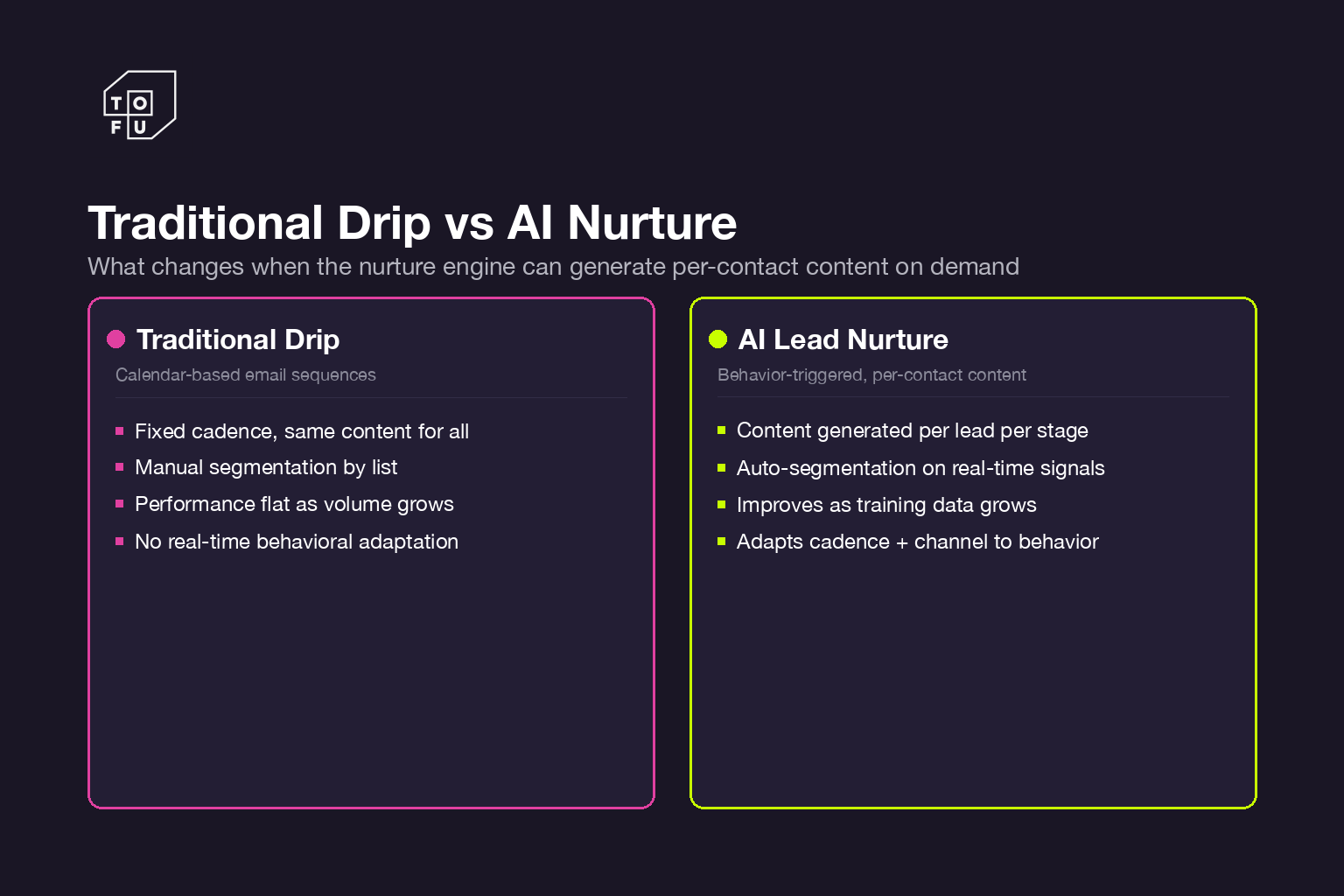
Traditional drip campaigns send pre-scheduled emails on a fixed timeline regardless of recipient behavior — every lead gets the same content on the same schedule. AI lead nurture differs in five fundamental ways. First, it is behavior-responsive: AI models analyze engagement patterns to adjust content, timing, and channel in real time based on what each lead does. Second, it uses predictive intelligence: tools like 6sense identify which accounts are actively in-market, enabling nurture programs to prioritize and accelerate for high-intent accounts. Third, it enables true content personalization: rather than one-size-fits-all messaging, platforms like Tofu generate content tailored to each account's industry, persona, and buying stage. Fourth, it is multi-channel: AI nurture orchestrates across email, website personalization, ads, conversational AI, and sales outreach rather than being email-only. Fifth, it is self-optimizing: AI models continuously learn from engagement data to improve send times, content selection, and sequence structure without manual intervention.
What results can I expect from AI-powered lead nurture?
B2B teams that implement AI-powered lead nurture typically see measurable improvements across three categories. Engagement metrics improve first: AI-personalized nurture emails see 2-3x higher open rates and click-through rates compared to generic drip sequences, because content is relevant to the recipient's specific context. Pipeline velocity accelerates next: by combining intent data (knowing when accounts are in-market) with personalized content (delivering the right message), teams report 20-40% reductions in time from MQL to SQL. Revenue impact follows: according to Forrester, companies using AI-powered nurture see 30% faster pipeline velocity and higher win rates on nurtured opportunities compared to non-nurtured leads. Results vary by implementation maturity — teams that combine intent data, personalized content, and behavioral automation see the strongest outcomes, while teams that simply add AI features to existing generic sequences see more modest gains. The most important factor is not which specific tools you choose but whether you use AI to deliver genuinely relevant content at the right time, rather than using it to send more of the same generic messaging faster.
Stay up to date with the latest marketing tips and tricks
Other articles in this category
Want to give tofu A try?
Request a custom demo to see how Tofu can supercharge your GTM efforts.
ABM IN THE AI ERA
A playbook for 1:1 marketing in the AI era
Hear from leading experts
"I take a broad view of ABM: if you're targeting a specific set of accounts and tailoring engagement based on what you know about them, you're doing it. But most teams are stuck in the old loop: Sales hands Marketing a list, Marketing runs ads, and any response is treated as intent."

"ABM has always been just good marketing. It starts with clarity on your ICP and ends with driving revenue. But the way we get from A to B has changed dramatically."
.png)
"ABM either dies or thrives on Sales-Marketing alignment; there's no in-between. When Marketing runs plays on specific accounts or contacts and Sales isn't doing complementary outreach, the whole thing falls short."

"In our research at 6sense, few marketers view ABM as critical to hitting revenue goals this year. But that's not because ABM doesn't work; it's because most teams haven't implemented it well."
"To me, ABM isn't a campaign; it's a go-to-market operating model. It starts with cross-functional planning: mapping revenue targets, territories, and board priorities."

"With AI, we can personalize not just by account, but by segment, by buying group, and even by individual. That level of precision just wasn't possible a few years ago."
%201%20(1).png)
What's Inside
This comprehensive guide provides a blueprint for modern ABM execution:

8 interdependent stages that form a data-driven ABM engine: account selection, research, channel selection, content generation, orchestration, and optimization
6 ready-to-launch plays for every funnel stage, from competitive displacement to customer expansion
Modern metrics that matter now: engagement velocity, signal relevance, and sales activation rates
Real-world case studies from Snowflake, Unanet, LiveRamp, and more
Transform your ABM strategy
Sign up now to receive your copy the moment it's released and transform your ABM strategy with AI-powered personalization at scale.
Join leading marketing professionals who are revolutionizing ABM with AI