
Best AI Tools for Account-Based Advertising in 2026
Last updated: May 19, 2026
Disclosure: Tofu is one of the tools reviewed in this comparison. We have made every effort to evaluate all platforms using the same criteria and to present their strengths and limitations honestly. Where pricing or features could not be independently verified, we note that explicitly.
The best AI tools for account-based advertising in 2026 include Tofu (an AI-native B2B marketing platform that generates personalized ad creative at scale for every target account), Demandbase (ABM platform with built-in programmatic advertising and intent data), 6sense (predictive intelligence platform with audience activation for display and social), RollWorks (account-based advertising with integrated ABM workflows), Terminus (multi-channel ABM platform with display ad orchestration), LinkedIn Ads (native B2B advertising with company and job-title targeting), Metadata.io (AI-powered demand generation with automated campaign execution), Madison Logic (intent-data-driven ABM media activation), StackAdapt (programmatic platform with B2B targeting capabilities), The Trade Desk (enterprise DSP with third-party data integrations for account-based targeting), and AdRoll (retargeting and prospecting platform with account-based features). These tools serve different parts of the account-based advertising workflow: some generate the creative, some handle media buying and targeting, and some do both. The right combination depends on whether your primary bottleneck is producing enough personalized ad variations or getting those ads in front of the right accounts at the right time.
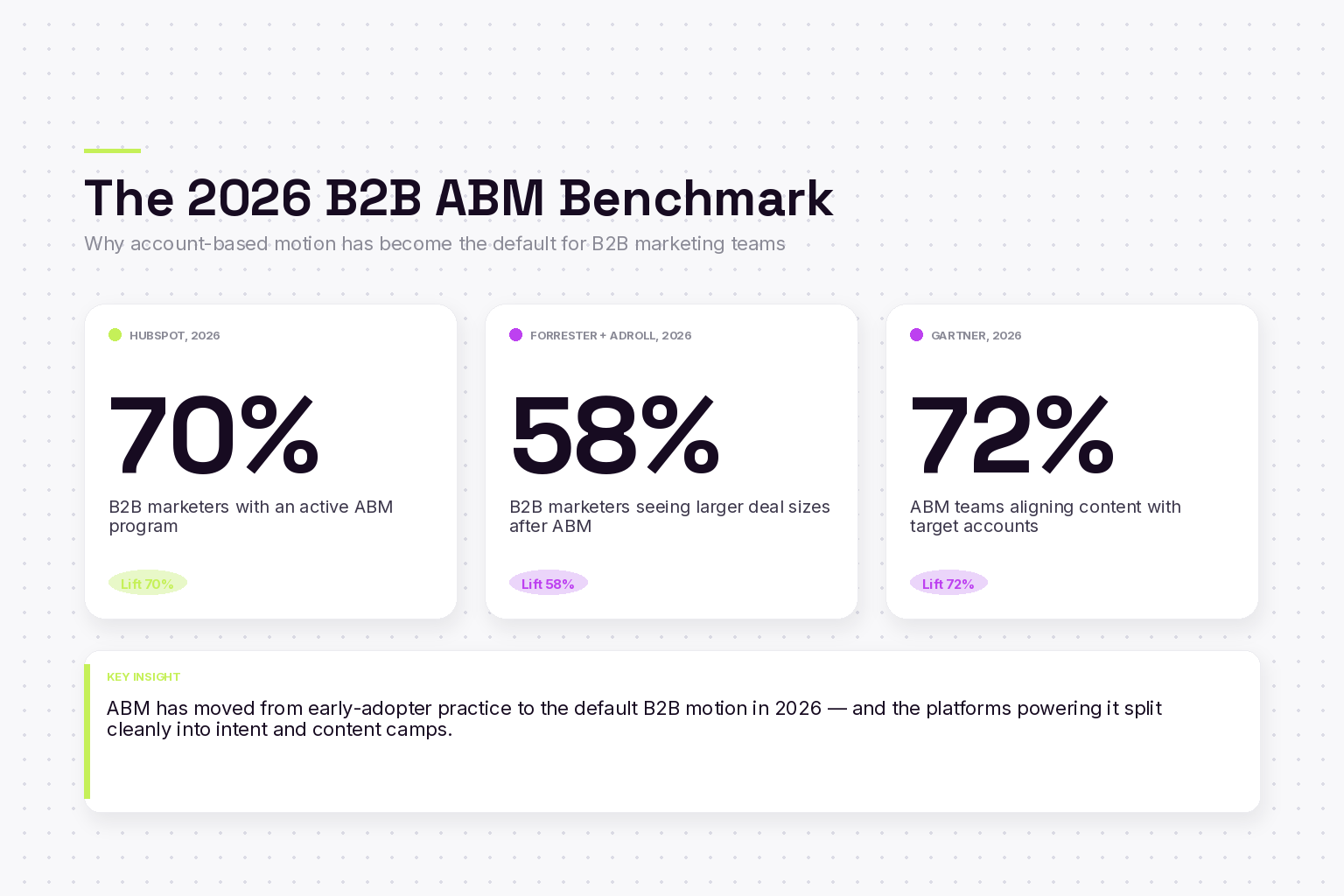
The market context: According to HubSpot (2026), 70% of B2B marketers have an active ABM program in place (HubSpot State of Marketing). According to Forrester and AdRoll (2026), 58% of B2B marketers see larger deal sizes after adopting ABM (Forrester x AdRoll 2026 ABM Report), and according to Gartner (2026), 72% of ABM teams use it specifically to align content strategy with target accounts. Our evaluation methodology assesses each platform on the evaluation criteria ABM buyers prioritize: core strength, intent data, content generation, account targeting, integrations, pricing, team fit, and stack role.
Evaluation Methodology
To compare these tools fairly, we evaluated each platform across seven criteria specifically relevant to account-based advertising. These criteria were selected based on the factors that most directly influence whether an account-based advertising tool will deliver measurable pipeline impact for B2B marketing teams.
1. Ad Creative Capabilities: Does the tool help generate, personalize, or optimize ad creative? We evaluated whether the platform can produce display, social, or video ad variations at scale, and whether creative can be tailored per account, industry, or persona. Some tools focus entirely on creative production while others treat creative as a secondary feature alongside media buying.
2. Account Targeting and Audience Building: How does the tool identify and reach target accounts? We assessed IP-based identification, cookie-based matching, first-party list uploads, intent signal integration, and lookalike modeling. The precision and scale of account targeting directly determines ad waste and ROI.
3. Intent Data and Signals: Does the platform incorporate buying intent signals to prioritize accounts and time ad delivery? We looked at proprietary intent data, third-party intent integrations (Bombora, TrustRadius, G2), website visitor identification, and engagement scoring. Intent-driven targeting is what separates account-based advertising from generic B2B display.
4. Media Buying and Channel Reach: Where can the tool serve ads? We evaluated programmatic display, social (LinkedIn, Facebook, Instagram), connected TV, native advertising, and search retargeting capabilities. We also assessed whether the tool operates its own DSP, integrates with third-party DSPs, or requires manual ad platform management.
5. Scalability: Can the tool support campaigns targeting 50 accounts, 500, or 5,000+? We assessed both the targeting infrastructure and the creative production workflow. A platform that requires manual creative uploads per account has a different scaling ceiling than one that generates variations automatically.
6. Integration Ecosystem: Does the tool connect with CRMs, marketing automation platforms, CDPs, sales engagement tools, and the broader martech stack? Account-based advertising does not operate in isolation. The ability to sync target account lists, push engagement data back to sales, and coordinate with other ABM channels is critical.
7. Measurement and Attribution: How does the tool measure advertising impact? We looked at account-level impression and engagement reporting, pipeline influence attribution, lift studies, and integration with revenue attribution platforms. B2B advertising cycles are long, and tools that only report clicks and impressions leave marketers unable to demonstrate ROI.
Tool Comparison Table
The following table summarizes how each platform compares across key dimensions relevant to account-based advertising. Ratings reflect publicly available information and user-reported experiences as of early 2026.
| Tool | Primary Function | Best For | Key Features | Pricing | Rating |
|---|---|---|---|---|---|
| Tofu | Ad creative generation | Generating personalized ad creative at scale, paired with a DSP for media buying | AI-generated ad variations per account/industry; campaign brief workflow; multi-format output (display, social, video storyboards); personalized landing pages and collateral tied to ads | Custom pricing on request | 4.6/5 |
| Demandbase | ABM platform with advertising | Enterprise ABM teams needing intent-driven programmatic display within a full ABM suite | Built-in DSP; account identification; intent data; audience segmentation; journey analytics; site personalization; sales intelligence | Custom enterprise pricing | 4.5/5 |
| 6sense | Predictive ABM with advertising | Revenue teams wanting predictive intent data to time and target account-based ad campaigns | AI-predicted buying stages; account identification; audience activation for display and social; intent data; sales intelligence; revenue AI | Custom pricing; tiered packages | 4.4/5 |
| RollWorks | Account-based advertising platform | Mid-market B2B teams wanting accessible account-based display advertising with ABM workflows | Account-based display ads; retargeting; account scoring; audience segmentation; journey tracking; HubSpot and Salesforce integrations | From ~$975/mo (Starter) to custom enterprise | 4.2/5 |
| Terminus | Multi-channel ABM platform | B2B marketers wanting orchestrated display, email, and web advertising across the account journey | Display advertising; email experiences; web personalization; chat; account-level analytics; audience segmentation; data studio | Custom pricing on request | 4.1/5 |
| LinkedIn Ads | Native B2B social advertising | B2B teams targeting by company, job title, seniority, and skills on the largest professional network | Company and contact targeting; Matched Audiences (list upload); Lookalike Audiences; Sponsored Content, Message, and InMail; Lead Gen Forms; conversion tracking | Self-serve; min $10/day; CPM/CPC bidding | 4.3/5 |
| Metadata.io | AI-powered campaign execution | Demand gen teams wanting automated audience building and multi-channel ad execution across LinkedIn, Facebook, and display | Automated audience building; multi-channel campaign execution; budget optimization; experiment automation; revenue attribution; enrichment | Custom pricing on request | 4.2/5 |
| Madison Logic | Intent-driven ABM media | Enterprise teams wanting to activate content syndication and display ads based on intent data from multiple sources | Multi-source intent data; ABM display; content syndication; LinkedIn activation; account prioritization; journey analytics | Custom enterprise pricing | 4.0/5 |
| StackAdapt | Programmatic DSP | Media buyers wanting a self-serve programmatic platform with B2B targeting overlays and broad inventory | Multi-channel programmatic (display, native, video, CTV, audio); B2B targeting segments; contextual targeting; retargeting; creative studio | Self-serve and managed; custom pricing | 4.2/5 |
| The Trade Desk | Enterprise DSP | Large teams and agencies wanting maximum programmatic control with third-party B2B data overlays | Omnichannel DSP (display, video, CTV, audio, DOOH); third-party data marketplace; Koa AI optimization; cross-device targeting; advanced bidding | Platform fee + media spend; enterprise-oriented | 4.3/5 |
| AdRoll | Retargeting and prospecting | SMB and mid-market teams wanting accessible retargeting with account-based audience layers | Display and social retargeting; prospecting; dynamic creative; audience segmentation; cross-channel attribution; Shopify and CRM integrations | Free plan + paid from $36/mo; pay-as-you-go media | 3.9/5 |
Individual Tool Reviews
1. Tofu
Tofu is an AI-native B2B marketing platform that generates personalized campaign content at scale from a single brief. In the context of account-based advertising, Tofu's core value is producing ad creative — display ads, social ad copy, video storyboards, and the landing pages and collateral those ads drive traffic to — that is personalized per target account, industry vertical, or buying persona.
The workflow starts with a campaign brief. You define the campaign objective, target accounts or segments, and messaging themes. Tofu then generates dozens or hundreds of ad variations, each tailored to a specific account's industry context, pain points, and language. A manufacturing company sees ad copy referencing supply chain efficiency; a fintech company sees copy about compliance automation. This extends beyond headlines to full ad sets — imagery direction, body copy, call-to-action text, and matching landing page content.
What Tofu does not do is handle media buying or audience targeting. It does not operate a DSP, bid on ad inventory, or identify which accounts are in-market. Tofu generates the creative assets; you then upload those assets to your advertising platform of choice — whether that is Demandbase, LinkedIn Ads, The Trade Desk, StackAdapt, or any other channel. This means Tofu pairs well with virtually any media buying tool, filling the creative production gap that most ABM advertising platforms leave unaddressed.
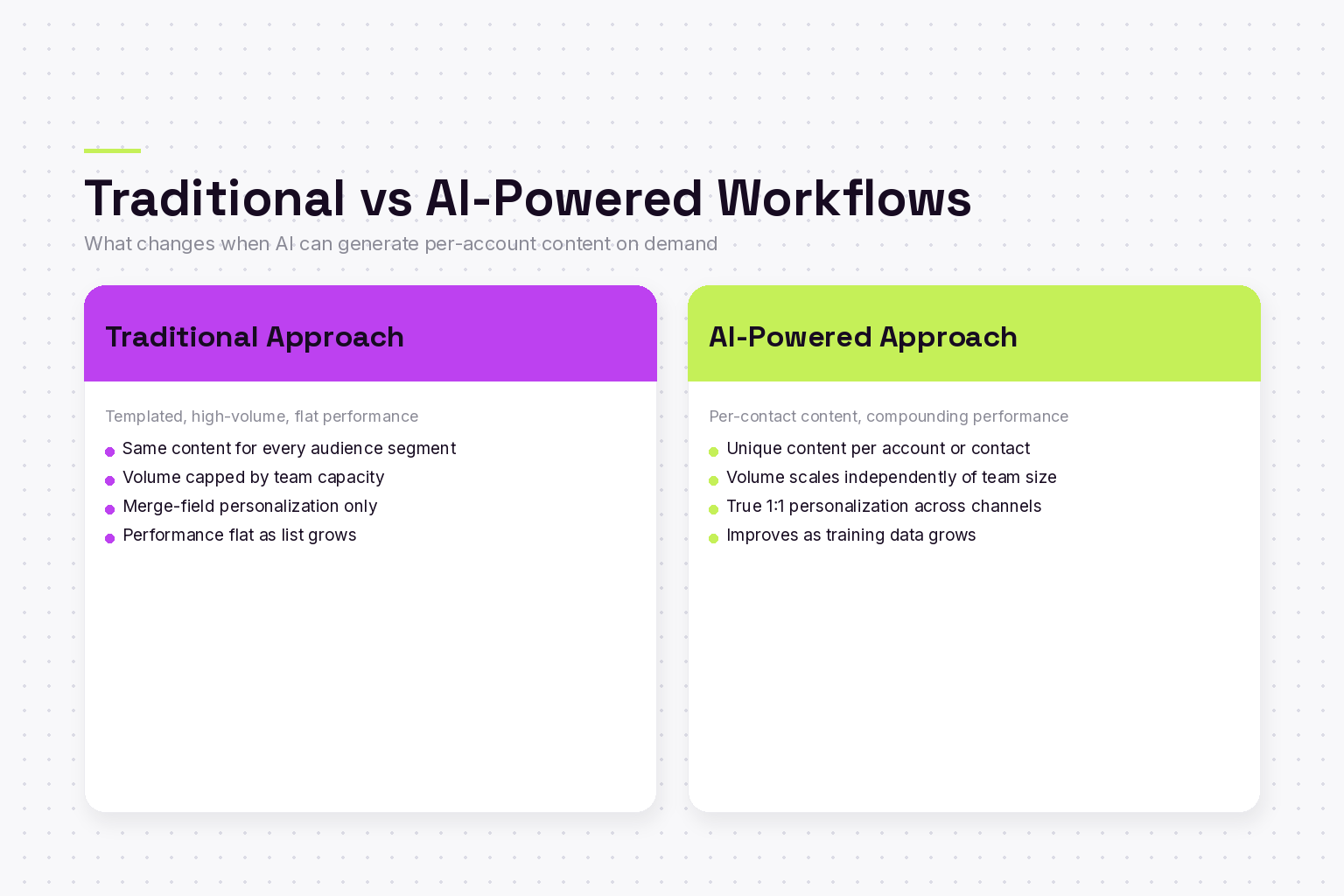
The scalability advantage is significant. Most account-based advertising programs run the same three or four ad creatives across their entire target account list because producing unique creative per account is too labor-intensive. Tofu changes that equation by automating the creative generation process, making it feasible to run genuinely personalized ad creative for 500 or 1,000 accounts without a proportional increase in design and copywriting hours.
Strengths: Unmatched scale of personalized ad creative production; single-brief workflow eliminates creative bottlenecks; multi-format output means ads, landing pages, emails, and sales collateral are all personalized and consistent; integrates with existing ad platforms rather than replacing them.
Limitations: Does not handle media buying or audience targeting; requires a separate DSP or ad platform for delivery; teams need to manage the handoff between creative generation and ad platform upload; no built-in ad performance analytics (relies on the delivery platform's reporting).
2. Demandbase
Demandbase is the most established enterprise ABM platform and one of the few that operates its own demand-side platform (DSP) for account-based display advertising. This means Demandbase handles the full advertising workflow from account identification to targeting, bidding, ad serving, and measurement — all within a single platform.
The platform's account identification technology maps IP addresses and other signals to companies in its database, enabling marketers to serve display ads to employees at specific target accounts as they browse the open web. Demandbase combines this with its own intent data (tracking research behavior across the B2B web) to help teams prioritize which accounts are showing buying signals and should receive increased ad spend.
Strengths: End-to-end ABM advertising workflow; strong account identification; proprietary intent data; comprehensive ABM suite beyond advertising (site personalization, sales intelligence, analytics); deep Salesforce integration; large enterprise customer base.
Limitations: Complex and expensive; primarily display-focused (limited social ad capabilities); creative tools are basic — most teams still need to design ads externally; learning curve for the full platform; best suited for enterprise budgets and headcount.
3. 6sense
6sense is a predictive revenue intelligence platform that helps B2B teams identify accounts in active buying cycles and reach them through display and social advertising. The platform's core differentiator is its AI-driven buying stage predictions, which classify target accounts into stages (awareness, consideration, decision, purchase) based on intent signals, web behavior, and engagement patterns.
For advertising specifically, 6sense offers audience activation capabilities that push account segments to display ad networks and LinkedIn. The platform can dynamically adjust which accounts receive ads based on their predicted buying stage, effectively automating the process of increasing ad frequency as accounts move deeper into the funnel.
Strengths: Best-in-class predictive buying stage models; strong anonymous account identification; audience activation across display and social; comprehensive revenue intelligence beyond advertising; growing ecosystem of integrations.
Limitations: Advertising is one feature within a larger platform, not the core product; limited ad creative tools; display ad inventory and reach can be narrower than dedicated DSPs; enterprise pricing may be prohibitive for smaller teams; complexity requires dedicated ops resources.
4. RollWorks
RollWorks (a division of NextRoll) is an account-based advertising platform that combines display ad delivery with ABM workflows including account scoring, audience segmentation, and journey tracking. It is generally positioned as more accessible and affordable than enterprise platforms like Demandbase and 6sense, making it a popular choice for mid-market B2B teams launching their first account-based advertising programs.
The platform offers both account-based retargeting (serving ads to accounts that have visited your site) and account-based prospecting (serving ads to target accounts that have not yet engaged). RollWorks uses machine learning to score and prioritize accounts, helping teams focus ad spend on accounts most likely to convert.
Strengths: Lower barrier to entry than enterprise ABM platforms; solid account-based display targeting; good HubSpot and Salesforce integrations; account scoring helps prioritize spend; machine learning optimization of targeting.
Limitations: Display ad inventory is more limited than larger DSPs; creative tools are basic; less sophisticated intent data than 6sense or Demandbase; account identification accuracy can vary for smaller companies; reporting is functional but not as deep as enterprise alternatives.
5. Terminus
Terminus is a multi-channel ABM platform that combines display advertising with email experiences, web personalization, and conversational marketing. Its advertising module delivers display ads through a combination of its own ad network and third-party inventory, targeting accounts using first-party list uploads and firmographic filters.
The platform's multi-channel approach is its primary differentiator. Rather than treating advertising as an isolated channel, Terminus enables marketers to orchestrate coordinated experiences where a target account sees a display ad, receives a personalized email, and encounters a tailored website experience — all tracked within a single account-level journey view.
Strengths: Multi-channel orchestration across ads, email, web, and chat; account-level journey analytics; accessible for teams new to ABM; strong customer support reputation; good Salesforce and HubSpot integrations.
Limitations: Display ad reach and inventory quality can be inconsistent; the platform has undergone significant ownership and product changes in recent years; limited intent data compared to 6sense and Demandbase; creative production tools are minimal; some users report ad viewability concerns.
6. LinkedIn Ads
LinkedIn Ads is the dominant platform for B2B social advertising, offering targeting capabilities that no other social network can match: company name, company size, industry, job title, job function, seniority, skills, and group membership. For account-based advertising, LinkedIn's Matched Audiences feature lets marketers upload a list of target companies (or individual contacts) and serve Sponsored Content, Message Ads, or Lead Gen Forms directly to employees at those companies.
The platform is effectively a required channel for any serious account-based advertising program. LinkedIn's professional context means ads reach buyers in a work mindset, and the targeting precision is unmatched for B2B. The challenge is cost: LinkedIn CPMs are significantly higher than programmatic display, often 5-10x more expensive.
Strengths: Unmatched B2B targeting precision; professional context for ad engagement; Matched Audiences for account-based list targeting; Lead Gen Forms for in-platform conversion; broad B2B audience reach; self-serve platform accessible to teams of any size.
Limitations: Significantly higher CPMs than other channels; limited ad format variety compared to programmatic display; campaign management is manual and time-consuming at scale; no built-in intent data; creative tools are basic; reporting is improving but still lags dedicated ABM platforms for account-level attribution.
7. Metadata.io
Metadata.io is an AI-powered demand generation platform that automates audience building, campaign execution, and budget optimization across LinkedIn, Facebook, and programmatic display. For account-based advertising, Metadata's primary value is automating the operational work of building custom audiences from your target account list, launching campaigns across multiple channels simultaneously, and automatically shifting budget toward the best-performing experiments.
The platform uses enrichment data to expand your target account list into matched audiences on each ad platform, often achieving higher match rates than manual list uploads. Its experimentation engine automatically tests combinations of audiences, creative, and offers, then reallocates budget to winning combinations.
Strengths: Automated multi-channel campaign execution; AI-driven budget optimization; strong audience enrichment and matching; reduces manual campaign management work; good revenue attribution capabilities; integrates with LinkedIn, Facebook, and display.
Limitations: Requires sufficient ad budget to benefit from automated optimization; platform has a learning curve; creative generation is not a core capability — you still need to produce the ad creative; limited display ad inventory compared to dedicated DSPs; pricing can be steep for smaller teams.
8. Madison Logic
Madison Logic is an ABM media activation platform that combines intent data from multiple sources with display advertising and content syndication. The platform aggregates intent signals from its own data co-op, Bombora, and other providers to help marketers identify which accounts are actively researching relevant topics, then activates those accounts through display ads, content syndication, and LinkedIn.
Content syndication is Madison Logic's distinctive capability. The platform can distribute your whitepapers, ebooks, and research reports to professionals at target accounts through its publisher network, generating leads while simultaneously building brand awareness through display ads.
Strengths: Multi-source intent data aggregation; combined display and content syndication; strong lead generation capabilities; LinkedIn integration; account journey analytics; dedicated account management support.
Limitations: Content syndication lead quality can vary; platform is more of a managed service than self-serve; limited creative tools; enterprise pricing may be prohibitive for smaller teams; less real-time campaign control than self-serve platforms.
9. StackAdapt
StackAdapt is a multi-channel programmatic advertising platform that supports native, display, video, connected TV (CTV), audio, and in-game advertising. While not exclusively a B2B tool, StackAdapt has invested heavily in B2B targeting capabilities, offering account-based audience segments, firmographic targeting, and integrations with intent data providers.
For account-based advertising teams, StackAdapt offers broad inventory access across premium publishers, along with the ability to layer B2B targeting segments (company, industry, job function) onto programmatic campaigns. The platform's CTV and audio capabilities are particularly interesting for B2B teams looking to reach decision-makers beyond traditional display.
Strengths: Broad multi-channel inventory (including CTV and audio); strong B2B targeting segments; self-serve platform with intuitive UI; native ad capabilities; good contextual targeting; competitive CPMs compared to ABM-specific platforms.
Limitations: B2B is one use case among many, not the primary focus; account-based targeting is not as precise as ABM-native platforms; no built-in intent data (requires integration); limited ABM-specific features like account journey tracking; creative production is not a platform strength.
10. The Trade Desk
The Trade Desk is the largest independent demand-side platform, offering omnichannel programmatic advertising across display, video, connected TV, audio, digital out-of-home (DOOH), and mobile. For B2B account-based advertising, The Trade Desk provides access to the broadest inventory of any platform on this list, combined with a third-party data marketplace that includes B2B segments from providers like Dun & Bradstreet, Bombora, and others.
The platform's Koa AI engine optimizes bidding and targeting in real time. For account-based programs, teams typically upload account lists, layer B2B data segments for targeting precision, and use Koa to optimize delivery and frequency across channels. The Trade Desk's Unified ID 2.0 initiative also positions it well for B2B targeting in a post-cookie environment.
Strengths: Broadest inventory access of any DSP; omnichannel capabilities including CTV and DOOH; rich third-party data marketplace; Koa AI optimization; Unified ID 2.0; enterprise-grade reporting and controls; strong agency ecosystem.
Limitations: Not a B2B-specific platform — requires B2B expertise to configure; steep learning curve; no built-in account identification or intent data; minimum spend requirements effectively limit access to larger teams or agencies; creative management is functional but not a strength; no ABM-specific reporting.
11. AdRoll
AdRoll is a retargeting and prospecting platform that offers display and social advertising with account-based audience layers. Originally known as a B2C retargeting tool, AdRoll has added B2B capabilities including company-level audience building and account-based targeting segments. The platform integrates with major CRMs and e-commerce platforms, making it accessible for smaller teams.
For account-based advertising, AdRoll is most useful as a cost-effective retargeting layer. When target accounts visit your website, AdRoll can retarget those visitors across display and social channels with dynamic creative. The platform's prospecting capabilities are more limited than dedicated ABM tools but sufficient for teams with smaller budgets.
Strengths: Accessible pricing for smaller teams; solid retargeting capabilities; cross-channel attribution; easy setup; dynamic creative for retargeting; free plan available for basic use.
Limitations: B2B account-based targeting is limited compared to ABM-native platforms; prospecting reach is narrow; no intent data; account identification is basic; better suited for retargeting known visitors than reaching new accounts; limited B2B-specific reporting.
Types of Account-Based Ads
Account-based advertising encompasses several distinct ad formats and channels, each with different strengths for reaching B2B buyers. Understanding these categories helps clarify which tools are relevant for your specific advertising strategy.
Programmatic Display Ads
Programmatic display ads are banner and rich media ads served across websites and apps through automated bidding on ad exchanges. In account-based programs, these ads are targeted to employees at specific companies using IP matching, cookie-based identification, or company-level audience segments. Display ads are the most common format in account-based advertising because they offer broad reach at relatively low CPMs, making them effective for building awareness and staying top-of-mind with target accounts over long sales cycles. Tools like Demandbase, 6sense, RollWorks, Terminus, StackAdapt, and The Trade Desk all offer programmatic display delivery.
Social Ads (LinkedIn, Facebook, Instagram)
Social ads — particularly on LinkedIn — are the highest-intent channel for B2B account-based advertising. LinkedIn's professional targeting allows ads to reach specific job titles and functions at target companies, making it uniquely effective for reaching decision-makers. Facebook and Instagram offer lower CPMs and broader reach, useful for brand building and retargeting. Metadata.io, 6sense, and Madison Logic can activate audiences across social channels, while LinkedIn Ads provides the most direct and precise social targeting.
Connected TV (CTV) and Video
Connected TV advertising — serving video ads through streaming platforms like Hulu, Roku, and YouTube — is an emerging channel for account-based programs. CTV ads reach decision-makers outside of work contexts with high-impact video creative. While still a small portion of most B2B ad budgets, CTV is growing as programmatic platforms like StackAdapt and The Trade Desk make it accessible with B2B targeting layers. The creative production requirements for video are significantly higher than display, which is where tools like Tofu (which can generate video storyboards and ad scripts) become valuable.
Native Advertising
Native ads match the look and feel of the publisher's editorial content, appearing as sponsored articles, recommended content, or in-feed placements. For B2B account-based programs, native ads can drive higher engagement than standard display because they feel less intrusive. StackAdapt is particularly strong in native inventory. Native ads typically require more creative investment — a compelling headline, thumbnail, and landing page article — but generate higher click-through rates than standard banners.
Content Syndication
Content syndication distributes gated content (whitepapers, ebooks, research reports) through publisher networks to generate leads from target accounts. While technically a lead generation tactic rather than traditional advertising, content syndication is a core component of many account-based media strategies. Madison Logic is the most prominent platform for intent-driven content syndication, combining it with display advertising for a multi-touch account-based approach.
Retargeting Ads
Retargeting serves ads to people who have already visited your website or engaged with your content. In account-based programs, retargeting is layered with account identification to ensure ads are served specifically to visitors from target accounts. This is the most efficient form of account-based advertising because you know the visitor has already shown interest. AdRoll, RollWorks, and most ABM platforms offer account-level retargeting capabilities.
Personalized Ad Creative
The highest-performing account-based advertising programs use creative that is personalized for each target account or segment. Rather than serving the same generic brand ad to every account, personalized ads reference the target company's industry, pain points, or specific use cases. This is the category where Tofu operates — generating the actual ad creative (headlines, body copy, imagery direction, CTAs) personalized per account at a scale that would be impossible manually. The personalized creative is then deployed through whichever media buying platform the team uses for targeting and delivery.
Decision Framework: How to Choose the Right Tools
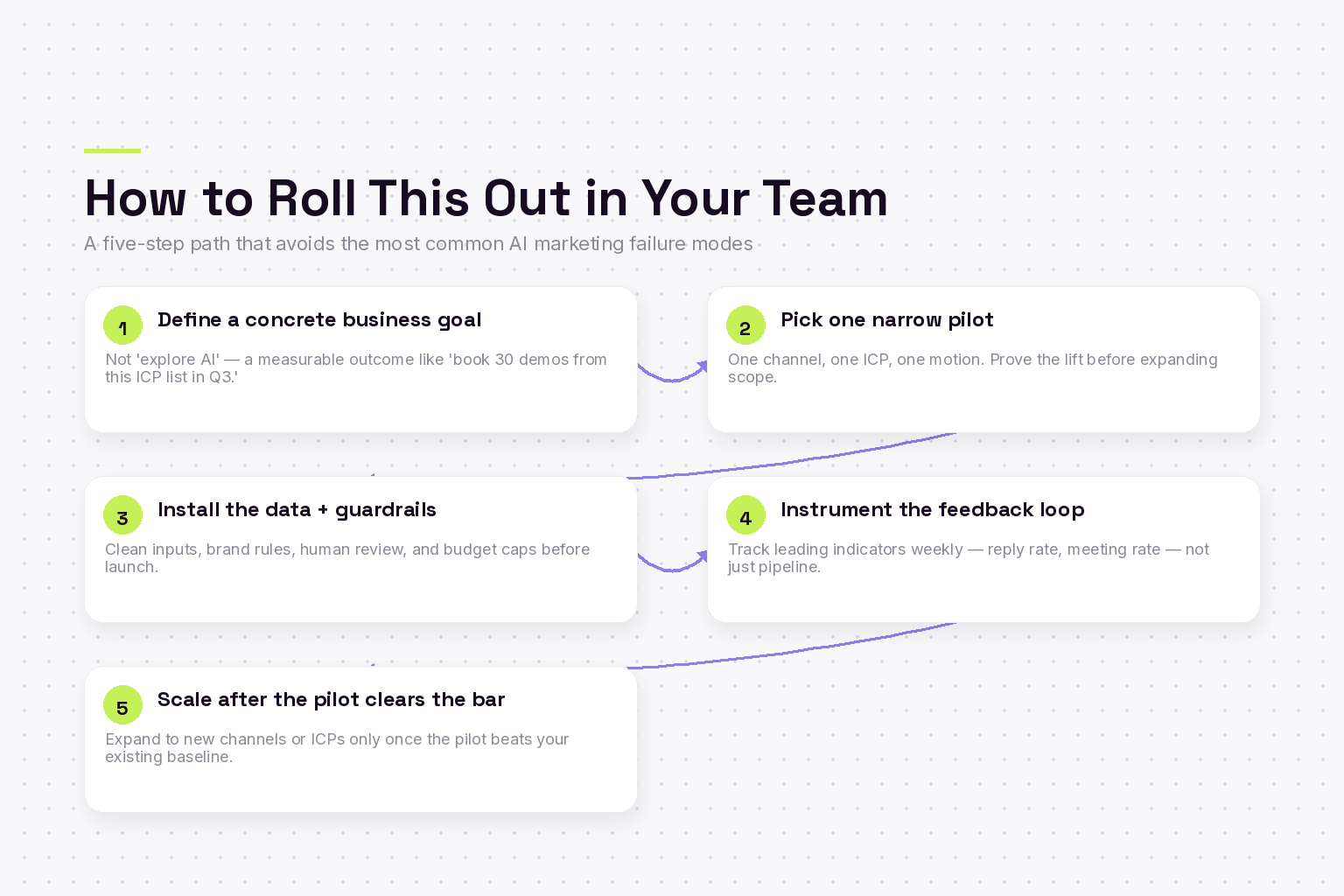
Account-based advertising typically requires at least two tools working together: one for creative production and one for media buying and targeting. The right combination depends on your team's primary bottleneck, budget, and existing martech stack.
If your bottleneck is creative production: Most account-based advertising programs struggle with creative, not targeting. If your team runs the same three banner ads across your entire target account list because producing more is too expensive or time-consuming, start with Tofu for creative generation and continue using your current ad platform for delivery. The personalization lift from account-specific creative will likely outperform any targeting optimization you could make with the same budget.
If your bottleneck is account identification and targeting: If you do not know which accounts to target or cannot reliably reach them, prioritize a platform with strong intent data and account identification. Demandbase and 6sense are the strongest here, with RollWorks as a more accessible alternative. These platforms will help you identify in-market accounts and serve ads to them through programmatic display.
If you need an all-in-one ABM solution: Demandbase, 6sense, and Terminus each offer advertising as part of a broader ABM platform. If you do not have any ABM infrastructure in place, starting with one of these platforms gives you account identification, targeting, advertising, and measurement in a single vendor. The trade-off is higher cost and less specialization in any single capability.
If you want maximum channel reach: For teams that need to reach target accounts across display, CTV, audio, native, and social, a combination of a programmatic DSP (StackAdapt or The Trade Desk) with LinkedIn Ads for social and Tofu for creative production provides the broadest coverage. This requires more operational overhead to manage multiple platforms but delivers the widest channel mix.
If you are budget-constrained: Start with LinkedIn Ads (self-serve, no minimum contract) and AdRoll (free plan available for retargeting). Upload your target account list to LinkedIn's Matched Audiences and run Sponsored Content to decision-makers at those companies. Use AdRoll to retarget account visitors with display ads. As budget grows, layer in a creative generation tool and a broader programmatic platform.
If you want to automate campaign operations: Metadata.io is designed to reduce the manual work of managing multi-channel account-based ad campaigns. If your team spends too much time on audience building, campaign setup, and budget allocation across LinkedIn and Facebook, Metadata can automate much of that workflow. Pair it with Tofu for creative generation to automate both the production and operational sides of account-based advertising.
Common Tool Combinations
In practice, the most effective account-based advertising stacks combine tools from different categories. Here are the most common and effective pairings based on team size and maturity.
Enterprise Stack: Tofu (creative generation) + Demandbase or 6sense (intent, targeting, display delivery) + LinkedIn Ads (social) + The Trade Desk (omnichannel programmatic). This configuration covers personalized creative at scale, intent-driven account prioritization, the most precise social targeting, and the broadest programmatic reach. It requires the highest budget and operational sophistication but delivers the most comprehensive account-based advertising program.
Mid-Market Stack: Tofu (creative generation) + RollWorks or Metadata.io (targeting and execution) + LinkedIn Ads (social). This combination covers creative production, account-based display targeting, and social advertising at a more accessible price point. RollWorks provides a self-contained ABM display solution, while Metadata.io automates multi-channel execution.
Starter Stack: LinkedIn Ads (social, targeting) + AdRoll (retargeting). The minimum viable account-based advertising setup. Upload your target account list to LinkedIn, run Sponsored Content to decision-makers, and use AdRoll to retarget account visitors. As results justify investment, add Tofu for creative personalization and expand into programmatic display.
Frequently Asked Questions
What is account-based advertising?
Account-based advertising is a B2B marketing strategy where paid ads are targeted to employees at specific companies (accounts) rather than broad demographic or interest-based audiences. Instead of casting a wide net and hoping the right people see your ads, account-based advertising starts with a defined list of target accounts and uses technologies like IP matching, company-level audience segments, and professional profile targeting to ensure ads reach decision-makers at those specific companies. This approach reduces ad waste, concentrates budget on high-value prospects, and aligns advertising with the broader account-based marketing strategy that sales and marketing teams use to pursue specific deals.
How is account-based advertising different from traditional B2B advertising?
Traditional B2B advertising targets audiences based on attributes like industry, job title, or interests — essentially reaching anyone who matches a profile, regardless of whether they work at a company you want as a customer. Account-based advertising inverts this by starting with specific companies and then targeting individuals within those companies. The practical difference is precision: traditional B2B ads might reach 50,000 people with the right job title, but only 500 of them work at companies that fit your ideal customer profile. Account-based advertising reaches those 500 directly. This typically results in higher CPMs but significantly better pipeline conversion rates because every impression is reaching a potential customer.
Do I need a dedicated ABM platform for account-based advertising, or can I use LinkedIn Ads alone?
LinkedIn Ads alone can be a viable starting point for account-based advertising. The Matched Audiences feature lets you upload a company list and target employees by job title, function, and seniority. This is sufficient for many teams, particularly those with smaller target account lists (under 500 companies) and budgets under $10,000 per month. A dedicated ABM platform like Demandbase, 6sense, or RollWorks becomes valuable when you need programmatic display reach beyond LinkedIn, intent data to prioritize accounts, account-level journey analytics, or the ability to coordinate advertising with other ABM channels. The decision is usually driven by scale and measurement requirements rather than basic targeting capability.
How does AI improve account-based advertising?
AI improves account-based advertising in three primary areas. First, AI powers the intent signals and predictive models that identify which accounts are actively researching solutions — platforms like 6sense use machine learning to predict buying stages, helping teams time their ad spend to reach accounts when they are most receptive. Second, AI automates campaign optimization, with tools like Metadata.io using algorithms to test audience and creative combinations and reallocate budget to top performers. Third, and often overlooked, AI enables the creative personalization that makes account-based ads effective. Tools like Tofu use AI to generate ad creative personalized per account or industry segment, solving the production bottleneck that forces most teams to run generic ads across all target accounts. The combination of AI-driven targeting, optimization, and creative personalization is what makes modern account-based advertising significantly more effective than its manual predecessors.
What budget do I need for account-based advertising?
Account-based advertising budgets vary widely depending on the tools and channels used. At the low end, a team can run account-based ads on LinkedIn for as little as $3,000-5,000 per month, targeting a list of 100-200 companies. Mid-market programs using a platform like RollWorks or Metadata.io typically invest $10,000-30,000 per month in combined platform fees and media spend. Enterprise programs using Demandbase or 6sense with multi-channel programmatic, LinkedIn, and CTV can run $50,000-150,000 or more per month. A useful rule of thumb is to budget at least $50-100 per month per target account across all channels to maintain sufficient impression frequency. Creative production costs are separate and depend on whether you are producing creative manually (expensive and slow to scale) or using a tool like Tofu to generate personalized variations at scale (higher platform cost but dramatically lower per-creative cost).
How do I measure account-based advertising ROI?
Measuring account-based advertising ROI requires shifting from lead-level metrics (cost per lead, click-through rate) to account-level metrics. The most meaningful metrics are: account engagement rate (percentage of target accounts that have shown ad engagement), pipeline influence (amount of pipeline where advertising touched the account before or during the deal cycle), account progression (did targeted accounts move from awareness to consideration to opportunity), and influenced revenue (closed-won revenue from accounts that received ads). Most ABM platforms provide some level of account-level reporting. For comprehensive attribution, teams typically integrate their ABM platform data with their CRM and a revenue attribution tool like Bizible, LeanData, or HubSpot's attribution reports. The key mindset shift is recognizing that B2B advertising rarely drives direct conversions — its value is in accelerating deals and increasing win rates across long sales cycles.
Can I use Tofu for ad creative if I already have an ABM platform for targeting?
Yes, and this is the most common way teams use Tofu for account-based advertising. Tofu generates personalized ad creative — display ads, social ad copy, video scripts, and matching landing pages — that you then upload to your existing advertising platform for targeting and delivery. If you already use Demandbase, 6sense, RollWorks, or LinkedIn Ads for media buying, Tofu slots into the creative production stage of your workflow. The output is standard ad creative (image files, copy text, landing page HTML) compatible with any advertising platform. This approach solves the most common gap in account-based advertising programs: having the technology to target the right accounts but only running generic, one-size-fits-all creative because producing personalized variations manually is too resource-intensive.
Generate Personalized Ad Creative at Scale
See how Tofu generates account-specific ad creative, landing pages, and campaign collateral from a single brief — personalized for every target account on your list.
Book a DemoStay up to date with the latest marketing tips and tricks
Other articles in this category
Want to give tofu A try?
Request a custom demo to see how Tofu can supercharge your GTM efforts.
ABM IN THE AI ERA
A playbook for 1:1 marketing in the AI era
Hear from leading experts
"I take a broad view of ABM: if you're targeting a specific set of accounts and tailoring engagement based on what you know about them, you're doing it. But most teams are stuck in the old loop: Sales hands Marketing a list, Marketing runs ads, and any response is treated as intent."

"ABM has always been just good marketing. It starts with clarity on your ICP and ends with driving revenue. But the way we get from A to B has changed dramatically."
.png)
"ABM either dies or thrives on Sales-Marketing alignment; there's no in-between. When Marketing runs plays on specific accounts or contacts and Sales isn't doing complementary outreach, the whole thing falls short."

"In our research at 6sense, few marketers view ABM as critical to hitting revenue goals this year. But that's not because ABM doesn't work; it's because most teams haven't implemented it well."
"To me, ABM isn't a campaign; it's a go-to-market operating model. It starts with cross-functional planning: mapping revenue targets, territories, and board priorities."

"With AI, we can personalize not just by account, but by segment, by buying group, and even by individual. That level of precision just wasn't possible a few years ago."
%201%20(1).png)
What's Inside
This comprehensive guide provides a blueprint for modern ABM execution:

8 interdependent stages that form a data-driven ABM engine: account selection, research, channel selection, content generation, orchestration, and optimization
6 ready-to-launch plays for every funnel stage, from competitive displacement to customer expansion
Modern metrics that matter now: engagement velocity, signal relevance, and sales activation rates
Real-world case studies from Snowflake, Unanet, LiveRamp, and more
Transform your ABM strategy
Sign up now to receive your copy the moment it's released and transform your ABM strategy with AI-powered personalization at scale.
Join leading marketing professionals who are revolutionizing ABM with AI