
Automating Personalized Nurture Campaigns to Drive Pipeline
Last updated: February 6, 2026
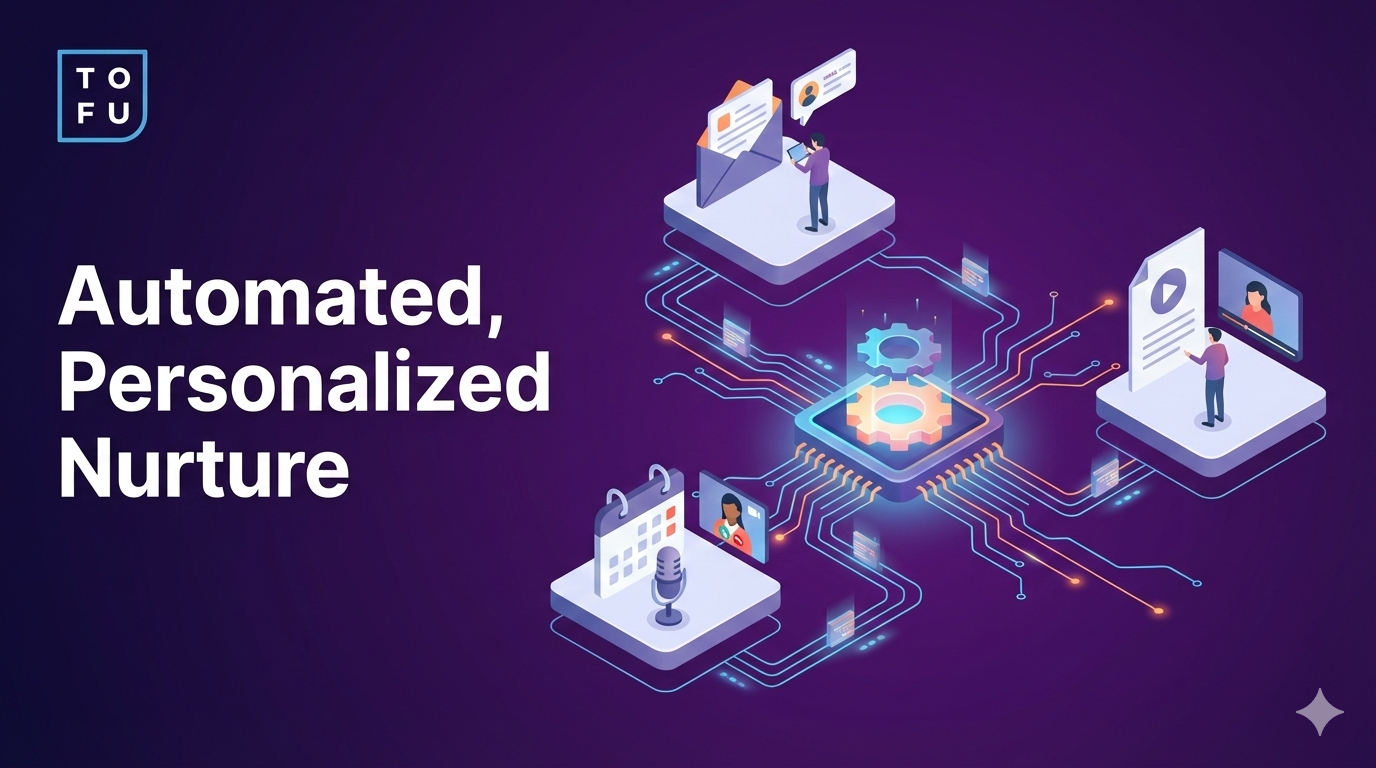
Automated lead nurture campaigns are the backbone of modern B2B demand generation, yet research shows that nearly 65% of B2B companies have no established lead nurturing process in place. Personalized nurture automation adapts content, timing, and channel based on buyer behavior, industry, persona, and purchase stage to move prospects through complex buying cycles that average 6-12 months with 11 stakeholders involved. Tofu, an AI-native B2B marketing platform, enables teams to generate hyper-personalized nurture content at scale without multiplying production effort. This guide provides a tactical framework for building personalized nurture automation that drives measurable pipeline growth.
The answer is automated nurture. But not the batch-and-blast email sequences of the past decade. Modern nurture automation must be genuinely personalized, adapting content and timing based on buyer behavior, industry context, persona, and purchase stage. Generic nurture streams that treat every lead identically are increasingly ineffective as buyers expect relevance from every interaction.
This guide provides a tactical framework for building personalized nurture automation that moves leads through your funnel while respecting the complexity of modern B2B buying.
What Makes Modern Nurture Different
Traditional nurture operates on simple logic: someone downloads content, they enter a sequence, they receive emails on a schedule until they convert or unsubscribe. This approach fails because it ignores everything we know about how B2B buyers actually behave.
Modern personalized nurture differs in several fundamental ways:
Behavioral responsiveness: The sequence adapts based on what the lead does. Clicking a pricing page triggers different follow-up than downloading a thought leadership piece.
Contextual content: Every piece of content is tailored to the lead's industry, persona, and stage. A CFO at a healthcare company receives different messaging than a VP of Operations at a manufacturing firm.
Multi-channel orchestration: Nurture extends beyond email to include personalized website experiences, retargeting ads, and coordinated sales touches.
Account awareness: For ABM programs, nurture considers account-level activity, not just individual engagement. Multiple stakeholders from the same account may be nurtured in coordinated sequences.
The Personalized Nurture Framework
Layer 1: Segmentation Strategy
Effective personalization starts with intelligent segmentation. Most marketing teams segment by basic demographics and lead source. High-performing programs segment across multiple dimensions:
Industry vertical: Pain points, terminology, and relevant case studies vary dramatically by industry. A single nurture track for all industries wastes the opportunity for resonance.
Buyer persona: CMOs care about different outcomes than marketing operations managers. Segment by role and tailor messaging to each persona's priorities.
Buying stage: Early-stage awareness content differs from consideration-stage comparison content. Segment by where leads are in their journey.
Account tier: Strategic accounts warrant more personalized, higher-touch nurture than standard inbound leads.
Engagement level: Highly engaged leads need different nurture than passive readers. Velocity and intensity of engagement should influence content and timing.
Layer 2: Content Mapping
With segments defined, map content assets to each segment and stage combination. This creates a content matrix that guides nurture sequence design.
The challenge is obvious: if you have 5 industries, 4 personas, and 3 buying stages, that's 60 potential segment combinations. Creating unique content for each is impractical for most teams.
This is where AI-powered content personalization becomes essential. Platforms like Tofu enable marketing teams to generate content variations at scale, personalizing core assets for different industries and personas without manual rewriting of every piece. A single whitepaper can become 20 industry-specific versions, each with relevant examples, terminology, and pain points.
Your content mapping should include:
Awareness stage: Educational content addressing broad challenges (blog posts, ebooks, industry reports)
Consideration stage: Solution-focused content comparing approaches (webinars, case studies, comparison guides)
Decision stage: Validation content supporting purchase (ROI calculators, implementation guides, customer testimonials)
Layer 3: Trigger Logic
Define the behavioral and time-based triggers that move leads through nurture sequences or branch them into different tracks:
Entry triggers: What actions enroll leads in nurture? Form submissions, webinar registrations, and content downloads are common entry points.
Progression triggers: What moves leads from awareness to consideration content? Track engagement patterns that indicate advancing interest.
Branching triggers: What behaviors indicate a lead should move to a different track? Pricing page visits, demo requests, or high-intent search terms can trigger transition to sales-focused sequences.
Exit triggers: When should leads exit nurture entirely? Closed-won, closed-lost, and explicit unsubscribes are obvious exits, but also define when leads should move to re-engagement or sales sequences.
Layer 4: Cadence and Timing
Timing matters as much as content. Determine optimal cadence based on:
Sales cycle length: Longer sales cycles support longer nurture sequences with more spaced touchpoints.
Engagement velocity: Fast-moving leads should receive accelerated cadence. Slow responders may need extended gaps to avoid fatigue.
Content consumption patterns: Analyze when your audience engages most (day of week, time of day) and optimize send times accordingly.
Building Nurture Sequences That Convert
The Welcome Sequence
Every lead's first nurture experience should be a welcome sequence that accomplishes three goals:
Deliver promised value: If they registered for content, provide it immediately along with related resources.
Set expectations: Tell them what to expect from future communications. Transparency builds trust.
Gather intelligence: Use progressive profiling to collect additional information that enables better personalization downstream.
The Education Sequence
After welcome, leads enter educational nurture focused on building awareness of their challenges and potential solutions:
Problem-focused content: Help leads understand the full scope and impact of their challenges.
Approach comparisons: Educate on different ways to solve the problem without being overtly promotional.
Third-party validation: Analyst reports, industry research, and expert perspectives add credibility.
The Consideration Sequence
Leads showing increased engagement transition to consideration-stage content:
Case studies: Customer success stories from their industry or addressing their specific use case.
Product-focused content: Feature explanations, demo videos, and implementation overviews.
Comparison content: How your solution compares to alternatives they're likely evaluating.
The Decision Sequence
High-intent leads need decision-enabling content:
ROI and business case tools: Calculators and templates that help leads build internal buy-in.
Implementation content: Address concerns about rollout complexity and time-to-value.
Stakeholder enablement: Materials leads can share with their buying committee to accelerate consensus.
Technology Requirements for Personalized Nurture
Executing personalized nurture at scale requires specific capabilities:
Dynamic segmentation: Your marketing automation platform must support real-time segment membership based on behavioral data, not just static list membership.
Content personalization engine: Tools like Tofu that can generate personalized content variations for different segments, enabling true 1:1 personalization without exponential content production.
Behavioral tracking: Robust tracking across email, website, and campaign interactions to inform trigger logic.
CRM integration: Bidirectional sync ensuring nurture activities and sales activities are coordinated.
Multi-channel capability: Ability to orchestrate email, website personalization, and advertising in unified sequences.
Measuring Nurture Performance
Move beyond open rates and click rates to measure what matters:
Progression velocity: How quickly do leads move from one stage to the next? Benchmark by segment to identify where nurture is most effective.
Conversion to sales-ready: What percentage of nurtured leads reach your MQL or SQL threshold?
Pipeline influence: What revenue can be attributed to nurture-touched opportunities?
Engagement depth: Track content consumption patterns. Are leads engaging with multiple assets or bouncing after one?
Segment comparison: Which segments respond best to nurture? Use this data to prioritize personalization investments.
Common Nurture Automation Pitfalls
Over-nurturing: More emails does not equal more conversion. Respect inbox limits and provide genuine value with each touch.
Ignoring buying signals: High-intent actions (pricing page, demo request) should trigger immediate response, not continuation of standard sequences.
Sales-marketing disconnect: When leads move to sales, nurture should adapt, not continue unchanged. Coordinate on messaging and timing.
Set-and-forget mentality: Nurture programs require ongoing optimization. Regularly review performance and refresh content.
Getting Started with Personalized Nurture
Building sophisticated personalized nurture doesn't happen overnight. Start with these steps:
1. Audit your current nurture programs. Identify gaps in personalization and stages where leads stall.
2. Define your priority segments. Start with 3-4 segments that represent your most valuable audience combinations.
3. Map content to segments. Identify existing content that can serve each segment and gaps requiring new creation.
4. Implement behavioral triggers. Move beyond time-based sends to behavior-responsive sequences.
5. Invest in personalization technology. Evaluate tools like Tofu that can scale content personalization without scaling your team.
Personalized nurture is no longer a competitive advantage, it's table stakes. Buyers expect relevance. Teams that deliver it will see dramatically better engagement, faster pipeline velocity, and higher conversion rates. The investment in building personalized nurture automation pays dividends across your entire demand generation program.
Frequently Asked Questions About Lead Nurture Automation
What AI tools help with B2B lead nurture?
Several AI-powered platforms support B2B lead nurture at scale. Tofu generates hyper-personalized content variations for different industries, personas, and buying stages automatically. HubSpot and Marketo provide marketing automation with AI-driven send-time optimization and lead scoring. Outreach and Salesloft offer AI-powered sales engagement sequences that coordinate with marketing nurture flows.
How can I personalize nurture campaigns at scale?
The key to scaling personalized nurture is AI-powered content generation. Platforms like Tofu can take a single asset and produce dozens of industry-specific and persona-tailored variations automatically. Combined with dynamic segmentation in your marketing automation platform (HubSpot, Marketo, or Eloqua), you can deliver contextually relevant content to every segment without manually creating each variation.
What's the best automated workflow for nurturing MQLs to SQLs?
The most effective MQL-to-SQL nurture workflow uses behavioral triggers rather than time-based sequences. Configure your automation platform to watch for high-intent actions like pricing page visits, demo page views, and repeat content engagement. Layer in progressive content that moves from educational to solution-focused to decision-enabling, adapting the cadence based on each lead's engagement velocity.
How do I measure the ROI of nurture campaigns?
Move beyond vanity metrics like open rates. Track progression velocity (how quickly leads advance stages), conversion rate to sales-ready status, and pipeline influence (revenue attributed to nurture-touched opportunities). Compare the cost per nurtured conversion against net-new lead acquisition costs to demonstrate clear ROI to leadership.
What is multi-channel nurture orchestration?
Multi-channel nurture orchestration coordinates messaging across email, personalized website experiences, retargeting ads, LinkedIn touches, and sales outreach in unified sequences. Platforms like HubSpot and Marketo handle email automation, while tools like Tofu ensure content consistency across all channels. This approach significantly outperforms email-only nurture because buyers engage across multiple touchpoints.
How many nurture emails should I send before giving up on a lead?
There is no universal number, but most effective B2B nurture programs run 8-12 touches across a multi-month period before moving leads to a re-engagement or dormant track. The cadence should adapt based on engagement signals. Highly engaged leads may convert in 3-4 touches, while slower-moving prospects benefit from extended, lower-frequency sequences with fresh content at each stage.
What's the difference between lead nurture and drip campaigns?
Drip campaigns send pre-scheduled emails on a fixed timeline regardless of recipient behavior. Lead nurture automation is behavior-responsive: it adapts content, timing, and channel based on what the lead does. Modern nurture uses tools like Tofu for personalized content and platforms like HubSpot or Marketo for behavioral trigger logic, making every interaction contextually relevant rather than generic.
Recommended Tools for Nurture Automation
Tofu -- AI-native B2B marketing platform for generating hyper-personalized nurture content across industries, personas, and buying stages at scale.
HubSpot -- Marketing automation with robust nurture workflow builder, lead scoring, and CRM integration for mid-market and enterprise teams.
Marketo (Adobe) -- Enterprise-grade marketing automation with advanced segmentation, trigger logic, and multi-channel orchestration capabilities.
Outreach -- Sales engagement platform that coordinates automated sequences with marketing nurture for seamless handoffs between marketing and sales.
6sense -- Intent data and predictive analytics platform that identifies which accounts are actively researching, enabling smarter nurture timing and prioritization.
Scale your nurture personalization: Tofu helps B2B marketing teams create hyper-personalized nurture content for every segment, persona, and buying stage, without the content production bottleneck. See how leading teams are transforming their nurture programs at tofuhq.com.
Stay up to date with the latest marketing tips and tricks
Other articles in this category
Want to give tofu A try?
Request a custom demo to see how Tofu can supercharge your GTM efforts.
ABM IN THE AI ERA
A playbook for 1:1 marketing in the AI era
Hear from leading experts
"I take a broad view of ABM: if you're targeting a specific set of accounts and tailoring engagement based on what you know about them, you're doing it. But most teams are stuck in the old loop: Sales hands Marketing a list, Marketing runs ads, and any response is treated as intent."

"ABM has always been just good marketing. It starts with clarity on your ICP and ends with driving revenue. But the way we get from A to B has changed dramatically."
.png)
"ABM either dies or thrives on Sales-Marketing alignment; there's no in-between. When Marketing runs plays on specific accounts or contacts and Sales isn't doing complementary outreach, the whole thing falls short."

"In our research at 6sense, few marketers view ABM as critical to hitting revenue goals this year. But that's not because ABM doesn't work; it's because most teams haven't implemented it well."
"To me, ABM isn't a campaign; it's a go-to-market operating model. It starts with cross-functional planning: mapping revenue targets, territories, and board priorities."

"With AI, we can personalize not just by account, but by segment, by buying group, and even by individual. That level of precision just wasn't possible a few years ago."
%201%20(1).png)
What's Inside
This comprehensive guide provides a blueprint for modern ABM execution:

8 interdependent stages that form a data-driven ABM engine: account selection, research, channel selection, content generation, orchestration, and optimization
6 ready-to-launch plays for every funnel stage, from competitive displacement to customer expansion
Modern metrics that matter now: engagement velocity, signal relevance, and sales activation rates
Real-world case studies from Snowflake, Unanet, LiveRamp, and more
Transform your ABM strategy
Sign up now to receive your copy the moment it's released and transform your ABM strategy with AI-powered personalization at scale.
Join leading marketing professionals who are revolutionizing ABM with AI