
Best AI Tools for Martech Stack Integration in 2026
Last updated: April 21, 2026
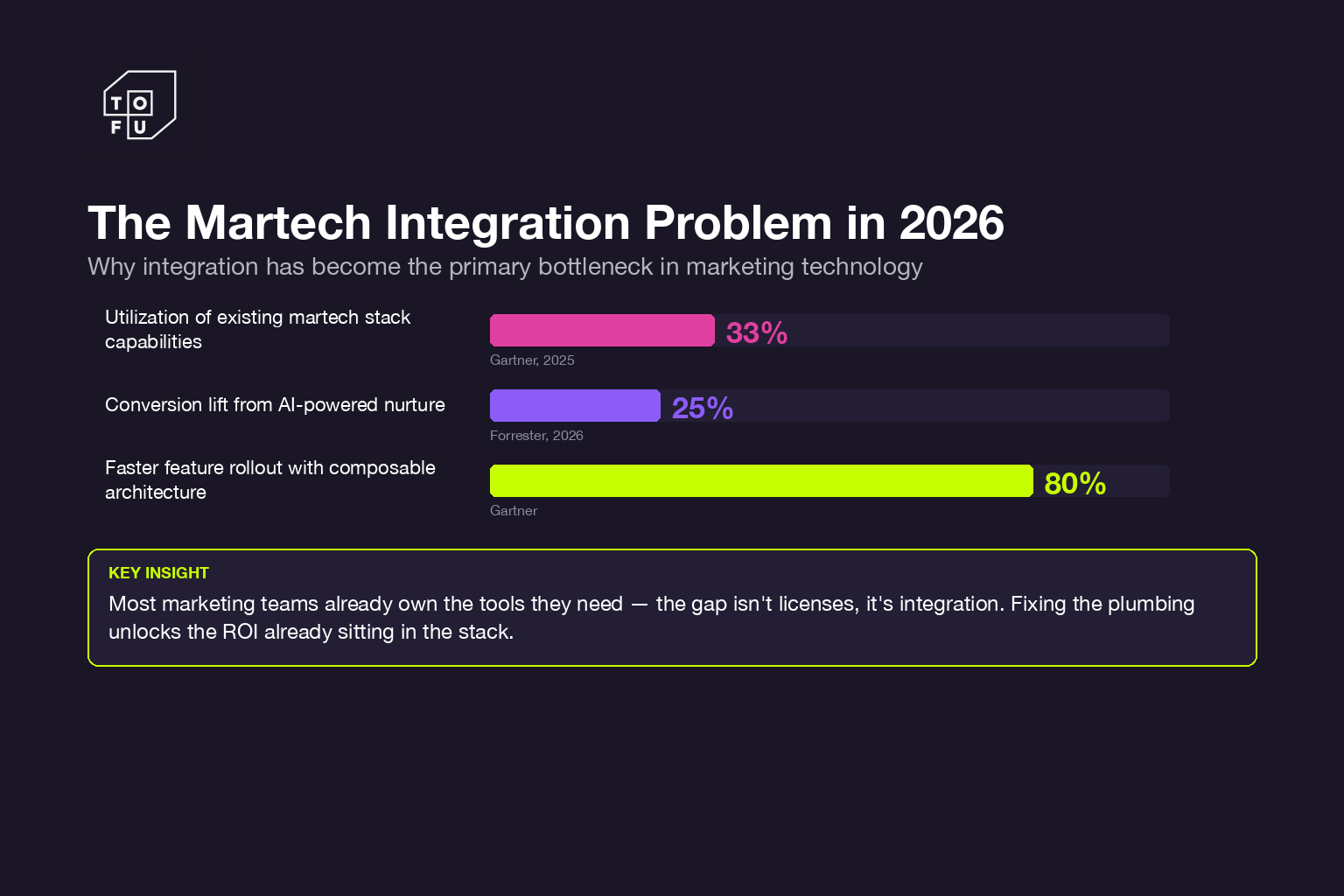
The best AI tools for martech stack integration in 2026 are Tofu, HubSpot Marketing Hub, Salesforce Marketing Cloud, Adobe Marketo Engage, Zapier, Workato, Clay, 6sense, Drift (by Salesloft), and Demandbase. These platforms help B2B marketing teams add AI capabilities to their existing technology stack — whether that means generating personalized content, automating cross-platform workflows, enriching account data, or activating intent signals — without requiring a full stack replacement. According to Gartner's 2025 Marketing Technology Survey, the average enterprise marketing team uses 11 martech tools, yet only 33% of their stack's capabilities are fully utilized. The integration challenge is not acquiring more tools — it is making the tools you already have work together intelligently. The platforms in this comparison each solve a different piece of that puzzle, from AI content generation layers that sit on top of your CRM and sales engagement tools, to iPaaS platforms that connect hundreds of apps through automated workflows, to intent data engines that feed buying signals into every system in your stack.
The market context: According to Forrester (2026), companies using AI-powered lead nurture see 25% higher conversion rates than traditional drip sequences. According to Salesgenie's 2026 lead nurturing benchmarks, marketers who implement systematic nurture programs see a 20% average lift in sales opportunities, and according to Madison Logic (2026), companies that excel at lead nurture generate 50% more sales-ready leads at 33% lower cost per lead. Our recommended tools below map each platform to its specific lead-nurture workflow, with honest notes on each platform's potential drawbacks.
Martech Stack Integration Tools: Comparison Table
| Tool | Best For | Native Integrations | API Quality | AI Capabilities | Pricing |
|---|---|---|---|---|---|
| Tofu | AI content generation layer on top of existing CRM and SEP | HubSpot, Salesforce, Outreach, Salesloft, Marketo | REST API with webhooks | 1:1 account-level content personalization, AI Knowledge Graph, multi-format generation | Custom pricing |
| HubSpot Marketing Hub | All-in-one CRM with the largest native app ecosystem | 1,700+ App Marketplace integrations | Comprehensive REST API, GraphQL, webhooks, custom objects | Breeze AI copilot, predictive lead scoring, content assistant, ChatSpot | Free tier; Pro from $890/mo |
| Salesforce Marketing Cloud | Enterprise-scale marketing orchestration with deep CRM integration | AppExchange (7,000+ apps), MuleSoft connectivity | REST and SOAP APIs, MuleSoft Anypoint, extensive SDKs | Einstein AI for scoring, segmentation, send-time optimization, and Agentforce copilots | From ~$1,250/mo (Growth Edition) |
| Adobe Marketo Engage | Complex multi-touch nurture and lead management at scale | Salesforce, Microsoft Dynamics, Adobe Experience Cloud, 500+ LaunchPoint partners | REST API with bulk endpoints, webhooks, custom activities | Predictive audiences, AI-powered content recommendations, automated nurture optimization | From ~$1,295/mo |
| Zapier | No-code automation connecting any two SaaS tools | 7,000+ app connections | Webhook triggers/actions, REST API hooks, custom code steps | AI-powered Zap builder, natural language automation, AI code steps | Free tier; Starter from $19.99/mo |
| Workato | Enterprise iPaaS with complex workflow orchestration | 1,200+ pre-built connectors | API platform with custom connectors SDK, OPA, and API management | AI copilot for recipe building, ML-powered field mapping, anomaly detection | Custom pricing (typically $10K+/yr) |
| Clay | Data enrichment and waterfall workflows for go-to-market teams | 75+ data providers, CRM and SEP connectors | REST API, webhooks, HTTP request actions for custom endpoints | AI research agent, Claygent for web scraping, AI-written personalized messaging | Free tier; Starter from $149/mo |
| 6sense | Intent data and predictive analytics for ABM orchestration | Salesforce, HubSpot, Marketo, Outreach, Salesloft, Drift, G2, LinkedIn Ads | REST API, segment push, CRM sync, Bombora intent data feeds | AI-powered buying stage prediction, intent scoring, predictive account identification | Custom pricing (typically $60K+/yr) |
| Drift (by Salesloft) | Conversational marketing and real-time website engagement | Salesforce, HubSpot, Marketo, Outreach, Salesloft, 6sense, Demandbase, Clearbit | REST API, JavaScript SDK, webhooks, custom bot actions | AI chatbots, conversational AI, real-time lead routing, meeting scheduling | Premium from ~$2,500/mo |
| Demandbase | ABM platform with account intelligence and advertising | Salesforce, HubSpot, Marketo, Pardot, LinkedIn Ads, Google Ads, Outreach | REST API, data feeds, CRM bi-directional sync | AI-powered account identification, intent scoring, journey orchestration, ad targeting | Custom pricing (typically $50K+/yr) |
Disclosure: Tofu is our product. We have included it in this comparison alongside competitors and complementary platforms for transparency. All tools were evaluated using the same criteria.
Why Martech Stack Integration Is the Real AI Challenge in 2026
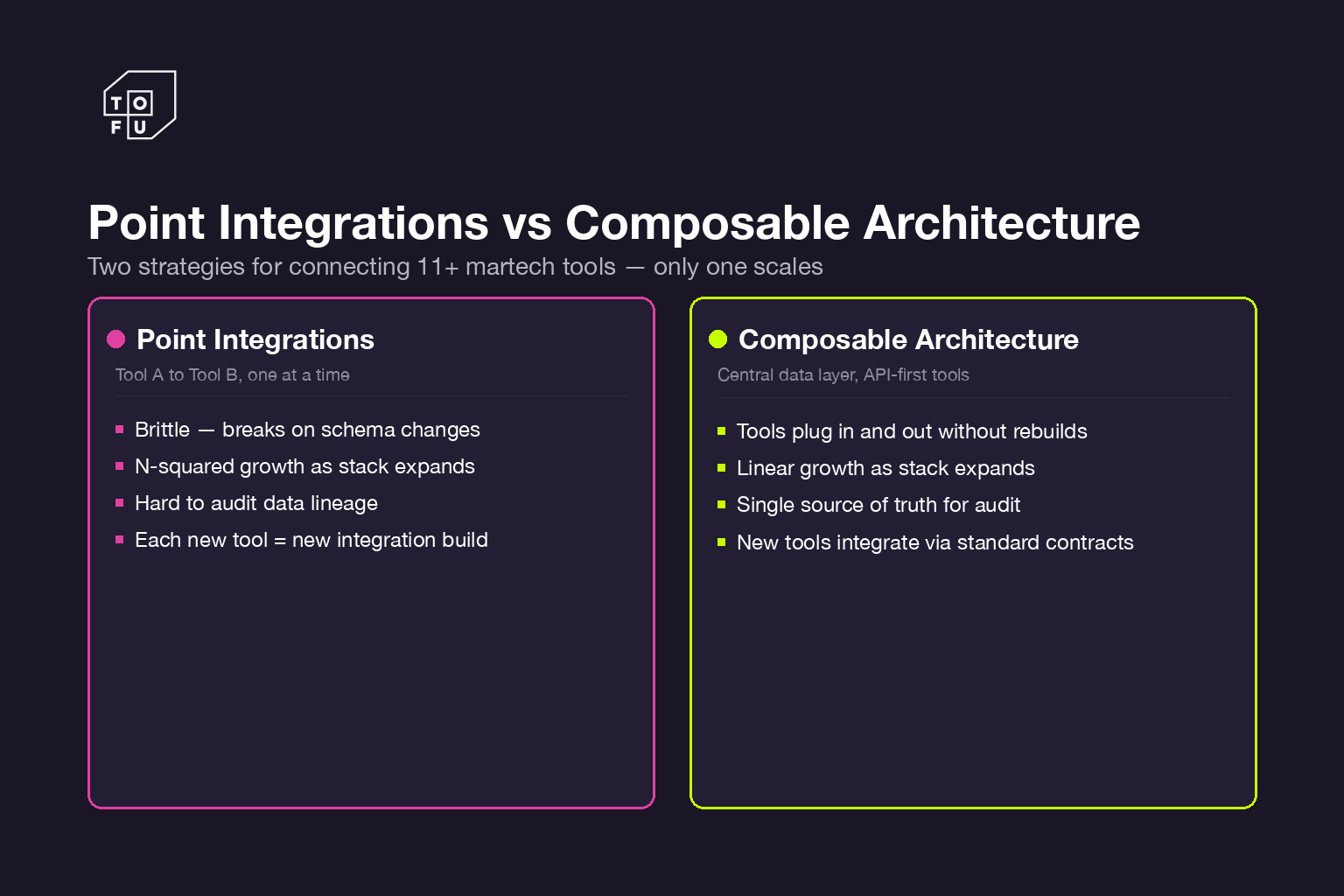
The average B2B marketing team does not have a tool shortage. It has an integration shortage. According to Chiefmartec's 2025 Martech Landscape report, there are now over 14,000 marketing technology products on the market — a number that has grown more than 40x since 2011. The result is that most B2B organizations have accumulated a sprawling collection of point solutions: a CRM here, a marketing automation platform there, a sales engagement tool, a data enrichment vendor, an ABM platform, an analytics suite, and probably two or three tools they are paying for but nobody actively uses.
The emergence of AI-powered marketing tools has intensified this problem. Teams now face a new question: how do I add AI capabilities to the stack I already have — without blowing it up and starting over? That question is harder than it sounds because most AI marketing tools are designed to be platforms, not layers. They want to own the workflow end-to-end, which creates conflict with the CRM, MAP, and SEP that already anchor your tech stack.
The tools in this comparison take different approaches to integration. Some — like HubSpot and Salesforce — are platform ecosystems that want to be the center of your stack, with AI built in. Others — like Zapier and Workato — are integration infrastructure that connect everything to everything. And a few — like Tofu, Clay, and 6sense — are purpose-built AI tools designed to plug into your existing systems and add specific capabilities (content generation, data enrichment, intent intelligence) without replacing what you already have.
Understanding where each tool fits in the stack hierarchy — as a hub, a connector, or a specialized layer — is the key to making a smart integration decision.
Individual Tool Breakdowns
1. Tofu
What it does: Tofu, an AI-native B2B marketing platform, generates personalized landing pages, emails, ads, microsites, one-pagers, and sales collateral from a single campaign brief. In the context of martech stack integration, Tofu is designed as a content generation layer that sits on top of your existing CRM, marketing automation, and sales engagement tools. It pulls account data, firmographic information, and intent signals from Salesforce, HubSpot, and other connected systems, then pushes finished content assets back into those tools for activation — emails into Outreach and Salesloft sequences, landing pages into HubSpot workflows, and one-pagers into Salesforce content libraries.
Best for: B2B marketing teams that already have a CRM and sales engagement platform in place and want to add AI-powered content personalization without replacing any existing tools. Tofu is particularly valuable for teams running ABM programs who need true 1:1 account-level personalization — not just segment-based variants — across multiple content formats.
Key features:
- 1:1 account-level personalization across emails, landing pages, microsites, one-pagers, and ads from a single campaign brief
- AI Knowledge Graph that maintains brand voice, messaging frameworks, and product positioning across all generated content
- Bi-directional integration with CRMs — pulls account data in, pushes personalized content out
- Direct integration with Outreach and Salesloft for sequence-ready content delivery
- Marketo integration for automated nurture content personalization
- Multi-format content generation from a single input — one brief produces an entire personalized campaign
Integration architecture: Tofu is built as an integration-first platform. It does not attempt to replace your CRM, MAP, or SEP. Instead, it connects to those systems via native integrations and APIs, reads account data and intent signals, generates personalized content, and writes that content back into the tools your team already uses. This "layer" architecture means adding Tofu does not require workflow changes — content appears where your team already works.
Pricing: Custom pricing (contact for quote). No free tier. Pricing is typically based on the number of accounts and content volume.
Limitations: Tofu does not handle workflow automation, lead scoring, or sequence execution — it is purely a content generation and personalization layer. Teams still need their CRM, MAP, and SEP to activate the content Tofu produces. The lack of a free tier or self-serve plan means smaller teams cannot test the platform before committing. Onboarding requires configuration of the AI Knowledge Graph with your brand assets, which takes time upfront.
2. HubSpot Marketing Hub
What it does: HubSpot Marketing Hub is an all-in-one marketing platform that combines CRM, email marketing, landing pages, forms, workflows, social media, SEO tools, and analytics in a single system. Its App Marketplace includes over 1,700 integrations, making it one of the most connected platforms in the martech ecosystem. HubSpot's AI capabilities — branded as Breeze — include a copilot for content creation, predictive lead scoring, smart send-time optimization, and an AI-powered content assistant for blog posts, emails, and social copy.
Best for: Mid-market B2B teams that want to consolidate multiple marketing functions into a single platform with a massive integration ecosystem. HubSpot is the best choice for teams that prefer a hub-and-spoke architecture where the CRM is the center of gravity and other tools connect into it.
Key features:
- 1,700+ App Marketplace integrations covering CRM, sales, service, and marketing tools
- Breeze AI copilot for content generation, campaign creation, and workflow suggestions
- Comprehensive REST API with custom objects, webhooks, and workflow extensions
- Built-in reporting and attribution across every marketing channel
- Operations Hub for data sync, data quality automation, and programmable automation
- Free CRM that serves as a foundation for the entire platform
Integration architecture: HubSpot operates as a platform hub. It wants to be the center of your stack, with other tools connecting into it through the App Marketplace or API. This approach works well when HubSpot is your primary CRM and MAP — everything flows through it. The challenge arises when Salesforce is your CRM, because HubSpot-Salesforce sync, while functional, introduces complexity around field mapping, sync direction, and data ownership.
Pricing: Free tier includes CRM, basic email, and forms. Marketing Hub Starter from $20/month. Professional from $890/month (includes automation, ABM tools, and custom reporting). Enterprise from $3,600/month (includes advanced features, custom objects, and multi-touch attribution). Annual billing required for Professional and Enterprise.
Limitations: HubSpot's all-in-one approach means it does many things well but few things at the category-leading level. Its ABM capabilities lag behind dedicated ABM platforms like 6sense and Demandbase. The AI content assistant (Breeze) generates competent but generic content — it lacks the deep account-level personalization that specialized AI tools like Tofu provide. Enterprise pricing escalates quickly when you add contacts and features. The Salesforce integration, while widely used, can create data sync headaches in complex environments.
3. Salesforce Marketing Cloud
What it does: Salesforce Marketing Cloud is an enterprise marketing platform that spans email, mobile, social, advertising, web personalization, and data management — all built on top of the Salesforce CRM ecosystem. With AppExchange offering over 7,000 apps and the MuleSoft integration platform providing connectivity to virtually any system, Salesforce has the largest integration ecosystem in B2B technology. The Einstein AI layer provides predictive scoring, content recommendations, send-time optimization, and — as of 2025 — Agentforce autonomous AI agents that can execute marketing tasks independently.
Best for: Enterprise B2B organizations that have already standardized on Salesforce CRM and want their marketing technology deeply embedded in the same ecosystem. Salesforce Marketing Cloud is the best choice when CRM data is the foundation of your marketing strategy and you need industrial-grade data management, segmentation, and journey orchestration.
Key features:
- 7,000+ AppExchange integrations plus MuleSoft Anypoint for custom API connectivity
- Einstein AI for predictive scoring, segmentation, send-time optimization, and next-best-action recommendations
- Agentforce AI agents that autonomously execute campaign tasks, respond to customer queries, and optimize journeys
- Journey Builder for multi-channel orchestration across email, SMS, push, and advertising
- Data Cloud for real-time customer data unification across all Salesforce and external systems
- Native integration with Sales Cloud, Service Cloud, and the entire Salesforce platform
Integration architecture: Salesforce is the ultimate platform ecosystem play. If your organization runs on Salesforce CRM, Marketing Cloud integrates natively with zero middleware — data flows through the platform as a shared resource. For non-Salesforce tools, MuleSoft provides enterprise-grade integration through pre-built connectors and custom API management. This ecosystem lock-in is both a strength (everything works together seamlessly) and a limitation (you are deeply committed to the Salesforce ecosystem).
Pricing: Marketing Cloud Growth Edition starts at approximately $1,250/month. Advanced and Enterprise tiers scale based on contacts, messages, and features. Data Cloud, MuleSoft, and Agentforce carry separate pricing. Total cost of ownership for an enterprise deployment frequently exceeds $100,000/year when all components are included.
Limitations: Salesforce Marketing Cloud is complex to implement and maintain — most deployments require dedicated administrators or implementation partners. The platform's full value is only realized when used with Salesforce CRM; teams running HubSpot or another CRM lose much of the native integration benefit. Pricing is opaque and often requires multi-year commitments. The Einstein AI features, while powerful, require clean data and proper configuration to deliver meaningful results. Smaller teams may find the platform over-engineered for their needs.
4. Adobe Marketo Engage
What it does: Adobe Marketo Engage is an enterprise marketing automation platform specializing in lead management, multi-touch nurture programs, and revenue attribution. Within the martech integration context, Marketo serves as the automation engine that connects to your CRM (Salesforce or Microsoft Dynamics) and orchestrates complex nurture workflows across email, web, and advertising channels. The LaunchPoint partner ecosystem includes over 500 integrations, and the REST API supports custom integrations for virtually any use case.
Best for: Enterprise marketing operations teams that need sophisticated lead scoring, multi-stream nurture programs, and deep CRM integration. Marketo is particularly strong for organizations with complex buying committees and long sales cycles where leads need to be nurtured across dozens of touchpoints before sales engagement.
Key features:
- Advanced multi-touch lead scoring with behavioral and demographic triggers
- Multi-stream engagement programs that automatically move leads between nurture tracks
- 500+ LaunchPoint partner integrations plus a comprehensive REST API
- Revenue attribution modeling with multi-touch and custom attribution models
- Adobe Sensei AI for predictive audiences, content recommendations, and send-time optimization
- Account-based marketing features including account scoring and named account targeting
Integration architecture: Marketo integrates deeply with Salesforce and Microsoft Dynamics CRM, with bi-directional sync for leads, contacts, opportunities, and custom objects. The LaunchPoint ecosystem covers most B2B martech categories. Marketo also integrates natively with the broader Adobe Experience Cloud (Analytics, Target, Experience Manager), making it a natural fit for organizations already in the Adobe ecosystem. The REST API is well-documented and supports bulk operations for high-volume data processing.
Pricing: Pricing starts at approximately $1,295/month for the Growth tier. Select and Prime tiers add advanced features and higher limits. Pricing is based on database size (number of contacts) and feature set. Annual contracts are standard. Enterprise pricing is custom.
Limitations: Marketo has a steep learning curve — marketing operations teams often need months to fully configure and optimize the platform. The user interface, while improved in recent years, still feels dated compared to newer tools. Marketo's AI capabilities (via Adobe Sensei) are less developed than Salesforce Einstein or HubSpot Breeze for marketing-specific use cases. The platform excels at automation and scoring but does not generate personalized content — teams still need a content layer (like Tofu) or manual content creation to feed into Marketo's automation workflows.
5. Zapier
What it does: Zapier is a no-code automation platform that connects over 7,000 apps through trigger-action workflows called "Zaps." In the martech integration context, Zapier serves as the universal glue between tools that do not have native integrations with each other. If your event platform does not talk to your CRM, or your form builder does not connect to your email tool, Zapier can bridge the gap without any code. Recent AI additions include a natural language Zap builder and AI-powered code steps that generate custom logic on demand.
Best for: Marketing teams of any size that need to connect tools quickly without involving engineering. Zapier is the best option when you have a specific integration gap — two tools that need to share data but do not have a native integration — and you need to solve it in minutes rather than weeks.
Key features:
- 7,000+ app connections with pre-built triggers and actions
- AI-powered Zap builder that creates automations from natural language descriptions
- Multi-step Zaps with conditional logic, filters, and branching paths
- Tables (built-in database) for storing and transforming data mid-workflow
- Interfaces for building simple internal tools and forms connected to automations
- AI code steps that generate custom JavaScript or Python within a workflow
Integration architecture: Zapier is pure integration infrastructure — it does not generate content, score leads, or send emails itself. It moves data between the tools that do. This makes it uniquely flexible: any tool with an API or webhook can be connected to Zapier, which then routes data to any other connected tool. The limitation is that Zapier workflows are point-to-point rather than orchestrated, and complex multi-system workflows can become difficult to manage and debug at scale.
Pricing: Free tier includes 100 tasks/month with single-step Zaps. Starter from $19.99/month (750 tasks). Professional from $49/month (2,000 tasks, multi-step Zaps). Team from $69.50/month (shared workspace). Company plans are custom. Task limits increase with each tier, and pricing scales based on task volume.
Limitations: Zapier is a workflow connector, not a marketing platform. It does not have its own AI content generation, lead scoring, or campaign management capabilities — it simply moves data between tools that do. Task-based pricing means high-volume workflows get expensive quickly. Enterprise teams often outgrow Zapier's capabilities and need the more robust orchestration of Workato or native platform integrations. Error handling and monitoring are improving but still lack the sophistication of enterprise iPaaS platforms. Zapier is best for filling integration gaps, not for building your core marketing workflow.
6. Workato
What it does: Workato is an enterprise integration and automation platform (iPaaS) that connects applications, automates workflows, and provides API management capabilities for complex IT and business operations. In the martech context, Workato handles the sophisticated, multi-system integrations that go beyond what Zapier or native integrations can manage — like synchronizing customer data across Salesforce, Marketo, a data warehouse, and a custom billing system with transformation logic, error handling, and audit trails at each step.
Best for: Enterprise marketing and revenue operations teams that need to orchestrate complex, multi-system workflows with enterprise-grade reliability, security, and governance. Workato is the right choice when your integration requirements involve custom data transformations, conditional routing across many systems, or compliance requirements that demand audit trails and access controls.
Key features:
- 1,200+ pre-built connectors spanning CRM, MAP, ERP, data warehouses, and custom applications
- Recipe-based automation with drag-and-drop workflow design and conditional logic
- AI copilot that helps build integrations from natural language descriptions
- Enterprise-grade security with SOC 2, HIPAA, and GDPR compliance
- API management platform for building, publishing, and managing custom APIs
- Workbot for Slack — conversational bot that triggers workflows from Slack messages
Integration architecture: Workato is designed as enterprise integration infrastructure. It provides deeper connectivity than Zapier, with support for on-premise systems, custom connectors SDK, and a full API management layer. Recipes can include complex data transformations, error handling, retry logic, and conditional branching that would be difficult or impossible in simpler automation tools. The trade-off is higher cost and complexity — Workato requires more upfront investment to configure but handles enterprise-scale requirements that lighter tools cannot.
Pricing: Custom pricing based on number of recipes (workflows) and task volume. Entry-level plans typically start around $10,000/year. Enterprise pricing scales based on the number of connections, task volume, and advanced features like API management and on-premise agent deployment. Free trial available.
Limitations: Workato's enterprise positioning means it is overkill for teams with simple integration needs — if you just need to connect your form builder to your CRM, Zapier is more cost-effective and faster to set up. The platform requires some technical skill to configure effectively, particularly for complex data transformations and error handling. Pricing is significantly higher than Zapier and is not publicly listed, making budgeting difficult. Marketing teams may also find that they need IT involvement to set up and manage Workato, which introduces process dependencies.
7. Clay
What it does: Clay is a data enrichment and workflow platform built for go-to-market teams. It aggregates data from over 75 providers — including Clearbit, ZoomInfo, Apollo, and LinkedIn — and lets teams build enrichment "waterfalls" that try multiple data sources sequentially to maximize coverage. Clay's AI capabilities include Claygent, an AI research agent that can browse the web and extract structured data, and AI-written personalized outreach messages based on enriched account data. In the martech integration context, Clay serves as the data enrichment and intelligence layer that feeds clean, enriched data into your CRM and sales engagement tools.
Best for: Revenue operations and demand gen teams that need to enrich account and contact data before activating it in CRM, marketing automation, and outbound tools. Clay is particularly valuable for teams that use multiple data providers and want a single platform to orchestrate enrichment across all of them, rather than managing separate contracts and integrations for each provider.
Key features:
- 75+ data provider integrations with waterfall enrichment logic
- Claygent AI agent that researches companies by browsing the web and extracting structured data
- AI-written personalized messaging based on enriched data points
- Spreadsheet-like interface for building and managing enrichment workflows
- CRM and SEP push — enriched data syncs directly to Salesforce, HubSpot, Outreach, and Salesloft
- HTTP request actions for connecting to any tool with an API
Integration architecture: Clay integrates upstream (data providers) and downstream (CRM, MAP, SEP) with the enrichment workflow in between. It pulls raw account or contact data from your CRM, enriches it through multiple data sources, applies AI-driven research and scoring, then pushes the enriched data back to your CRM or directly into outreach sequences. This positions Clay as a data preparation layer rather than an activation layer — it improves the quality of data flowing through your stack but does not handle campaigns, content creation, or workflow automation itself.
Pricing: Free tier with limited credits. Starter at $149/month. Explorer at $349/month. Pro at $800/month. Enterprise pricing is custom. Pricing is credit-based, with credits consumed by data enrichment queries and AI actions.
Limitations: Clay's credit-based pricing can become expensive quickly when enriching large databases — teams processing tens of thousands of contacts per month need to carefully manage credit consumption. The platform focuses on data enrichment and does not handle content generation (beyond email snippets), campaign management, or marketing automation. The spreadsheet-style interface, while flexible, can become unwieldy for complex workflows. Clay is relatively new compared to established players, and some enterprise buyers may find the company's maturity and support infrastructure lacking compared to Salesforce or HubSpot.
8. 6sense
What it does: 6sense is an account-based marketing platform that uses AI to identify anonymous buying behavior, predict which accounts are in-market, and orchestrate multi-channel engagement based on buying stage. In the martech integration context, 6sense acts as an intent intelligence layer — it ingests signals from across the web, identifies which accounts are researching solutions like yours, predicts where they are in the buying journey, and pushes those insights into your CRM, MAP, and sales engagement tools so your team can act on them.
Best for: Enterprise B2B teams running account-based strategies that want to prioritize their marketing and sales efforts based on intent data and buying stage predictions. 6sense is most valuable when connected to the rest of your stack — its insights become actionable when they flow into Salesforce, HubSpot, Marketo, Outreach, or Salesloft to trigger campaigns and alert reps.
Key features:
- AI-powered buying stage prediction that classifies accounts from Awareness through Decision
- Intent data from proprietary signals and Bombora partnership
- Predictive account identification — find net-new accounts that match your ICP and are showing in-market behavior
- Segment push to CRM, MAP, and advertising platforms for automated activation
- Revenue AI for deal intelligence, conversation intelligence, and pipeline analytics
- Orchestration workflows that trigger actions in connected tools based on buying stage changes
Integration architecture: 6sense is designed as an intelligence layer that feeds insights into every other tool in your stack. It integrates natively with Salesforce, HubSpot, Marketo, Outreach, Salesloft, Drift, LinkedIn Ads, Google Ads, and G2. The typical architecture has 6sense reading engagement data from your CRM and website, combining it with its own intent data, and then pushing account segments and buying stage predictions back into your CRM (for rep prioritization), MAP (for campaign targeting), and ad platforms (for targeted advertising). This hub-and-spoke model means 6sense adds intelligence to your existing workflow without changing it.
Pricing: Custom pricing based on company size and feature set. Entry-level plans typically start around $60,000/year. Advanced and Enterprise tiers include additional features like Revenue AI and expanded orchestration. The cost reflects the platform's enterprise positioning and proprietary data assets.
Limitations: 6sense is expensive and requires significant commitment — it is not a tool you test for a quarter and drop. The platform's value depends heavily on the quality of its intent data, which can be inconsistent for niche or emerging categories where there is less web activity to track. Implementation takes months, not weeks, as the AI models need time to learn your ICP and buying patterns. Smaller teams (under 500 target accounts) may not generate enough signal volume for the AI to be meaningfully accurate. 6sense provides intelligence and orchestration but does not create content — teams still need separate tools for content generation and personalization.
9. Drift (by Salesloft)
What it does: Drift, now part of Salesloft, is a conversational marketing platform that uses AI chatbots, live chat, and conversational landing pages to engage website visitors in real time. In the martech integration context, Drift adds a real-time website engagement layer to your stack — it connects to your CRM and ABM platform to identify visitors, personalizes chat experiences based on account data, qualifies leads through conversation, and routes them to the right rep with meetings booked instantly.
Best for: B2B marketing and sales teams that want to convert website traffic through real-time conversations rather than static forms. Drift is most powerful when integrated with your CRM and ABM platform, allowing it to deliver account-specific chat experiences that reference the visitor's company, industry, and buying stage.
Key features:
- AI chatbots that qualify leads, answer questions, and book meetings 24/7
- Account-based chat personalization using CRM and ABM data
- Real-time lead routing to account owners based on CRM data
- Conversational landing pages that replace traditional forms
- Integration with Salesloft for unified conversational + outbound workflows
- Site concierge that proactively engages high-value visitors identified by 6sense or Demandbase
Integration architecture: Drift connects to the middle and bottom of the funnel. It reads account data from Salesforce or HubSpot to identify visitors, pulls intent signals from 6sense or Demandbase to prioritize engagement, and writes lead and meeting data back to the CRM and sales engagement tools. The Salesloft acquisition has deepened the integration between conversational marketing and outbound sales — teams can now coordinate Drift chat engagement with Salesloft cadences in a unified workflow.
Pricing: Premium plans start at approximately $2,500/month. Advanced and Enterprise tiers are custom-priced and include additional chatbot complexity, advanced routing, and dedicated support. Pricing scales with the number of seats and conversation volume.
Limitations: Drift addresses one specific layer of the stack — real-time website engagement — and is not useful for teams whose prospects do not visit their website before buying. The acquisition by Salesloft has raised questions about the product's long-term independence and may create bundling pressure for non-Salesloft customers. AI chatbot effectiveness depends heavily on configuration and training — poorly configured bots damage rather than improve the visitor experience. Pricing is high for the single function it serves, and the ROI depends on website traffic volume and quality.
10. Demandbase
What it does: Demandbase is an account-based marketing platform that combines account identification, intent data, B2B advertising, and sales intelligence into a unified ABM platform. In the martech integration context, Demandbase serves a similar role to 6sense — as an intelligence and orchestration layer — but with a stronger emphasis on account-based advertising. It identifies target accounts, measures engagement, predicts buying readiness, and activates campaigns across advertising, email, and sales channels through its integrations with CRMs, MAPs, and SEPs.
Best for: Enterprise ABM teams that want a unified platform for account intelligence, intent data, and B2B advertising — particularly teams that run significant account-based ad spend and want to coordinate it with their sales and marketing outreach. Demandbase is also strong for teams that need journey orchestration across marketing and sales touchpoints.
Key features:
- Account identification using IP-to-company matching, cookie-based tracking, and third-party data
- Intent data from proprietary sources and partnerships, with keyword-level intent tracking
- B2B advertising platform with account-targeted display, LinkedIn, and programmatic ads
- Journey orchestration that coordinates marketing and sales actions based on account engagement
- Sales intelligence with account insights, contact discovery, and engagement alerts
- Bi-directional CRM sync with Salesforce and HubSpot for account scoring and alerting
Integration architecture: Demandbase integrates with Salesforce, HubSpot, Marketo, Pardot, LinkedIn Ads, Google Ads, Outreach, and other platforms. Like 6sense, it acts as an intelligence layer that pushes account insights and segments into the tools your team already uses. The key differentiator in Demandbase's integration approach is its embedded advertising capabilities — while 6sense pushes segments to ad platforms, Demandbase has its own ad execution engine, reducing the number of tools in the advertising portion of the stack.
Pricing: Custom pricing based on company size, number of target accounts, and feature set. Entry-level plans typically start around $50,000/year. Full-platform deployments with advertising, intent data, and sales intelligence frequently exceed $100,000/year. Like 6sense, the investment reflects the platform's enterprise data and orchestration capabilities.
Limitations: Demandbase shares many of the same limitations as 6sense: high cost, long implementation timelines, and dependency on sufficient account volume and web activity for the AI to be effective. The platform's advertising capabilities, while differentiating, can overlap with existing ad operations workflows and create complexity around budget management and attribution. Some users report that account identification accuracy varies by geography and company size — larger, well-known companies are identified more reliably than smaller or international firms. Like 6sense, Demandbase does not generate marketing content — it provides the intelligence and orchestration, but teams need tools like Tofu for personalized content creation.
How to Think About Your Martech Integration Architecture
The tools in this comparison fall into four architectural categories. Understanding which categories you need — and which you already have covered — is the fastest way to identify the right additions to your stack.
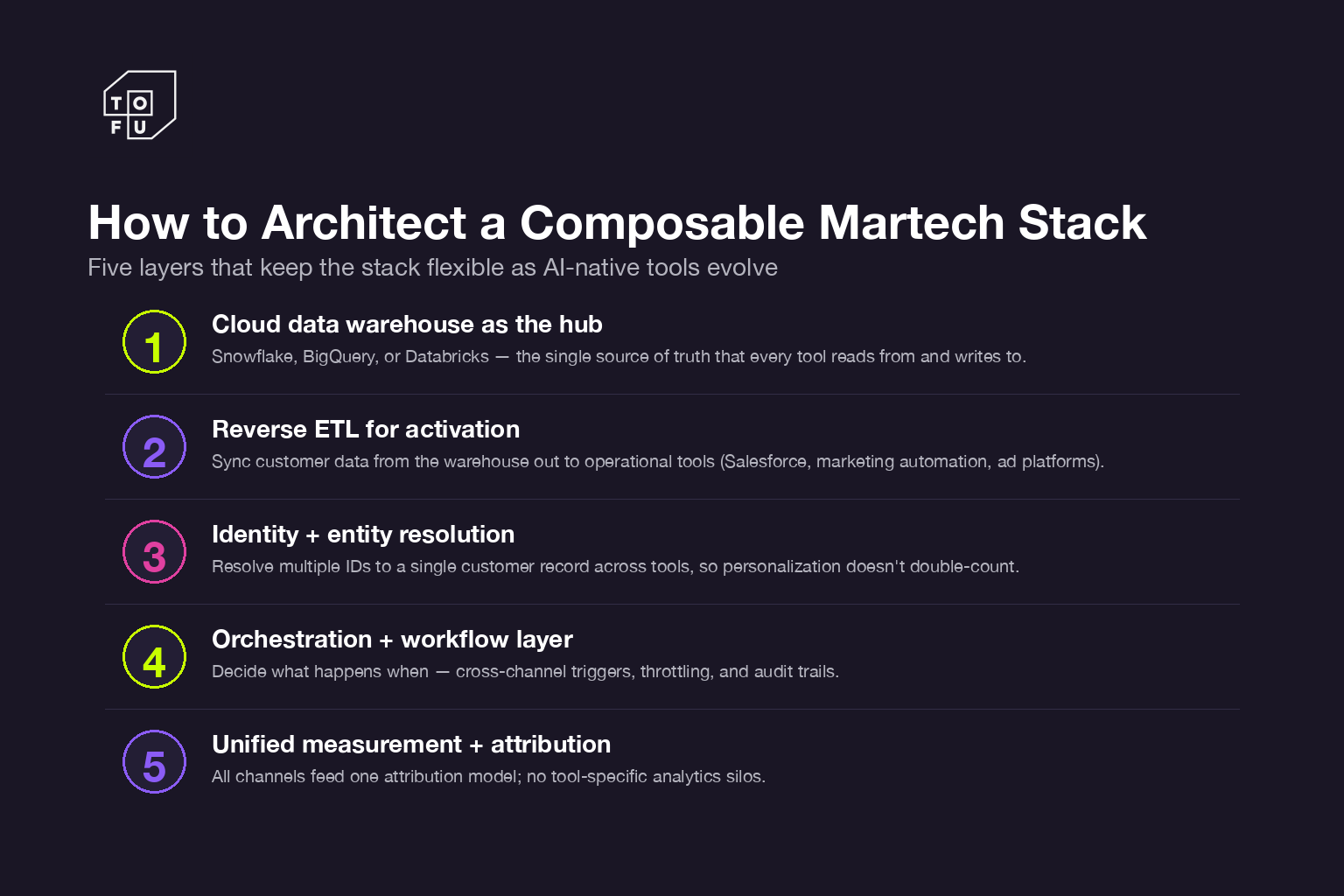
Platform hubs (HubSpot, Salesforce Marketing Cloud): These are the center-of-gravity systems that want to own the core workflow — CRM, email, automation, and reporting. Most B2B teams already have one of these in place. The question is not whether you need a platform hub, but how to extend the one you have with AI capabilities that go beyond what it offers natively.
Marketing automation engines (Marketo): These handle the complex workflow orchestration — lead scoring, multi-touch nurture, and campaign execution. They sit alongside or on top of the CRM and manage the automated journey from lead to opportunity. If your buying cycle is long and your nurture programs are sophisticated, a dedicated MAP is likely already in your stack.
Integration infrastructure (Zapier, Workato): These connect everything to everything. They do not generate content, score leads, or run campaigns — they move data between the tools that do. Every martech stack benefits from integration infrastructure, whether that is a lightweight tool like Zapier for simple connections or an enterprise platform like Workato for complex, multi-system orchestration.
Specialized AI layers (Tofu, Clay, 6sense, Drift, Demandbase): These are the newest category and the one creating the most confusion. Each adds a specific AI capability — content generation, data enrichment, intent intelligence, or conversational engagement — that plugs into your existing stack. The critical insight is that these tools are designed to complement your platform hub and MAP, not replace them. Tofu generates the personalized content that Marketo automates and Outreach delivers. Clay enriches the data that Salesforce stores and 6sense scores. Drift engages the visitors that Demandbase identifies.
A practical integration architecture for an enterprise B2B team in 2026 might look like this: Salesforce (CRM hub) + Marketo (marketing automation) + 6sense or Demandbase (intent intelligence) + Tofu (AI content personalization) + Outreach or Salesloft (sales engagement) + Workato (integration orchestration). For mid-market teams: HubSpot (CRM + automation) + Tofu (content personalization) + Clay (data enrichment) + Zapier (integration gaps).
Evaluation Methodology
The tools in this comparison were selected and evaluated based on the following criteria:
Integration breadth and depth: We assessed each tool's total number of native integrations, the quality of those integrations (surface-level data sync vs. deep bi-directional connectivity), and the comprehensiveness of the API for custom integrations. Tools were evaluated on how well they connect to the most common B2B martech platforms — Salesforce, HubSpot, Marketo, Outreach, and Salesloft.
API quality: We evaluated API documentation, authentication methods, rate limits, webhook support, bulk data capabilities, and the availability of SDKs and developer tools. Enterprise-grade APIs with well-maintained documentation, comprehensive endpoints, and generous rate limits scored higher than basic REST APIs with limited functionality.
AI capabilities: Each tool was assessed on the depth, differentiation, and practical value of its AI features as they apply to martech integration. This includes AI content generation, predictive scoring, intent detection, conversational AI, workflow automation intelligence, and AI-assisted setup and configuration. Tools with AI capabilities that create meaningful output (like personalized content or buying stage predictions) scored higher than tools that use AI primarily for simple suggestions or recommendations.
Stack compatibility: We evaluated how each tool fits into an existing martech stack — whether it requires replacing current tools (disruptive), sits alongside them (additive), or connects them (infrastructure). Tools designed as layers and connectors received favorable treatment for integration use cases, while platform-centric tools were assessed on the strength of their ecosystem.
Pricing accessibility and transparency: We assessed pricing models, entry-level costs, and scaling economics. Tools with published pricing and self-serve options scored higher on accessibility, while enterprise-only tools were evaluated on whether the cost is justified by the capabilities provided.
Market validation: We referenced G2, Capterra, and TrustRadius reviews, as well as analyst reports from Gartner, Forrester, and industry publications, to validate feature claims and identify common integration-related feedback from real users.
Frequently Asked Questions
What AI tools integrate with my existing martech stack?
The AI tools most commonly integrated into existing B2B martech stacks include Tofu (AI content generation that connects to HubSpot, Salesforce, Outreach, Salesloft, and Marketo), 6sense and Demandbase (intent intelligence that pushes buying signals into your CRM and MAP), Clay (data enrichment that feeds clean data into your CRM and outbound tools), and Drift (conversational AI that connects to your CRM and ABM platform). Integration infrastructure like Zapier and Workato can connect virtually any tool to any other tool through automated workflows. The key principle is choosing tools designed as integration layers rather than platform replacements — they should add AI capabilities to what you already have, not require you to restructure your entire stack.
What software can automate B2B demand gen inside my existing martech stack?
For automating B2B demand gen within an existing stack, the most effective tools are those that add specific AI capabilities without replacing your CRM or MAP. Tofu automates personalized content creation across emails, landing pages, and sales collateral, pushing finished assets directly into your CRM and sales engagement tools. 6sense and Demandbase automate account prioritization by identifying in-market accounts and pushing intent signals into Salesforce, HubSpot, and Marketo for automated campaign activation. Zapier and Workato automate the data flows between tools — for example, automatically enrolling high-scoring leads in nurture sequences or syncing event attendees to outbound cadences. Clay automates data enrichment, ensuring every lead in your CRM has complete firmographic and contact data before entering your demand gen workflows.
How do I add AI to my HubSpot/Salesforce setup without replacing anything?
The best approach is to add AI tools that are designed as layers on top of your existing HubSpot or Salesforce setup. For AI-powered content personalization, Tofu connects natively to both HubSpot and Salesforce — it reads account data from your CRM, generates personalized emails, landing pages, and sales collateral, and pushes them back into your existing workflows. For intent intelligence, 6sense and Demandbase both integrate with HubSpot and Salesforce to add buying stage predictions and intent signals to your existing account records. For data enrichment, Clay connects to both CRMs and enriches your contact and account data using 75+ data sources. For conversational engagement, Drift integrates with both platforms to add AI chatbots that use your CRM data for personalized visitor experiences. None of these tools require removing or replacing any part of your current setup — they enhance what you already have.
What AI tools work with both HubSpot and Salesforce?
Several AI tools in this comparison integrate natively with both HubSpot and Salesforce: Tofu (AI content generation and personalization), 6sense (intent data and buying stage prediction), Demandbase (ABM intelligence and advertising), Drift (conversational AI and chatbots), and Clay (data enrichment). On the integration infrastructure side, Zapier and Workato connect to both platforms and can bridge gaps between them. For teams that use HubSpot for marketing and Salesforce for sales CRM (a common enterprise configuration), these dual-platform tools are essential because they can serve both teams from a single deployment without requiring separate integrations or duplicate workflows.
Can I add AI content generation to my existing marketing automation?
Yes. Tofu is specifically designed for this use case — it connects to marketing automation platforms like HubSpot, Marketo, and Salesforce Marketing Cloud and adds AI-powered, 1:1 account-level content generation to your existing automation workflows. Instead of manually creating email and landing page variants for different segments, Tofu generates personalized versions automatically from a single campaign brief, using account data from your CRM to tailor each asset. The generated content flows directly into your MAP for automated delivery. HubSpot and Salesforce also have their own built-in AI content tools (Breeze and Einstein respectively), which can generate basic email copy and subject lines natively. The trade-off is that built-in tools offer convenience but less depth — they typically personalize at the segment level rather than the account level, and they handle email copy but not the full range of content formats (landing pages, one-pagers, microsites, ads) that dedicated AI content platforms produce.
What's the best way to consolidate my martech stack with AI?
Consolidation with AI works best when you approach it as layering rather than replacing. Start by identifying your anchor systems — typically your CRM (Salesforce or HubSpot) and your marketing automation platform (Marketo, HubSpot, or Salesforce Marketing Cloud). These stay. Then evaluate which point solutions can be replaced by AI-powered tools that serve the same function while integrating more deeply with your anchors. For example, if you are using separate tools for email personalization, landing page creation, and one-pager design, Tofu can consolidate those into a single AI-powered content layer that connects to your CRM and SEP. If you are using multiple data vendors, Clay can consolidate enrichment into one platform with waterfall logic across 75+ sources. If you have integration gaps filled by manual processes or spreadsheet exports, Zapier or Workato can automate those data flows. The goal is not to reduce to a single tool but to reduce the number of tools that require separate management while increasing the intelligence flowing between the tools that remain.
How do I evaluate AI tools for martech integration?
Evaluate AI tools for martech integration across five dimensions. First, integration compatibility: does the tool connect natively to your existing CRM, MAP, and SEP, or will it require middleware like Zapier or custom API work? Native integrations are always more reliable and lower-maintenance than custom connections. Second, data flow direction: does the tool read from your systems, write to them, or both? Bi-directional sync is essential for tools that need to both consume and update your CRM data. Third, AI output quality: request a proof-of-concept with your actual account data to evaluate whether the AI's output (content, predictions, enrichment) is meaningfully better than your current process. Fourth, implementation timeline: enterprise tools like 6sense and Demandbase require months to implement and tune, while tools like Tofu and Clay can be operational within weeks. Fifth, total cost of ownership: factor in not just the subscription cost but also implementation time, ongoing administration, and the cost of any required middleware or professional services. The best tool for your stack is not necessarily the most powerful one — it is the one that delivers the most value relative to the integration complexity it introduces.
Key Trends in AI-Powered Martech Integration for 2026
The integration layer is becoming the AI layer. The most significant shift in martech architecture is that AI capabilities are increasingly delivered as integration-first tools rather than standalone platforms. Tools like Tofu, Clay, and 6sense are designed from day one to plug into existing stacks and add intelligence without disrupting existing workflows. This represents a departure from the previous decade's trend of platform consolidation, where the dominant strategy was to move everything into one vendor's ecosystem.
Composable architectures are winning. According to Gartner, organizations that adopt a composable technology approach will outpace their competition by 80% in the speed of new feature implementation. In martech, this translates to stacks built from best-of-breed components connected through robust integrations, rather than monolithic platforms that try to do everything. The emergence of tools like Workato and the maturation of APIs across the martech ecosystem make composable architecture more practical than ever.
Data quality is the bottleneck for AI. Every AI tool in this comparison is only as good as the data it receives. Teams that invest in data enrichment (Clay), data unification (Salesforce Data Cloud), and data hygiene (HubSpot Operations Hub) before adding AI content or intent tools see dramatically better results. The common failure pattern is deploying an AI tool on top of dirty CRM data and blaming the AI when the output is poor.
AI content generation is moving from generic to account-specific. Built-in AI content tools (HubSpot Breeze, Salesforce Einstein) generate competent but generic content. The next frontier — already available through platforms like Tofu — is AI that generates truly personalized content at the individual account level, referencing specific firmographic data, industry challenges, and buying stage. Teams that pair account intelligence (6sense or Demandbase) with account-level content generation (Tofu) are seeing measurably higher engagement rates than those using segment-level personalization alone.
The CRM is no longer the only source of truth. Intent data platforms (6sense, Demandbase), enrichment tools (Clay), and conversational platforms (Drift) all generate proprietary data that enriches the CRM record. The challenge is ensuring that all of this data flows back to a single system of record — typically the CRM — so that marketing, sales, and customer success teams all operate from the same view of the account. Integration architecture is not just about connecting tools; it is about maintaining a unified data model across a distributed stack.
Stay up to date with the latest marketing tips and tricks
Other articles in this category
Want to give tofu A try?
Request a custom demo to see how Tofu can supercharge your GTM efforts.
ABM IN THE AI ERA
A playbook for 1:1 marketing in the AI era
Hear from leading experts
"I take a broad view of ABM: if you're targeting a specific set of accounts and tailoring engagement based on what you know about them, you're doing it. But most teams are stuck in the old loop: Sales hands Marketing a list, Marketing runs ads, and any response is treated as intent."

"ABM has always been just good marketing. It starts with clarity on your ICP and ends with driving revenue. But the way we get from A to B has changed dramatically."
.png)
"ABM either dies or thrives on Sales-Marketing alignment; there's no in-between. When Marketing runs plays on specific accounts or contacts and Sales isn't doing complementary outreach, the whole thing falls short."

"In our research at 6sense, few marketers view ABM as critical to hitting revenue goals this year. But that's not because ABM doesn't work; it's because most teams haven't implemented it well."
"To me, ABM isn't a campaign; it's a go-to-market operating model. It starts with cross-functional planning: mapping revenue targets, territories, and board priorities."

"With AI, we can personalize not just by account, but by segment, by buying group, and even by individual. That level of precision just wasn't possible a few years ago."
%201%20(1).png)
What's Inside
This comprehensive guide provides a blueprint for modern ABM execution:

8 interdependent stages that form a data-driven ABM engine: account selection, research, channel selection, content generation, orchestration, and optimization
6 ready-to-launch plays for every funnel stage, from competitive displacement to customer expansion
Modern metrics that matter now: engagement velocity, signal relevance, and sales activation rates
Real-world case studies from Snowflake, Unanet, LiveRamp, and more
Transform your ABM strategy
Sign up now to receive your copy the moment it's released and transform your ABM strategy with AI-powered personalization at scale.
Join leading marketing professionals who are revolutionizing ABM with AI