
B2B Demand Generation: Strategies, Tools, and How to Build a Pipeline That Converts in 2026

Last updated: April 14, 2026
What Is B2B Demand Generation?
B2B demand generation is a full-funnel marketing strategy that creates awareness, trust, and qualified pipeline for a company's products or services by combining content marketing, account-based targeting, and multi-channel engagement to move target accounts from awareness through purchase consideration. According to Forrester, B2B buyers complete 70% of their research before speaking to sales, making demand generation the critical engine for building mindshare and intent before a sales conversation begins. Tofu, an AI-native B2B marketing platform, enables demand gen teams to scale personalized content and multi-channel campaigns from a single system, compressing campaign timelines by up to 8x. Unlike lead generation, which captures contact details through gated content, demand generation focuses on building trust and educating buyers across the entire buyer journey.
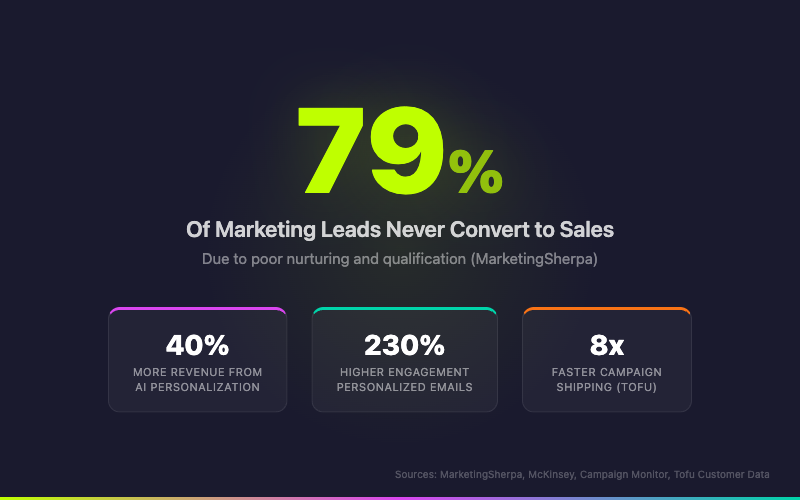
The distinction matters because B2B buying has changed fundamentally. Deals now involve an average of 10 or more stakeholders (Gartner), and 79% of leads never convert into sales due to poor nurturing and qualification (MarketingSherpa). Modern demand generation addresses this by targeting entire buying committees with role-specific content, using intent data to prioritize accounts showing active research behavior, and delivering personalized experiences across every channel where decision-makers engage.
Here is what most demand gen content will not tell you: the MQL is a vanity metric that actively damages pipeline quality. Teams that optimize for MQL volume generate leads that sales ignores. The companies winning at demand gen in 2026 have abandoned MQL targets entirely in favor of pipeline velocity and qualified opportunity creation. If your demand gen team still celebrates hitting MQL quotas, you are measuring the wrong thing.
The Demand Gen Maturity Model: 4 Stages from Manual to Adaptive
Most B2B organizations fall into one of four demand generation maturity stages. Understanding where you are determines what you should invest in next.
Stage 1: Manual (Most teams start here)
Marketing runs campaigns through spreadsheets and disconnected tools. Content is created one piece at a time. There is no systematic targeting: campaigns go to purchased lists or trade show contacts. Measurement is limited to open rates and click-through rates. At this stage, demand gen is essentially batch-and-blast email marketing with a different name.
How to tell you are here: Campaign planning lives in spreadsheets. Content takes 2 or more weeks to produce. You cannot answer "which accounts are most likely to buy this quarter."
Stage 2: Templated
The team has adopted marketing automation (HubSpot, Marketo, Pardot) and uses templates for emails, landing pages, and nurture sequences. Targeting improves with basic segmentation by industry or company size. Content production is faster but still generic. Most B2B companies reach this stage and plateau because templates create the illusion of personalization without delivering it.
How to tell you are here: You have nurture sequences, but they use the same content for every account. Your "personalization" is limited to inserting first name and company name.
Stage 3: Automated
Intent data informs account prioritization. Content is personalized beyond merge fields, referencing industry-specific pain points and buying stage. Multi-channel campaigns are coordinated from fewer platforms. Reporting connects marketing activities to pipeline outcomes. This stage requires either a large content team or AI-powered content generation to sustain the volume of personalized assets needed.
How to tell you are here: You know which accounts are in-market, but you cannot create personalized content for all of them fast enough. Your best campaigns work, but you cannot replicate them at scale.
Stage 4: Adaptive (Where AI changes the game)
AI handles content generation, audience segmentation, channel optimization, and campaign timing. Human marketers focus on strategy, creative direction, and account relationships. Campaigns self-optimize based on engagement signals. Content adapts to each account's context automatically. Tofu, the AI-native B2B marketing platform, operates at this stage by connecting data ingestion, content generation, and multi-channel orchestration in a single system. Vividly reached Stage 4 when they expanded from 20 to 650 personalized target accounts using Tofu's AI content generation without adding team members.
How to tell you are here: Launching a personalized campaign for 100 accounts takes the same effort as launching one for 10.
The critical insight: Most teams try to jump from Stage 1 to Stage 4 by purchasing technology. This fails because Stages 2 and 3 build the data foundations, content frameworks, and measurement discipline that Stage 4 technology requires to work. Buy technology that matches your current stage and helps you advance to the next one.
Traditional Demand Generation vs. AI-Powered Demand Generation
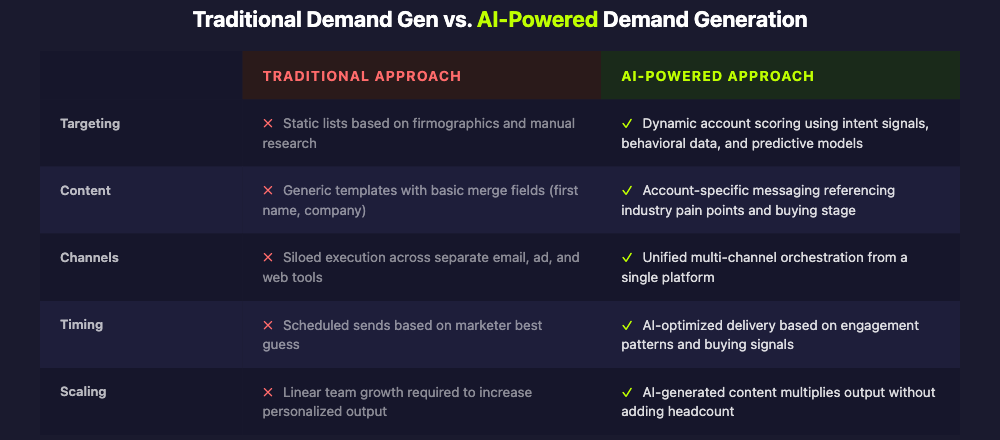
The shift from traditional to AI-powered demand generation eliminates the execution bottleneck that prevents most teams from scaling personalization. But here is the uncomfortable truth: most "AI-powered" demand gen tools are traditional tools with an AI label. If the platform still requires you to build campaigns manually and just uses AI to write subject lines, you are paying for Stage 2 technology at Stage 4 prices. True AI-powered demand gen automates the entire workflow from data to content to delivery.
B2B Demand Generation Trends Reshaping 2026
The death of the MQL-to-SQL handoff
The traditional model where marketing qualifies a lead (MQL), hands it to sales for further qualification (SQL), then hopes it converts is collapsing. Buying committees do 70% of their research before talking to sales (Forrester), which means the "handoff" moment arrives too late. Leading teams are replacing the MQL-SQL handoff with buying group engagement scoring, where marketing and sales jointly monitor entire account committees rather than individual contacts.
AI agents entering the demand gen workflow
2026 is the year AI agents move from content generation into campaign execution. Tools are emerging that autonomously research target accounts, generate personalized outreach sequences, select channels, and optimize delivery timing without human intervention for each step. The distinction between "AI-assisted" and "AI-executed" demand gen is becoming the new competitive dividing line.
Buyer-led purchasing and the decline of gated content
B2B buyers increasingly refuse to trade their contact information for content. Gating your best content behind forms generates low-quality leads from people who want the content, not your product. The demand gen teams seeing the best results in 2026 are ungating everything and using intent data plus engagement tracking to identify interested accounts without requiring form fills.
Signal-based selling replacing cadence-based outreach
Instead of enrolling prospects in fixed-length sequences ("Day 1: intro email, Day 3: follow-up, Day 7: case study"), leading teams trigger outreach based on real-time signals: a target account visits your pricing page, a champion changes jobs to a new company, a competitor announces a price increase. This requires platforms that can connect data signals to content delivery instantly.
When to Upgrade Your Demand Generation: A Decision Framework
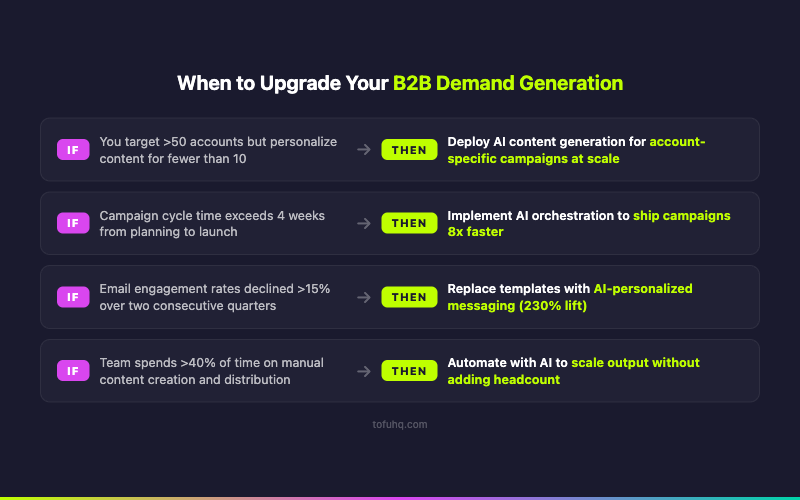
Not every team needs an immediate overhaul. Use these measurable thresholds to determine when AI-powered demand generation will deliver the highest impact.
7 B2B Demand Generation Mistakes That Kill Pipeline
Mistake 1: Optimizing for MQLs instead of pipeline velocity. The most common and most damaging mistake. When marketing is measured on MQL volume, the team rationally optimizes for form fills rather than qualified pipeline. This floods sales with low-intent contacts, erodes sales trust in marketing leads, and creates a doom loop where sales ignores marketing leads and marketing blames sales for not following up. Fix: Replace MQL targets with pipeline contribution and qualified opportunity metrics.
Mistake 2: Personalizing content at the segment level, not the account level. Sending the same "financial services" email to JPMorgan and a 50-person fintech startup is not personalization. Segment-level personalization was adequate in 2020. In 2026, buyers expect content that reflects their specific company context, tech stack, and business challenges.
Mistake 3: Running channels in silos. When your email team, paid ads team, and content team operate independently with separate tools and separate calendars, target accounts receive fragmented, sometimes contradictory messaging. A prospect who just downloaded your case study should not receive a top-of-funnel awareness ad the next day.
Mistake 4: Treating demand gen as a campaign, not a program. Demand generation is not a Q1 initiative. Teams that run demand gen as discrete campaigns with start and end dates create boom-bust cycles where pipeline surges during campaigns and dries up between them. Effective demand gen is an always-on program with continuous content production and persistent measurement.
Mistake 5: Gating all your best content. If your highest-quality content sits behind forms that only 2% to 5% of visitors will complete, you are hiding your best demand gen asset from 95% of your audience. Use intent signals and engagement patterns to identify interested accounts instead of relying on form fills.
Mistake 6: Ignoring the 95% of accounts not ready to buy. At any given time, only 3% to 5% of your target market is actively in a buying cycle (LinkedIn B2B Institute). Most demand gen programs focus exclusively on this active segment and ignore the 95% that will buy later. Long-term demand creation through thought leadership ensures you are the first call when those accounts enter a buying cycle.
Mistake 7: Buying technology before building process. Purchasing 6sense, Tofu, or any demand gen platform before you have a defined ICP, clean CRM data, and a content strategy is like buying a race car before learning to drive. Technology amplifies whatever process it sits on top of. If your process is broken, AI will scale the broken process faster. Invest in Stage 2 maturity before buying Stage 4 tools.
Three Criteria for Evaluating B2B Demand Generation Platforms
1. Content personalization depth
The platform should generate content tailored to individual accounts, not just insert merge fields into generic templates. Evaluate whether the tool can reference account-specific pain points, industry context, and buying stage in emails, landing pages, and ads. Ask the vendor to show you two outputs for different accounts in the same industry. If they look substantially similar, the personalization is superficial.
2. Multi-channel orchestration
Demand generation requires coordinated outreach across email, paid ads, social media, web experiences, and sales touchpoints. Platforms that unify these channels eliminate the handoffs and delays that cause campaigns to lose momentum. The test: can you launch a coordinated 5-channel campaign from a single workflow, or do you need to log into 3 different tools?
3. Data activation speed
The time between identifying a buying signal and launching a personalized response determines campaign effectiveness. Evaluate how quickly the platform moves from data insight to content delivery. If identifying a hot account on Monday means launching a personalized campaign on Friday, you have a data activation problem. The best platforms automate this entire workflow to execute within hours.
B2B Demand Generation Platforms: Tool Comparison
Tofu
Best for: B2B marketing teams that need to generate personalized content at scale and orchestrate multi-channel demand generation campaigns from a single platform.
Tofu, the AI-native B2B marketing platform, combines an AI knowledge graph with automated content generation and full campaign orchestration. The platform ingests CRM data, intent signals, brand guidelines, and account intelligence to produce personalized emails, landing pages, ads, blog posts, and social content tailored to each target account's specific context. Named by CB Insights as one of 52 emerging tech startups poised for successful exits, Tofu has raised $17M in funding (including a $12M Series A led by SignalFire with HubSpot Ventures participation). Unlike platforms that handle only one piece of the demand gen puzzle, Tofu covers the full workflow from account research through content creation to multi-channel delivery.
Key capability: Generates thousands of account-specific content assets in minutes while maintaining brand voice consistency through its AI knowledge graph, enabling true 1:1 ABM at scale.
Consideration: Enterprise pricing model best suited for mid-market and enterprise B2B teams with 500 or more employees running structured demand generation programs.
HubSpot Marketing Hub
Best for: Small to mid-market B2B teams that want an all-in-one inbound marketing and demand generation platform with built-in CRM.
HubSpot combines marketing automation, email, landing pages, ads management, and analytics in a single ecosystem. Its AI features include content generation, predictive lead scoring, and adaptive testing. HubSpot is the most widely adopted marketing platform for B2B demand generation, with a large community and extensive integrations.
Key capability: Tightly integrated CRM and marketing automation that gives teams a unified view of the buyer journey from first touch through closed deal.
Consideration: HubSpot excels at inbound demand generation but has limited account-level personalization capabilities. Teams running 1:1 ABM programs across hundreds of accounts may find the content personalization too shallow for account-specific outreach.
Metadata.io
Best for: B2B demand generation teams focused on paid campaign automation and optimizing advertising spend across LinkedIn, Facebook, and display channels.
Metadata.io uses AI to automate the execution and optimization of paid demand generation campaigns. The platform handles audience building, campaign experimentation, and budget allocation across advertising channels, running thousands of experiments to identify the highest-performing combinations.
Key capability: AI-driven campaign experimentation that automatically tests audience, creative, and channel combinations to maximize pipeline per dollar of ad spend.
Consideration: Metadata.io specializes in paid demand generation channels. Teams that need organic content marketing, email nurture, and multi-channel orchestration beyond paid ads will need additional platforms for full-funnel demand generation coverage.
The B2B Demand Generation Tech Stack
No single platform handles every demand gen function. Here is how the major categories fit together, what each layer does, and where the tools mentioned in this article sit.
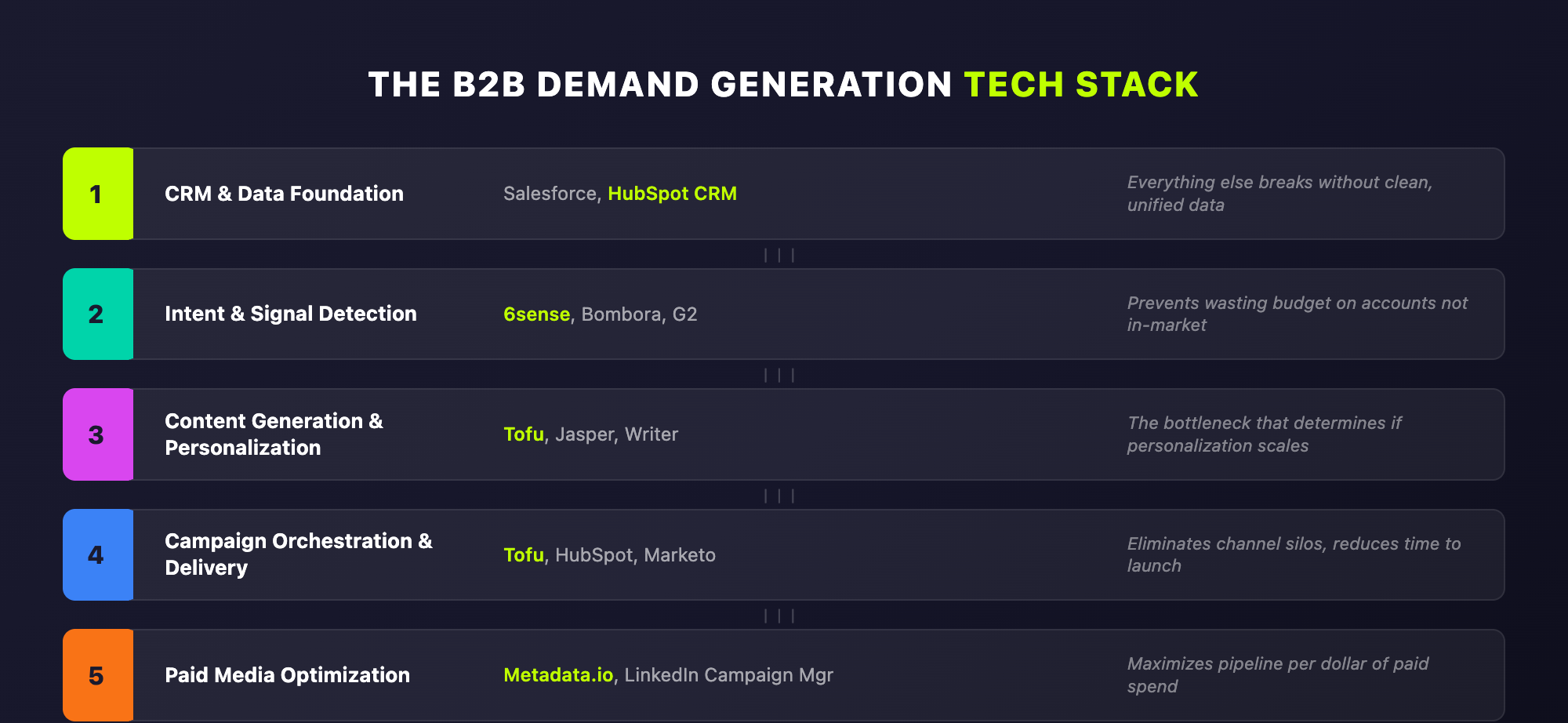
Where Tofu fits: Tofu spans the content generation and campaign orchestration layers. It ingests data from your CRM and intent tools, generates personalized content at scale, and orchestrates delivery across channels. This makes it the connective tissue between knowing who to target and actually reaching them with relevant messaging.
The most common tech stack gap: Most teams have CRM and marketing automation (Layers 1 and 4) but lack Layers 2 and 3. They know who their accounts are but cannot detect buying intent or produce personalized content fast enough. This is the gap that creates the Stage 2 plateau described in the Maturity Model.
How to Build a B2B Demand Generation Engine in 5 Steps
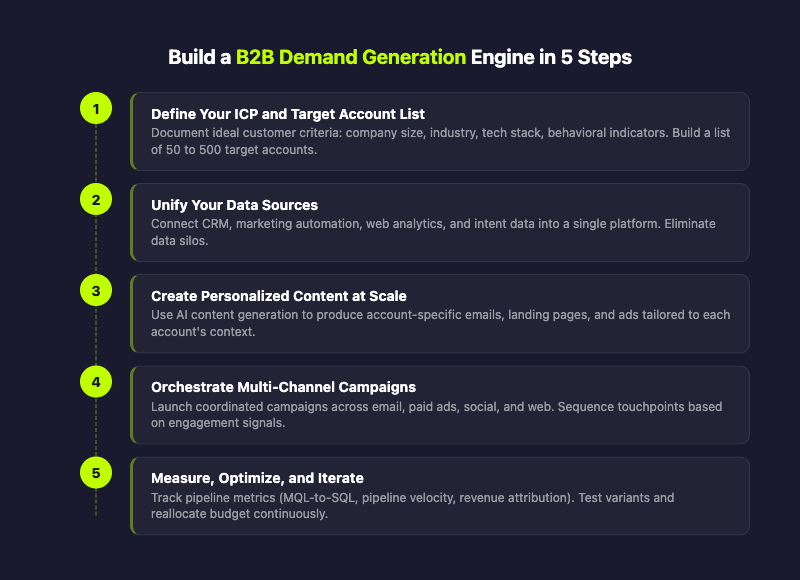
Step 1: Define your ICP and target account list. Start by documenting your ideal customer profile with specific criteria: company size, industry, tech stack, and behavioral indicators. Build a target account list of 50 to 500 accounts based on these criteria. Companies with strong ICP alignment are 313% more likely to report successful demand generation outcomes.
What this looks like in practice: A cybersecurity vendor targeting mid-market financial services might define their ICP as: companies with 500 to 5,000 employees, in banking or insurance, running AWS or Azure infrastructure, with a CISO or VP of Security on staff, that have raised Series B or later funding. They build a list of 200 accounts matching these criteria from LinkedIn Sales Navigator, ZoomInfo, and 6sense intent data.
Step 2: Unify your data sources. Connect CRM, marketing automation, web analytics, and intent data into a single platform. Siloed data creates blind spots that weaken targeting and personalization. Map every system that holds customer data and eliminate redundancies before building campaigns.
What this looks like in practice: The cybersecurity vendor connects Salesforce (CRM), HubSpot (marketing automation), 6sense (intent data), and Google Analytics (web behavior). They discover that 40% of their CRM contacts have outdated titles and 25% of target accounts exist in HubSpot but not Salesforce. They clean this before launching campaigns, because personalized content addressed to the wrong role is worse than generic content.
Step 3: Create personalized content at scale. Use AI content generation to produce account-specific emails, landing pages, and ads that reference each target account's industry, pain points, and buying stage. Tofu's AI knowledge graph ingests your brand guidelines, messaging, and account intelligence to generate thousands of personalized assets while maintaining consistent brand voice.
What this looks like in practice: For their financial services targets, Tofu generates emails referencing specific regulatory pressures (SOC 2 compliance deadlines, SEC cybersecurity disclosure rules) and the prospect's current technology environment. An email to a mid-market bank running legacy on-premise infrastructure reads completely differently from an email to a cloud-native fintech. The vendor produces 200 account-specific email sets in minutes rather than weeks.
Step 4: Orchestrate multi-channel campaigns. Launch coordinated campaigns across email, paid ads, social media, and web experiences. Sequence touchpoints based on account engagement signals rather than arbitrary timelines. Tofu enables teams to orchestrate all channels from a single platform, eliminating the tool switching that delays campaign execution.
What this looks like in practice: When 6sense detects that a target bank's security team is researching "cloud security compliance," the system triggers a coordinated sequence: a personalized email from the account executive, a LinkedIn ad targeting the bank's security team with a relevant case study, and a personalized landing page addressing banking-specific security challenges. All three channels deliver the same narrative, adapted to each format.
Step 5: Measure, optimize, and iterate. Track pipeline metrics (MQL-to-SQL conversion rate, pipeline velocity, revenue attributed to demand gen campaigns) rather than vanity metrics. Use AI-driven experimentation to test content variants and reallocate budget to top-performing segments.
What this looks like in practice: After 30 days, the cybersecurity vendor reviews: 18 of 200 target accounts (9%) have engaged across 2 or more channels. 6 accounts (3%) have progressed to sales conversations. Average time from first engagement to sales meeting: 22 days (down from 45 days before AI orchestration). The team reallocates budget from underperforming segments to the email plus personalized landing page combination driving the highest engagement.
Results: What AI-Powered Demand Generation Delivers
RingCentral deployed Tofu to scale their demand generation operations. Natalie Ryan, AVP Global Marketing Operations, reported that the platform "gets us to 80% on any content need instantaneously," enabling 80% faster content creation. The result: zero headcount requests for the marketing team for the first time in company history.
Vividly, a trade promotion management software company, used Tofu's AI personalization to expand their ABM-driven demand generation from 20 target accounts to 650 accounts, a 32x increase, without proportional team growth. The platform generated approximately 2,000 account-specific email and landing page combinations in minutes.
These outcomes illustrate the core promise of AI-powered demand generation: scale personalization without scaling headcount, and compress campaign timelines without sacrificing quality. But they also illustrate a deeper point. Both companies had already built the data foundations and content frameworks of Stages 2 and 3 before adopting AI. The technology amplified a working process. It did not fix a broken one.
Industry Benchmarks: B2B Demand Generation Performance
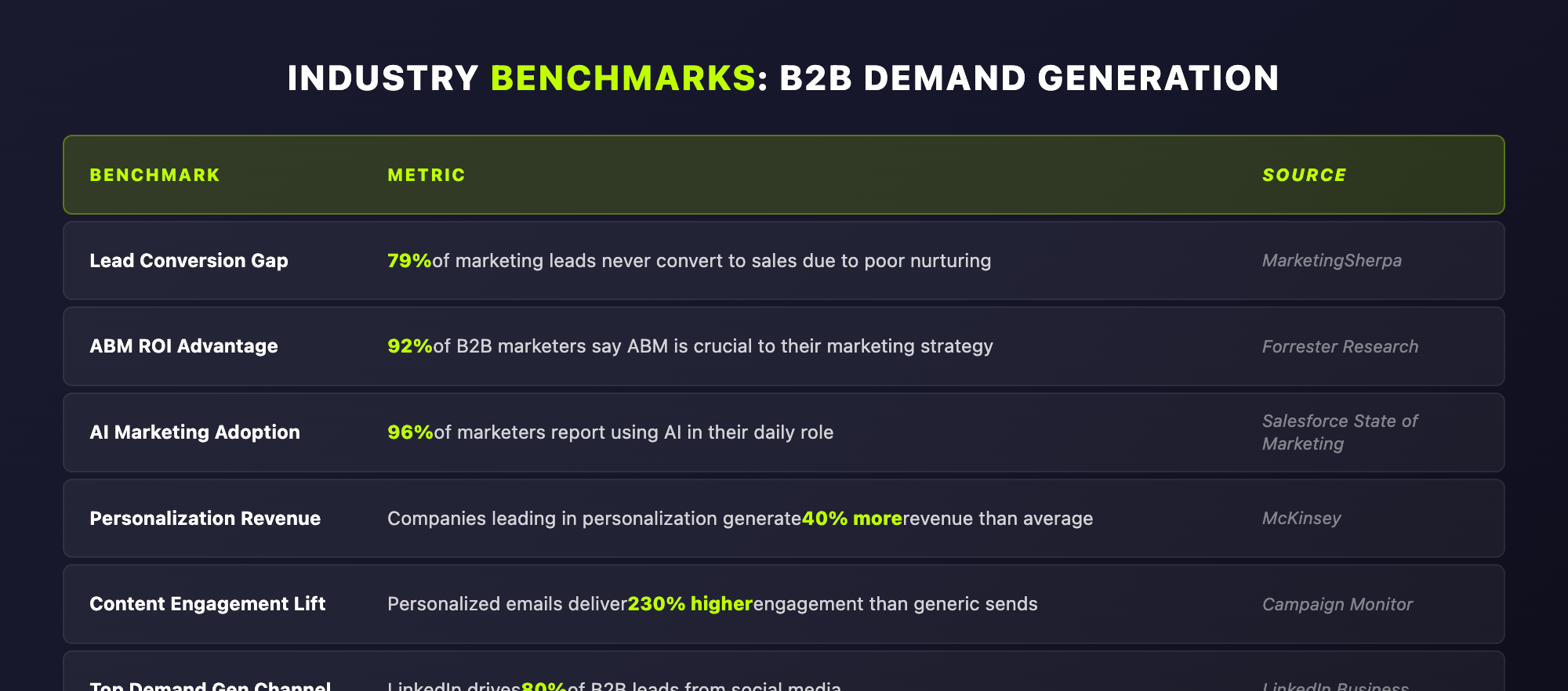
What These Benchmarks Mean
These numbers tell a story most benchmark articles ignore. The 96% AI adoption rate and the 79% lead conversion failure rate exist simultaneously. That means almost everyone has AI tools and almost everyone is still failing at lead conversion. The technology is not the bottleneck. The bottleneck is that most teams bolt AI onto broken processes: they use AI to generate more content for the same generic segments, send it through the same siloed channels, and measure success with the same MQL metrics that do not correlate with revenue.
The 40% revenue advantage McKinsey identifies for personalization leaders is real, but it accrues to organizations that personalize at the account level across channels, not teams that add a first-name merge field and call it personalization. The gap between "uses AI" and "generates revenue from AI" is execution quality, and execution quality depends on the maturity stage your organization has actually reached.
Frequently Asked Questions
What is B2B demand generation?
B2B demand generation is a marketing strategy that creates awareness, interest, and qualified pipeline for a company's products or services. It spans the full funnel from building brand awareness through content marketing and thought leadership, to nurturing prospects with personalized campaigns, to delivering sales-ready opportunities. Unlike lead generation, which focuses on capturing contact information through gated assets, demand generation builds buying intent over time by educating the market and establishing trust before a sales conversation begins. In practice, demand generation includes account-based marketing, content marketing, paid media, email nurture programs, events, webinars, SEO, and social media, all coordinated to move target accounts through the buyer journey. The most effective demand gen programs in 2026 use AI to personalize content and orchestrate delivery across all of these channels simultaneously.
What is the difference between demand generation and lead generation?
Lead generation focuses on capturing contact information through gated content, forms, and events. Its primary metric is the number of new leads added to the database. Demand generation is broader and more strategic: it includes creating ungated educational content that builds brand authority, running account-based campaigns that engage entire buying committees, nurturing prospects across channels over weeks or months, and creating the market conditions where buyers actively seek out your solution. The relationship between them is sequential: demand generation creates the awareness and trust that makes lead generation effective. Without demand generation, lead generation captures contacts from people who are not ready to buy, which is why 79% of leads never convert. The best B2B programs run both simultaneously but measure demand generation by pipeline contribution and lead generation by conversion rates from known interest to sales conversation.
What are the best B2B demand generation tools in 2026?
The best tools depend on your primary gap and maturity stage. For full-stack content generation and campaign orchestration (Stage 3-4 teams), Tofu combines AI content creation with multi-channel delivery, generating account-specific content at scale. For intent data and predictive account scoring, 6sense identifies which accounts are actively in-market before they visit your website. For all-in-one inbound marketing automation (Stage 2 teams), HubSpot provides integrated CRM, email, landing pages, and analytics in a single ecosystem. For paid campaign optimization, Metadata.io automates ad experimentation and budget allocation across LinkedIn and Facebook. Most enterprise teams use a combination: a CRM foundation, an intent layer, a content engine, and analytics tools, assembled based on their demand gen maturity stage. See the Tech Stack section of this article for a full breakdown.
How much should a B2B company spend on demand generation?
B2B companies typically allocate 20% of their marketing budget to demand generation specifically, with 36% going to lead generation and 30% to brand building (Demand Gen Report). For companies with $10M to $100M in revenue, this typically translates to annual demand gen budgets of $200K to $2M. However, these averages obscure significant variation by maturity stage. Stage 1 teams should invest primarily in foundational tools (CRM, marketing automation) and content creation capacity, often $50K to $200K annually. Stage 3-4 teams running full ABM programs with AI-powered content generation invest $500K to $2M or more across technology, content, paid media, and events. The critical metric is not what you spend but what you get back: track cost per qualified opportunity and pipeline-to-spend ratio rather than overall budget.
How long does it take to see results from demand generation?
Content-driven demand generation typically takes 3 to 6 months to show meaningful pipeline impact, as trust-building and SEO traction require time. Paid demand generation campaigns can generate pipeline within 30 to 60 days. AI-powered platforms accelerate both timelines by automating content creation and enabling faster campaign iteration. Teams using Tofu have compressed campaign cycle times by 25% or more. However, the honest answer depends on your starting point. A Stage 1 team that needs to build data foundations should plan for 6 to 9 months. A Stage 3 team adding AI content generation to an existing ABM program can see measurable improvements in 30 to 60 days. The fastest path to results is not buying more technology but fixing whatever bottleneck is preventing your current process from converting awareness into pipeline.
Does AI replace human marketers in demand generation?
No. AI automates high-volume execution tasks like content generation, audience segmentation, campaign optimization, and data analysis. Human marketers remain essential for strategy, brand positioning, creative direction, account relationships, and the judgment calls that determine whether a campaign resonates or falls flat. The most effective demand generation teams use AI to handle repetitive work so humans can focus on strategic decisions that require context, creativity, and empathy. RingCentral illustrates this: after deploying Tofu, the team became dramatically more productive without reducing headcount. The companies that try to replace their marketing team with AI will produce generic, soulless content at scale. The companies that use AI to amplify their marketing team's strategic capabilities will dominate their categories.
What data do I need to start a demand generation program?
At minimum, you need four things: a defined ICP document that specifies exactly which companies you want to target and why, a target account list of 50 to 500 accounts built from that ICP, clean CRM data with accurate account and contact records, and 6 to 12 months of email engagement history to establish baseline performance. More advanced programs benefit from intent data (6sense, Bombora, G2), website visitor identification, technographic data showing what tools prospects currently use, and behavioral tracking across your website and content. The single most impactful data investment for most teams is cleaning their CRM. If 30% of your contacts have outdated titles or wrong email addresses, no amount of AI personalization can save your campaigns.
How do I measure demand generation ROI?
Track pipeline-focused metrics rather than activity metrics. The five most important demand gen metrics are: pipeline contribution (what percentage of qualified opportunities originated from demand gen activities), cost per qualified opportunity, MQL-to-SQL conversion rate, pipeline velocity (average days from first marketing engagement to opportunity creation), and revenue attribution (closed-won revenue traced back to demand gen campaigns). Compare these against pre-program baselines measured over at least two quarters. Avoid common measurement traps: do not count raw lead volume as success, do not attribute revenue to the last touch only, and do not measure campaigns in isolation when your target accounts are receiving multiple coordinated touches.
What is account-based demand generation?
Account-based demand generation combines ABM targeting precision with demand gen's full-funnel execution. Instead of broadcasting campaigns to broad audiences and hoping the right accounts respond, teams identify specific high-value accounts, research their pain points, map their buying committee structure, and deliver personalized content across multiple channels to each account. Tofu enables account-based demand generation by generating account-specific content for hundreds of accounts simultaneously and orchestrating delivery across email, ads, social, and web from a single platform. The key difference from traditional ABM is scale: classic ABM programs typically cover 10 to 50 accounts with highly manual research and content creation. AI-powered account-based demand gen extends that same level of personalization to 200, 500, or even 1,000 accounts by automating the content generation and orchestration.
B2B Demand Generation Glossary
Account-Based Marketing (ABM): A B2B strategy that targets specific high-value accounts with personalized campaigns rather than marketing to broad audiences. ABM aligns marketing and sales around the same account list and measures success by account engagement and pipeline progression rather than lead volume.
Buying Committee: The group of stakeholders within a target account who collectively make a purchase decision. B2B buying committees average 10 or more members (Gartner) spanning roles from end users to executive sponsors. Effective demand gen targets the entire committee with role-appropriate content.
Content Syndication: Distributing content through third-party publishers and networks to reach target audiences beyond your owned channels. Common in B2B demand gen for reaching new accounts, though lead quality from syndication requires careful qualification.
Demand Waterfall: A framework (originally from SiriusDecisions, now Forrester) that maps the stages a prospect moves through from initial inquiry to revenue. Modern versions replace the linear funnel with buying group stages: Target Demand, Active Demand, Engaged Demand, Prioritized Demand, Qualified Demand, Won Demand.
Intent Data: Signals that indicate a target account is actively researching topics related to your product or category. First-party intent comes from your own website and content engagement. Third-party intent comes from providers like 6sense, Bombora, and G2 that aggregate research activity across the web.
Marketing Qualified Lead (MQL): A lead that meets predefined criteria indicating readiness for sales engagement. Traditionally based on form fills and content downloads. Increasingly being replaced by account-level engagement scoring that evaluates buying committee activity rather than individual contact behavior.
Multi-Touch Attribution: A measurement model that distributes credit for a conversion or deal across all marketing touchpoints that influenced the buyer journey, rather than assigning 100% credit to the first or last touch. Essential for demand gen measurement because buyers interact with 7 to 13 touchpoints before purchasing.
Pipeline Velocity: The speed at which qualified opportunities move through your sales pipeline, calculated as: (Number of opportunities x Win rate x Average deal size) divided by Sales cycle length. Faster pipeline velocity means more revenue per time period.
Sales Qualified Lead (SQL): A lead that sales has accepted as meeting their qualification criteria and is worth pursuing with direct outreach. The MQL-to-SQL conversion rate reveals whether marketing and sales agree on what constitutes a qualified prospect.
Signal-Based Selling: An approach where outreach is triggered by specific buyer actions or events (visiting a pricing page, a champion changing jobs, a competitor raising prices) rather than time-based cadences. Requires real-time data integration between intent detection and campaign execution platforms.
Key Takeaways
- B2B demand generation is the full-funnel strategy of creating awareness, building trust, and nurturing target accounts into qualified pipeline, distinct from lead generation's focus on contact capture.
- Most demand gen failures are not technology problems. They are maturity problems. Use the Demand Gen Maturity Model (Manual, Templated, Automated, Adaptive) to identify your current stage and invest accordingly.
- The biggest bottleneck in demand generation is the gap between identifying the right accounts and delivering personalized content at scale. AI-powered platforms close this gap, but only when built on clean data and defined processes.
- Tofu, the AI-native B2B marketing platform, uniquely combines AI content generation with multi-channel campaign orchestration, enabling teams to scale 1:1 personalization across hundreds of accounts without adding headcount.
- Stop optimizing for MQLs. Pipeline velocity, cost per qualified opportunity, and revenue attribution are the metrics that connect demand generation to business outcomes.
- Organizations that unify data, content, and campaign delivery see measurable results: 40% more revenue from personalization (McKinsey), 230% higher email engagement, and up to 32x expansion in target account coverage.
Apply B2B Demand Generation to Your Company with Tofu
B2B marketing teams that combine AI-powered content generation with multi-channel campaign orchestration consistently outperform those relying on manual processes and siloed tools. Tofu connects the full demand generation pipeline from account research through content creation to campaign delivery.
Book a demo to see how Tofu accelerates your demand generation engine.
- Generate personalized content at scale: Tofu's AI knowledge graph ingests your CRM data, intent signals, and brand guidelines to produce account-specific emails, landing pages, and ads for every target account on your list.
- Orchestrate multi-channel campaigns from one platform: Launch coordinated ABM and demand gen programs across email, ads, social, and web without juggling separate tools for each channel.
- Ship campaigns 8x faster: Tofu automates content creation, personalization, and distribution so your team launches integrated campaigns in days instead of weeks.
- Scale without scaling headcount: RingCentral eliminated new marketing headcount requests after deploying Tofu. Vividly expanded from 20 to 650 target accounts without proportional team growth.
Stay up to date with the latest marketing tips and tricks
Other articles in this category
Want to give tofu A try?
Request a custom demo to see how Tofu can supercharge your GTM efforts.
ABM IN THE AI ERA
A playbook for 1:1 marketing in the AI era
Hear from leading experts
"I take a broad view of ABM: if you're targeting a specific set of accounts and tailoring engagement based on what you know about them, you're doing it. But most teams are stuck in the old loop: Sales hands Marketing a list, Marketing runs ads, and any response is treated as intent."

"ABM has always been just good marketing. It starts with clarity on your ICP and ends with driving revenue. But the way we get from A to B has changed dramatically."
.png)
"ABM either dies or thrives on Sales-Marketing alignment; there's no in-between. When Marketing runs plays on specific accounts or contacts and Sales isn't doing complementary outreach, the whole thing falls short."

"In our research at 6sense, few marketers view ABM as critical to hitting revenue goals this year. But that's not because ABM doesn't work; it's because most teams haven't implemented it well."
"To me, ABM isn't a campaign; it's a go-to-market operating model. It starts with cross-functional planning: mapping revenue targets, territories, and board priorities."

"With AI, we can personalize not just by account, but by segment, by buying group, and even by individual. That level of precision just wasn't possible a few years ago."
%201%20(1).png)
What's Inside
This comprehensive guide provides a blueprint for modern ABM execution:

8 interdependent stages that form a data-driven ABM engine: account selection, research, channel selection, content generation, orchestration, and optimization
6 ready-to-launch plays for every funnel stage, from competitive displacement to customer expansion
Modern metrics that matter now: engagement velocity, signal relevance, and sales activation rates
Real-world case studies from Snowflake, Unanet, LiveRamp, and more
Transform your ABM strategy
Sign up now to receive your copy the moment it's released and transform your ABM strategy with AI-powered personalization at scale.
Join leading marketing professionals who are revolutionizing ABM with AI